FORCETALLY
Loading the evidence…
Preparing your view.


Preparing your view.
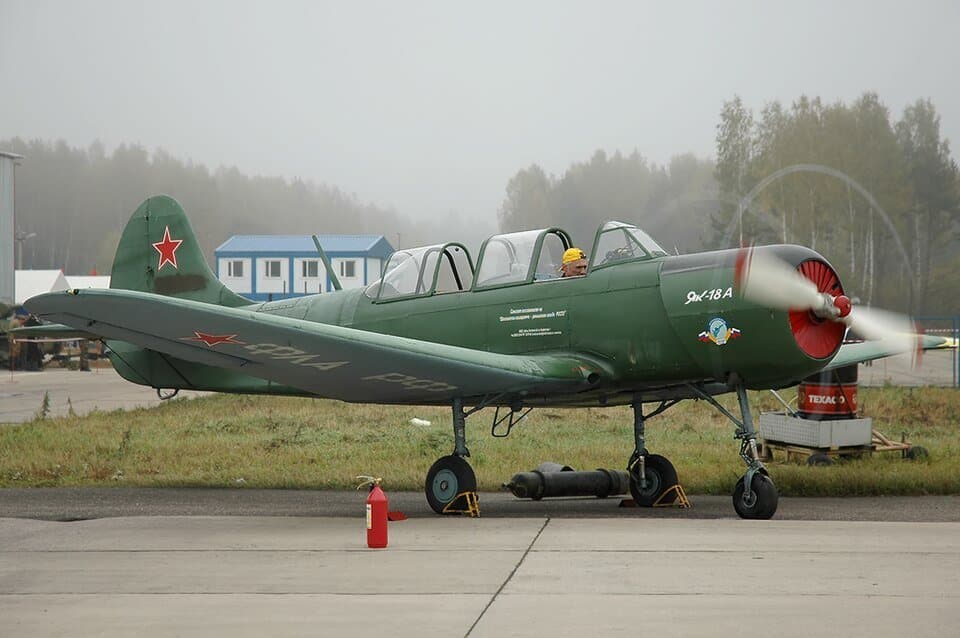
Trainer aircraftIn service
Training aircraft
Yakovlev Yak-18 is a training aircraft. It was built by Yakovlev. Reported operators include Soviet Air Force DOSAAF People's Liberation Army Air Force Polish Air Force.
Training aircraft
Yakovlev
in limited service
Soviet Air Force DOSAAF People's Liberation Army Air Force Polish Air Force
1946
1946
2
8.35 m (27 ft 5 in)
10.6 m (34 ft 9 in)
3.35 m (11 ft 0 in)
17.8 m 2 (192 sq ft)
root: Clark YH (14.5%); tip: Clark YH (9.3%)
1,025 kg (2,260 lb)
1,320 kg (2,910 lb)
1 × Ivchenko AI-14RF 9-cylinder air-cooled radial piston engine, 224 kW (300 hp)
2-bladed variable-pitch propeller
300 km/h (190 mph, 160 kn)
700 km (430 mi, 380 nmi)
5,060 m (16,600 ft)
The Yakovlev Yak-18 ( Russian : Яковлев Як-18 ; NATO reporting name Max ) is a tandem two-seat military primary trainer aircraft manufactured in the Soviet Union .
The Yakovlev Yak-18 ( Russian : Яковлев Як-18 ; NATO reporting name Max ) is a tandem two-seat military primary trainer aircraft manufactured in the Soviet Union . Originally powered by one 119 kW (160 hp) Shvetsov M-11 FR-1 radial piston engine , it entered service in 1946. It was also produced in China as the Nanchang CJ-5 .
A member of the second generation of Russian aircraft designers, and best known for fighter designs, Alexander Sergeyevich Yakovlev always retained a light aircraft design section. In May 1945, Yakovlev initiated design of the Yak-18 two-seat primary trainer. He designed it to replace the earlier Yakovlev UT-2 and Yakovlev Yak-5 in service with the Soviet Air Forces and DOSAAF (Voluntary Society for Collaboration with the Army, Air Force and Navy, which sponsored aero clubs throughout the USSR). In 1944, an advanced version of the UT-2 had been built with many of the features of the new Yak-18. The new aircraft flew a year later, powered by a 119 kW (160 hp) Shvetsov M-11 five-cylinder radial engine and featuring pneumatically operated retractable main landing gear and a fixed tailwheel. It entered service as a trainer later that year and was built by Yakovlev up until 1956. Examples were exported to China in kit form beginning in 1950. The Chinese began producing license built copies in 1954 with the designation CJ-5 .
Other claims to fame for the Yak-18 are an international speed record for its class in 1951 as well as being the aircraft used for initial flight training by Yuri Gagarin (1st human in space) and Ken Rowe ( No Kum-Sok , who defected from North Korea with a Mikoyan-Gurevich MiG-15 jet fighter during the Korean War). Later, as the need for conventional landing gear trainers abated, Yakovlev re-designed the Yak-18 with retractable tricycle landing gear and an Ivchenko AI-14RF radial engine of 224 kW (300 hp); this was designated the Yak-18A. The design proved exceptionally easy to build and maintain.
Cleaned up version of the Yak-18U, powered by a 194 kW (260 hp) Ivchenko AI-14 FR engine. Built in large numbers.
Yak-18PS
The Yakovlev Yak-18T was developed as an Aeroflot training aircraft and also as a light passenger transport aircraft, with a cabin for one pilot and three passengers. It is not a variant of the Yak-18 as it has very little in common, and was designed from scratch 20 years later.
Kazakh Air Defense Forces − Operated 4 Yak-18 in 2011, retired
Air Force of Mali − 2 in 2011, non-operational
Length: 8.35 m (27 ft 5 in)
Wingspan: 10.6 m (34 ft 9 in)
Height: 3.35 m (11 ft 0 in)
Wing area: 17.8 m 2 (192 sq ft)
Empty weight: 1,025 kg (2,260 lb)
Max takeoff weight: 1,320 kg (2,910 lb)
Powerplant: 1 × Ivchenko AI-14RF 9-cylinder air-cooled radial piston engine, 224 kW (300 hp)
Maximum speed: 300 km/h (190 mph, 160 kn)
Range: 700 km (430 mi, 380 nmi)
Service ceiling: 5,060 m (16,600 ft)
{"datatype": "wikibase-item", "datavalue": {"type": "wikibase-entityid", "value": {"entity-type": "item", "id": "Q15180", "numeric-id": 15180}}, "hash": "128186894bf5c025c6a6a74248caa5aefad97f59", "property": "P495", "snaktype": "value"}
Reference text from Wikipedia contributors, used under CC BY-SA 4.0.
True scale
Sourced dimensions beside a 1.75 m human reference.
See it in your room. Scan with your phone to open this model in 3D, then place it in your space.
Points represent sourced observations, including revisions. Revisions on the same effective date are not separate inventory events. Ranges appear in the table and are not plotted as exact points.
| Observation / report period | Value | Source | Claim state |
|---|---|---|---|
| 1 Oct 2026 | 2 people | Wikipedia contributors | superseded |
| 1 Oct 2026 | 2 people | Wikipedia contributors | superseded |
| 1 Oct 2026 | 2 people | Wikipedia contributors | approved |
Yakovlev Yak-18 equipment records. Variants, orders and quantities are shown as reported in each inventory source; coverage is incomplete.
 Moldova
Air Force exact named equipment holdings: Yak-18 Max. Active, operational-reserve and training units excluding equipment in store; November 2025 IISS assessment. Named service only; no parent-force or national total inferred. Source role: AIRCRAFT / Light. Original estimates, ranges, reporting names, reserve, lease and employment scopes retained; nested included counts are not added. Missile-system quantities mean launchers, not rounds. No readiness, crew, carried weapon, payload, factory-production or future order count inherited.
Soviet Air Force DOSAAF People's Liberation Army Air Force Polish Air Force
Equipment reference ↗Keep exploring
Training aircraft
 IranCompare with Yakovlev Yak-18
Training aircraft
Compare with Yakovlev Yak-18Basic training aircraft
 IndiaCompare with Yakovlev Yak-18
Trainer aircraft
 United StatesCompare with Yakovlev Yak-18
Trainer aircraft
 SwitzerlandCompare with Yakovlev Yak-18
 Poland