
Credit
Government of India · GODL-India · Resized · GODL-India · Source ↗ · Modified


Preparing your view.
At a glance
True scale
Side by side. From every angle. A human reference for perspective.
3.36 MB · Loads when you open it| Model | Length | Width / span | Height |
|---|---|---|---|
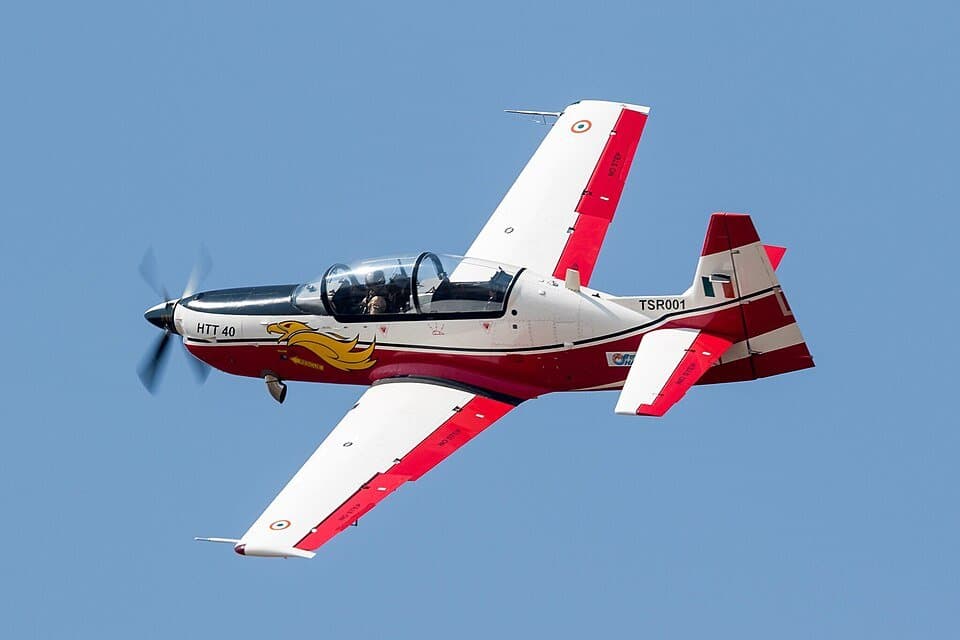
| HAL HTT-40 | ≈ 10.06 m | ≈ 11 m (Wingspan) | ≈ 3.58 m |
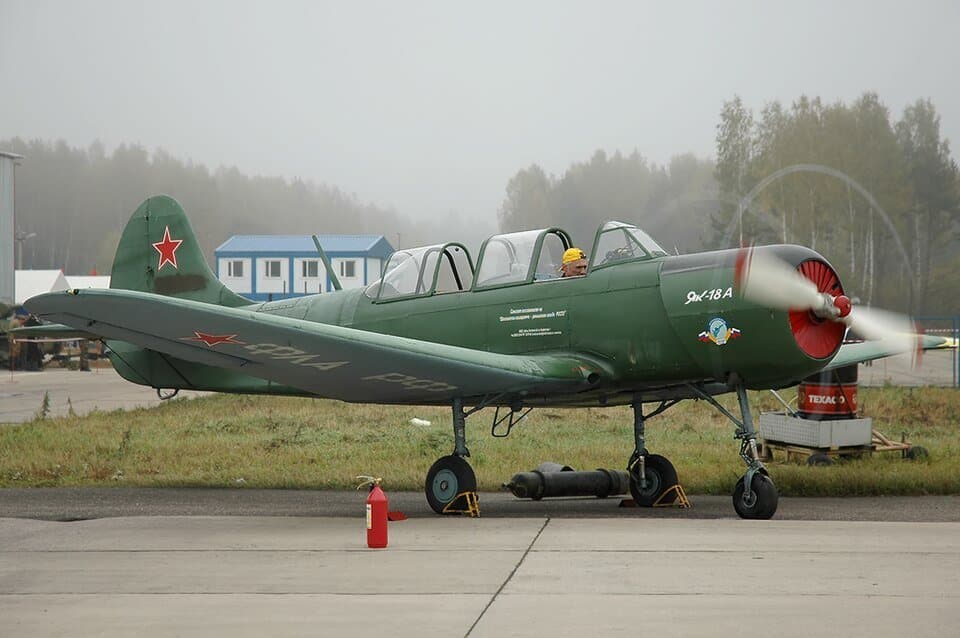
| Yakovlev Yak-18 | ≈ 8.35 m | ≈ 10.6 m (Wingspan) | ≈ 3.91 m |
Scaled uniformly to the sourced length of 10.061 m. The shape was turned square to the axes; the height was fitted to the sourced 3.583 m; the width was fitted to the sourced 11 m wingspan. Not an official model or a measured survey.
ForceTally · All rights reserved
Scaled uniformly to the sourced length of 8.35 m. The shape was turned square to the axes; the width was fitted to the sourced 10.6 m wingspan. Not an official model or a measured survey.
ForceTally · All rights reserved
The human reference is a generic 1.75 m figure. Models describe external size, not combat performance.
Measured figures
HTT-40 · Length
DisputedConfiguration
| Specification | HAL HTT-40 | Yakovlev Yak-18 |
|---|---|---|
| Type | Basic training aircraft[source] | Training aircraft[source] |
| National origin | India[source] | — |
| Manufacturer | Hindustan Aeronautics Limited[source] Hindustan Aeronautics Limited (HAL)[source]HTT-40 | Yakovlev[source] |
| Designer | Aircraft Research and Design Centre[source] |
HTT-40 · Length
Yak-18A · Length
Single source8.35 m (27 ft 5 in)[source]
Empty; HTT-40 / Basic Empty Mass · Empty mass
Single sourceGross; HTT-40 · Gross weight
Single sourceGross; HTT-40 / Normal Training Configuration Mass · Gross weight
Single sourceMaximum take-off; HTT-40 / Maximum Take-off Mass · Max takeoff weight
Single source2,800 kg (6,173 lb)[source]
2414 kg[source]HTT-40 / Basic Empty Mass
3040 kg[source]HTT-40 / Maximum Take-off Mass
2960 kg[source]HTT-40 / Normal Training Configuration Mass
Empty; Yak-18A · Empty weight
Single sourceMaximum take-off; Yak-18A · Max takeoff weight
Single sourceMaximum; HTT-40 · Maximum speed
DisputedMaximum; HTT-40 / Max level Speed · Maximum speed
Manufacturer claimMaximum; HTT-40 / Max permissible Speed · @ 6g
Manufacturer claimMaximum; HTT-40 · Maximum speed
Disputed400 km/h (249 mph, 216 kn)[source]
450 kmph @ 6g[source]HTT-40 / Max permissible Speed
407 kmph[source]HTT-40 / Max level Speed
450 km/h[source]HTT-40
Maximum; Yak-18A · Maximum speed
Single source300 km/h (190 mph, 160 kn)[source]
HTT-40 · 1 × Honeywell Garrett TPE331-12B turboprop (1,100 shp) derated to
Single sourceHTT-40 · 950 shp
Single source1 × Honeywell Garrett TPE331-12B turboprop, 834 kW (1,100 shp) derated to 708 kW (950 shp)[source]
1100 Shp[source]HTT-40 / Max Power
Yak-18A · 1 × Ivchenko AI-14RF 9-cylinder air-cooled radial piston engine
Single source1 × Ivchenko AI-14RF 9-cylinder air-cooled radial piston engine, 224 kW (300 hp)[source]
HTT-40 · Endurance
Manufacturer claim3.09 hrs[source]HTT-40
Yak-18A · Wing area
Single source17.8 m 2 (192 sq ft)[source]
Bars compare reported quantities only. A larger figure does not make a system better; configurations and test conditions differ.
| — |
| Status | In service[source] | in limited service[source] |
|---|
| Primary user | Indian Air Force[source] | — |
|---|
| Number built | 3 (excluding 2 prototypes)[source] | — |
|---|
| Introduction date | 2026 (planned)[source] | 1946[source] |
|---|
| First flight | 31 May 2016[source] | 1946[source] |
|---|
| Developed from | HPT-32 Deepak[source] | — |
|---|
| Fuel capacity | 450 kg[source] | — |
|---|
| Propellers | 4-bladed[source] | 2-bladed variable-pitch propeller[source] |
|---|
| Never exceed speed | 450 km/h (279 mph, 243 kn)[source] | — |
|---|
| g limits | +6/-3[source] | — |
|---|
| Internal fuel mass | 460 kg[source]HTT-40 / Internal fuel mass | — |
|---|
| Take-off Distance | 785 meter[source]HTT-40 | — |
|---|
| Landing Distance | 987 meter[source]HTT-40 | — |
|---|
| Time to Climb 3 km | 7.05 min[source]HTT-40 | — |
|---|
| Engine | Honeywell TPE331-12B Turboprop engine[source]HTT-40 | — |
|---|
| Primary users | — | Soviet Air Force DOSAAF People's Liberation Army Air Force Polish Air Force[source] |
|---|
| Airfoil | — | root: Clark YH (14.5%); tip: Clark YH (9.3%)[source] |
|---|
| Role | — | tandem two-seat military primary trainer aircraft[source] |
|---|
| Source measurement | — | The Yakovlev Yak-18 ( Russian : Яковлев Як-18 ; NATO reporting name Max ) is a tandem two-seat military primary trainer aircraft manufactured in the Soviet Union . Originally powered by one 119 kW (160 hp) Shvetsov M-11 FR-1 radial piston engine , it entered service in 1946. It was also produced in China as the Nanchang CJ-5 .[source]Yakovlev Yak-18 · Lead; only the objects and conditions stated in this passage A member of the second generation of Russian aircraft designers, and best known for fighter designs, Alexander Sergeyevich Yakovlev always retained a light aircraft design section. In May 1945, Yakovlev initiated design of the Yak-18 two-seat primary trainer. He designed it to replace the earlier Yakovlev UT-2 and Yakovlev Yak-5 in service with the Soviet Air Forces and DOSAAF (Voluntary Society for Collaboration with the Army, Air Force and Navy, which sponsored aero clubs throughout the USSR). In 1944, an advanced version of the UT-2 had been built with many of the features of the new Yak-18. The new aircraft flew a year later, powered by a 119 kW (160 hp) Shvetsov M-11 five-cylinder radial engine and featuring pneumatically operated retractable main landing gear and a fixed tailwheel. It entered service as a trainer later that year and was built by Yakovlev up until 1956. Examples were exported to China in kit form beginning in 1950. The Chinese began producing license built copies in 1954 with the designation CJ-5 .[source]Yakovlev Yak-18 · Design and development; only the objects and conditions stated in this passage Other claims to fame for the Yak-18 are an international speed record for its class in 1951 as well as being the aircraft used for initial flight training by Yuri Gagarin (1st human in space) and Ken Rowe ( No Kum-Sok , who defected from North Korea with a Mikoyan-Gurevich MiG-15 jet fighter during the Korean War). Later, as the need for conventional landing gear trainers abated, Yakovlev re-designed the Yak-18 with retractable tricycle landing gear and an Ivchenko AI-14RF radial engine of 224 kW (300 hp); this was designated the Yak-18A. The design proved exceptionally easy to build and maintain.[source]Yakovlev Yak-18 · Design and development; only the objects and conditions stated in this passage Cleaned up version of the Yak-18U, powered by a 194 kW (260 hp) Ivchenko AI-14 FR engine. Built in large numbers.[source]Yakovlev Yak-18 · Variants; only the objects and conditions stated in this passage Yak-18PS[source]Yakovlev Yak-18 · Variants; only the objects and conditions stated in this passage The Yakovlev Yak-18T was developed as an Aeroflot training aircraft and also as a light passenger transport aircraft, with a cabin for one pilot and three passengers. It is not a variant of the Yak-18 as it has very little in common, and was designed from scratch 20 years later.[source]Yakovlev Yak-18 · Similar model designation; only the objects and conditions stated in this passage Kazakh Air Defense Forces − Operated 4 Yak-18 in 2011, retired[source]Yakovlev Yak-18 · Operators; only the objects and conditions stated in this passage Air Force of Mali − 2 in 2011, non-operational[source]Yakovlev Yak-18 · Operators; only the objects and conditions stated in this passage Length: 8.35 m (27 ft 5 in)[source]Yakovlev Yak-18 · Specifications (Yak-18A); only the objects and conditions stated in this passage Wingspan: 10.6 m (34 ft 9 in)[source]Yakovlev Yak-18 · Specifications (Yak-18A); only the objects and conditions stated in this passage Height: 3.35 m (11 ft 0 in)[source]Yakovlev Yak-18 · Specifications (Yak-18A); only the objects and conditions stated in this passage Wing area: 17.8 m 2 (192 sq ft)[source]Yakovlev Yak-18 · Specifications (Yak-18A); only the objects and conditions stated in this passage Empty weight: 1,025 kg (2,260 lb)[source]Yakovlev Yak-18 · Specifications (Yak-18A); only the objects and conditions stated in this passage Max takeoff weight: 1,320 kg (2,910 lb)[source]Yakovlev Yak-18 · Specifications (Yak-18A); only the objects and conditions stated in this passage Powerplant: 1 × Ivchenko AI-14RF 9-cylinder air-cooled radial piston engine, 224 kW (300 hp)[source]Yakovlev Yak-18 · Specifications (Yak-18A); only the objects and conditions stated in this passage Maximum speed: 300 km/h (190 mph, 160 kn)[source]Yakovlev Yak-18 · Specifications (Yak-18A); only the objects and conditions stated in this passage Range: 700 km (430 mi, 380 nmi)[source]Yakovlev Yak-18 · Specifications (Yak-18A); only the objects and conditions stated in this passage Service ceiling: 5,060 m (16,600 ft)[source]Yakovlev Yak-18 · Specifications (Yak-18A); only the objects and conditions stated in this passage |
|---|
| Country of origin | — | Soviet Union[source] |
|---|