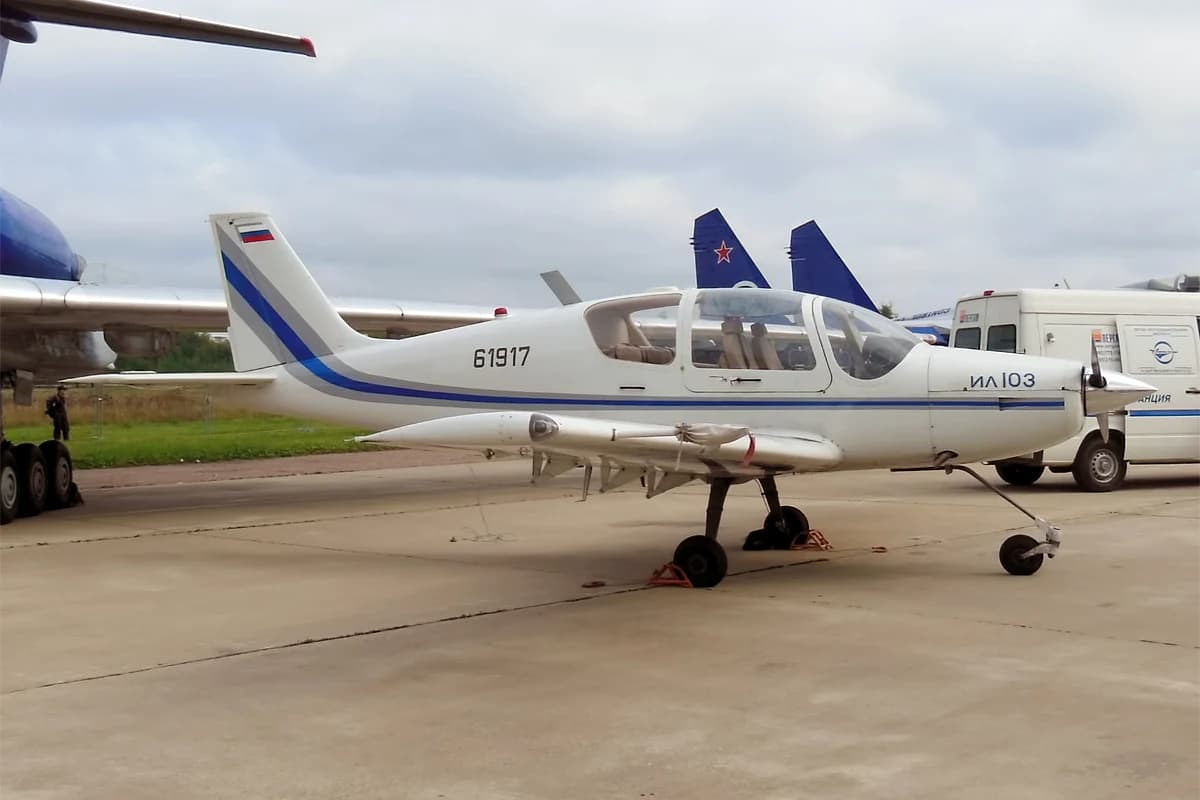

Credit
Anna Zvereva · CC BY-SA 2.0 · Resized / WebP conversion · CC BY-SA 2.0 · Source ↗ · Modified


Preparing your view.
At a glance
True scale
Side by side. From every angle. A human reference for perspective.
3.13 MB · Loads when you open it| Model | Length | Width / span | Height |
|---|---|---|---|
| Ilyushin Il-103 | ≈ 8 m | ≈ 10.56 m (Wingspan) | ≈ 3.14 m |
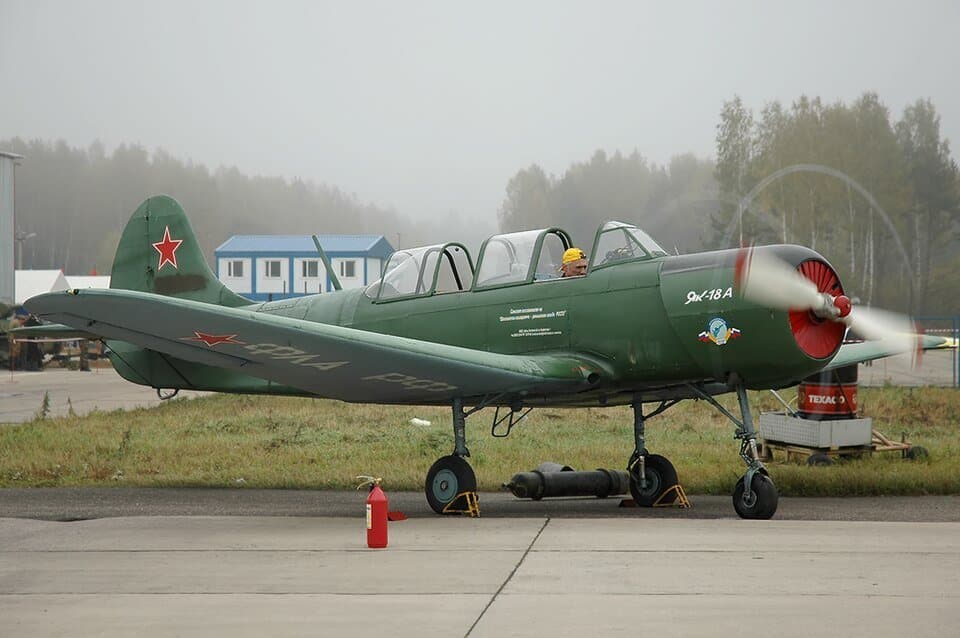
| Yakovlev Yak-18 | ≈ 8.35 m | ≈ 10.6 m (Wingspan) | ≈ 3.91 m |
Scaled uniformly to the sourced length of 8 m. The shape was turned square to the axes; the height was fitted to the sourced 3.135 m; the width was fitted to the sourced 10.56 m wingspan. Not an official model or a measured survey.
ForceTally · All rights reserved
Scaled uniformly to the sourced length of 8.35 m. The shape was turned square to the axes; the width was fitted to the sourced 10.6 m wingspan. Not an official model or a measured survey.
ForceTally · All rights reserved
The human reference is a generic 1.75 m figure. Models describe external size, not combat performance.
Measured figures
Il-103 · Length
Single source8 m (26 ft 3 in)[source]
Yak-18A · Length
Configuration
| Specification | Ilyushin Il-103 | Yakovlev Yak-18 |
|---|---|---|
| Type | Training aircraft[source] | Training aircraft[source] |
| National origin | Soviet Union / Russia[source] | — |
| Manufacturer | Ilyushin[source] | Yakovlev[source] |
| Designer | Genrikh Novozhilov[source] | — |
| Status | In service[source] |
8.35 m (27 ft 5 in)[source]
Il-103 · 1 × Teledyne Continental IO-360-ES2B 6-cyl. air-cooled horizontally-opposed piston engine
Single source1 × Teledyne Continental IO-360-ES2B 6-cyl. air-cooled horizontally-opposed piston engine, 157 kW (211 hp)[source]
Yak-18A · 1 × Ivchenko AI-14RF 9-cylinder air-cooled radial piston engine
Single source1 × Ivchenko AI-14RF 9-cylinder air-cooled radial piston engine, 224 kW (300 hp)[source]
Il-103 · 623.4 ft/min
Single source3.167 m/s (623.4 ft/min)[source]
Bars compare reported quantities only. A larger figure does not make a system better; configurations and test conditions differ.
in limited service[source] |
| Primary user | see Operators[source] | — |
|---|
| Number built | 66[source] | — |
|---|
| Manufactured | 1994–present[source] | — |
|---|
| Introduction date | 1996[source] | 1946[source] |
|---|
| First flight | 17 May 1994[source] | 1946[source] |
|---|
| Capacity | 4 pax ( max payload: 270 kg (600 lb))[source] | — |
|---|
| Aspect ratio | 7.6[source] | — |
|---|
| Fuel capacity | 150 kg (330 lb) / 200 L (53 US gal; 44 imp gal) in two wing tanks[source] | — |
|---|
| Propellers | 2-bladed Hartzell BHC-C2YF-1BF/F8459A-8R[source] | 2-bladed variable-pitch propeller[source] |
|---|
| Stall speed | 117 km/h (73 mph, 63 kn) flaps up; 111 km/h (69 mph; 60 kn) 10° flaps[source] | — |
|---|
| Never exceed speed | 340 km/h (210 mph, 180 kn)[source] | — |
|---|
| g limits | Utility: =4.4 / -1.8; Aerobatic: +6 / -3[source] | — |
|---|
| Wing loading | 89.1 kg/m 2 (18.2 lb/sq ft)[source] | — |
|---|
| Power/mass | 8.37 kg/kW (13.75 lb/hp)[source] | — |
|---|
| Role | single-engine, low-wing training aircraft[source] | tandem two-seat military primary trainer aircraft[source] |
|---|
| Source measurement | The Ilyushin Il-103 is a single-engine, low-wing training aircraft developed by the Ilyushin Design Bureau that started in 1990 in the Soviet Union . The aircraft is now produced in Russia . It was the first Russian aircraft to achieve Federal Aviation Administration certification in 1998, it is for sale in the United States .[source]Ilyushin Il-103 · Lead; only the objects and conditions stated in this passage Russia’s United Aircraft Corporation reached an agreement with Aviation Engineering Zrt of Pécs, Hungary, to develop and licence produce a modernised version of the Ilyushin Il-103 in Hungary in March 2021.[source]Ilyushin Il-103 · Operational history / Hungary; only the objects and conditions stated in this passage Capacity: 4 pax ( max payload: 270 kg (600 lb))[source]Ilyushin Il-103 · Specifications (Il-103); only the objects and conditions stated in this passage Length: 8 m (26 ft 3 in)[source]Ilyushin Il-103 · Specifications (Il-103); only the objects and conditions stated in this passage Wingspan: 10.56 m (34 ft 8 in)[source]Ilyushin Il-103 · Specifications (Il-103); only the objects and conditions stated in this passage Height: 3.135 m (10 ft 3 in)[source]Ilyushin Il-103 · Specifications (Il-103); only the objects and conditions stated in this passage Wing area: 14.71 m 2 (158.3 sq ft)[source]Ilyushin Il-103 · Specifications (Il-103); only the objects and conditions stated in this passage Empty weight: 900 kg (1,984 lb)[source]Ilyushin Il-103 · Specifications (Il-103); only the objects and conditions stated in this passage Max takeoff weight: 1,310 kg (2,888 lb)[source]Ilyushin Il-103 · Specifications (Il-103); only the objects and conditions stated in this passage Fuel capacity: 150 kg (330 lb) / 200 L (53 US gal; 44 imp gal) in two wing tanks[source]Ilyushin Il-103 · Specifications (Il-103); only the objects and conditions stated in this passage Powerplant: 1 × Teledyne Continental IO-360-ES2B 6-cyl. air-cooled horizontally-opposed piston engine, 157 kW (211 hp)[source]Ilyushin Il-103 · Specifications (Il-103); only the objects and conditions stated in this passage Maximum speed: 220 km/h (140 mph, 120 kn)[source]Ilyushin Il-103 · Specifications (Il-103); only the objects and conditions stated in this passage Cruise speed: 180 km/h (110 mph, 97 kn)[source]Ilyushin Il-103 · Specifications (Il-103); only the objects and conditions stated in this passage Stall speed: 117 km/h (73 mph, 63 kn) flaps up; 111 km/h (69 mph; 60 kn) 10° flaps[source]Ilyushin Il-103 · Specifications (Il-103); only the objects and conditions stated in this passage Never exceed speed : 340 km/h (210 mph, 180 kn)[source]Ilyushin Il-103 · Specifications (Il-103); only the objects and conditions stated in this passage Range: 800 km (500 mi, 430 nmi) (at cruising speed, pilot and 270 kg (600 lb) payload with 30 min fuel reserve)[source]Ilyushin Il-103 · Specifications (Il-103); only the objects and conditions stated in this passage Service ceiling: 3,000 m (9,840 ft) (maximum certified altitude)[source]Ilyushin Il-103 · Specifications (Il-103); only the objects and conditions stated in this passage Rate of climb: 3.167 m/s (623.4 ft/min)[source]Ilyushin Il-103 · Specifications (Il-103); only the objects and conditions stated in this passage | The Yakovlev Yak-18 ( Russian : Яковлев Як-18 ; NATO reporting name Max ) is a tandem two-seat military primary trainer aircraft manufactured in the Soviet Union . Originally powered by one 119 kW (160 hp) Shvetsov M-11 FR-1 radial piston engine , it entered service in 1946. It was also produced in China as the Nanchang CJ-5 .[source]Yakovlev Yak-18 · Lead; only the objects and conditions stated in this passage A member of the second generation of Russian aircraft designers, and best known for fighter designs, Alexander Sergeyevich Yakovlev always retained a light aircraft design section. In May 1945, Yakovlev initiated design of the Yak-18 two-seat primary trainer. He designed it to replace the earlier Yakovlev UT-2 and Yakovlev Yak-5 in service with the Soviet Air Forces and DOSAAF (Voluntary Society for Collaboration with the Army, Air Force and Navy, which sponsored aero clubs throughout the USSR). In 1944, an advanced version of the UT-2 had been built with many of the features of the new Yak-18. The new aircraft flew a year later, powered by a 119 kW (160 hp) Shvetsov M-11 five-cylinder radial engine and featuring pneumatically operated retractable main landing gear and a fixed tailwheel. It entered service as a trainer later that year and was built by Yakovlev up until 1956. Examples were exported to China in kit form beginning in 1950. The Chinese began producing license built copies in 1954 with the designation CJ-5 .[source]Yakovlev Yak-18 · Design and development; only the objects and conditions stated in this passage Other claims to fame for the Yak-18 are an international speed record for its class in 1951 as well as being the aircraft used for initial flight training by Yuri Gagarin (1st human in space) and Ken Rowe ( No Kum-Sok , who defected from North Korea with a Mikoyan-Gurevich MiG-15 jet fighter during the Korean War). Later, as the need for conventional landing gear trainers abated, Yakovlev re-designed the Yak-18 with retractable tricycle landing gear and an Ivchenko AI-14RF radial engine of 224 kW (300 hp); this was designated the Yak-18A. The design proved exceptionally easy to build and maintain.[source]Yakovlev Yak-18 · Design and development; only the objects and conditions stated in this passage |
|---|
| Primary users | — | Soviet Air Force DOSAAF People's Liberation Army Air Force Polish Air Force[source] |
|---|
| Airfoil | — | root: Clark YH (14.5%); tip: Clark YH (9.3%)[source] |
|---|
| Country of origin | — | Soviet Union[source] |
|---|
Cleaned up version of the Yak-18U, powered by a 194 kW (260 hp) Ivchenko AI-14 FR engine. Built in large numbers.[source]Yakovlev Yak-18 · Variants; only the objects and conditions stated in this passage
Yak-18PS[source]Yakovlev Yak-18 · Variants; only the objects and conditions stated in this passage
The Yakovlev Yak-18T was developed as an Aeroflot training aircraft and also as a light passenger transport aircraft, with a cabin for one pilot and three passengers. It is not a variant of the Yak-18 as it has very little in common, and was designed from scratch 20 years later.[source]Yakovlev Yak-18 · Similar model designation; only the objects and conditions stated in this passage
Kazakh Air Defense Forces − Operated 4 Yak-18 in 2011, retired[source]Yakovlev Yak-18 · Operators; only the objects and conditions stated in this passage
Air Force of Mali − 2 in 2011, non-operational[source]Yakovlev Yak-18 · Operators; only the objects and conditions stated in this passage
Length: 8.35 m (27 ft 5 in)[source]Yakovlev Yak-18 · Specifications (Yak-18A); only the objects and conditions stated in this passage
Wingspan: 10.6 m (34 ft 9 in)[source]Yakovlev Yak-18 · Specifications (Yak-18A); only the objects and conditions stated in this passage
Height: 3.35 m (11 ft 0 in)[source]Yakovlev Yak-18 · Specifications (Yak-18A); only the objects and conditions stated in this passage
Wing area: 17.8 m 2 (192 sq ft)[source]Yakovlev Yak-18 · Specifications (Yak-18A); only the objects and conditions stated in this passage
Empty weight: 1,025 kg (2,260 lb)[source]Yakovlev Yak-18 · Specifications (Yak-18A); only the objects and conditions stated in this passage
Max takeoff weight: 1,320 kg (2,910 lb)[source]Yakovlev Yak-18 · Specifications (Yak-18A); only the objects and conditions stated in this passage
Powerplant: 1 × Ivchenko AI-14RF 9-cylinder air-cooled radial piston engine, 224 kW (300 hp)[source]Yakovlev Yak-18 · Specifications (Yak-18A); only the objects and conditions stated in this passage
Maximum speed: 300 km/h (190 mph, 160 kn)[source]Yakovlev Yak-18 · Specifications (Yak-18A); only the objects and conditions stated in this passage
Range: 700 km (430 mi, 380 nmi)[source]Yakovlev Yak-18 · Specifications (Yak-18A); only the objects and conditions stated in this passage
Service ceiling: 5,060 m (16,600 ft)[source]Yakovlev Yak-18 · Specifications (Yak-18A); only the objects and conditions stated in this passage