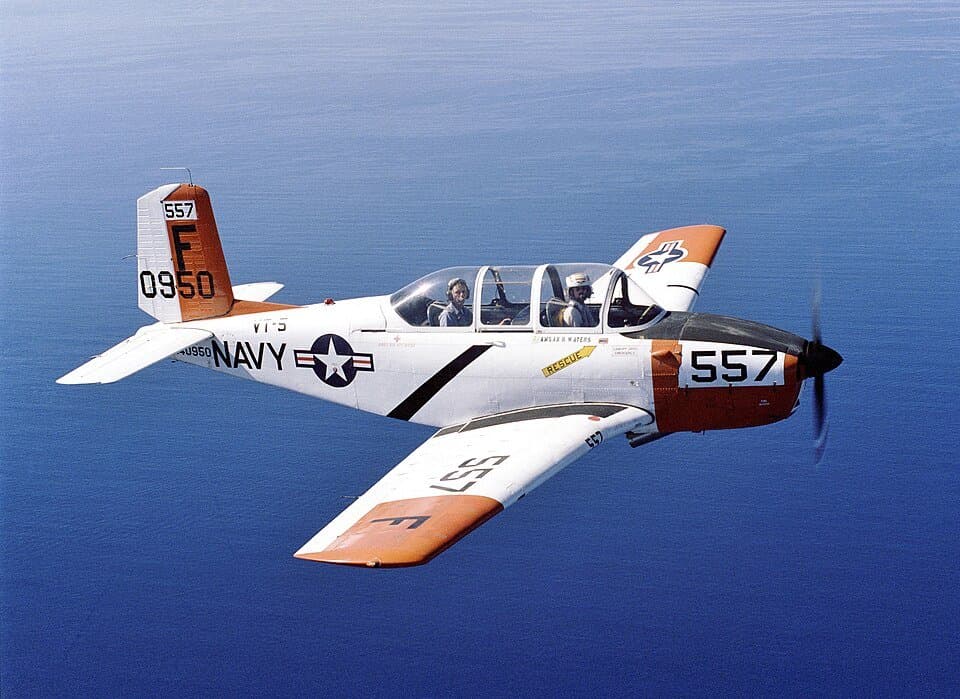

Credit
PHCS R. L. LAWSON · Public domain · Resized · Public domain · Source ↗ · Modified


Preparing your view.
At a glance
True scale
Side by side. From every angle. A human reference for perspective.
3.16 MB · Loads when you open it| Model | Length | Width / span | Height |
|---|---|---|---|
| Beechcraft T-34 Mentor | ≈ 8.75 m | ≈ 10.16 m (Wingspan) | ≈ 2.92 m |
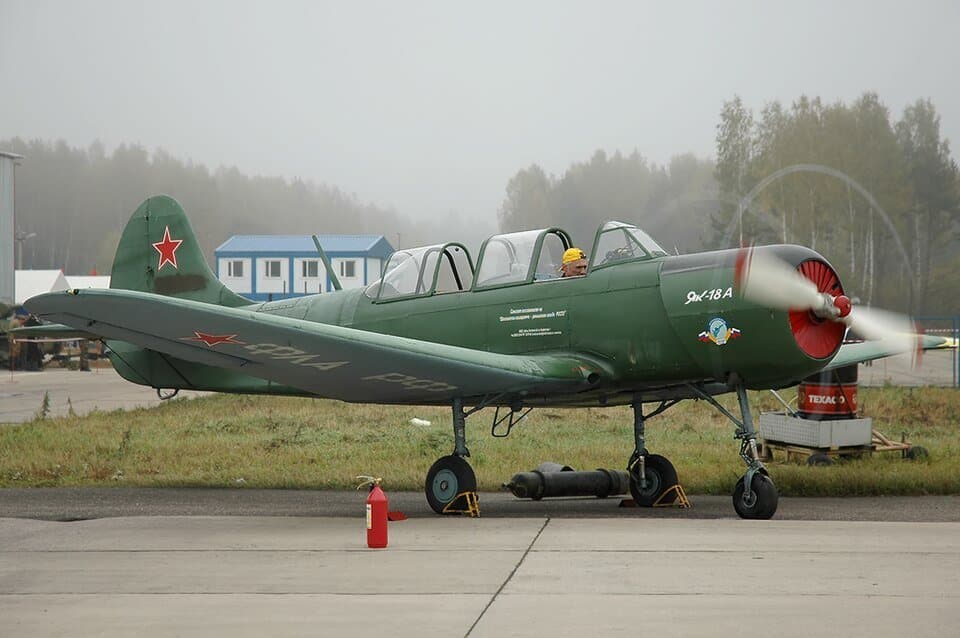
| Yakovlev Yak-18 | ≈ 8.35 m | ≈ 10.6 m (Wingspan) | ≈ 3.91 m |
Scaled uniformly to the sourced length of 8.75 m. The shape was turned square to the axes; the height was fitted to the sourced 2.92 m; the width was fitted to the sourced 10.157 m wingspan. Not an official model or a measured survey.
ForceTally · All rights reserved
Scaled uniformly to the sourced length of 8.35 m. The shape was turned square to the axes; the width was fitted to the sourced 10.6 m wingspan. Not an official model or a measured survey.
ForceTally · All rights reserved
The human reference is a generic 1.75 m figure. Models describe external size, not combat performance.
Measured figures
T-34C · Length
Single source28 ft 8 + 1 ⁄ 2 in (8.750 m)[source]
Configuration
| Specification | Beechcraft T-34 Mentor | Yakovlev Yak-18 |
|---|---|---|
| Type | Trainer aircraft[source] | Training aircraft[source] |
| National origin | United States[source] | — |
| Manufacturer | Beechcraft[source] | Yakovlev[source] |
| Primary users | United States Air Force United States Navy Japan Air Self-Defense Force Republic of China Air Force[source] | Soviet Air Force DOSAAF People's Liberation Army Air Force Polish Air Force |
Yak-18A · Length
8.35 m (27 ft 5 in)[source]
Empty; T-34C · Empty weight
Single sourceMaximum take-off; T-34C · Max takeoff weight
Single sourceMaximum take-off; T-34C · T-34C-1 weapons trainer
Single source2,960 lb (1,343 kg)[source]
4,300 lb (1,950 kg) (T-34C-1 weapons trainer 5,500 lb (2,500 kg))[source]
Empty; Yak-18A · Empty weight
Single sourceMaximum take-off; Yak-18A · Max takeoff weight
Single sourceT-34C · 1 × Pratt & Whitney Canada PT6 A-25 turboprop , 550 shp (
Single source1 × Pratt & Whitney Canada PT6 A-25 turboprop , 550 shp (410 kW)[source]
Yak-18A · 1 × Ivchenko AI-14RF 9-cylinder air-cooled radial piston engine
Single source1 × Ivchenko AI-14RF 9-cylinder air-cooled radial piston engine, 224 kW (300 hp)[source]
T-34C · 1,480 ft/min (
Single source1,480 ft/min (7.5 m/s)[source]
Bars compare reported quantities only. A larger figure does not make a system better; configurations and test conditions differ.
| Number built | 2,300+[source] | — |
|---|
| Manufactured | 1953–1959 1975–1990[source] | — |
|---|
| Introduction date | 1953[source] | 1946[source] |
|---|
| First flight | 2 December 1948[source] | 1946[source] |
|---|
| Developed from | Beechcraft Bonanza[source] | — |
|---|
| Developed into | Fuji LM-1 Nikko[source] | — |
|---|
| Fuel capacity | 130 US gal (110 imp gal; 490 L)[source] | — |
|---|
| Propellers | 3-bladed Hartzell constant-speed[source] | 2-bladed variable-pitch propeller[source] |
|---|
| Stall speed | 53 kn (61 mph, 98 km/h) (flaps down, power off)[source] | — |
|---|
| Never exceed speed | 280 kn (320 mph, 520 km/h)[source] | — |
|---|
| g limits | +6, -3[source] | — |
|---|
| Hardpoints | 4 with a capacity of 600 lb (272 kg) inner, 300 lb (136 kg) outer, 1,200 lb (544 kg) total[source] | — |
|---|
| Role | American propeller-driven, single-engined, military trainer aircraft derived[source] | tandem two-seat military primary trainer aircraft[source] |
|---|
| Source measurement | Three initial design concepts were developed for the Model 45, including one with the Bonanza's signature V-tail , but the final design that emerged in 1948 incorporated conventional tail control surfaces for the benefit of the more conservative military (featuring a relatively large unswept vertical fin that would find its way onto the Travel Air twin-engine civil aircraft almost ten years later). The Bonanza's fuselage with four-passenger cabin was replaced with a narrower fuselage incorporating a two-seater tandem cockpit and bubble canopy , which provided greater visibility for the trainee pilot and flight instructor. Structurally, the Model 45 was much stronger than the Bonanza, being designed for +10 g and −4.5 g , while the Continental E-185 engine of 185 horsepower (hp) at takeoff (less than a third of the power of the T-6's engine) was the same as that fitted to contemporary Bonanzas.[source]Beechcraft T-34 Mentor · Design and development; only the objects and conditions stated in this passage The Model 73 Jet Mentor shared many components with the piston-engined aircraft; major visual differences were the redesigned cockpit which was moved forward in the fuselage and the air intakes for the jet engine in the wing roots , supplying air to a single 920 lbf (4.1 kN) Continental J69 jet engine in the rear fuselage.[source]Beechcraft T-34 Mentor · Design and development / Model 73 Jet Mentor; only the objects and conditions stated in this passage Equipped with hardpoints for training or light attack, able to carry 1,200 lb (540 kg) of weapons on four underwing pylons. The armament could include flares, incendiary bombs, rocket or gun pods and antitank missiles. Widely exported.[source]Beechcraft T-34 Mentor · Variants; only the objects and conditions stated in this passage Powered by a 920 lbf (4.09 kN) Continental J69-T-9 turbojet engine . The sole aircraft first flew on 18 December 1955.[source]Beechcraft T-34 Mentor · Variants; only the objects and conditions stated in this passage Argentine Naval Aviation – 15 T-34C-1 in 1978.[source]Beechcraft T-34 Mentor · Operators / Military operators; only the objects and conditions stated in this passage Colombian Air Force – Purchased 50 T-34s in 1954, with six more acquired in 1970 and 10 in 1977. The final T-34 was retired in December 2013.[source]Beechcraft T-34 Mentor · Operators / Military operators; only the objects and conditions stated in this passage Length: 28 ft 8 + 1 ⁄ 2 in (8.750 m)[source]Beechcraft T-34 Mentor · Specifications (T-34C); only the objects and conditions stated in this passage Wingspan: 33 ft 3 + 7 ⁄ 8 in (10.157 m)[source]Beechcraft T-34 Mentor · Specifications (T-34C); only the objects and conditions stated in this passage Height: 9 ft 7 in (2.92 m)[source]Beechcraft T-34 Mentor · Specifications (T-34C); only the objects and conditions stated in this passage Wing area: 179.6 sq ft (16.69 m 2 )[source]Beechcraft T-34 Mentor · Specifications (T-34C); only the objects and conditions stated in this passage Empty weight: 2,960 lb (1,343 kg)[source]Beechcraft T-34 Mentor · Specifications (T-34C); only the objects and conditions stated in this passage Max takeoff weight: 4,300 lb (1,950 kg) (T-34C-1 weapons trainer 5,500 lb (2,500 kg))[source]Beechcraft T-34 Mentor · Specifications (T-34C); only the objects and conditions stated in this passage Powerplant: 1 × Pratt & Whitney Canada PT6 A-25 turboprop , 550 shp (410 kW)[source]Beechcraft T-34 Mentor · Specifications (T-34C); only the objects and conditions stated in this passage Cruise speed: 214 kn (246 mph, 396 km/h) at 17,000 ft (5,200 m) (max cruise)[source]Beechcraft T-34 Mentor · Specifications (T-34C); only the objects and conditions stated in this passage Stall speed: 53 kn (61 mph, 98 km/h) (flaps down, power off)[source]Beechcraft T-34 Mentor · Specifications (T-34C); only the objects and conditions stated in this passage Never exceed speed : 280 kn (320 mph, 520 km/h)[source]Beechcraft T-34 Mentor · Specifications (T-34C); only the objects and conditions stated in this passage Range: 708 nmi (815 mi, 1,311 km) at 180 kn (210 mph; 330 km/h) and 20,000 ft (6,100 m)[source]Beechcraft T-34 Mentor · Specifications (T-34C); only the objects and conditions stated in this passage Service ceiling: 30,000 ft (9,100 m)[source]Beechcraft T-34 Mentor · Specifications (T-34C); only the objects and conditions stated in this passage Rate of climb: 1,480 ft/min (7.5 m/s)[source]Beechcraft T-34 Mentor · Specifications (T-34C); only the objects and conditions stated in this passage Hardpoints: 4 with a capacity of 600 lb (272 kg) inner, 300 lb (136 kg) outer, 1,200 lb (544 kg) total[source]Beechcraft T-34 Mentor · Specifications (T-34C); only the objects and conditions stated in this passage | The Yakovlev Yak-18 ( Russian : Яковлев Як-18 ; NATO reporting name Max ) is a tandem two-seat military primary trainer aircraft manufactured in the Soviet Union . Originally powered by one 119 kW (160 hp) Shvetsov M-11 FR-1 radial piston engine , it entered service in 1946. It was also produced in China as the Nanchang CJ-5 .[source]Yakovlev Yak-18 · Lead; only the objects and conditions stated in this passage A member of the second generation of Russian aircraft designers, and best known for fighter designs, Alexander Sergeyevich Yakovlev always retained a light aircraft design section. In May 1945, Yakovlev initiated design of the Yak-18 two-seat primary trainer. He designed it to replace the earlier Yakovlev UT-2 and Yakovlev Yak-5 in service with the Soviet Air Forces and DOSAAF (Voluntary Society for Collaboration with the Army, Air Force and Navy, which sponsored aero clubs throughout the USSR). In 1944, an advanced version of the UT-2 had been built with many of the features of the new Yak-18. The new aircraft flew a year later, powered by a 119 kW (160 hp) Shvetsov M-11 five-cylinder radial engine and featuring pneumatically operated retractable main landing gear and a fixed tailwheel. It entered service as a trainer later that year and was built by Yakovlev up until 1956. Examples were exported to China in kit form beginning in 1950. The Chinese began producing license built copies in 1954 with the designation CJ-5 .[source]Yakovlev Yak-18 · Design and development; only the objects and conditions stated in this passage Other claims to fame for the Yak-18 are an international speed record for its class in 1951 as well as being the aircraft used for initial flight training by Yuri Gagarin (1st human in space) and Ken Rowe ( No Kum-Sok , who defected from North Korea with a Mikoyan-Gurevich MiG-15 jet fighter during the Korean War). Later, as the need for conventional landing gear trainers abated, Yakovlev re-designed the Yak-18 with retractable tricycle landing gear and an Ivchenko AI-14RF radial engine of 224 kW (300 hp); this was designated the Yak-18A. The design proved exceptionally easy to build and maintain.[source]Yakovlev Yak-18 · Design and development; only the objects and conditions stated in this passage |
|---|
| Country of origin | United States[source] | Soviet Union[source] |
|---|
| Status | — | in limited service[source] |
|---|
| Airfoil | — | root: Clark YH (14.5%); tip: Clark YH (9.3%)[source] |
|---|
Cleaned up version of the Yak-18U, powered by a 194 kW (260 hp) Ivchenko AI-14 FR engine. Built in large numbers.[source]Yakovlev Yak-18 · Variants; only the objects and conditions stated in this passage
Yak-18PS[source]Yakovlev Yak-18 · Variants; only the objects and conditions stated in this passage
The Yakovlev Yak-18T was developed as an Aeroflot training aircraft and also as a light passenger transport aircraft, with a cabin for one pilot and three passengers. It is not a variant of the Yak-18 as it has very little in common, and was designed from scratch 20 years later.[source]Yakovlev Yak-18 · Similar model designation; only the objects and conditions stated in this passage
Kazakh Air Defense Forces − Operated 4 Yak-18 in 2011, retired[source]Yakovlev Yak-18 · Operators; only the objects and conditions stated in this passage
Air Force of Mali − 2 in 2011, non-operational[source]Yakovlev Yak-18 · Operators; only the objects and conditions stated in this passage
Length: 8.35 m (27 ft 5 in)[source]Yakovlev Yak-18 · Specifications (Yak-18A); only the objects and conditions stated in this passage
Wingspan: 10.6 m (34 ft 9 in)[source]Yakovlev Yak-18 · Specifications (Yak-18A); only the objects and conditions stated in this passage
Height: 3.35 m (11 ft 0 in)[source]Yakovlev Yak-18 · Specifications (Yak-18A); only the objects and conditions stated in this passage
Wing area: 17.8 m 2 (192 sq ft)[source]Yakovlev Yak-18 · Specifications (Yak-18A); only the objects and conditions stated in this passage
Empty weight: 1,025 kg (2,260 lb)[source]Yakovlev Yak-18 · Specifications (Yak-18A); only the objects and conditions stated in this passage
Max takeoff weight: 1,320 kg (2,910 lb)[source]Yakovlev Yak-18 · Specifications (Yak-18A); only the objects and conditions stated in this passage
Powerplant: 1 × Ivchenko AI-14RF 9-cylinder air-cooled radial piston engine, 224 kW (300 hp)[source]Yakovlev Yak-18 · Specifications (Yak-18A); only the objects and conditions stated in this passage
Maximum speed: 300 km/h (190 mph, 160 kn)[source]Yakovlev Yak-18 · Specifications (Yak-18A); only the objects and conditions stated in this passage
Range: 700 km (430 mi, 380 nmi)[source]Yakovlev Yak-18 · Specifications (Yak-18A); only the objects and conditions stated in this passage
Service ceiling: 5,060 m (16,600 ft)[source]Yakovlev Yak-18 · Specifications (Yak-18A); only the objects and conditions stated in this passage