FORCETALLY
Loading the evidence…
Preparing your view.


Preparing your view.
Anti-aircraft gunsIn service
Self-propelled anti-aircraft gun
K30 Biho is a self-propelled anti-aircraft gun originating in South Korea. It was built by Hanwha Aerospace LIG Defense & Aerospace. Reported operators include South Korea, India.
 South Korea
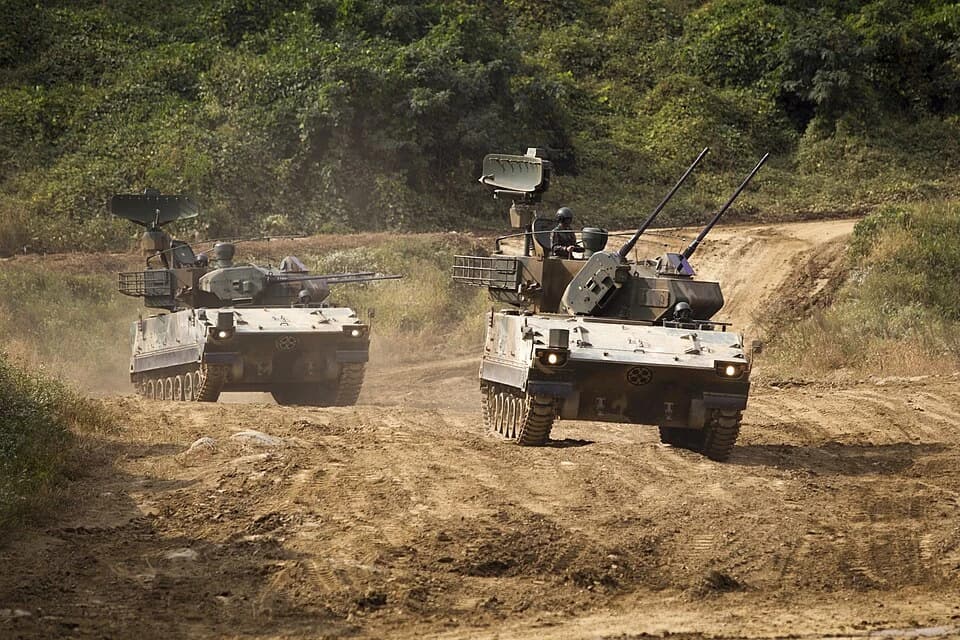
K30 Biho tracked twin-gun air-defence vehicle with raised radar in the foreground of the source-pictured 2014 DX Korea field demonstration; a second vehicle is visible behind.
대한민국 국군 Republic of Korea Armed Forces · CC BY-SA 2.0 · Resized / optimised · CC BY-SA 2.0 · Source ↗ · ModifiedSelf-propelled anti-aircraft gun
South Korea
1999–present
See Users
Agency for Defense Development
1983–1991
Hanwha Aerospace LIG Defense & Aerospace
13,3 billion KRW (12.1 million USD)
1996–present
176
26.5 metric tons (26.1 long tons; 29.2 short tons)
6.77 meters (22 ft 3 in)
3 meters (9 ft 10 in)
4.05 meters (13 ft 3 in)
4
2 × SNT Dynamics K KCB 30×170 mm autocannon
KP-SAM Chiron MANPADS
MAN - Doosan D2840L 520 hp (388 kw) diesel engine
19.62 hp/t (14.63 kW/t)
S&T Dynamics HMPT500-3EK/4EK
Torsion bar
500 km (310 mi)
65 km/h (40 mph)
South Korea
India
The South Korean K30 Biho ( Korean : 비호, Hanja : 飛虎; literally "Flying Tiger ") twin 30 mm self-propelled anti-aircraft weapon was developed to meet the operational requirements of the Republic of Korea Armed Forces for a highly mobile short range air defense system suited to the operational and terrain conditions of the Korean peninsula. It combines an electro-optically guided 30 mm gun system with a surveillance radar system on a K200 chassis. It supplements the K263A1 Chungung , a self-propelled 20 mm Vulcan system.
The K30 was first announced as a project in 1983 with 600 personnel conducting research and around 10 billion won spent on R&D. In September 2001, the production of prototypes were done under Tong-il Heavy Industries before Doosan Infracore concluded a contract with Korea's Defense Acquisition Program in 2007. An initial order was made in 2002 to supply the K30.
A K30 Biho system consists of twin KCB 30 mm guns, a TPS-830K surveillance and fire-control radar, an electro-optical targeting system (EOTS), panoramic periscope , forward looking infrared system (FLIR), laser rangefinder (LRF), thermal sight , a TV camera, and a digital fire-control system . The combined targeting system of EOTS, FLIR, and LRF has a targeting range of over 10 km (6.2 mi). The TPS-830K radar can detect and track a 2 m 2 (22 ft 2 )-RCS target from a range of 17 km (11 mi). The cannons have a cyclic rate of fire of 600 rpm and an effective anti-aircraft range of 3,000 m (1.9 mi), and each is loaded with 300 rounds of (30×170 mm KCB) ammunition. In December 2013, DAPA announced that the Biho had been integrated with the Shingung surface-to-air missile to increase its coverage to 7 km. Two pods each containing two missiles are mounted, one of each side of the turret. Design integration with the missiles was completed in 2014, and by October 2015 the system was in full-rate production. The upgraded vehicle was in service by late 2018.
The TPS-830K radar of K30 is an X-band (8 to 12.5 GHz) surveillance and fire-control pulse-Doppler radar , specialized for use against low-flying aircraft. Its features include real-time early warning, multiple target detection, an integral L-band (1 to 2 GHz) Identification Friend or Foe (IFF) subsystem, pulse compression, frequency agility, and adaptive moving target indication as an anti-chaff measure. It supplies ballistic computation data to the digital fire-control system to direct the aim of the electro-optical targeting system, which then aligns the 30 mm guns with the target for accurate fire. The radar can be installed on a separate vehicle (usually a 5-ton six-wheeled truck with a self-towed generator unit) to serve as an independent surveillance platform for other short range air defense systems. The secondary FLIR system and laser rangefinder supplements the TPS-830K radar to provide additional targeting means in case the radar is rendered inoperative, or is turned off to retain the element of surprise against aircraft that are equipped with radar warning receivers .
The K30 adapts the chassis of the K200 infantry fighting vehicle, but has some differences. It has an extra roadwheel in its suspension and uses a D2840L engine instead of the D2848T engine of the K200, with an increase in engine power from 350 horsepower to 520 horsepower, necessary since the K30 weighs almost twice as much as the K200. Allison Transmission 's X200-5K transmission is likewise replaced by S&T Dynamics ' HMPT500-3EK/4EK to accommodate the more powerful engine. The modified chassis largely retains the protection and amphibious capability of the original chassis.
A K30 Biho system consists of twin KCB 30 mm guns, a TPS-830K surveillance and fire-control radar, an electro-optical targeting system (EOTS), panoramic periscope , forward looking infrared system (FLIR), laser rangefinder (LRF), thermal sight , a TV camera, and a digital fire-control system .
Reference text from Wikipedia contributors, used under CC BY-SA 4.0.
True scale
Sourced dimensions beside a 1.75 m human reference.
See it in your room. Scan with your phone to open this model in 3D, then place it in your space.
Points represent sourced observations, including revisions. Revisions on the same effective date are not separate inventory events. Ranges appear in the table and are not plotted as exact points.
| Observation / report period | Value | Source | Claim state |
|---|---|---|---|
| 28 Sept 2026 | 30 mm | Wikipedia contributors | approved |
K30 Biho equipment records. Variants, orders and quantities are shown as reported in each inventory source; coverage is incomplete.
 India South Korea
Army exact named equipment holdings: K30 Biho. Active, operational-reserve and training units excluding equipment in store; November 2025 IISS assessment. Named service only; no parent-force or national total inferred. Source role: AIR DEFENCE / 30mm. Original estimates, ranges, reporting names, reserve, lease and employment scopes retained; nested included counts are not added. Missile-system quantities mean launchers, not rounds. No readiness, crew, carried weapon, payload, factory-production or future order count inherited.
Keep exploring
Self-propelled anti-aircraft gun
Compare with K30 BihoSelf-propelled anti-aircraft gun
 United StatesCompare with K30 Biho
Self-propelled anti-aircraft gun
United StatesCompare with K30 Biho Self-propelled anti-aircraft gun
Compare with K30 BihoSelf-propelled anti-aircraft gun
 ChinaCompare with K30 Biho
Self-propelled anti-aircraft gun
Compare with K30 Biho