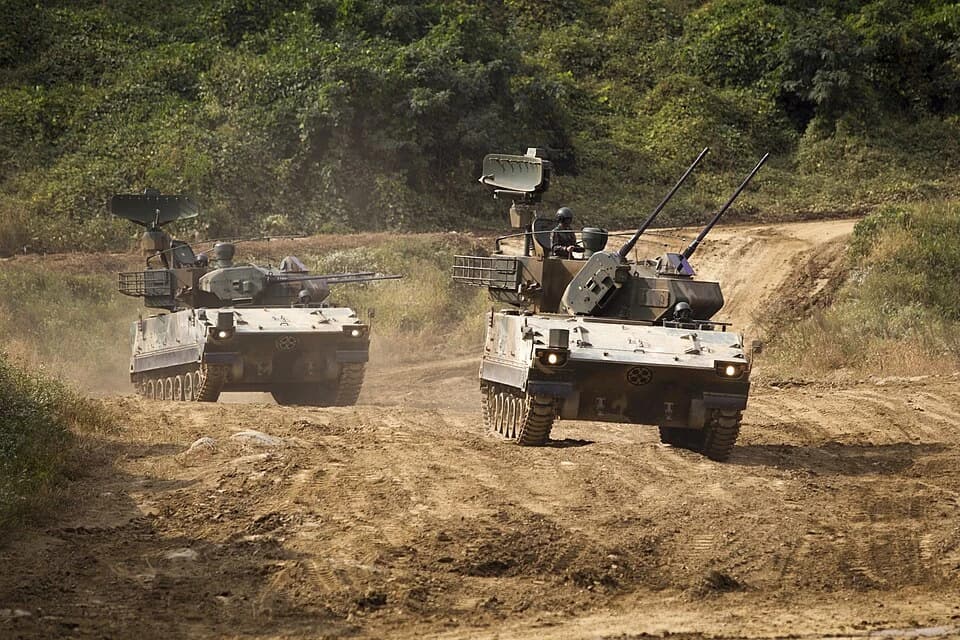

Credit
대한민국 국군 Republic of Korea Armed Forces · CC BY-SA 2.0 · Resized / optimised · CC BY-SA 2.0 · Source ↗ · Modified


Preparing your view.


At a glance
K30 Biholarger figure on 4 of 5
PGZ-09larger figure on 1 of 5
Counts only measures both sources give with the same scope. A larger figure is not a better system.
True scale
Side by side. From every angle. A human reference for perspective.
3.37 MB · Loads when you open it| Model | Length | Width / span | Height |
|---|---|---|---|
| K30 Biho | ≈ 6.77 m | ≈ 3.36 m (Width) | ≈ 4.2 m |
| PGZ-09 | ≈ 6.7 m | ≈ 3.47 m (Width) | ≈ 3.54 m |
Scaled uniformly to the sourced length of 6.77 m. Not an official model or a measured survey.
ForceTally · All rights reserved
Scaled uniformly to the sourced length of 6.7 m. Not an official model or a measured survey.
ForceTally · All rights reserved
The human reference is a generic 1.75 m figure. Models describe external size, not combat performance.
Measured figures
Length
Single source6.77 meters (22 ft 3 in)[source]
Length
Single sourceConfiguration
| Specification | K30 Biho | PGZ-09 |
|---|---|---|
| Type | Self-propelled anti-aircraft gun[source] | Self-propelled anti-aircraft gun[source] |
| Place of origin | South Korea[source] | China[source] |
| In service | 1999–present[source] | 2009-present[source] |
| Used by | See Users[source] | — |
| Designer | Agency for Defense Development |
6.7 m (20 ft)[source]
Rate of fire
Single source1100 rounds/min[source]
Bars compare reported quantities only. A larger figure does not make a system better; configurations and test conditions differ.
Northwest Institute of Mechanical & Electrical Engineering[source] |
| Designed | 1983–1991[source] | — |
|---|
| Manufacturer | Hanwha Aerospace LIG Defense & Aerospace[source] | Norinco[source] |
|---|
| Unit cost | 13,3 billion KRW (12.1 million USD)[source] | — |
|---|
| Produced | 1996–present[source] | 2007-present[source] |
|---|
| No. built | 176[source] | — |
|---|
| Main armament | 2 × SNT Dynamics K KCB 30×170 mm autocannon[source] | 2 × PG99 35 mm autocannon 2 to 4 infrared guided MANPADS (optional)[source] |
|---|
| Secondary armament | KP-SAM Chiron MANPADS[source] | 2 × 3 smoke dischargers[source] |
|---|
| Power/weight | 19.62 hp/t (14.63 kW/t)[source] | 22.85 hp/tonne[source] |
|---|
| Transmission | S&T Dynamics HMPT500-3EK/4EK[source] | — |
|---|
| Suspension | Torsion bar[source] | torsion bar and hydropneumatic suspension[source] |
|---|
| Source measurement | The South Korean K30 Biho ( Korean : 비호, Hanja : 飛虎; literally "Flying Tiger ") twin 30 mm self-propelled anti-aircraft weapon was developed to meet the operational requirements of the Republic of Korea Armed Forces for a highly mobile short range air defense system suited to the operational and terrain conditions of the Korean peninsula. It combines an electro-optically guided 30 mm gun system with a surveillance radar system on a K200 chassis. It supplements the K263A1 Chungung , a self-propelled 20 mm Vulcan system.[source]K30 Biho · Lead; only the objects and conditions stated in this passage The K30 was first announced as a project in 1983 with 600 personnel conducting research and around 10 billion won spent on R&D. In September 2001, the production of prototypes were done under Tong-il Heavy Industries before Doosan Infracore concluded a contract with Korea's Defense Acquisition Program in 2007. An initial order was made in 2002 to supply the K30.[source]K30 Biho · History; only the objects and conditions stated in this passage A K30 Biho system consists of twin KCB 30 mm guns, a TPS-830K surveillance and fire-control radar, an electro-optical targeting system (EOTS), panoramic periscope , forward looking infrared system (FLIR), laser rangefinder (LRF), thermal sight , a TV camera, and a digital fire-control system . The combined targeting system of EOTS, FLIR, and LRF has a targeting range of over 10 km (6.2 mi). The TPS-830K radar can detect and track a 2 m 2 (22 ft 2 )-RCS target from a range of 17 km (11 mi). The cannons have a cyclic rate of fire of 600 rpm and an effective anti-aircraft range of 3,000 m (1.9 mi), and each is loaded with 300 rounds of (30×170 mm KCB) ammunition. In December 2013, DAPA announced that the Biho had been integrated with the Shingung surface-to-air missile to increase its coverage to 7 km. Two pods each containing two missiles are mounted, one of each side of the turret. Design integration with the missiles was completed in 2014, and by October 2015 the system was in full-rate production. The upgraded vehicle was in service by late 2018.[source]K30 Biho · General characteristics; only the objects and conditions stated in this passage The TPS-830K radar of K30 is an X-band (8 to 12.5 GHz) surveillance and fire-control pulse-Doppler radar , specialized for use against low-flying aircraft. Its features include real-time early warning, multiple target detection, an integral L-band (1 to 2 GHz) Identification Friend or Foe (IFF) subsystem, pulse compression, frequency agility, and adaptive moving target indication as an anti-chaff measure. It supplies ballistic computation data to the digital fire-control system to direct the aim of the electro-optical targeting system, which then aligns the 30 mm guns with the target for accurate fire. The radar can be installed on a separate vehicle (usually a 5-ton six-wheeled truck with a self-towed generator unit) to serve as an independent surveillance platform for other short range air defense systems. The secondary FLIR system and laser rangefinder supplements the TPS-830K radar to provide additional targeting means in case the radar is rendered inoperative, or is turned off to retain the element of surprise against aircraft that are equipped with radar warning receivers .[source]K30 Biho · General characteristics; only the objects and conditions stated in this passage The K30 adapts the chassis of the K200 infantry fighting vehicle, but has some differences. It has an extra roadwheel in its suspension and uses a D2840L engine instead of the D2848T engine of the K200, with an increase in engine power from 350 horsepower to 520 horsepower, necessary since the K30 weighs almost twice as much as the K200. Allison Transmission 's X200-5K transmission is likewise replaced by S&T Dynamics ' HMPT500-3EK/4EK to accommodate the more powerful engine. The modified chassis largely retains the protection and amphibious capability of the original chassis.[source]K30 Biho · General characteristics; only the objects and conditions stated in this passage | The Type 09 (PLA military designation: PGZ09 – Chinese : 09式自行高射炮 ; pinyin : 09 shì zì xíng gāoshèpào , "Type 09 self-propelled anti-aircraft artillery") is a Chinese self-propelled anti-aircraft vehicle manufactured by Norinco . It is armed with two 35 millimeter cannons and optionally two to four fire-and-forget infrared homing missiles. It started to gradually replace the predecessor Type 95 in 2009. Some military analysts designated the vehicle as Type 07, but the official designation was confirmed as Type 09 on the Theme Exhibition of the 90th Anniversary of Chinese People's Liberation Army in 2017.[source]PGZ-09 · Lead; only the objects and conditions stated in this passage In 1987, China imported the Oerlikon GDF-002 with manufacture licenses, which was designated as Type 90 twin 35 mm anti-aircraft gun systems in China. Type 90 is mainly designed to engage low-flying target such as Close air support aircraft, helicopters, unmanned aerial vehicles (UAV) and cruise missiles. Type 09 is the self-propelled version of Type 90.[source]PGZ-09 · History; only the objects and conditions stated in this passage Type 09 utilizes a tracked chassis similar to PLZ-05 , which is powered by an 8V150 diesel engine with 800 hp. The chassis features six roadwheels with combined torsion bar and hydropneumatic suspension system and CH700 manual transmission. The tracked design and 800hp engine allows for a road speed of up to 55 km/h. The turret is made of welded steel armor that protects the crew from small arms fire and shell splinters. Over the frontal arc the armor is rated to withstand 14.5mm heavy machine gun round.[source]PGZ-09 · Design; only the objects and conditions stated in this passage The main armaments are PG-99 (Type 90) twin-barrel anti-aircraft guns. The twin-barrel artillery has a combined cyclic rate of 1100 rounds per minute. The vehicle can choose from five types of ammunition before engagement, including HEI (High Explosive Incendiary) with tracer variant, SAPHEI (Semi-armor-piercing high-explosive incendiary) with tracer variant, armor-piercing discarding sabot, programmable Air burst and Target Practice Tracer. The turret has two separate loading mechanism for each barrel. |
|---|
| Role | — | Chinese self-propelled anti-aircraft vehicle[source] |
|---|
| Reported operators | — |
|---|
The vehicle features two types of radar. The search and surveillance radar ( Doppler radar ) is located at the rear of the turret roof which has a reported range of 20 kilometers with identification friend or foe capability. The tracking radar is mounted in front of the turret with digital fire control system above. It is equipped with a computer-controlled targeting system with laser range finder and thermal-tracking sight. An emergency daylight optics is situated on top of the turret. A digital fire control system and auto-loader is situated in the rear of the vehicle. Other standard equipment for Type 09 includes air-conditioning for crew and computers, heating and ventilation, and an NBC system that provides protection against the effects of nuclear, biological and chemical weapons. Type 09 also has an automatic fire detection and suppression system, data-link and external communications system with other vehicles in the battalion.[source]PGZ-09 · Design; only the objects and conditions stated in this passage