FORCETALLY
Loading the evidence…
Preparing your view.


Preparing your view.
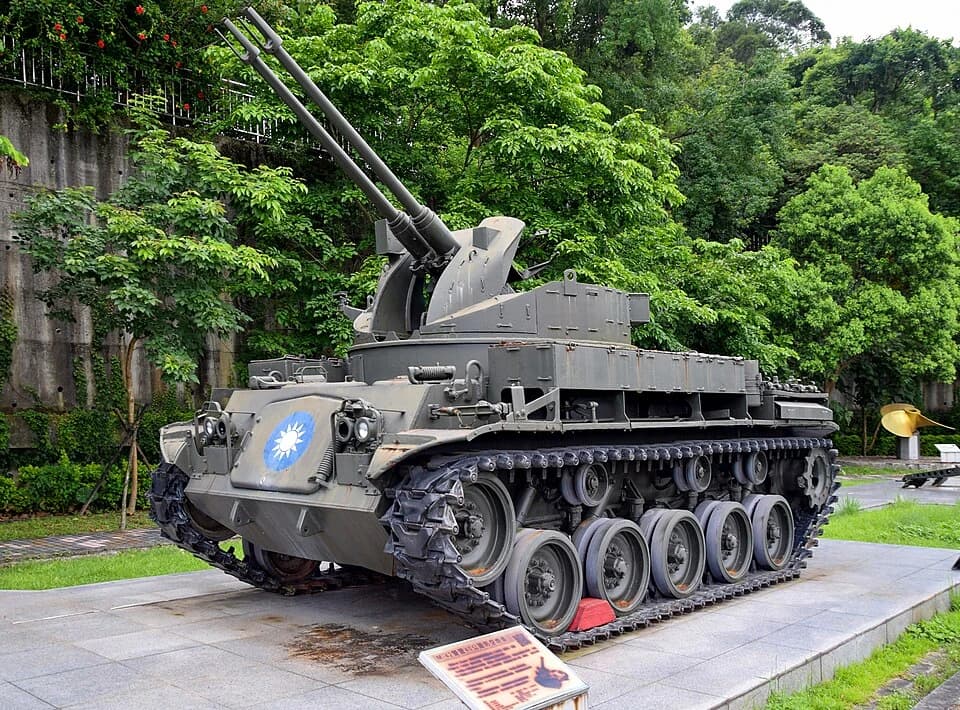
Anti-aircraft gunsIn service
Self-propelled anti-aircraft gun
M42 Duster is a self-propelled anti-aircraft gun originating in United States. It was built by General Motors Corporation. Reported operators include Greece, Taiwan, Thailand, Tunisia, Vietnam.
 United States
Self-propelled anti-aircraft gun
United States
Vietnam War Sino-Vietnamese War Lebanese Civil War 2025 Cambodian–Thai clashes
General Motors Corporation
3,700
24.8 t (loaded)
5.82 m (19 ft 1 in)
3.23 m (10 ft 7 in)
2.85 m (9 ft 4 in)
4–6
9–25 mm
M2A1 40 mm twin anti-aircraft gun with 336 rounds
1 × M1919A4 7.62 mm machine gun or 7.62mm M60 machine gun
6- cylinder air-cooled gasoline 500 hp (375 kW)
22.2 hp/t
torsion bar
160 km (99 mi)
72 km/h (45 mph)
Greece
Taiwan
Thailand
Tunisia
Vietnam
Austria : After the end of the Cold War , all 38 M42A1 Dusters were phased out in 1992.
Japan : Japan Ground Self Defense Force, 22 M42A1 Dusters, retired from service in 1994.
Jordan : Royal Jordanian Army , Phased out - One now sits on the sea bed in Aqaba, acting as a dive attraction and artificial reef.
Lebanon : 15 M42A1 Dusters in service with the Lebanese Army (1958–1984).
Pakistan : Pakistan Army , Phased out
Kingdom of Greece / Greek junta
West Germany : From 1956 on 496 M42 supplied to the air-defence battalion of the divisions, replaced by Flakpanzer Gepard SPAAG starting in 1976.
Turkey : Replaced by a new ASELSAN 35mm Self Propelled Air Defense Gun (Korkut)
United States : US Army, Army National Guard , United States Marine Corps , last units retired in 1988.
Republic of Venezuela : Venezuelan Army, retired from service in 1989
South Vietnam : Were delivered by the US to the South Vietnamese forces in 1973.
North Vietnam : Captured from South Vietnam, who had them after being transferred by the US to the South Vietnamese forces in 1973; was captured and inherited by the Liberation Army as well as the People's Army of Vietnam
The M42 40 mm self-propelled anti-aircraft gun , or Duster , is an American armored light air-defense gun built for the United States Army from 1952 until December 1960, in service until 1988.
The M42 40 mm self-propelled anti-aircraft gun , or Duster , is an American armored light air-defense gun built for the United States Army from 1952 until December 1960, in service until 1988. Production of this vehicle was performed by the tank division of the General Motors Corporation . It used components from the M41 light tank and was constructed of all-welded steel.
A total of 3,700 M42s were built. The vehicle has a crew of six and weighs 22,500 kg (49,500 lb) fully loaded. Maximum speed is 45 mph (72 km/h) with a range of 100 miles (160 km). Armament consists of fully automatic twin 40 mm M2A1 Bofors , with a rate of fire of 2×120 rounds per minute (rpm) enabling nearly 85 seconds of fire time before running out of ammo, and either a .30 caliber Browning M1919A4 or 7.62mm M60 machine gun . The 500 hp, six-cylinder, Continental (or Lycoming Engines ), air-cooled, gasoline engine is located in the rear of the vehicle. It was driven by a cross-drive, two-speed Allison transmission .
During the course of the Korean War , the U.S. Army decided to phase out all vehicles based on the M24 Chaffee chassis, such as the M19 multiple gun motor carriage 40 mm anti-aircraft, in favor of designs that utilized the chassis of the M41. Since the 40 mm guns were still seen as an effective anti-aircraft weapon, a modified version of the gun mount used in the M19 was mounted in a redesigned turret to accommodate the larger turret ring of the M41 and designated as the M42.
The 40 mm guns were initially planned to be aimed with the assistance of a radar fire control system housed in a secondary vehicle of similar design but this idea was scrapped as development costs mounted.
Despite a few early air kills, the air threat posed by North Vietnam never materialized and ADA crews found themselves increasingly involved in ground support missions. Most often the M42 was on point security, convoy escort, or perimeter defense. The Duster was soon found to excel in ground support. The 40 mm guns proved to be effective against massed infantry attacks. According to an article that appeared in Vietnam Magazine :
Although the Duster's 40mm shell had a terrific blast and fragmentation effect, it also had a highly sensitive point-detonating fuse that limited effectiveness in heavy vegetation. Under those conditions, the better weapon was the Quad, because the heavy .50-caliber projectile could easily punch through cover that would detonate the Duster's 40mm shell too early for it to be effective. At long ranges, however the 40mm shell was far more useful, particularly against field formations. The Duster also was able to deliver indirect fires by using data from field artillery fire-directions centers.
Soldiers of the 1-44th Artillery and their Marine counterparts in I Corps set the pattern of Quad and Duster operations. Because of an early scarcity of armored-combat vehicles, M-42s were first used as armor. Often thankful men quickly learned the value of high volumes of 40mm and .50-caliber fire, both in the field and perimeter defenses. Quads beefed up the defenses of remote fire bases, while Dusters accompanied both supply and tactical convoys along contested highways to break up ambushes. Dusters of Battery C, 1-44th Artillery, led the task force of Operations Pegasus that broke the siege of Khe Sanh in April 1968. Dusters and Quads provided critical final-protective fires throughout Vietnam during the Tet offensive and later took part in Operation Lam Son 719. Whenever fire support was needed, M-42s and M-55s could be found.
M42A1 : received the AOSI-895-5 engine (500 hp).
Main armament M2A1 40 mm twin anti-aircraft gun with 336 rounds
Reference text from Wikipedia contributors, used under CC BY-SA 4.0.
True scale
Sourced dimensions beside a 1.75 m human reference.
See it in your room. Scan with your phone to open this model in 3D, then place it in your space.
Points represent sourced observations, including revisions. Revisions on the same effective date are not separate inventory events. Ranges appear in the table and are not plotted as exact points.
| Observation / report period | Value | Source | Claim state |
|---|---|---|---|
| 28 Sept 2026 | 40 mm | Wikipedia contributors | approved |
M42 Duster equipment records. Variants, orders and quantities are shown as reported in each inventory source; coverage is incomplete.
 Greece
 Taiwan
 Thailand
 Tunisia
 Türkiye
 Venezuela
Air Defence Command (CODAI) exact named equipment holdings: M42. Active, operational-reserve and training units excluding equipment in store; November 2025 IISS assessment. Named service only; no parent-force or national total inferred. Source role: AIR DEFENCE / SP 40mm. Original estimates, ranges, reporting names, reserve, lease and employment scopes retained; nested included counts are not added. Missile-system quantities mean launchers, not rounds. No readiness, crew, carried weapon, payload, factory-production or future order count inherited.
 Vietnam
Keep exploring
Self-propelled anti-aircraft gun
Compare with M42 DusterSelf-propelled anti-aircraft gun
 ChinaCompare with M42 Duster
Self-propelled anti-aircraft gun
Compare with M42 DusterSelf-propelled anti-aircraft gun
Compare with M42 DusterSelf-propelled anti-aircraft gun
Compare with M42 DusterSelf-propelled anti-aircraft gun
 South KoreaCompare with M42 Duster