Credit
Hans-Hermann Bühling · CC BY-SA 3.0 · Resized / optimised · CC BY-SA 3.0 · Source ↗ · Modified


Preparing your view.

At a glance
Flakpanzer Gepardlarger figure on 2 of 3
M42 Dusterlarger figure on 1 of 3
Counts only measures both sources give with the same scope. A larger figure is not a better system.
True scale
Side by side. From every angle. A human reference for perspective.
3.37 MB · Loads when you open it| Model | Length | Width / span | Height |
|---|---|---|---|
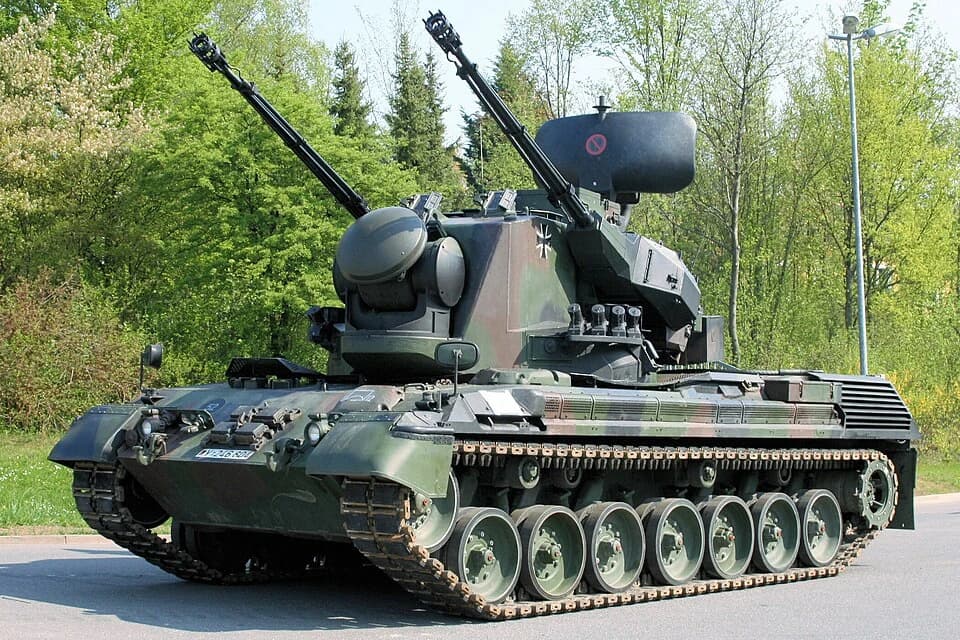
| Flakpanzer Gepard | ≈ 7.68 m | ≈ 3.8 m (Width) | ≈ 3.13 m |
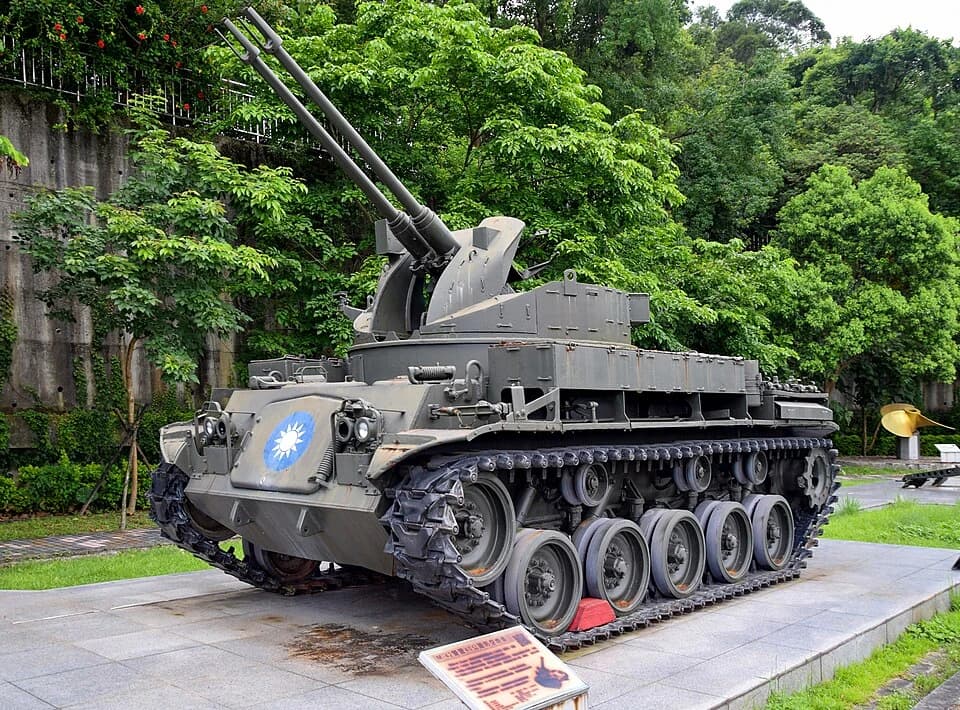
| M42 Duster | ≈ 5.82 m | ≈ 3.23 m (Width) | ≈ 2.93 m |
Scaled uniformly to the sourced length of 7.68 m. Not an official model or a measured survey.
ForceTally · All rights reserved
Scaled uniformly to the sourced length of 5.82 m. The width was fitted to the sourced 3.23 m. Not an official model or a measured survey.
ForceTally · All rights reserved
The human reference is a generic 1.75 m figure. Models describe external size, not combat performance.
Measured figures
Overall
Single sourceOverall: 7.68 m (25 ft 2 in)[source]
Length
Single sourceConfiguration
| Specification | Flakpanzer Gepard | M42 Duster |
|---|---|---|
| Type | Self-propelled anti-aircraft gun[source] | Self-propelled anti-aircraft gun[source] |
| Place of origin | Switzerland West Germany[source] | United States[source] |
| In service | 1976–present[source] | — |
| Used by | See Operators[source] | — |
| Wars | Russo-Ukrainian War[source] |
5.82 m (19 ft 1 in)[source]
Flakpanzer Gepard · primary fitted anti-aircraft gun; bore calibre
Single source35 mm[source]Flakpanzer Gepard · primary fitted anti-aircraft gun; bore calibre
M42 Duster · primary fitted anti-aircraft gun; bore calibre
Single source40 mm[source]M42 Duster · primary fitted anti-aircraft gun; bore calibre
Bars compare reported quantities only. A larger figure does not make a system better; configurations and test conditions differ.
Vietnam War Sino-Vietnamese War Lebanese Civil War 2025 Cambodian–Thai clashes[source] |
| Designer | Oerlikon-Bührle AG (Switzerland) Contraves (Switzerland) Siemens-Albis AG (Switzerland) Krauss-Maffei AG (vehicle - West Germany)[source] | — |
|---|
| Manufacturer | Krauss-Maffei AG (licence production)[source] | General Motors Corporation[source] |
|---|
| Armor | conventional steel[source] | 9–25 mm[source] |
|---|
| Main armament | 2 × 35 mm Oerlikon GDF autocannon , each with 320 rounds anti-air ammunition and 20 rounds anti-tank[source] | M2A1 40 mm twin anti-aircraft gun with 336 rounds[source] |
|---|
| Secondary armament | 2 × quad 76 mm smoke grenade dischargers[source] | 1 × M1919A4 7.62 mm machine gun or 7.62mm M60 machine gun[source] |
|---|
| Power/weight | 17.5 PS/t[source] | 22.2 hp/t[source] |
|---|
| Suspension | Torsion bar suspension[source] | torsion bar[source] |
|---|
| Role | all-weather-capable West German self-propelled anti-aircraft gun (SPAAG)[source] | American armored light air-defense gun[source] |
|---|
| Source measurement | The Gepard was developed during the 1960s as a replacement for the M42 Duster . Two projects were investigated. These were the ‘Matador’ (designed by Rheinmetall , AEG , Siemensi , and Krauss-Maffei ) and the ‘5PFZ-A’ (designed by Oerlikon , Contraves , Siemens-Albis, Hollandse Signaalapparaten and Kraus-Maffei/Porsche ). In 1969, construction began of four A prototypes testing both 30 and 35 mm guns. In June 1970, it was decided to use the 35 mm type. In 1971, twelve second phase B prototypes were ordered. In 1971 the Dutch army ordered a CA preseries of five vehicles based on a parallel development that had used a West German 0-series Leopard 1 vehicle made available by the West German government in March 1970 as the C-prototype.[source]Flakpanzer Gepard · Developmental history; only the objects and conditions stated in this passage The vehicle is based on the hull of the Leopard 1 tank with a large fully rotating turret carrying the armament—a pair of 35 mm Oerlikon KDA autocannons.[source]Flakpanzer Gepard · Technology and systems; only the objects and conditions stated in this passage The Gepard is based on a slightly modified chassis of the Leopard 1 main battle tank, including the complete drive unit with a 37.4-liter 10-cylinder multi-fuel engine (type: MB 838 CaM 500) with two mechanical superchargers. The V-engine with a cylinder angle of 90 degrees has 610 kW at 2200 RPM (830 PS) and consumes—depending on the surface and driving style—around 150 liters per 100 kilometers. To ensure a steady supply of oil, even in difficult terrain and under extreme skew, the engine is provided with a dry sump forced lubrication. Even the gearbox (type: 4 HP-250) from ZF Friedrichshafen and the exhaust system with fresh air admixture to reduce the infrared signature were taken from the Leopard 1 main battle tank.[source]Flakpanzer Gepard · Technology and systems / Chassis and propulsion; only the objects and conditions stated in this passage The Gepard is equipped with a Daimler-Benz (type: OM 314) 4-cylinder diesel auxiliary engine for the energy supply system. This engine is on the front left of the vehicle, located where the Leopard 1 has an ammunition magazine . The engine, which has a 3.8 liter capacity, is designed as a multi-fuel engine and produces 66 kW (90 PS). It consumes between 10 and 20 liters per hour, depending on the operational status of the tank.[source]Flakpanzer Gepard · Technology and systems / Chassis and propulsion; only the objects and conditions stated in this passage The auxiliary engine is coupled with five generators to operate at different speeds: Two Metadyn machines in tandem with a flywheel (which is used to store energy during the acceleration and deceleration of the turret) for the power of the elevation and traverse drives, two 380 Hz three-phase generators with a capacity of 20 kVA for the ventilation, fire-control and radar systems, and a 300 A 28 volt direct current generator for the electrical system. The fuel capacity is 985 liters, which ensures a combined operating time of approximately 48 hours.[source]Flakpanzer Gepard · Technology and systems / Chassis and propulsion; only the objects and conditions stated in this passage The hull only had slight modifications, e.g., a modified roadwheel distance (8 cm increased distance between the third and fourth roadwheel) and the transfer of additional batteries in battery boxes at the rear. The batteries and the electrical system operate at 24 volts DC.[source]Flakpanzer Gepard · Technology and systems / Chassis and propulsion; only the objects and conditions stated in this passage Vehicles delivered to the German Bundeswehr and Belgium were equipped with a Siemens MPDR 12 S-band search radar installed on a swing arm (lowered behind the turret for transit) on the rear of the turret, which provides a 15 km hemispherical detection range and has an integrated MSR 400 Mk XII interrogator for automated target discrimination.[source]Flakpanzer Gepard · Technology and systems / Radar and laser; only the objects and conditions stated in this passage The K u band tracking radar also developed by Siemens-Albis has a 15 km range and is mounted at the front of the turret, between the guns; its dome-covered antenna is mounted on a powered base which can traverse in a 180° arc.[source]Flakpanzer Gepard · Technology and systems / Radar and laser; only the objects and conditions stated in this passage Additionally, the Gepard has a back-up optical sighting system for passive target acquisition and engagement, consisting of two stabilized, panoramic periscopes for both gunner and commander, with a variable magnification (1.5× and a field of view of 50° and 6× magnification with a narrow, 12.5° FOV).[source]Flakpanzer Gepard · Technology and systems / Radar and laser; only the objects and conditions stated in this passage The Gepard utilizes two Oerlikon GDF , 90 calibres (3.15 m (10 ft 4 in)) long, with a muzzle velocity of 1,440 m/s (4,700 ft/s) ( FAPDS (Frangible Armour Piercing Discarding Sabot) rounds), giving an effective range of 5.5 km (3.4 miles). The ammunition is 35×228mm calibre ( STANAG 4516).[source]Flakpanzer Gepard · Technology and systems / Guns; only the objects and conditions stated in this passage Each gun has a firing rate of 550 rounds/min. The combined rate of fire is 1,100 rounds/min, which – in unlimited mode – gives a continuous fire time of 35 seconds before running out of ammunition (with 640 AA rounds for both guns). It is standard to fire bursts against air targets, 24 rounds per gun for a total of 48 in limited mode and 48 rounds per gun for a total of 96 in normal mode. The Ukrainian air defence have found that the guns "take an hour-and-a-half to reload", thus limiting their effectiveness.[source]Flakpanzer Gepard · Technology and systems / Guns; only the objects and conditions stated in this passage Search radar : S band , 15 km range[source]Flakpanzer Gepard · Technology and systems / Variants; only the objects and conditions stated in this passage Tracking radar: K u band , 15 km range[source]Flakpanzer Gepard · Technology and systems / Variants; only the objects and conditions stated in this passage Search radar: X band , 15 km range[source]Flakpanzer Gepard · Technology and systems / Variants; only the objects and conditions stated in this passage Tracking radar: X/ K a band , 13 km range[source]Flakpanzer Gepard · Technology and systems / Variants; only the objects and conditions stated in this passage 55 in active service as of 2025 ; 130 delivered in 2022−2024[source]Flakpanzer Gepard · Operators / Current; only the objects and conditions stated in this passage | The M42 40 mm self-propelled anti-aircraft gun , or Duster , is an American armored light air-defense gun built for the United States Army from 1952 until December 1960, in service until 1988. Production of this vehicle was performed by the tank division of the General Motors Corporation . It used components from the M41 light tank and was constructed of all-welded steel.[source]M42 Duster · Lead; only the objects and conditions stated in this passage A total of 3,700 M42s were built. The vehicle has a crew of six and weighs 22,500 kg (49,500 lb) fully loaded. Maximum speed is 45 mph (72 km/h) with a range of 100 miles (160 km). Armament consists of fully automatic twin 40 mm M2A1 Bofors , with a rate of fire of 2×120 rounds per minute (rpm) enabling nearly 85 seconds of fire time before running out of ammo, and either a .30 caliber Browning M1919A4 or 7.62mm M60 machine gun . The 500 hp, six-cylinder, Continental (or Lycoming Engines ), air-cooled, gasoline engine is located in the rear of the vehicle. It was driven by a cross-drive, two-speed Allison transmission .[source]M42 Duster · Lead; only the objects and conditions stated in this passage During the course of the Korean War , the U.S. Army decided to phase out all vehicles based on the M24 Chaffee chassis, such as the M19 multiple gun motor carriage 40 mm anti-aircraft, in favor of designs that utilized the chassis of the M41. Since the 40 mm guns were still seen as an effective anti-aircraft weapon, a modified version of the gun mount used in the M19 was mounted in a redesigned turret to accommodate the larger turret ring of the M41 and designated as the M42.[source]M42 Duster · Development; only the objects and conditions stated in this passage The 40 mm guns were initially planned to be aimed with the assistance of a radar fire control system housed in a secondary vehicle of similar design but this idea was scrapped as development costs mounted.[source]M42 Duster · Development; only the objects and conditions stated in this passage |
|---|
| No. built | — | 3,700[source] |
|---|
| Former operator · Austria | — | Austria[source] |
|---|
| Former operator · Japan | — | Japan[source] |
|---|
| Former operator · Jordan | — | Jordan[source] |
|---|
| Former operator · Lebanon | — | Lebanon[source] |
|---|
| Former operator · Pakistan | — | Pakistan[source] |
|---|
| Former operator · Kingdom of Greece | — | Kingdom of Greece[source] |
|---|
| Former operator · West Germany | — | West Germany[source] |
|---|
| Former operator · Türkiye | — | Türkiye[source] |
|---|
| Former operator · United States | — | United States[source] |
|---|
| Former operator · Republic of Venezuela | — | Republic of Venezuela[source] |
|---|
| Former operator · South Vietnam | — | South Vietnam[source] |
|---|
| Former operator · North Vietnam | — | North Vietnam[source] |
|---|
| Reported operators | — |
|---|
Despite a few early air kills, the air threat posed by North Vietnam never materialized and ADA crews found themselves increasingly involved in ground support missions. Most often the M42 was on point security, convoy escort, or perimeter defense. The Duster was soon found to excel in ground support. The 40 mm guns proved to be effective against massed infantry attacks. According to an article that appeared in Vietnam Magazine :[source]M42 Duster · Service history / Vietnam War; only the objects and conditions stated in this passage
Although the Duster's 40mm shell had a terrific blast and fragmentation effect, it also had a highly sensitive point-detonating fuse that limited effectiveness in heavy vegetation. Under those conditions, the better weapon was the Quad, because the heavy .50-caliber projectile could easily punch through cover that would detonate the Duster's 40mm shell too early for it to be effective. At long ranges, however the 40mm shell was far more useful, particularly against field formations. The Duster also was able to deliver indirect fires by using data from field artillery fire-directions centers.[source]M42 Duster · Service history / Vietnam War; only the objects and conditions stated in this passage
Soldiers of the 1-44th Artillery and their Marine counterparts in I Corps set the pattern of Quad and Duster operations. Because of an early scarcity of armored-combat vehicles, M-42s were first used as armor. Often thankful men quickly learned the value of high volumes of 40mm and .50-caliber fire, both in the field and perimeter defenses. Quads beefed up the defenses of remote fire bases, while Dusters accompanied both supply and tactical convoys along contested highways to break up ambushes. Dusters of Battery C, 1-44th Artillery, led the task force of Operations Pegasus that broke the siege of Khe Sanh in April 1968. Dusters and Quads provided critical final-protective fires throughout Vietnam during the Tet offensive and later took part in Operation Lam Son 719. Whenever fire support was needed, M-42s and M-55s could be found.[source]M42 Duster · Service history / Vietnam War; only the objects and conditions stated in this passage
M42A1 : received the AOSI-895-5 engine (500 hp).[source]M42 Duster · Variants; only the objects and conditions stated in this passage