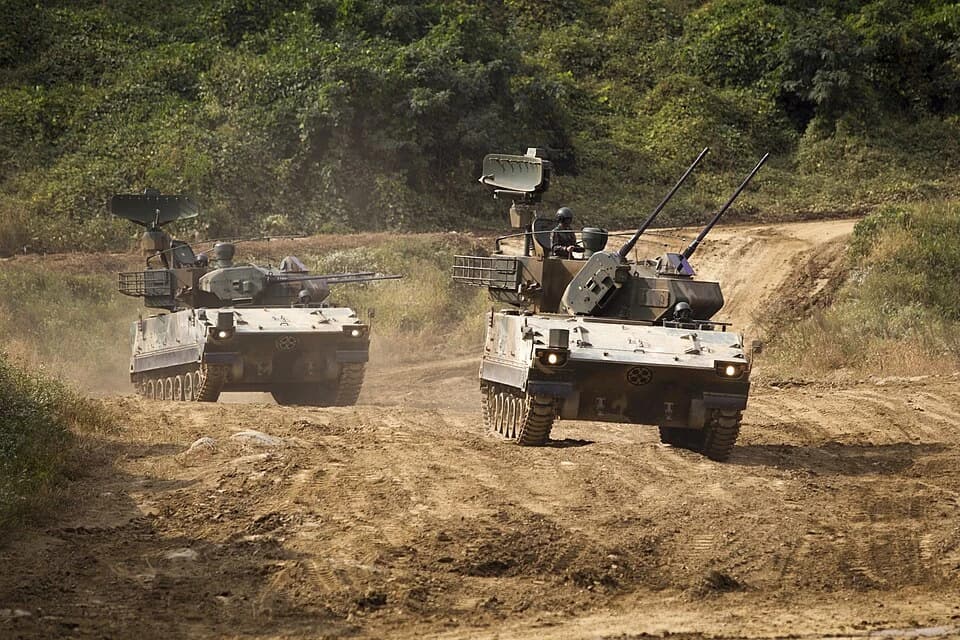

Credit
대한민국 국군 Republic of Korea Armed Forces · CC BY-SA 2.0 · Resized / optimised · CC BY-SA 2.0 · Source ↗ · Modified


Preparing your view.

At a glance
K30 Biholarger figure on 1 of 3
KORKUTlarger figure on 2 of 3
Counts only measures both sources give with the same scope. A larger figure is not a better system.
Measured figures
Length
Single source6.77 meters (22 ft 3 in)[source]
Length
Single sourceConfiguration
| Specification | K30 Biho | KORKUT |
|---|---|---|
| Type | Self-propelled anti-aircraft gun[source] | Self-propelled anti-aircraft gun[source] Self-propelled anti-aircraft gun[source]Korkut SSA 2x 35mm Oerlikon KDC-02[source]Korkut SSA |
| Place of origin | South Korea[source] | Türkiye[source] |
| In service | 1999–present[source] | 2016 – present |
Korkut SSA · Length
Single sourceBars compare reported quantities only. A larger figure does not make a system better; configurations and test conditions differ.
| Used by | See Users[source] | Türkiye Pakistan[source] |
|---|
| Designer | Agency for Defense Development[source] | ASELSAN[source] |
|---|
| Designed | 1983–1991[source] | — |
|---|
| Manufacturer | Hanwha Aerospace LIG Defense & Aerospace[source] | Aselsan and FNSS[source] |
|---|
| Unit cost | 13,3 billion KRW (12.1 million USD)[source] | — |
|---|
| Produced | 1996–present[source] | — |
|---|
| No. built | 176[source] | 13 systems[source] |
|---|
| Main armament | 2 × SNT Dynamics K KCB 30×170 mm autocannon[source] | 35 mm dual-barrelled autocannon (with 400 rounds)[source] |
|---|
| Secondary armament | KP-SAM Chiron MANPADS[source] | Stinger or Igla-S MANPADS[source] |
|---|
| Power/weight | 19.62 hp/t (14.63 kW/t)[source] | — |
|---|
| Transmission | S&T Dynamics HMPT500-3EK/4EK[source] | Automatic[source]Korkut SSA |
|---|
| Suspension | Torsion bar[source] | Torsion bar[source]Korkut SSA |
|---|
| Source measurement | The South Korean K30 Biho ( Korean : 비호, Hanja : 飛虎; literally "Flying Tiger ") twin 30 mm self-propelled anti-aircraft weapon was developed to meet the operational requirements of the Republic of Korea Armed Forces for a highly mobile short range air defense system suited to the operational and terrain conditions of the Korean peninsula. It combines an electro-optically guided 30 mm gun system with a surveillance radar system on a K200 chassis. It supplements the K263A1 Chungung , a self-propelled 20 mm Vulcan system.[source]K30 Biho · Lead; only the objects and conditions stated in this passage The K30 was first announced as a project in 1983 with 600 personnel conducting research and around 10 billion won spent on R&D. In September 2001, the production of prototypes were done under Tong-il Heavy Industries before Doosan Infracore concluded a contract with Korea's Defense Acquisition Program in 2007. An initial order was made in 2002 to supply the K30.[source]K30 Biho · History; only the objects and conditions stated in this passage A K30 Biho system consists of twin KCB 30 mm guns, a TPS-830K surveillance and fire-control radar, an electro-optical targeting system (EOTS), panoramic periscope , forward looking infrared system (FLIR), laser rangefinder (LRF), thermal sight , a TV camera, and a digital fire-control system . The combined targeting system of EOTS, FLIR, and LRF has a targeting range of over 10 km (6.2 mi). The TPS-830K radar can detect and track a 2 m 2 (22 ft 2 )-RCS target from a range of 17 km (11 mi). The cannons have a cyclic rate of fire of 600 rpm and an effective anti-aircraft range of 3,000 m (1.9 mi), and each is loaded with 300 rounds of (30×170 mm KCB) ammunition. In December 2013, DAPA announced that the Biho had been integrated with the Shingung surface-to-air missile to increase its coverage to 7 km. Two pods each containing two missiles are mounted, one of each side of the turret. Design integration with the missiles was completed in 2014, and by October 2015 the system was in full-rate production. The upgraded vehicle was in service by late 2018.[source]K30 Biho · General characteristics; only the objects and conditions stated in this passage The TPS-830K radar of K30 is an X-band (8 to 12.5 GHz) surveillance and fire-control pulse-Doppler radar , specialized for use against low-flying aircraft. Its features include real-time early warning, multiple target detection, an integral L-band (1 to 2 GHz) Identification Friend or Foe (IFF) subsystem, pulse compression, frequency agility, and adaptive moving target indication as an anti-chaff measure. It supplies ballistic computation data to the digital fire-control system to direct the aim of the electro-optical targeting system, which then aligns the 30 mm guns with the target for accurate fire. The radar can be installed on a separate vehicle (usually a 5-ton six-wheeled truck with a self-towed generator unit) to serve as an independent surveillance platform for other short range air defense systems. The secondary FLIR system and laser rangefinder supplements the TPS-830K radar to provide additional targeting means in case the radar is rendered inoperative, or is turned off to retain the element of surprise against aircraft that are equipped with radar warning receivers .[source]K30 Biho · General characteristics; only the objects and conditions stated in this passage The K30 adapts the chassis of the K200 infantry fighting vehicle, but has some differences. It has an extra roadwheel in its suspension and uses a D2840L engine instead of the D2848T engine of the K200, with an increase in engine power from 350 horsepower to 520 horsepower, necessary since the K30 weighs almost twice as much as the K200. Allison Transmission 's X200-5K transmission is likewise replaced by S&T Dynamics ' HMPT500-3EK/4EK to accommodate the more powerful engine. The modified chassis largely retains the protection and amphibious capability of the original chassis.[source]K30 Biho · General characteristics; only the objects and conditions stated in this passage | Designed to replace the aging M42A1 Duster systems of the Turkish Armed Forces , each Korkut system comprises one command and control vehicle and three weapons platforms. Each weapon platform carries a twin 2×35 mm Oerlikon KDC-02 cannon, manufactured under licence by MKEK . Each weapons system can fire up to 1,100 rounds a minute up to a range of 4 km. The command and control vehicle has an effective radar range of 70 km. The Weapon System Vehicle and Command-and-Control Vehicle configurations designed under the Korkut Project are based on the FNSS ACV-30 and is fully amphibious and have the capability of propelling themselves in deep water and rivers.[source]KORKUT · Lead; only the objects and conditions stated in this passage The cannons can fire different types of 35×228 mm ammunitions including Aselsan made ATOM 35mm airburst ammunition.[source]KORKUT · Ammunition; only the objects and conditions stated in this passage ATOM 35mm airburst ammunition ejects tungsten pellets at a predetermined distance. It is a smart ammunition which has a base fuse. Together with the ability of precise time counting and the capability of being programmed during firing by taking muzzle velocity into consideration automatically sets the fuse to detonate the round as it approaches a pre-set distance from the target. Whilst a single pellet is too small to do major damage in itself, the accumulation of damage from multiple strikes is designed to destroy wings and control surfaces, sensors and aerodynamics, causing the target to crash. According to Aselsan, the ammunition is resistant against electromagnetic jamming.[source]KORKUT · Ammunition; only the objects and conditions stated in this passage In June 2025 Aselsan unveiled the KORKUT 100/25 SB, a dedicated counter-drone variant using 25mm AI-guided airburst ammunition; in January 2026 the KORKUT 140/35 successfully engaged an FPV drone in live-fire trials.[source]KORKUT · Ammunition; only the objects and conditions stated in this passage |
|---|
| Wars | — | Second Libyan Civil War Turkish military intervention[source] |
|---|
| Variants | — | Aselsan GOKDENIZ[source] |
|---|
| Traverse | — | 360°[source] 360°[source]Korkut SSA |
|---|
| Role | — | Turkish all-weather-capable 35 mm self-propelled anti-aircraft gun (SPAAG)[source] |
|---|
| Origin | — | Türkiye[source]Korkut SSA |
|---|
| Mount | — | Main guns in turret[source]Korkut SSA |
|---|
| Ammunition | — | 400 rounds in total[source]Korkut SSA 100 rounds ready to fire per gun[source]Korkut SSA |
|---|
| Stabilizer | — | Yes[source]Korkut SSA |
|---|
| Chassis type | — | Tracked chassis, 6 roadwheels[source]Korkut SSA |
|---|
| Layout | — | Drive sprocket front, idler rear[source]Korkut SSA |
|---|
| Amphibious propulsion | — | 2x water jet[source]Korkut SSA |
|---|
| Engine type | — | Diesel[source]Korkut SSA |
|---|
| Power to weight ratio | — | 20.3 hp/t[source]Korkut SSA |
|---|
| Wall | — | 0.8 m[source]Korkut SSA |
|---|
| Trench | — | 2 m[source]Korkut SSA |
|---|
| Gradient | — | 60 %[source]Korkut SSA |
|---|
| Slope | — | 30 %[source]Korkut SSA |
|---|
| Fording | — | Amphibious[source]Korkut SSA |
|---|
| Armor type | — | Steel and aluminum[source]Korkut SSA |
|---|
| Protection level | — | STANAG 4569 level 4 versus small arms[source]Korkut SSA STANAG 4569 level 2 explosives[source]Korkut SSA |
|---|
| Smoke system | — | 2x4 smoke grenade dischargers[source]Korkut SSA |
|---|
| Night vision | — | Yes, for driver[source]Korkut SSA |
|---|
| Fire control | — | Fire control radar, Ku-band[source]Korkut SSA Optical tracker[source]Korkut SSA IFF system[source]Korkut SSA |
|---|
| Radio | — | Yes, including datalink to KKA[source]Korkut SSA |
|---|
| Reported operators |
|---|