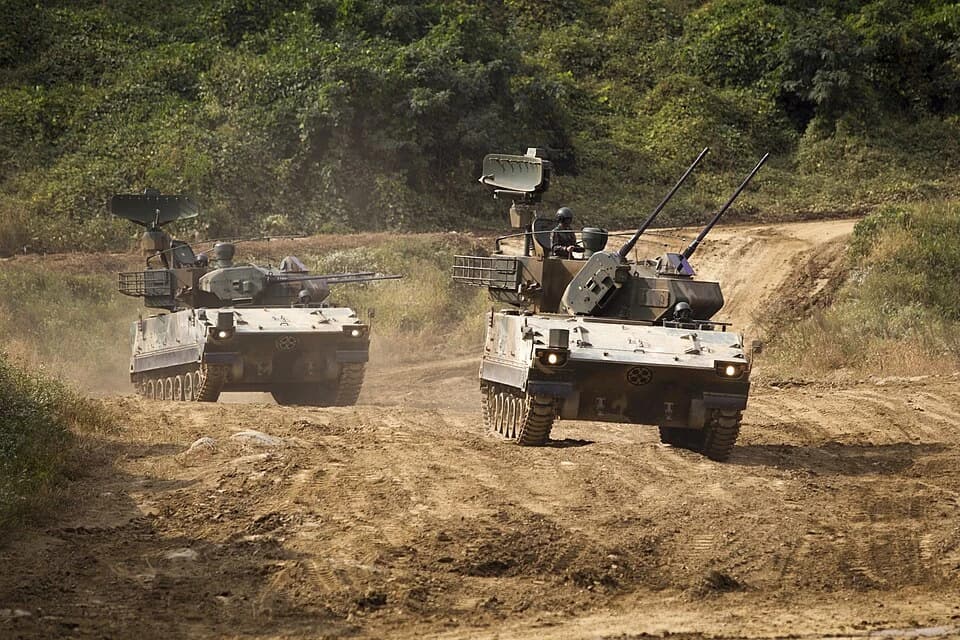

Credit
대한민국 국군 Republic of Korea Armed Forces · CC BY-SA 2.0 · Resized / optimised · CC BY-SA 2.0 · Source ↗ · Modified


Preparing your view.

At a glance
K30 Biholarger figure on 4 of 5
M53/59 Pragalarger figure on 1 of 5
Counts only measures both sources give with the same scope. A larger figure is not a better system.
True scale
Side by side. From every angle. A human reference for perspective.
3.29 MB · Loads when you open it| Model | Length | Width / span | Height |
|---|---|---|---|
| K30 Biho | ≈ 6.77 m | ≈ 3.36 m (Width) | ≈ 4.2 m |
| M53/59 Praga | ≈ 6.92 m | ≈ 2.35 m (Width) | ≈ 3.65 m |
Scaled uniformly to the sourced length of 6.77 m. Not an official model or a measured survey.
ForceTally · All rights reserved
Scaled uniformly to the sourced length of 6.92 m. The width was fitted to the sourced 2.35 m. Not an official model or a measured survey.
ForceTally · All rights reserved
The human reference is a generic 1.75 m figure. Models describe external size, not combat performance.
Measured figures
Length
Single source6.77 meters (22 ft 3 in)[source]
Length
Single sourceConfiguration
| Specification | K30 Biho | M53/59 Praga |
|---|---|---|
| Type | Self-propelled anti-aircraft gun[source] | Self-propelled anti-aircraft gun[source] |
| Place of origin | South Korea[source] | Czechoslovakia[source] |
| In service | 1999–present[source] | 1959−1992 (Czechoslovakia)[source] |
| Used by | See Users[source] | See operators[source] |
6.92 m (22.7 ft)[source]
Operational; Operational range
Single source500 km (310 mi)[source]
per barrel (cyclic)
Single sourceper barrel (practical)
Single source450−500 rpm per barrel (cyclic) 150 rpm per barrel (practical)[source]
Bars compare reported quantities only. A larger figure does not make a system better; configurations and test conditions differ.
| Designer | Agency for Defense Development[source] | — |
|---|
| Designed | 1983–1991[source] | — |
|---|
| Manufacturer | Hanwha Aerospace LIG Defense & Aerospace[source] | Praga[source] Praga[source] Strojárske a metalurgické závody, závod Trenčín-Kubrá (1959–1961) Škoda, n. p., Plzeň[source]M53/59 own native Manufacturer row · original Trenčín-Kubrá 1959–1961 and Škoda Plzeň production, retaining source dates |
|---|
| Unit cost | 13,3 billion KRW (12.1 million USD)[source] | — |
|---|
| Produced | 1996–present[source] | 1959–1978[source] |
|---|
| No. built | 176[source] | 900+[source] |
|---|
| Main armament | 2 × SNT Dynamics K KCB 30×170 mm autocannon[source] | 30 mm twin AA autocannon (600−900 rounds)[source] |
|---|
| Secondary armament | KP-SAM Chiron MANPADS[source] | — |
|---|
| Power/weight | 19.62 hp/t (14.63 kW/t)[source] | 11.57 hp/t (8.63 kW/t)[source] |
|---|
| Transmission | S&T Dynamics HMPT500-3EK/4EK[source] | Manual with 4 forward and 2 reverse gears[source] |
|---|
| Suspension | Torsion bar[source] | — |
|---|
| Source measurement | The South Korean K30 Biho ( Korean : 비호, Hanja : 飛虎; literally "Flying Tiger ") twin 30 mm self-propelled anti-aircraft weapon was developed to meet the operational requirements of the Republic of Korea Armed Forces for a highly mobile short range air defense system suited to the operational and terrain conditions of the Korean peninsula. It combines an electro-optically guided 30 mm gun system with a surveillance radar system on a K200 chassis. It supplements the K263A1 Chungung , a self-propelled 20 mm Vulcan system.[source]K30 Biho · Lead; only the objects and conditions stated in this passage The K30 was first announced as a project in 1983 with 600 personnel conducting research and around 10 billion won spent on R&D. In September 2001, the production of prototypes were done under Tong-il Heavy Industries before Doosan Infracore concluded a contract with Korea's Defense Acquisition Program in 2007. An initial order was made in 2002 to supply the K30.[source]K30 Biho · History; only the objects and conditions stated in this passage A K30 Biho system consists of twin KCB 30 mm guns, a TPS-830K surveillance and fire-control radar, an electro-optical targeting system (EOTS), panoramic periscope , forward looking infrared system (FLIR), laser rangefinder (LRF), thermal sight , a TV camera, and a digital fire-control system . The combined targeting system of EOTS, FLIR, and LRF has a targeting range of over 10 km (6.2 mi). The TPS-830K radar can detect and track a 2 m 2 (22 ft 2 )-RCS target from a range of 17 km (11 mi). The cannons have a cyclic rate of fire of 600 rpm and an effective anti-aircraft range of 3,000 m (1.9 mi), and each is loaded with 300 rounds of (30×170 mm KCB) ammunition. In December 2013, DAPA announced that the Biho had been integrated with the Shingung surface-to-air missile to increase its coverage to 7 km. Two pods each containing two missiles are mounted, one of each side of the turret. Design integration with the missiles was completed in 2014, and by October 2015 the system was in full-rate production. The upgraded vehicle was in service by late 2018.[source]K30 Biho · General characteristics; only the objects and conditions stated in this passage The TPS-830K radar of K30 is an X-band (8 to 12.5 GHz) surveillance and fire-control pulse-Doppler radar , specialized for use against low-flying aircraft. Its features include real-time early warning, multiple target detection, an integral L-band (1 to 2 GHz) Identification Friend or Foe (IFF) subsystem, pulse compression, frequency agility, and adaptive moving target indication as an anti-chaff measure. It supplies ballistic computation data to the digital fire-control system to direct the aim of the electro-optical targeting system, which then aligns the 30 mm guns with the target for accurate fire. The radar can be installed on a separate vehicle (usually a 5-ton six-wheeled truck with a self-towed generator unit) to serve as an independent surveillance platform for other short range air defense systems. The secondary FLIR system and laser rangefinder supplements the TPS-830K radar to provide additional targeting means in case the radar is rendered inoperative, or is turned off to retain the element of surprise against aircraft that are equipped with radar warning receivers .[source]K30 Biho · General characteristics; only the objects and conditions stated in this passage The K30 adapts the chassis of the K200 infantry fighting vehicle, but has some differences. It has an extra roadwheel in its suspension and uses a D2840L engine instead of the D2848T engine of the K200, with an increase in engine power from 350 horsepower to 520 horsepower, necessary since the K30 weighs almost twice as much as the K200. Allison Transmission 's X200-5K transmission is likewise replaced by S&T Dynamics ' HMPT500-3EK/4EK to accommodate the more powerful engine. The modified chassis largely retains the protection and amphibious capability of the original chassis.[source]K30 Biho · General characteristics; only the objects and conditions stated in this passage | The M53/59 Praga is a Czechoslovak self-propelled anti-aircraft gun developed in the late 1950s. It consists of an armoured version of the Praga V3S six-wheel drive truck chassis, armed with a modified version of the M53 twin 30 mm (1.2 in) anti-aircraft gun mounted on the rear, which can be removed and used to provide ground support.[source]M53/59 Praga · Lead; only the objects and conditions stated in this passage The twin guns have an elevation of +85°, and a depression of −10°, except over the crew compartment where the depression is limited to +2° and the commander's cupola where there is none. A steel plate on the back of the crew compartment prevents the gun barrels from hitting the roof. The turret can fully traverse 360° degrees and the traverse, elevation, and depression hydraulic systems can be manually controlled in case of emergency. The gunner is seated on the left side of the turret under the armoured cabin protection.[source]M53/59 Praga · Description; only the objects and conditions stated in this passage The 30 mm twin autocannons are gas-operated , with a maximum rate of fire of 450 to 500 rounds per barrel/minute and a practical rate of fire of 150 rounds per barrel/minute. Each gun has a 50-round magazine which are fed with 10-round clips. Each vehicle typically carries around 600 to 800 rounds. Fully loaded magazines are carried in the back of the crew compartment fastened to the floor by quick-release catches, while three spare magazines are carried on either side of the platform. Originally the guns were fitted with muzzle brakes , but they were later observed with conical flash hiders instead. The barrels can be quickly changed when overheated, and spare barrels were provided to the crews as part of the basic equipment.[source]M53/59 Praga · Description; only the objects and conditions stated in this passage Maximum horizontal range is 9.7 km (6 mi), maximum vertical range is 6.3 km (4 mi), and effective anti-aircraft range is 3 km (2 mi). The M53 guns can fire armor-piercing incendiary rounds capable of penetrating 55 mm (2.2 in) of RHA at a 0° angle at a range of 500 m (550 yd) and high-explosive incendiary rounds. |
|---|
| Wars | — | Gulf War Yugoslav Wars Second Congo War[source] |
|---|
| Shell | — | Armour-piercing incendiary (API) High-explosive incendiary (HEI)[source] |
|---|
| Barrels | — |
|---|
| Action | — | Gas-operated[source] |
|---|
| Elevation | — | -10° – +85°[source] |
|---|
| Traverse | — | 360°[source] |
|---|
| Feed system | — | 50-round box magazines[source] |
|---|
| Armor | — | Steel, 10 mm (0.39 in) max (estimated)[source] |
|---|
| Fuel capacity | — | 120 L (26 imp gal; 32 US gal)[source] |
|---|
| Former operator · Bosnia and Herzegovina | — | Bosnia and Herzegovina[source] |
|---|
| Former operator · Croatia | — | Croatia[source] |
|---|
| Former operator · Czech Republic | — | Czech Republic[source] |
|---|
| Former operator · Czechoslovakia | — | Czechoslovakia[source] |
|---|
| Former operator · Herzeg-Bosnia | — | Herzeg-Bosnia[source] |
|---|
| Former operator · Iraq | — | Iraq[source] |
|---|
| Former operator · Libya | — | Libya[source] |
|---|
| Former operator · Republika Srpska | — | Republika Srpska[source] |
|---|
| Former operator · Serbia and Montenegro | — | Serbia and Montenegro[source] |
|---|
| Former operator · Serbian Krajina | — | Serbian Krajina[source] |
|---|
| Former operator · Slovakia | — | Slovakia[source] |
|---|
| Former operator · Slovenia | — | Slovenia[source] |
|---|
| Former operator · Yugoslavia | — | Yugoslavia[source] |
|---|
| Role | — | Czechoslovak self-propelled anti-aircraft gun[source] |
|---|
| Reported operators |
|
|---|
Maximum; vertical
Single sourceThe system lacks radar guidance, and night vision equipment, which makes it only effective during the day under good weather conditions. Other drawbacks of the M53/59 are the lack of a NBC protection system, no amphibious capabilities, and no central tire pressure regulation system. It also suffers from poor cross-country mobility, preventing effective coordination with tracked vehicles. Despite these drawbacks, the Czechoslovak Army used the M53/59 in place of the Soviet ZSU-57-2 .[source]M53/59 Praga · Description; only the objects and conditions stated in this passage
Praga VS35 M19 − A proposed upgrade by Srboauto in 2019 to meet the requirements of the Serbian Armed Forces . Improvements included a new four-door cab fully armoured to the NATO STANAG 4569 Level 2 standard, fitted with bullet/splinter proof windows on the front and sides and an Eberspächer 8 kW (11 hp) heater installed in the crew compartment.[source]M53/59 Praga · Variants / Serbia; only the objects and conditions stated in this passage
At least one M53/59 was seen in 2012 in the city of Goma . While its exact origin is unknown (possibly from Serbia, Slovakia, or Libya), it is known that the newly reformed DRC Army was armed with weapons left by the former Zairean Army and whatever could be purchased abroad.[source]M53/59 Praga · Combat history / Democratic Republic of Congo; only the objects and conditions stated in this passage