FORCETALLY
Loading the evidence…
Preparing your view.


Preparing your view.
Ballistic missilesIn production
Intercontinental ballistic missile
Hwasong-14 is a intercontinental ballistic missile originating in North Korea. Reported operators include Korean People's Army Strategic Force.
 North Korea
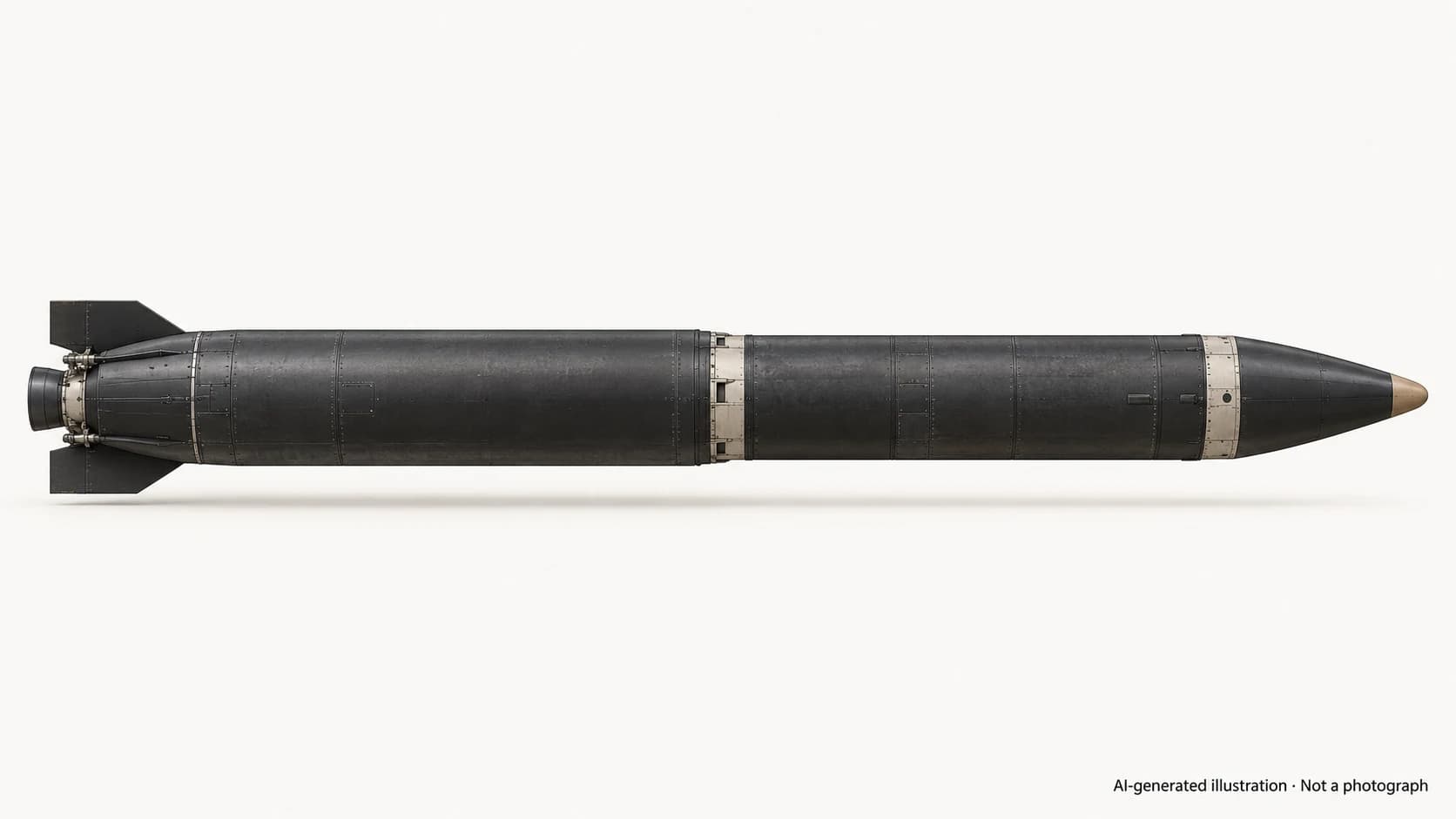
AI-generated illustration · Not a photograph — Representative exterior of Hwasong-14; geometry is illustrative. Not evidence for specifications.
ForceTally · AI-generated illustration · Not a photograph · AI-generated · OpenAI output terms · Source ↗ · ModifiedIntercontinental ballistic missile
North Korea
First successful test on 4 July 2017
Korean People's Army Strategic Force
2017–present
Unknown
31,000–32,000 kg (68,000–71,000 lb)
19.5 m (64 ft)
1.8 m (5.9 ft)
300–500 kg (660–1,100 lb)
Two-stage, liquid-fueled 470 kN (48 tf) (first stage) 40.6 kN (4.14 tf) (second stage)
UDMH/ N 2 O 4
10,000 km (6,200 mi)
3,720 km (2,310 mi) (lofted trajectory)
Road-mobile TEL
《화성-14》형
火 星 14 型
Hwaseong 14-hyeong
Hwasŏng 14-hyŏng
The Hwasong-14 ( Korean : 《화성-14》형 ; lit. ' Mars Type 14 ' ) is a mobile intercontinental ballistic missile developed by North Korea .
The Hwasong-14 is likely a two-stage version of the Hwasong-12 first tested in May 2017. The second stage appears to have increased its range. The first stage engine appears very similar to the Hwasong-12. With a single liquid fuel engine, it has four vernier thrusters for stability and guidance. Based on images, the missile is estimated to be 19.5 m (64 ft) long and 1.8 m (5.9 ft) wide, and has a takeoff mass of 31,000–32,000 kg (68,000–71,000 lb).
A first-generation North Korean nuclear missile warhead is estimated to weigh 500–600 kg (1,100–1,300 lb). Calculations of the range of the Hwasong-14 carrying such a payload vary from 6,000–8,000 km (3,700–5,000 mi), enough to reach Anchorage and Honolulu, Hawaii , to as much as 10,400 km (6,500 mi), enough to reach major U.S. west coast cities, including Seattle and Los Angeles , but with a lighter warhead at 300–500 kg (660–1,100 lb). The 10,400 km (6,500 mi)-range is based on the 200 kg (440 lb) reentry vehicle carried during the July 2017 tests, although such a payload is much lighter than North Korea is believed to be capable of weaponizing.
Michael Elleman of IISS and the Bulletin of the Atomic Scientists both claim that available evidence clearly indicates that the engine is based on the Soviet RD-250 family of engines for the R-36 missile, and has been modified to operate as the boosting force for the Hwasong-12 and -14, which is capable of producing a thrust of 470 kN (48 tf).
Arms expert Jeffrey Lewis claimed that the second stage of Hwasong-14 is similar to the upper stages designed for the Iranian space launch vehicles. According to German expert Norbert Brügge, the second stage engine has a thrust of 40.6 kN (4.14 tf).
The first publicly announced flight test was on 4 July 2017, to coincide with the US Independence Day celebrations. This flight had a claimed range of 933 kilometres (580 miles) eastwards into the Sea of Japan (East Sea of Korea) and reached an altitude of 2,802 km (1,741 mi) during a 39-minute flight.
A prediction for the possible range, following an optimum trajectory, has been given at 6,700 km (4,200 mi) or as much as 10,400 km (6,500 mi) not taking into account the Earth’s rotation. If true, then this brings the U.S. states of Alaska and Hawaii within the missile's range.
Preparations for a second test flight were detected by US intelligence as early as 20 July. On 28 July, the missile was fired at 11:41 p.m local time, the first time a night-time launch was carried out. The missile was fired at a lofted trajectory with apogee of 3,700 km (2,300 mi), landing 998 km (620 mi) away with a total flight time of approximately 47 minutes. Based on the data from the test flight, if the missile were fired at the optimal efficient trajectory, it is predicted that the maximum effective range would exceed 10,000 km (6,200 mi). If factoring in the rotation of the Earth, which may provide a range boost when travelling eastward, the Hwasong-14’s coverage area would include the US West Coast, Chicago, and possibly even New York, but only with a substantially reduced payload.
{"datatype": "wikibase-item", "datavalue": {"type": "wikibase-entityid", "value": {"entity-type": "item", "id": "Q423", "numeric-id": 423}}, "hash": "90a804e79b8cb3c9705de2d18a8f0d3d300d72e1", "property": "P176", "snaktype": "value"}
중량 33.8 톤
길이 19.5 m (63 ft)
지름 1.7 m (5.5 ft)
유도장치 관성항법
Reference text from Wikipedia contributors, used under CC BY-SA 4.0.
True scale
Sourced dimensions beside a 1.75 m human reference.
Points represent sourced observations, including revisions. Revisions on the same effective date are not separate inventory events. Ranges appear in the table and are not plotted as exact points.
| Observation / report period | Value | Source | Claim state |
|---|---|---|---|
| 28 Sept 2026 | 1.8 m | Wikipedia contributors | superseded |
| 28 Sept 2026 | 1.8 m | Wikipedia contributors | superseded |
| 28 Sept 2026 | 1.8 m | Wikipedia contributors | superseded |
| 28 Sept 2026 | 1.8 m | Wikipedia contributors | superseded |
| 29 Sept 2026 | 1.7 m | Wikipedia contributors | approved |
Hwasong-14 equipment records. Variants, orders and quantities are shown as reported in each inventory source; coverage is incomplete.
Keep exploring
Intercontinental ballistic missile
North KoreaIntercontinental ballistic missile
North KoreaIntercontinental ballistic missile
North KoreaIntercontinental ballistic missile
North KoreaIntercontinental ballistic missile
 United States
Intercontinental ballistic missile
United States