FORCETALLY
Loading the evidence…
Preparing your view.


Preparing your view.
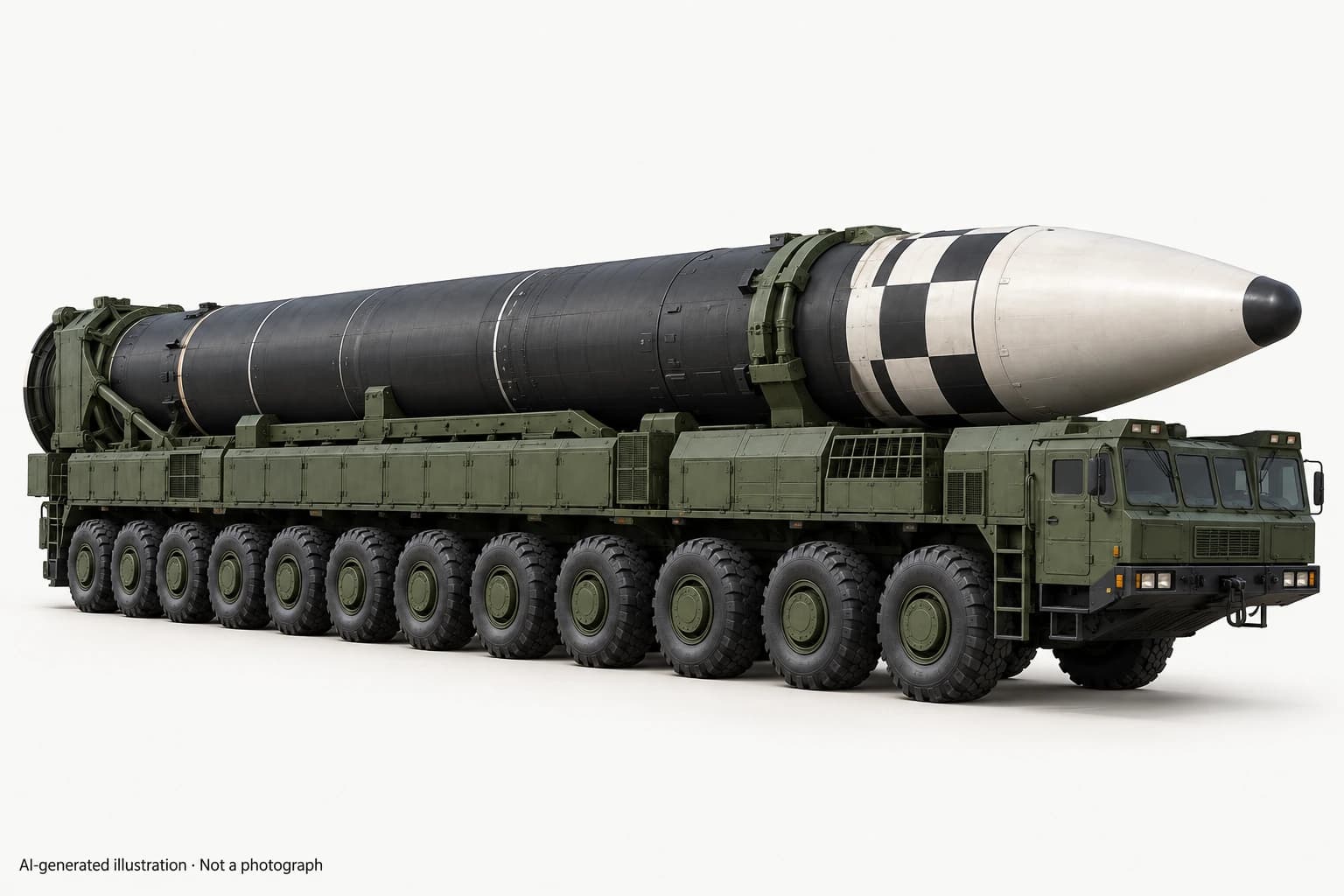
Ballistic missilesIn service
Intercontinental ballistic missile
Hwasong-17 is a intercontinental ballistic missile originating in North Korea. It was built by North Korea. Reported operators include Korean People's Army Strategic Force.
 North Korea
AI-generated illustration · Not a photograph — Representative exterior; geometry is illustrative. Not evidence for specifications.
ForceTally · AI-generated illustration · Not a photograph · AI-generated · OpenAI output terms · Source ↗ · ModifiedIntercontinental ballistic missile
North Korea
2020–present
Korean People's Army Strategic Force
North Korea
2020–present
About 80,000–150,000 kilograms (180,000–330,000 lb)
24–26 m (79–85 ft)
2.4–2.9 metres (7.9–9.5 ft)
nuclear weapon , possibly MRV
About 2,000–3,500 kg (4,400–7,700 lb)
First stage: two RD-250 -type rocket engines
liquid propellant
15,000 km (9,300 mi)
11-axle transporter erector launcher (TEL)
The Hwasong-17 ( Korean : 《화성포-17》형 ; lit. ' Mars Artillery Type 17 ' ) is a North Korean two-stage, liquid-fueled intercontinental ballistic missile .
The Hwasong-17 ( Korean : 《화성포-17》형 ; lit. ' Mars Artillery Type 17 ' ) is a North Korean two-stage, liquid-fueled intercontinental ballistic missile . First unveiled on 10 October 2020 at a military parade, the Japanese Ministry of Defence estimates its operational range at 15,000 km (9,300 mi) or more. Unlike its predecessors, the Hwasong-17 may be capable of carrying multiple warheads. North Korea claimed the Hwasong-17's first successful launch occurred on 24 March 2022. Some Western analysts instead believe the 24 March launch was an earlier missile design, and a later test that took place on 18 November 2022 was the first successful test launch.
Based on images released by North Korea, the missile's mass, length and diameter itself are judged to be about 80,000–150,000 kg (180,000–330,000 lb), 24–26 metres (79–85 ft) and 2.4–2.9 metres (7.9–9.5 ft) respectively.
It has a payload capacity of about 2,000–3,500 kg (4,400–7,700 lb) and can have the capability of carrying multiple independently targetable reentry vehicle (MIRV) with three to four warheads and decoys as well, which would be a less expensive way to launch multiple warheads than deploying many ICBMs with single warhead payloads.
Information from Japan's defense minister Yasukazu Hamada and from the March 2022 test-fire suggests that the Hwasong-17's operational range of the Hwasong-17 is 15,000 km (9,300 mi) or more, if mounted with a sufficiently light warhead. Ankit Panda of the Carnegie Endowment for International Peace agreed that if the successful November missile test had been fired at the US instead of up into the air, it could easily reach anywhere in the continental United States. An alleged unsuccessful test-flight occurred on 2 November 2022 had suggested the Hwasong-17 might be unreliable. As of November 2022, it is unknown how much a large (for example, MRV) warhead would reduce Hwasong-17 range, and it is also unknown whether North Korean ICBM technology has the ability to deliver a warhead that survives re-entry into the atmosphere.
While the ICBM configuration of Hwasong-17 can deliver a 400 kg (880 lb) payload to a 500 km (310 mi) Low Earth orbit , the payload capacity can be increased if North Korea configures it to be an SLV, making it a medium-lift launch vehicle .
Length 24-26 m
Diameter 2.4-2.5 m
Range 15,000 km
중량 80,000–150,000 kg
길이 24–26 m
지름 2.4–2.9 m
유도장치 관성항법
Range: 15,000km~
Range: 5,500km~
Range: 14,000km~
Range: 15,000km~
Range: 5,500km~
Range: 14,000km~
Reference text from Wikipedia contributors, used under CC BY-SA 4.0.
Additional sources
Hwasong-17 at a Glance · Diameter · fully fueled
Single sourceHwasong-17 at a Glance · Range · estimated operational
Single sourceTrue scale
Sourced dimensions beside a 1.75 m human reference.
Points represent sourced observations, including revisions. Revisions on the same effective date are not separate inventory events. Ranges appear in the table and are not plotted as exact points.
| Observation / report period | Value | Source | Claim state |
|---|---|---|---|
| 28 Sept 2026 | 2.4–2.9 m | Wikipedia contributors | superseded |
| 28 Sept 2026 | 2.4–2.9 m | Wikipedia contributors | superseded |
| 28 Sept 2026 | 2.4–2.9 m | Wikipedia contributors | superseded |
| 28 Sept 2026 | 2.4–2.9 m | Wikipedia contributors | superseded |
| 29 Sept 2026 | 2.4–2.9 m | Wikipedia contributors | approved |
Hwasong-17 equipment records. Variants, orders and quantities are shown as reported in each inventory source; coverage is incomplete.
Keep exploring
Intercontinental ballistic missile
North KoreaIntercontinental ballistic missile
North KoreaIntercontinental ballistic missile
 United States
Intercontinental ballistic missile
United StatesIntercontinental ballistic missile
Intercontinental Ballistic Missile
 Russia