FORCETALLY
Loading the evidence…
Preparing your view.


Preparing your view.
Ballistic missilesIn service
Intercontinental ballistic missile
Hwasong-18 is a intercontinental ballistic missile originating in North Korea. It was built by North Korea.
 North Korea
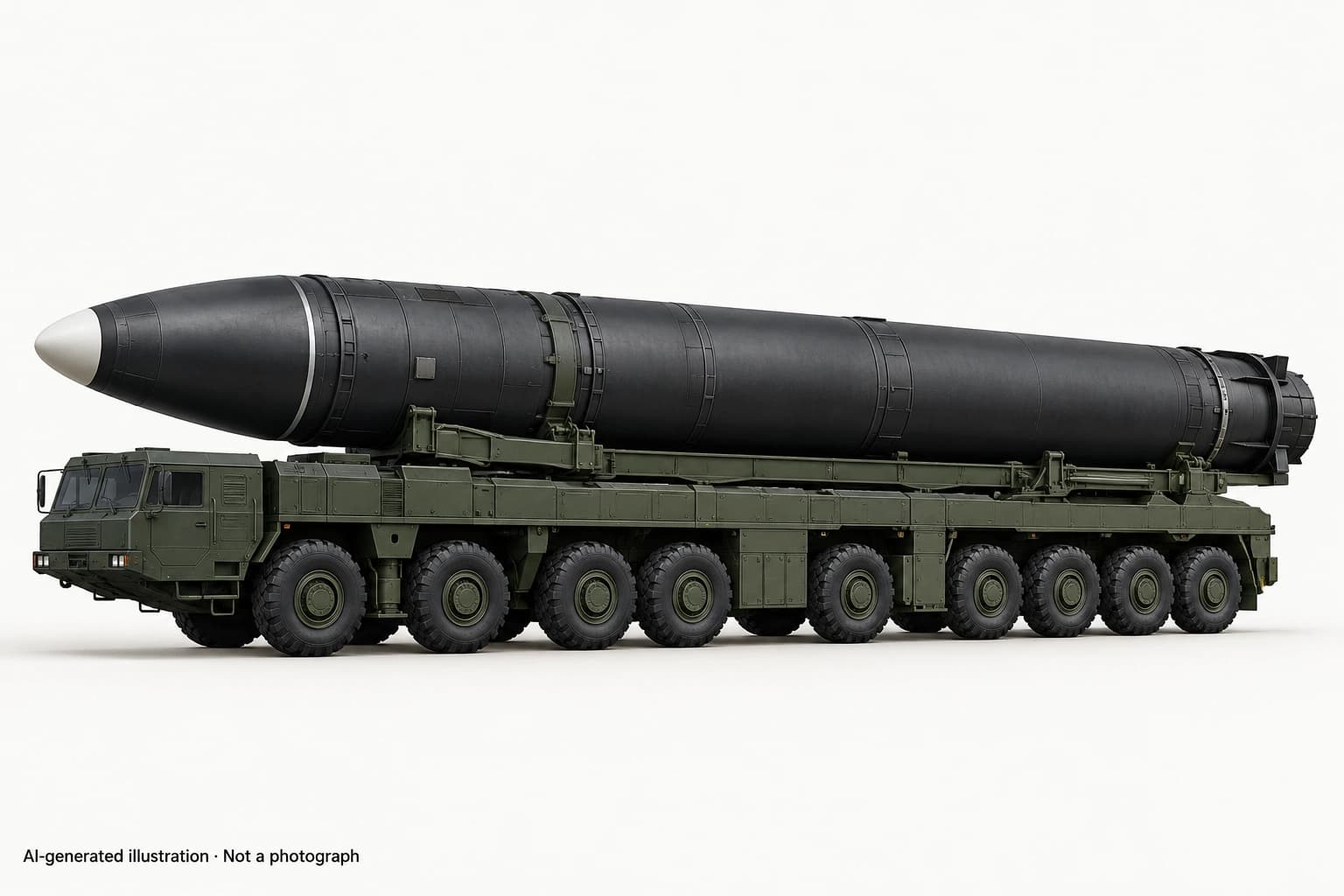
AI-generated illustration · Not a photograph. Representative rendering based on the page’s sourced specifications; exterior details are illustrative.
ForceTally · AI-generated illustration · Not a photograph · AI-generated · OpenAI output terms · Source ↗ · ModifiedTechnical data
Intercontinental ballistic missile
North Korea
2023–present
Korean People's Army Strategic Force
North Korea
2023–present
Unknown
55–60 tons (estimated)
25 m (82 ft) (estimated)
2.1 m (6 ft 11 in) (estimated)
nuclear weapon , possibly MIRV
three stage solid fuel rocket motor 100 tf (980 kN)
solid fuel
15,000 km (9,300 mi)
6,648 km (4,131 mi) (lofted trajectory)
9-axle transporter erector launcher
화성포-18형
火星砲18型
Mars Artillery Type 18
Hwaseongpo-18hyeong
Hwasŏngp'o-18hyŏng
The Hwasong-18 ( Korean : 《화성포-18》형 ; lit. ' Mars Artillery Type 18 ' ) is a North Korean three-stage solid-fuelled intercontinental ballistic missile (ICBM).
Hwasong-18 is the first solid-fueled ICBM developed by North Korea. Released information and images indicate that Hwasong-18 is a three-stage, solid-fueled missile, cold-launched on an 9-axle transporter erector launcher . It is estimated to be 25 m (82 ft) long, 2.1 m (6 ft 11 in) wide, and has a body mass of about 55–60 tons. A solid-fueled missile, its launch is more difficult to preempt than previous liquid-fueled missiles , as it does not require hours of fueling and is easier to conceal since it does not require as many accompanying support vehicles. The missile is nuclear-capable and can accommodate multiple independently targetable reentry vehicle (MIRV).
It is estimated to be 25 m (82 ft) long, 2.1 m (6 ft 11 in) wide, and has a body mass of about 55–60 tons.
Information from the 12 July 2023 test suggests that the Hwasong-18 can travel 15,000 km (9,300 mi) on an operational trajectory, enough to reach anywhere in the continental United States .
According to arms expert Jeffrey Lewis , the Hwasong-18's engine has a thrust of 100 tf (980 kN).
North Korean leader Kim Jong Un first alluded to the development of a solid-fuel ICBM in January 2021 when it was included as part of a five-year arms development plan. A static ground test of a large solid-propellant rocket motor was conducted on 15 December 2022 which produced a thrust of 140 metric tons of force.
The Hwasong-18's maiden flight test was carried out on 13 April 2023. The first stage followed a standard trajectory optimized for reaching maximum range, but the second and third stages pulled up into a highly- lofted trajectory ; this unusual flight path caused Japan to issue a missile alarm, as during the first stage burn it appeared that the missile could overfly the country. North Korea test-fired Hwasong-18 for the second time on 12 July 2023 and became the longest flight time and highest apogee of any North Korean ICBM flight as of launch date (nearly 75 minutes and 6,648 km (4,131 mi) apogee).
Length 25-26.95 m
Diameter 2.0 m
Range 15,000 km
The Hwasong-18 is a North Korean solid-fueled, intercontinental ballistic missile (ICBM). It has a three-stage booster and is cold-launched, with a stated range of over 15,000 km. It is North Korea’s first solid-fueled ICBM.
Lenkung Trägheitsnavigationssystem
Reference text from Wikipedia contributors, used under CC BY-SA 4.0.
Additional sources
Hwasong-18 at a Glance · Range · estimated
Single sourceTrue scale
Sourced dimensions beside a 1.75 m human reference.
Points represent sourced observations, including revisions. Revisions on the same effective date are not separate inventory events. Ranges appear in the table and are not plotted as exact points.
| Observation / report period | Value | Source | Claim state |
|---|---|---|---|
| 28 Sept 2026 | 2.1 m | Wikipedia contributors | superseded |
Hwasong-18 equipment records. Variants, orders and quantities are shown as reported in each inventory source; coverage is incomplete.
Keep exploring
Intercontinental ballistic missile
North KoreaIntercontinental ballistic missile
 United States
Intercontinental ballistic missile
United StatesIntercontinental ballistic missile
Intercontinental Ballistic Missile
 Russia
Intercontinental ballistic missile
Russia