FORCETALLY
Loading the evidence…
Preparing your view.


Preparing your view.
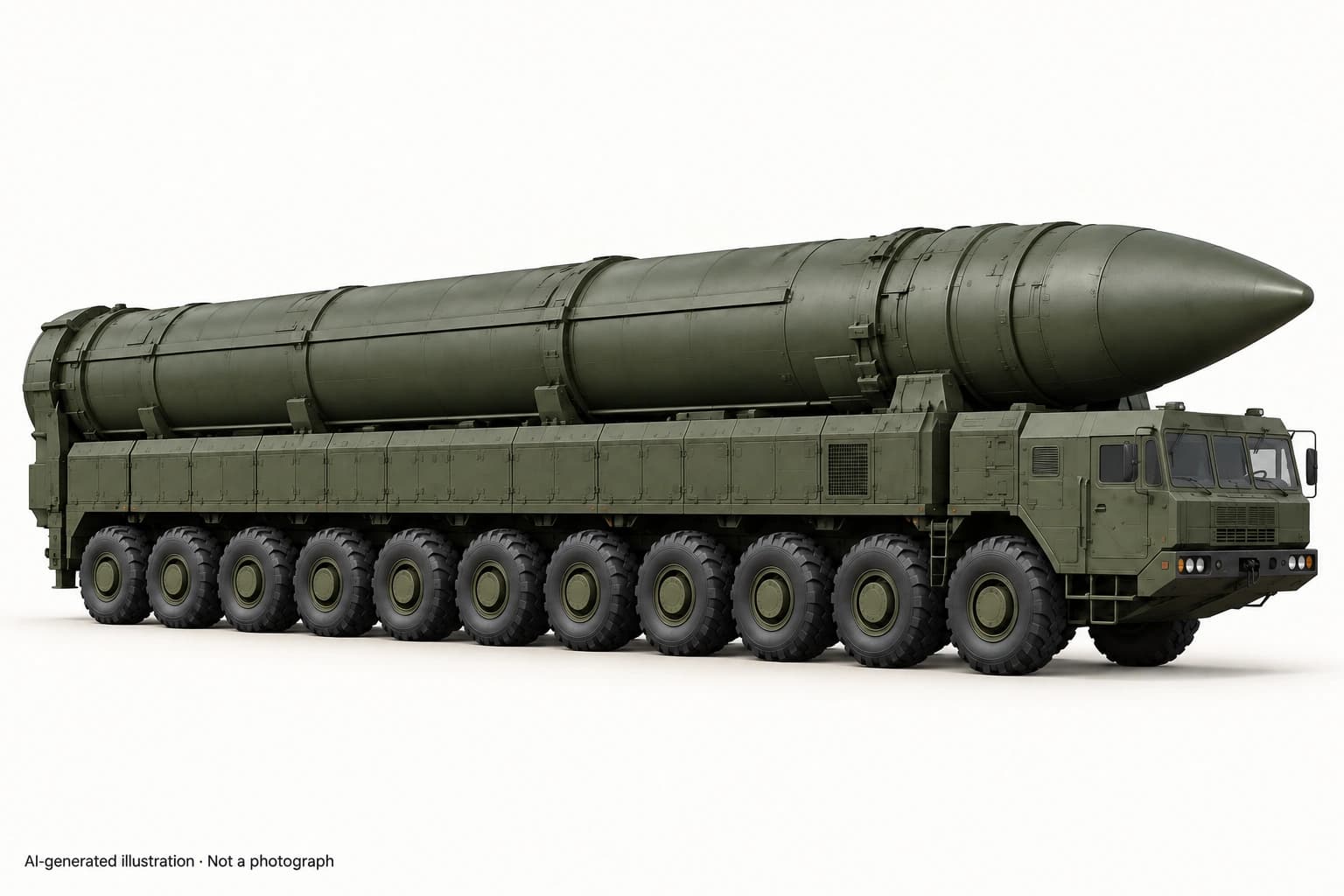
Ballistic missilesIn service
Intercontinental ballistic missile
Hwasong-19 is a intercontinental ballistic missile originating in North Korea. It was built by North Korea. Reported operators include Korean People's Army Strategic Force.
 North Korea
AI-generated illustration · Not a photograph. Representative rendering based on the page’s sourced specifications; exterior details are illustrative.
ForceTally · AI-generated illustration · Not a photograph · AI-generated · OpenAI output terms · Source ↗ · ModifiedIntercontinental ballistic missile
North Korea
2024–present
Korean People's Army Strategic Force
North Korea
At least 80,000 kg (180,000 lb)
At least 28 m (92 ft)
Nuclear warhead MIRV -capable
solid-fueled (all three stages)
At least 15,000 km (9,300 mi)
11-axle transporter erector launcher (TEL)
The Hwasong-19 ( Korean : 《화성포-19》형 ; lit. ' Mars Artillery Type 19 ' ) is a North Korean solid-fueled intercontinental ballistic missile (ICBM).
Its body is longer and wider than the Hwasong-18 , allowing the missile to have more propellant than its predecessor, causing its flight time and apogee to increase by 13 minutes and 1,100 km (680 mi), respectively during its first flight test.
Its long range, which is estimated to be at least 15,000 km (9,300 mi), allows it to reach targets anywhere in the contiguous United States .
The Hwasong-19's length and launch mass is estimated to be at least 28 m (92 ft) and 80,000 kg (180,000 lb), respectively, with the former being longer than Hwasong-18 and Russia 's mobile ICBMs. However, its large size could limit its deployment area and mobility, making it vulnerable to detection by US and South Korean intelligence before it can be fired and making it a priority target for enemy's preemptive strikes.
According to information released by North Korean state media in September 2025, the future modified version of Hwasong-19 will use a new solid-fueled engine, which produces a thrust of 1,960–1,971 kN (199.9–201.0 tf). This engine, which underwent eight static firing tests between 2023 and 2 September 2025, is also used by the newer Hwasong-20 . It has about 40 percent more thrust than the Hwasong-18. Analysts allege it can be modified for reconnaissance satellite launches.
Length 28 m
Range Tested range 1,000 km, operational unknown
誘導方式 慣性誘導 + GNSS (推定)
지름 3m
지름 3m
지름 3m
Reference text from Wikipedia contributors, used under CC BY-SA 4.0.
True scale
Sourced dimensions beside a 1.75 m human reference.
Points represent sourced observations, including revisions. Revisions on the same effective date are not separate inventory events. Ranges appear in the table and are not plotted as exact points.
| Observation / report period | Value | Source | Claim state |
|---|---|---|---|
| 29 Sept 2026 | 3 m | Wikipedia contributors | superseded |
| 29 Sept 2026 | 3 m | Wikipedia contributors | superseded |
| 29 Sept 2026 | 3 m | Wikipedia contributors | approved |
Hwasong-19 equipment records. Variants, orders and quantities are shown as reported in each inventory source; coverage is incomplete.
Keep exploring
Intercontinental ballistic missile
 United States
Intercontinental ballistic missile
United StatesIntercontinental ballistic missile
Intercontinental Ballistic Missile
 Russia
Intercontinental ballistic missile
RussiaIntercontinental ballistic missile