FORCETALLY
Loading the evidence…
Preparing your view.


Preparing your view.
Ballistic missilesIn production
Intercontinental ballistic missile
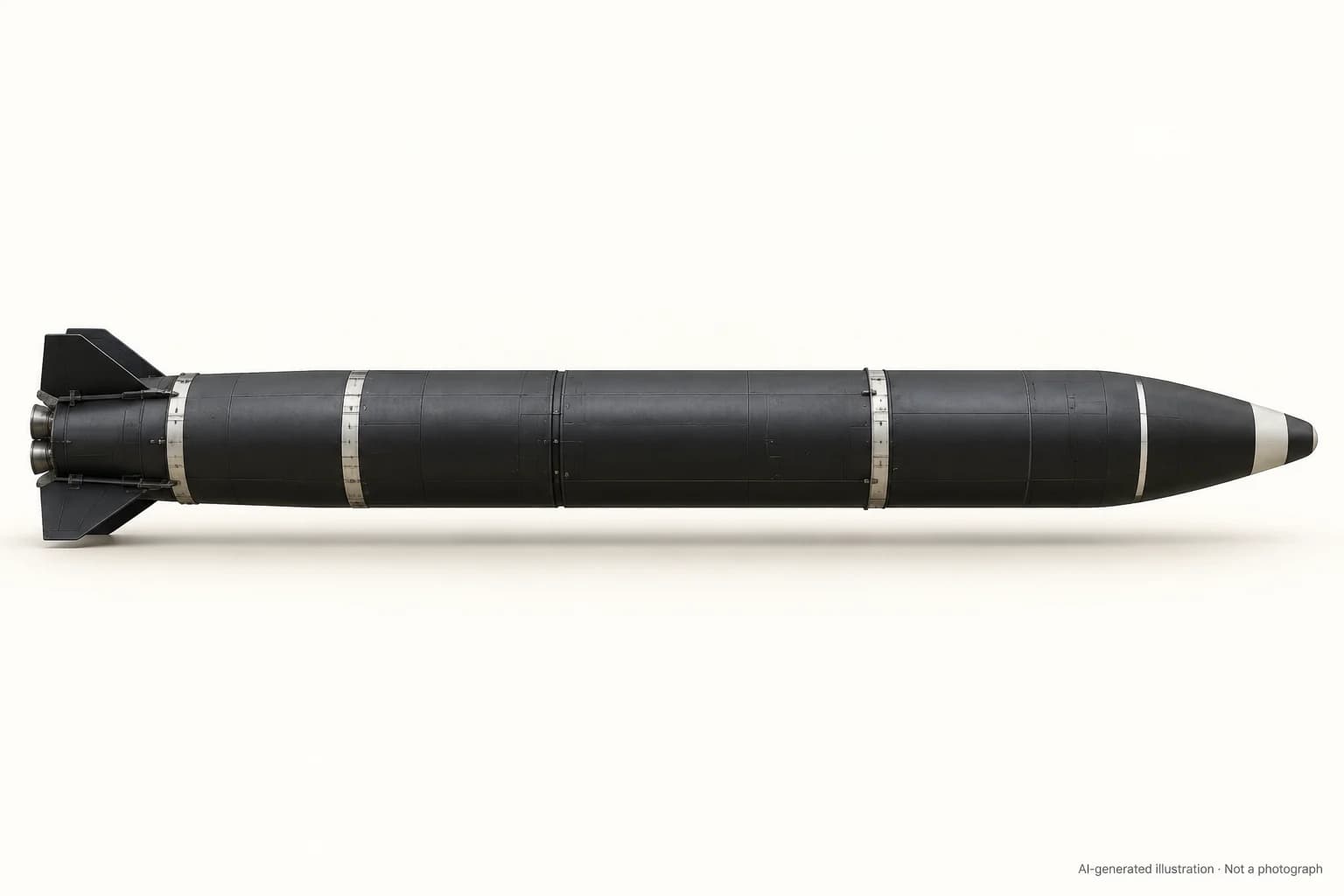
Hwasong-15 is a intercontinental ballistic missile originating in North Korea. It was built by North Korea. Reported operators include Korean People's Army Strategic Force.
 North Korea
AI-generated illustration · Not a photograph. Representative exterior illustration; details are illustrative and do not establish specifications.
ForceTally · AI-generated illustration · Not a photograph · AI-generated · OpenAI output terms · Source ↗ · ModifiedIntercontinental ballistic missile
North Korea
Korean People's Army Strategic Force
North Korea
2017–present
Unknown
About 72,000 kg (159,000 lb)
22.5 m (74 ft)
2.4 m (7 ft 10 in)
nuclear weapon , possibly MIRV
1,000 kg (2,200 lb)
1 Paektusan (potentially RD-250) 788 kN (177,000 lbf)
N 2 O 4 / UDMH
13,000 km (8,100 mi) (estimated)
4,500 km (2,800 mi) (lofted trajectory)
9-axle transporter erector launcher (TEL)
《화성-15》형
火星15型
Mars Type 15
Hwaseong-15hyeong
Hwasŏng-15hyŏng
The Hwasong-15 ( Korean : 《화성-15》형 ; lit. ' Mars Type 15 ' ) is a North Korean road-mobile, liquid-fueled intercontinental ballistic missile .
Judged from images released by North Korea, the Hwasong-15 is 22.5 m (74 ft) in length, 2.4 m (7 ft 10 in) wide and has a body mass of about 72,000 kg (159,000 lb). It is longer and wider than Hwasong-14 by 2 m (6 ft 7 in) and 0.4–0.8 m (1 ft 4 in – 2 ft 7 in), respectively.
Based on its trajectory and distance, the missile would have a range of more than 13,000 km (8,100 mi) – more than enough to reach Washington D.C. and the rest of the United States, albeit, according to the Union of Concerned Scientists , probably with a reduced payload. Several important US allies, including the United Kingdom , France and Australia , also lie within the missile's theoretical range, which covers most of Earth's land masses except South America , the Caribbean , and the majority of Antarctica . However, in the first flight, North Korea fired Hwasong-15 using lofted trajectory, in which the missile can reach nearly 4,500 km (2,800 mi) apogee, but also has a reduced range of 950 km (590 mi).
According to missile specialist Norbert Brügge, the missile uses the Paektusan ( 백두산 ) engine, the first stage of the two-stage missile uses an RD-250 clone liquid propulsion system developed by Pyongyang, comprising two combustors fed by common turbopump to increase takeoff thrust. The new propulsion is estimated to have 788 kN (177,000 lbf) thrust, a 170 percent increase compared to the Hwasong-14.
On 29 November 2017, Michael Elleman wrote for 38 North that at 13,000 km (8,100 mi), the payload would be around 150 kg (330 lb), based on flight data of the test and conjectured it was a reconfigured Hwasong-14. On 30 November, after the publication of the images and video of the launch, he wrote a subsequent article on 38 North in which he stated that he first visualized the design of the missile based solely on flight data. After seeing the images and video, Elleman increased the maximum estimate of payload from 150 kg (330 lb) to 1,000 kg (2,200 lb) at a range of 13,000 km (8,100 mi). He noted major differences in the design of the actual Hwasong-15 and the missile he visualized the day before, from the dimensions to two nozzles/engine instead of one, such as on the Hwasong-14.
North Korea launched what appears to be an ICBM on 3 November 2022 from the Sunan area toward the east. Initially, South Korea assumed the missile to be a Hwasong-17 . It reached a maximum speed of Mach 15 (18,400 km/h; 11,400 mph), flew 750 km (470 mi) and achieved an altitude of about 2,000 km (1,200 mi). The 30-minute flight ended after disappearing from the radar before going over Japan. It could be a failure as the second stage likely failed after separation before falling into the sea. Japan issued alerts to residents in Miyagi , Yamagata and Niigata prefectures under the J-Alert system as they assessed that the missile could overfly the country on a trajectory toward the Pacific Ocean, although later reports indicated it did not cross Japan.
Length 21 – 22.5 m
Diameter 2.0 – 2.4 m
Range 8,500 – 13,000 km
Lenkung Trägheitsnavigationssystem
Reference text from Wikipedia contributors, used under CC BY-SA 4.0.
True scale
Sourced dimensions beside a 1.75 m human reference.
Points represent sourced observations, including revisions. Revisions on the same effective date are not separate inventory events. Ranges appear in the table and are not plotted as exact points.
| Observation / report period | Value | Source | Claim state |
|---|---|---|---|
| 28 Sept 2026 | 2.4 m | Wikipedia contributors | superseded |
| 28 Sept 2026 | 2.4 m | Wikipedia contributors | superseded |
| 28 Sept 2026 | 2.4 m | Wikipedia contributors | approved |
Hwasong-15 equipment records. Variants, orders and quantities are shown as reported in each inventory source; coverage is incomplete.
Keep exploring
Intercontinental ballistic missile
North KoreaIntercontinental ballistic missile
North KoreaIntercontinental ballistic missile
North KoreaIntercontinental ballistic missile
 United States
Intercontinental ballistic missile
United StatesIntercontinental ballistic missile