FORCETALLY
Loading the evidence…
Preparing your view.


Preparing your view.
Military space systemsIn service
communication satellite
XTAR-EUR is a communication satellite. Reported operators include Hisdesat.
 Spain /
 United States
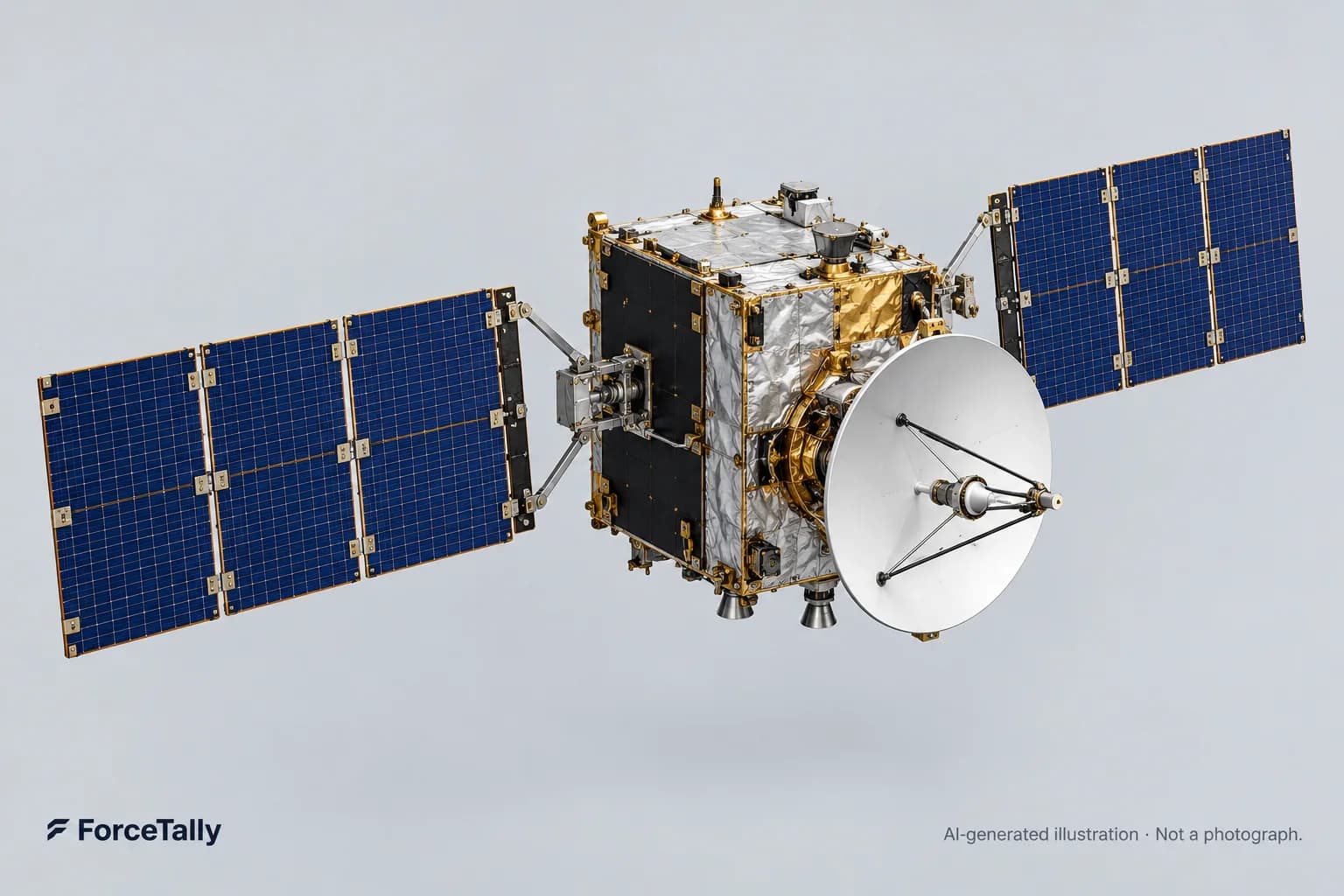
AI-generated illustration · Not a photograph · XTAR-EUR military communications satellite. Exterior details are illustrative and are not specification evidence.
ForceTally · AI-generated illustration · Not a photograph. Created from the sourced exact XTAR-EUR designation and exterior description; no input photograph. · ForceTally · All rights reserved · Source ↗ · ModifiedHisdesat
2005-005A
28542
SSL 1300
The XTAR-EUR is a communication satellite developed by Spain and the United States and in order to provide a secure channel over the Indian Ocean .
The satellite is based on the Space Systems/Loral LS-1300 model . Consequently, it is shaped like a box (5.4 x 2.9 x 2.2 m) with a total weight of 1412 kg (3631 kg at launch). The sides of the box contain two retractable solar panels (providing up to 3.6 kW of power) while the lower base (facing anti-radial direction) holds the communication module. This module operates on the X band (compatible with SATCOM systems employed by NATO ) and consists of 12 X-band transponders of 72 MHz broadband each (reserving 4 for usage by the Spanish Ministry of Defense while offering the other 8 for potential partners) and a 2.4 diameter antenna . The system allows both RHCP and LHCP polarization while covering an area of 6,3095 m 2 RCS (2 global beams from Eastern Brazil and the Atlantic Ocean , across all of Africa and the Middle East to as far east as Singapore , 1 beam across the Mediterranean Sea and 4 steerable beams with the possibility of overlapping). Additional systems provide 3-axis inflight stability.
Its orbit is geostationary (GEO) 29º East , around 35,800 km high (35,782.6 km of perigee and 35,803.7 km of apogee ) with 0º of inclination , a period of 1,436.1 minutes and a semi-major axis of 42,164 km.
The XTAR-EUR is a communication satellite developed by Spain and the United States and in order to provide a secure channel over the Indian Ocean .
Consequently, it is shaped like a box (5.4 x 2.9 x 2.2 m) with a total weight of 1412 kg (3631 kg at launch).
Consequently, it is shaped like a box (5.4 x 2.9 x 2.2 m) with a total weight of 1412 kg (3631 kg at launch).
Consequently, it is shaped like a box (5.4 x 2.9 x 2.2 m) with a total weight of 1412 kg (3631 kg at launch).
The sides of the box contain two retractable solar panels (providing up to 3.6 kW of power) while the lower base (facing anti-radial direction) holds the communication module.
The XTAR-EUR is a communication satellite developed by Spain and the United States and in order to provide a secure channel over the Indian Ocean .
{"datatype": "wikibase-item", "datavalue": {"type": "wikibase-entityid", "value": {"entity-type": "item", "id": "Q571107", "numeric-id": 571107}}, "hash": "e564f897fce7c96a0c92bc5c89101217c955aa67", "property": "P176", "snaktype": "value"}
Reference text from Wikipedia contributors, used under CC BY-SA 4.0.
XTAR-EUR equipment records. Variants, orders and quantities are shown as reported in each inventory source; coverage is incomplete.
SpainSpace exact named equipment holdings: Xtar-Eur. Active, operational-reserve and training units excluding equipment in store; November 2025 IISS assessment. Named service only; no parent-force or national total inferred. Source role: SATELLITES / COMMUNICATIONS. Original estimates, ranges, reporting names, reserve, lease and employment scopes retained; nested included counts are not added. Missile-system quantities mean launchers, not rounds. No readiness, crew, carried weapon, payload, factory-production or future order count inherited.
 Russia
 India