FORCETALLY
Loading the evidence…
Preparing your view.


Preparing your view.
Military space systemsIn service
Earth observation Reconnaissance Intelligence
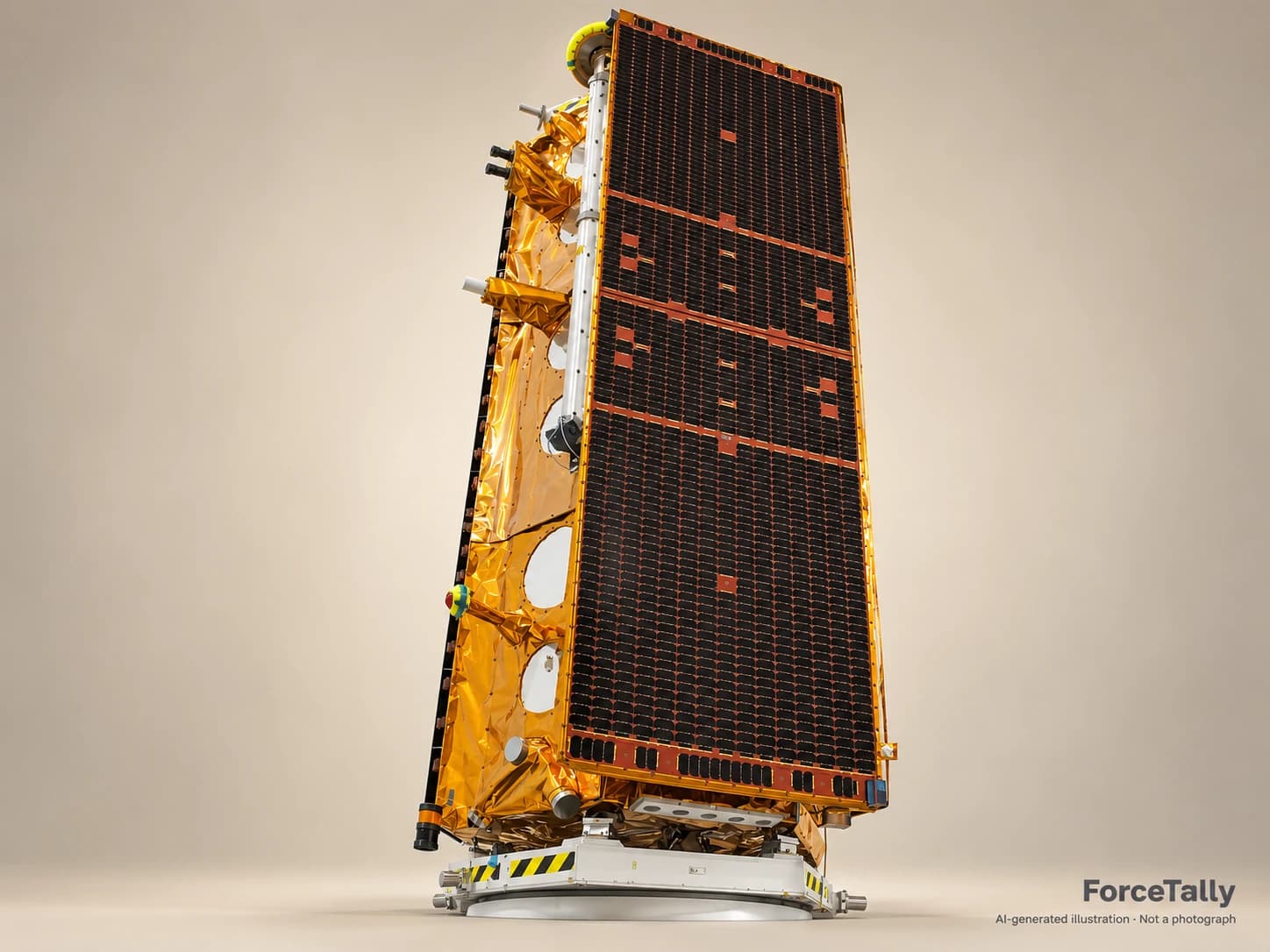
Paz (satellite) is a earth observation Reconnaissance Intelligence originating in Spain. It was built by Airbus Defence and Space. Reported operators include Hisdesat.
 Spain
AI-generated illustration · Not a photograph · PAZ Earth-observation satellite — illustrated source-pictured pre-launch exterior with solar panel stowed against the body; ground handling machinery omitted. Exterior details are illustrative, not specification evidence.
ForceTally · AI-generated illustration · Not a photograph · Adapted from SpaceX · CC0 · OpenAI output terms · Source ↗ · ModifiedSEOSAR
Earth observation Reconnaissance Intelligence
Hisdesat
2018-020A
43215
Planned: ≥7 years Elapsed: 8 years, 7 months, 6 days
Airbus Defence and Space
1,341 kg (2,956 lb)
1,282 kg (2,826 lb)
Hexagonal: 2.4 × 5 m (7.9 × 16.4 ft)
850 W
22 February 2018, 14:17 ( 2018-02-22UTC14:17 ) UTC
Falcon 9 Full Thrust B1038-2
Vandenberg , SLC-4E
SpaceX
Geocentric
Low Earth
507.2 km (315.2 mi)
509.5 km (316.6 mi)
97.45°
94.79 minutes
20 September 2018, 07:51:55 UTC
X band
300 Mbits/sec
Paz (Spanish for "Peace") is a Spanish Earth observation and reconnaissance satellite launched on 22 February 2018.
For observational purposes, Paz uses a synthetic aperture radar (SAR) to collect images of Earth for governmental and commercial use, as well as other ship tracking and weather sensors, which enables high-resolution mapping of large geographical areas at day and night. The X-band radar imaging payload operates at a wavelength of 3.1 centimetres (1.2 in), or a frequency of 9.65 gigahertz.
The satellite launched on a reused Falcon 9 rocket by SpaceX from Vandenberg Air Force Base , SLC-4E on 22 February 2018 at 14:17 UTC . The satellite hosted two secondary payloads: an AIS receiver and the Radio-Occultation and Heavy Precipitation (ROHP) experiment. The launch was shared by two 400 kg (880 lb) SpaceX test satellites for their Starlink , named Tintin A and B. It was the final flight of a Block 3 first stage, and reused the booster B1038 from the Formosat-5 mission. Paz weighs 1,282 kg (2,826 lb), and its total mass with fuel is 1,341 kg (2,956 lb). The payloads were carried to a Sun-synchronous dawn-dusk orbit. The launch was originally scheduled for 30 January 2018.
Paz weighs 1,282 kg (2,826 lb), and its total mass with fuel is 1,341 kg (2,956 lb).
Reference text from Wikipedia contributors, used under CC BY-SA 4.0.
Paz (satellite) equipment records. Variants, orders and quantities are shown as reported in each inventory source; coverage is incomplete.
SpainSpace exact named equipment holdings: Paz. Active, operational-reserve and training units excluding equipment in store; November 2025 IISS assessment. Named service only; no parent-force or national total inferred. Source role: SATELLITES / ISR. Original estimates, ranges, reporting names, reserve, lease and employment scopes retained; nested included counts are not added. Missile-system quantities mean launchers, not rounds. No readiness, crew, carried weapon, payload, factory-production or future order count inherited.
 India
 Russia