FORCETALLY
Loading the evidence…
Preparing your view.


Preparing your view.
Military space systemsIn service
second generation of Uragan satellite design
GLONASS-M is a second generation of Uragan satellite design originating in Russia. Reported operators include JSC «Navigation-Information Systems».
 Russia
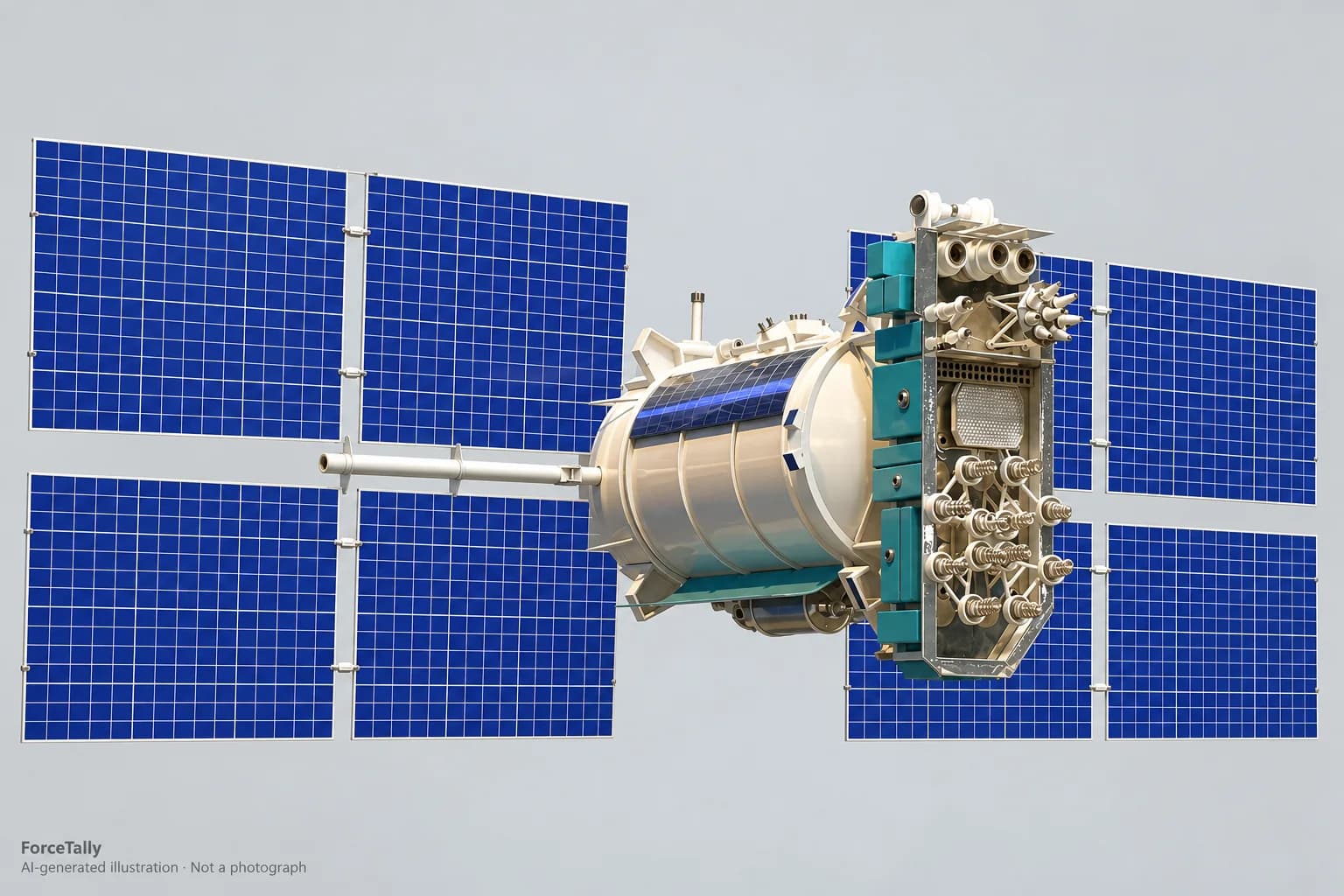
AI-generated illustration · Not a photograph · GLONASS-M navigation satellite; illustrative adaptation of its CeBIT 2011 exhibition model. Appearance and unseen details are illustrative, not specification evidence.
ForceTally · AI-generated illustration · Not a photograph. Adapted from Bin im Garten’s CeBIT 2011 GLONASS-M exhibition-model photograph, CC BY-SA 3.0. Background and rendering changed; illustration uses the same ShareAlike licence. · CC BY-SA 3.0 · Source ↗ · ModifiedISS Reshetnev
Russia
JSC «Navigation-Information Systems»
Navigation
3-Axis stabilized Uragan-M
GLONASS
1,415 kg (3,120 lb)
1250 W
NiH 2
3 Cs clocks FDMA signals: L1OF, L1SF, L2OF and L2SF CDMA signals: L3OC (s/n 755+) Space Laser Ranging
MEO
7 years
51
51
21
24
6
10 December 2003 ( Kosmos 2404 )
28 November 2022 ( Kosmos 2564 )
3 December 2022 ( Kosmos 2464 )
GLONASS
GLONASS-K1 →
It used a 3-axis stabilized pressurized bus with two solar panels, a propulsion module and a payload module. At 1,415 kilograms (3,120 lb) these are just 2 kg (4.4 lb) heavier than the previous generation, but have 25% more power 1250 W, 230% more design life (7 years), an additional signal (L2OF) and generally improved accuracy. It uses an on-board computer based on a Russian microprocessor reimplementation of the VAX 11/750 architecture: the Angstrem K1839 .
The Uragan-M are usually launched in trios, and due to the close distance, the radios of the three would interfere with each other, meaning that the ground segment can only command one satellite at a time. Setting sun pointing attitude for power and then Earth pointing attitude for communications for a single unit takes about 5 hours. Since the radio contact window with ground control is between 4 and 6 hours, ground control can not control all spacecraft in a single pass. The on-board computer in the Uragan-M can put the spacecraft in sun pointing mode autonomously, and does many of the start up processes so the ground segment can take control and process the Earth pointing mode.
The payload consists of L-Band navigation signals in 25 channels separated by 0.5625 MHz intervals in 2 frequency bands: 1602.5625–1615.5 MHz and 1240–1260 MHz. EIRP 25 to 27 dBW. Right hand circular polarized. It transmits the FDMA signals L1OF, L1SF, L2OF and L2SF, with the open L2OF being new to the Uragan series. It uses 3 Cs clocks with a clock stability of 1 × 10 −13 (an 5x improvement over the 5 × 10 −13 clock stability of the previous generation Uragan).
GLONASS-M (Russian: ГЛОНАСС-М ), also known as Uragan-M (Russian: Ураган-М ) ( GRAU index 11F654M given to the first two pilot satellites and 14F113 to the rest) are the second generation of Uragan satellite design used as part of the Russian GLONASS radio-based satellite navigation system. Developed by ISS Reshetnev (Information Satellite Systems Reshetnev), it had its debut launch in 2003, and is in the process of being phased out. Its production finished in 2015 and its last launch was in November 2022. It is an evolution of the previous Uragan ( GRAU Index 11F654) second-generation satellites, improving accuracy, increasing power, extending the design life and adding the FDMA L2OF open signal. The last eight Glonass-M spacecraft in production included the new CDMA L3OC open signal.
Navigation
{"datatype": "wikibase-item", "datavalue": {"type": "wikibase-entityid", "value": {"entity-type": "item", "id": "Q2371486", "numeric-id": 2371486}}, "hash": "9572d2415d2921ee203a3dede26cc1f54575ed0a", "property": "P176", "snaktype": "value"}
Satellite Glonass-M Satellite specification ADCS type active, 3-axes EPS power 1400 W Mass 1415 kg
Годы развёртывания 1982–2005 2003–2016 2011–2018 после 2018
Срок активного суще- ствования, лет 3,5 7 10
Масса на орбите, кг 1500 1415 935 1600
Габариты, м – 2,71×3,05×2,71 2,53×3,01×1,43 2,53×6,01×1,43
Энергопотребление, Вт – 1400 1270 4370
Тип сигналов FDMA В основном FDMA (CDMA на КА 755-761) FDMA и CDMA
Reference text from Wikipedia contributors, used under CC BY-SA 4.0.
Сигналы с открытым доступом (для сигна- лов FDMA приведено значение централь- ной частоты) L1OF (1602 МГц) L1OF (1602 МГц), L2OF (1246 МГц), начиная с № 755: L3OC (1202 МГц) L1OF (1602 МГц), L2OF (1246 МГц), L3OC (1202 МГц), начиная с № 17Л: L2OC (1248 МГц) L1OF (1602 МГц), L2OF (1246 МГц), L1OC (1600 МГц), L2OC (1248 МГц), L3OC (1202 МГц)
Наличие ретрансля- тора системы поиска и спасания – – + +
GLONASS-M equipment records. Variants, orders and quantities are shown as reported in each inventory source; coverage is incomplete.
RussiaSpace Command exact named equipment holdings: GLONASS-M. Active, operational-reserve and training units excluding equipment in store; November 2025 IISS assessment. Named service only; no parent-force or national total inferred. Source role: SATELLITES / POSITIONING, NAVIGATION & TIMING. Original estimates, ranges, reporting names, reserve, lease and employment scopes retained; nested included counts are not added. Missile-system quantities mean launchers, not rounds. No readiness, crew, carried weapon, payload, factory-production or future order count inherited.
 India
 Spain