FORCETALLY
Loading the evidence…
Preparing your view.


Preparing your view.
Military space systemsIn production
latest satellite design
GLONASS-K is a latest satellite design originating in Russia. It was built by ISS Reshetnev. Reported operators include JSC «Navigation-Information systems».
 Russia
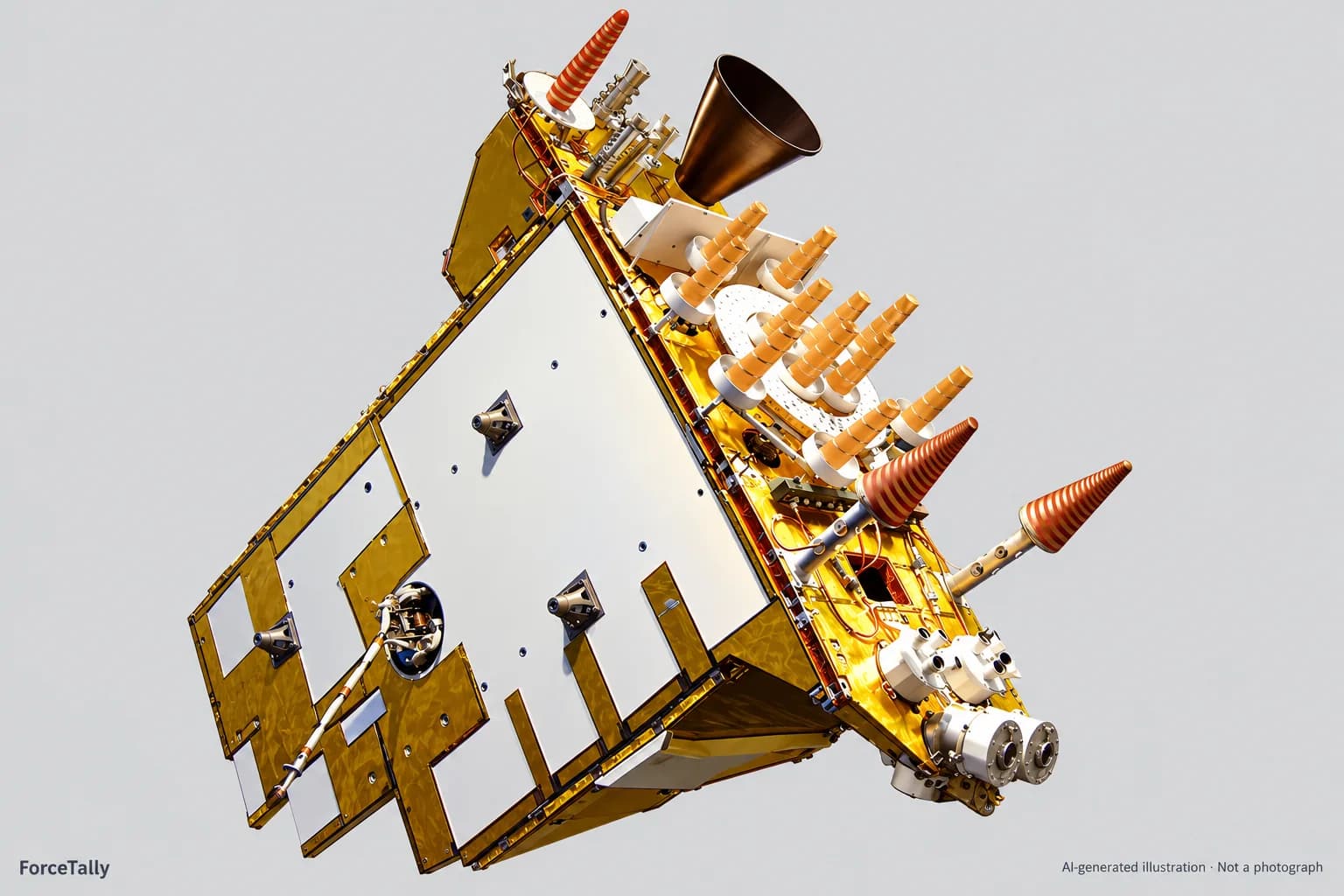
AI-generated illustration · Not a photograph · GLONASS-K navigation satellite; illustrative adaptation of its CeBIT 2011 exhibition model. Appearance and unseen details are illustrative, not specification evidence.
ForceTally · AI-generated illustration · Not a photograph. Adapted from MKonair’s CeBIT 2011 GLONASS-K exhibition-model photograph, CC BY-SA 2.0. Background and rendering changed; illustration uses the same ShareAlike licence. · CC BY-SA 2.0 · Source ↗ · ModifiedISS Reshetnev
Russia
JSC «Navigation-Information systems»
Navigation
Ekspress-1000K
935 kg
1600 watts
NiH 2
FDMA signals: L1OF, L1SF, L2OF and L2SF CDMA signals: L3OC
Medium Earth orbit (MEO)
10 years (planned)
In production
7
5
5
3
1
26 February 2011
24 August 2026
GLONASS-M
GLONASS-K2 →
GLONASS-K is the first unpressurised GLONASS satellite — all of its equipment is able to operate in a vacuum. Due to this, the satellite's mass has been substantially reduced: GLONASS-K has a mass of just 935 kg compared to its predecessor GLONASS-M, which had a mass of 1450 kg. The new satellite has an operational lifetime of 10 years, three years longer than that of GLONASS-M and seven years longer than the lifetime of the original GLONASS satellite. It also increased the power supply from GLONASS-M's 1400 watts to 1600 watts.
GLONASS-V, also known as GLONASS-VKK, is a planned modification of GLONASS-K for use in highly elliptical orbit . Roscosmos plans to launch six GLONASS-V satellites in three orbital planes starting in 2028. The new satellites will improve location accuracy in urban canyons and increase redundancy in longitudes between 20° and 160° East covering most of Russia.
GLONASS-K is the latest satellite design intended as a part of the Russian GLONASS radio-based satellite navigation system. Developed by ISS Reshetnev (Information Satellite Systems Reshetnev) and first launched on 26 February 2011, it is a substantial improvement of the previous GLONASS-M second-generation satellites, having a longer lifespan and better accuracy.
GLONASS-K is the latest satellite design intended as a part of the Russian GLONASS radio-based satellite navigation system.
Годы развёртывания 1982–2005 2003–2016 2011–2018 после 2018
Срок активного суще- ствования, лет 3,5 7 10
Масса на орбите, кг 1500 1415 935 1600
Габариты, м – 2,71×3,05×2,71 2,53×3,01×1,43 2,53×6,01×1,43
Энергопотребление, Вт – 1400 1270 4370
Тип сигналов FDMA В основном FDMA (CDMA на КА 755-761) FDMA и CDMA
Reference text from Wikipedia contributors, used under CC BY-SA 4.0.
Сигналы с открытым доступом (для сигна- лов FDMA приведено значение централь- ной частоты) L1OF (1602 МГц) L1OF (1602 МГц), L2OF (1246 МГц), начиная с № 755: L3OC (1202 МГц) L1OF (1602 МГц), L2OF (1246 МГц), L3OC (1202 МГц), начиная с № 17Л: L2OC (1248 МГц) L1OF (1602 МГц), L2OF (1246 МГц), L1OC (1600 МГц), L2OC (1248 МГц), L3OC (1202 МГц)
Наличие ретрансля- тора системы поиска и спасания – – + +
GLONASS-K equipment records. Variants, orders and quantities are shown as reported in each inventory source; coverage is incomplete.
RussiaSpace Command exact named equipment holdings: GLONASS-K1. Active, operational-reserve and training units excluding equipment in store; November 2025 IISS assessment. Named service only; no parent-force or national total inferred. Source role: SATELLITES / POSITIONING, NAVIGATION & TIMING. Original estimates, ranges, reporting names, reserve, lease and employment scopes retained; nested included counts are not added. Missile-system quantities mean launchers, not rounds. No readiness, crew, carried weapon, payload, factory-production or future order count inherited.
 India
 Spain