FORCETALLY
Loading the evidence…
Preparing your view.


Preparing your view.
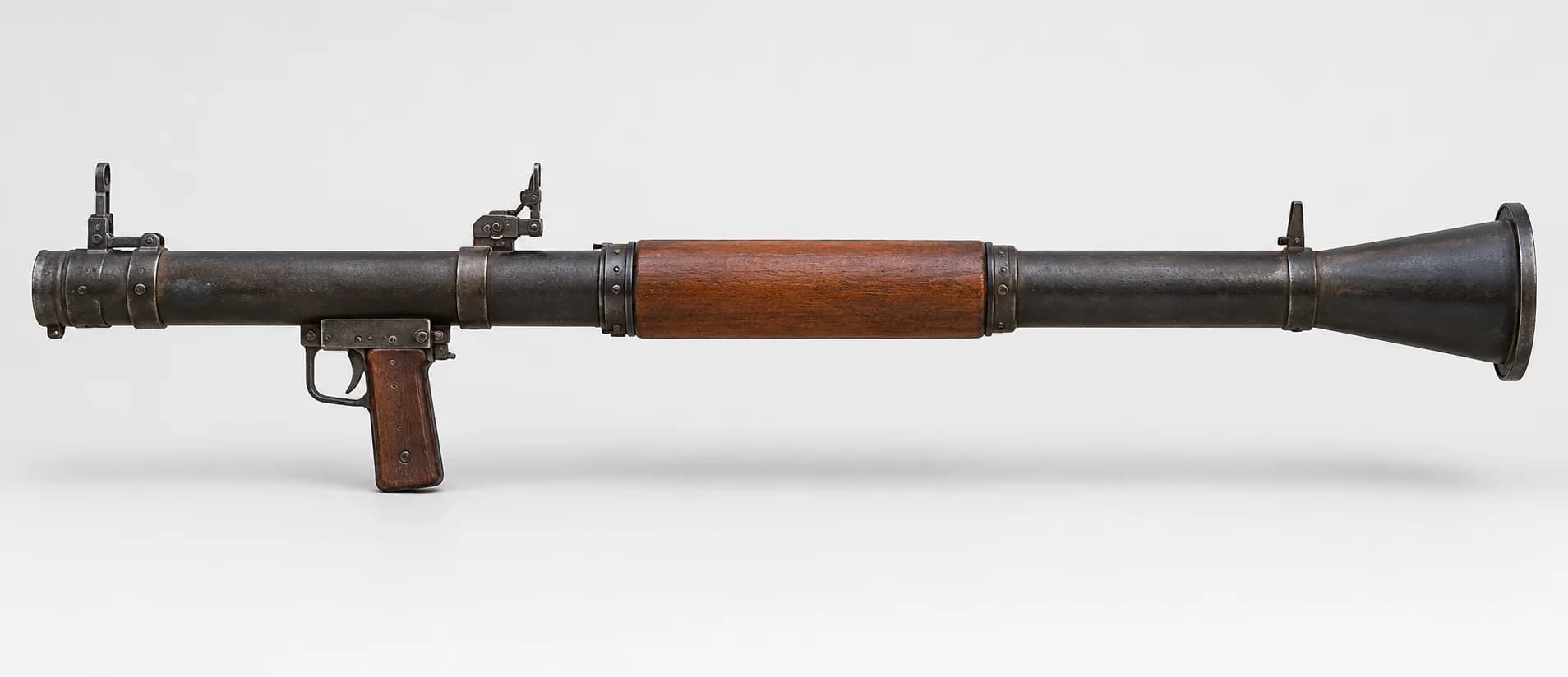
Anti-tank weaponsIn service
Anti-tank recoilless gun
RPG-2 is a anti-tank recoilless gun originating in Soviet Union. It was built by State factories.
AI-generated illustration · Not a photograph · RPG-2. Exterior details are illustrative and are not specification evidence.
ForceTally · AI-generated illustration · Not a photograph. Created from sourced military equipment identity; no input photograph. · ForceTally · All rights reserved · Source ↗ · ModifiedAnti-tank recoilless gun
Soviet Union
1954–1960 (Soviet Union) 1954–present (other countries)
See Users
Vietnam War Laotian Civil War Cambodian Civil War Nigerian Civil War Rhodesian Bush War Portuguese Colonial War Moro conflict Battle of Marawi Black September Indonesian invasion of East Timor Nicaraguan Revolution Cambodian-Vietnamese War Sino-Vietnamese War Lebanese Civil War Salvadoran Civil War Thai–Laotian Border War Somali Civil War War in Afghanistan (2001–2021) Iraq War Kivu Conflict Kosovo war Syrian Civil War 2025 Cambodia–Thailand conflict
State factories
See Variants
2.83 kg (6 lb 4 oz) (unarmed) 4.67 kg (10 lb 5 oz) (ready to fire)
1,200 mm (47.2 in)
2 (Grenadier and 'Assistant')
PG-2 HEAT round
40 mm (1.6 in) barrel 82 mm (3.2 in) warhead
3–4 rounds per minute
100–150 m (110–160 yd)
200 m (220 yd)
Cambodia
Laos
North Korea
Somalia
Somaliland
Syria
Thailand
man-portable, shoulder-fired anti-tank weapon
Cambodia
Laos
Albania − Type 56
Angola
Biafra − Used Type 56s in small numbers
Bulgaria
China − Adopted and produced by the People's Liberation Army (PLA) as the Type 56 RPG; replaced by the newer Type 69 RPG
Czechoslovakia − P-27 clone
East Germany
Egypt − 60 launchers and 3,600 rounds supplied by East Germany between 1967 and 1968
Georgia
Grenada
Guinea
Hungary
Indonesia − M57
Iraq − Type 56
Lesotho
Libya
Mali
Mongolia
Mozambique − Type 56s were supplied by China during Independence War
Myanmar − Supposedly used RPG-2s secretly provided by Israel through Singaporean channel from pro-Palestinian guerrilla stock
North Macedonia
Poland − Ordered 2,600 P-27s from Czechoslovakia between 1952 and 1955 Also used RPG-2s
Portugal − A number of units captured from the Angolan, Guinean and Mozambican guerrillas , used mainly by the Portuguese paratroopers , commandos and other special forces
Romania
Rhodesia
Soviet Union
Ukraine − Several units in storage as of 2008
United States − Used by MACVSOG recon teams
Vietnam − Designated as the B-40 in Vietnamese service
Yugoslavia − Adopted and produced as the M57
Zaire − M57 Used by Serbian mercenaries of the White Legion
Zimbabwe
Studying German and US anti-tank rocket designs, in 1944 the Soviets developed the RPG-1 with the goal of combining the best features of the German Panzerfaust single shot recoilless weapon with the US Bazooka rocket launcher. Propelled by a 30 mm cartridge, the 70 mm (2.8 in) high-explosive anti-tank (HEAT) shaped charge round could penetrate about 150 mm (5.9 in) of homogeneous armour.
Early testing revealed several minor problems, but, by the time these were being solved, 150 mm of penetration was no longer considered effective against modern tanks, even late-war designs like the Panther . The warhead was already straining the abilities of the cartridge and its range was already considered too low. Modifications to improve this began, but in 1947 the RPG-2 program began as a parallel project. Development of the RPG-2 was carried out by the GSKB-30 design bureau, originally part of the Commissariat for Munitions , but in the post-war period handed to the Ministry of Agriculture to help design farm equipment.
The main difference in performance between the two were due to size. The RPG-2 used a custom designed 40 mm (1.6 in) cartridge to provide much greater power, and the warhead enlarged to 80 mm (3.1 in). This improved penetration to 180 mm (7.1 in), which allowed it to penetrate the frontal armor of all but the very heaviest tanks, and the side and rear armor of any tank. The larger cartridge gave the PG-2 warhead slightly better practical range as well, about 150 m (490 ft) against stationary targets.
In 1957, the launcher was adapted to be able to mount the NSP-2 infrared (IR) night-sight system, which consisted of an IR spotlight and a detector, together weighing (with batteries) 6 kg (13 lb 4 oz). The NSP-2 was usable out to 150–200 metres (490–660 ft) under good conditions. When fitted with the NSP-2, the launcher became known as the RPG-2N.
Widely distributed to allies of the Soviet Union, it was also produced under license by China, North Vietnam and North Korea . Used against the U.S. military in the Vietnam War , its Vietnamese variants were called the B40 ("Bazooka, 40mm") and B50 , using the Chinese Type 50 HEAT warhead.
On March 8, 1968, a medevac helicopter was shot down with a B-40 rocket by a Vietnamese soldier during the Vietnam War. On February 20, 1971, UH-1H was shot down with B-40 rocket during the Vietnam War. On June 6, 1970, UH-1C was shot down with B-40 rocket. There were numerous reports of US military helicopters shot down with B-40 during Vietnam war .
The RPG-2 anti tank grenade launcher is a simple 40 millimeter steel tube into which the PG-2 grenade is fitted. The tailboom of the grenade inserts into the launcher. The diameter of the PG-2 warhead is 80 mm. The center section of the tube has a thin wooden covering to protect the user from the heat generated by the grenade launch. The wooden covering also makes using the weapon in extreme cold conditions easier.
The total length of the weapon with a grenade fitted is 120 centimeters (47 in) and it weighs 4.48 kilograms (9.9 lb ). Only a simple iron sight is provided for aiming.
The weapon is accurate, depending on the soldier's experience, against stationary targets up to 150 m (490 ft) and against moving targets at ranges of less than 100 m (330 ft). It has a muzzle velocity of 84 m/s (280 ft/s) and can penetrate armor up to 180 mm (7.1 in) thick.
B40 – North Vietnamese clone of the RPG-2. Rear barrel guard is 50 mm (2.0 in) shorter than the RPG-2/Type 56.
Origin Soviet Union
Type Rocket launcher
Crew 2 (grenadier and assistant)
Lifespan Reusable launcher
Weight 2.83 kg empty
Weight 2.83 kg empty 4.67 kg with PG-2 rocket
Length 1.194 without rocket
Tube diameter 40 mm
Ammunition types PG-2 in Soviet model
Method of Operation Single Stage, Unguided Black Powder Rocket
Designation: ручной противотанковый гранатомет, рпг-2 (Rocket Propelled Grenade Launcher, RPG-2)
Manufacturer: Tula Arsenal
Year Adopted: (1) 1949
Operational Status: Russia - Obsolete, no longer in use People's Republic of China (as Type 56): In reserve service. Other Known Users - North Vietnam (as B-40), Cambodia, Afghanistan, and others
Ammunition PG-2 High Explosive Rocket
Method of Operation Single Stage, Unguided Black Powder Rocket
Selector: Fire and Safe
Weight (Launcher only): (Launcher and rocket): 2.86 kilograms (6.3 pounds) 4.48 kilograms (9.9 pounds)
Reference text from Wikipedia contributors, used under CC BY-SA 4.0.
True scale
Sourced dimensions beside a 1.75 m human reference.
Points represent sourced observations, including revisions. Revisions on the same effective date are not separate inventory events. Ranges appear in the table and are not plotted as exact points.
| Observation / report period | Value | Source | Claim state |
|---|---|---|---|
| 28 Sept 2026 | 40 mm | Wikipedia contributors | superseded |
| 28 Sept 2026 | 40 mm | Wikipedia contributors | superseded |
| 28 Sept 2026 | 40 mm | Wikipedia contributors | superseded |
| 28 Sept 2026 | 40 mm | Wikipedia contributors | superseded |
| 28 Sept 2026 | 40 mm | Wikipedia contributors | superseded |
| 28 Sept 2026 | 40 mm | Wikipedia contributors | approved |
Rate of fire 3 to 4 rpm
Sights Mechanical sight
Sights Mechanical sight Optional NSP-2 infrared night sight on RPG-2N model
Origin Soviet Union
Type Rocket launcher
Crew 2 (grenadier and assistant)
Lifespan Reusable launcher
Weight 2.83 kg empty
Weight 2.83 kg empty 4.67 kg with PG-2 rocket
Length 1.194 without rocket
Tube diameter 40 mm
Ammunition types PG-2 in Soviet model
Rate of fire 3 to 4 rpm
Sights Mechanical sight
Sights Mechanical sight Optional NSP-2 infrared night sight on RPG-2N model
Effective Range: 100 meters (310 feet)
Length (launcher only): (launcher and PG-2 rocket): 95.0 cm (37.4 inches) 120.0 cm (47.2 inches)
Barrel Diameter: 40 mm (1.57 inches)
Sights: Sight Range: Flip up post sights 150 meters (450 feet)
Rate of Fire: 4 to 6 shots per minute
Armor penetration: (Against homogeneous steel armor at 0 degrees) 180 millimeters (7.17 inches )
Maximum Velocity: 84 meters/second (275.6 feet/second)
RPG-2 equipment records. Variants, orders and quantities are shown as reported in each inventory source; coverage is incomplete.
North Korea, Somalia, Somaliland, Syria, Thailand
Equipment reference ↗ Afghanistan
 Cambodia
 Guinea
 Laos
 North Korea
 Somalia
 Syria
 Thailand
 Uganda
 United States
 Israel