FORCETALLY
Loading the evidence…
Preparing your view.


Preparing your view.
Anti-tank weaponsIn service
Recoilless gun
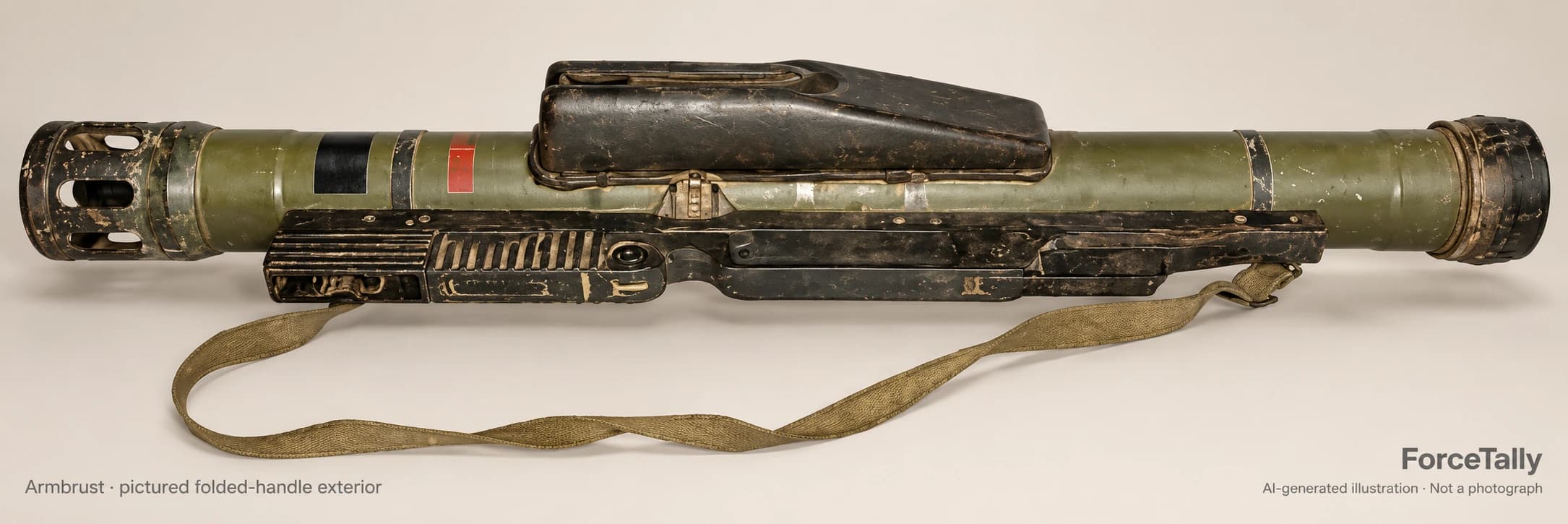
Armbrust is a recoilless gun originating in West Germany. It was built by Messerschmitt-Bölkow-Blohm (MBB) Pouderies Réunies de Belgique (PRB) ST Kinetics (STK). Reported operators include Brunei, Cambodia, Chile, Indonesia, Philippines, Singapore, Slovenia, Thailand.
AI-generated illustration · Not a photograph · Armbrust · source-pictured folded firing-handle exterior. Exterior details are illustrative, not specification evidence.
ForceTally · AI-generated illustration · Not a photograph · Reference photograph: US Gov (Naval EOD Technology division) · Public domain · AI-generated illustration · OpenAI output terms · Source ↗ · ModifiedRecoilless gun
West Germany
See Operators
Cambodian–Vietnamese War Yugoslav Wars Cambodian–Thai border stand-off 2013 Lahad Datu standoff
Messerschmitt-Bölkow-Blohm (MBB)
Messerschmitt-Bölkow-Blohm (MBB) Pouderies Réunies de Belgique (PRB) ST Kinetics (STK)
Armbrust AT, Armbrust AP, Armbrust Ub, Armbrust SC
6.3 kg (13 lb 14 oz )
850 mm (2 ft 9 in)
126 mm (5.0 in)
140 mm (5.5 in)
67 mm (2.6 in)
Recoilless weapon
210 m/s (690 ft/s)
300 m (980 ft)
1,500 m (4,900 ft)
Single shot
Reticle, externally illuminated for night
Brunei
Cambodia
Chile
Indonesia
Philippines
Singapore
Slovenia
Thailand
Croatia – Used during the Croatian War of Independence
Kosovo Liberation Army − Used during the Kosovo War
Armbrust (German: Crossbow ) is a lightweight unguided anti-tank weapon designed and developed by Messerschmitt-Bölkow-Blohm of Germany, who later sold its manufacturing rights to Chartered Industries of Singapore (the predecessor of ST Kinetics ).
Armbrust (German: Crossbow ) is a lightweight unguided anti-tank weapon designed and developed by Messerschmitt-Bölkow-Blohm of Germany, who later sold its manufacturing rights to Chartered Industries of Singapore (the predecessor of ST Kinetics ).
The Armbrust is a recoilless weapon , and is one of the few weapons of this kind that may safely be fired in an enclosed space. The propellant charge is placed between two pistons with the projectile in front of one and a mass of shredded plastic in the rear. Unlike most recoilless weapons, it is a true counter-shot weapon, as the mass of the projectile is equal to the mass of the counterweight and they are ejected from the barrel at the same initial velocity . When the weapon is fired, the propellant expands, pushing the two pistons out. The projectile is forced out of the front and the plastic out of the back. The plastic disperses on leaving the back of the barrel, and is quickly stopped by air resistance . The pistons jam at either end of the barrel, locking the hot gases inside. Its warhead can penetrate up to 300 mm of steel armor.
Reference text from Wikipedia contributors, used under CC BY-SA 4.0.
True scale
Sourced dimensions beside a 1.75 m human reference.
See it in your room. Scan with your phone to open this model in 3D, then place it in your space.
Points represent sourced observations, including revisions. Revisions on the same effective date are not separate inventory events. Ranges appear in the table and are not plotted as exact points.
| Observation / report period | Value | Source | Claim state |
|---|---|---|---|
| 29 Sept 2026 | 67 mm | Wikipedia contributors | superseded |
Armbrust equipment records. Variants, orders and quantities are shown as reported in each inventory source; coverage is incomplete.
Brunei, Cambodia, Chile, Indonesia, Philippines, Singapore, Slovenia, Thailand
Equipment reference ↗ Brunei
 Cambodia
 Chile
 Indonesia
 Philippines
 Singapore
 Slovenia
 Thailand
 United States