FORCETALLY
Loading the evidence…
Preparing your view.


Preparing your view.
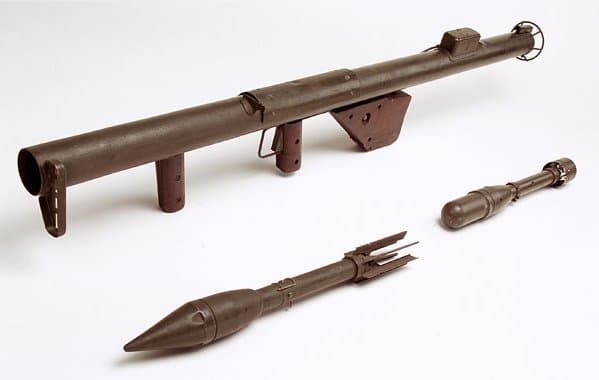
Anti-tank weaponsIn service
Recoilless rocket anti-tank weapon
Bazooka is a recoilless rocket anti-tank weapon originating in United States. Reported operators include Argentina, Australia, Austria, Belgium, Bolivia, Brazil, Canada, Chile, Cuba, El Salvador, France, Greece, Guatemala, Guinea-Bissau, Indonesia, India, Iraq, Israel, Provisional Irish Republican Army, Italy, Japan, Liberia, Luxembourg, Malaysia, Malawi, Mexico, Morocco, Myanmar, Nazi Germany, Netherlands, Nigeria, Norway, Pakistan, Paraguay, People's Republic of China, Philippines, Portugal, Republic of China, Rhodesia, Sierra Leone, South Africa, South Korea, South Vietnam, Soviet Union, Spain, Sweden, Thailand, Tunisia, Türkiye, United Kingdom, United States, Vietnam, West Germany, Yugoslavia.
 United States
Recoilless rocket anti-tank weapon
United States
1942–present
See § Users
World War II Chinese Civil War First Indochina War Korean War Algerian War Vietnam War Operation Vantage The Troubles Bay of Pigs Invasion Portuguese Colonial War Rhodesian Bush War Yom Kippur War Lebanese Civil War Iran–Iraq War Falklands War South African Border War
Edward Uhl
1942
June 1942 – May 1945 (2.36 inch Bazookas)
112,790 (M1) 59,932 (M1A1) 6,087 (M9) 277,819 (M9A1) Unknown (M20) 1,500 (M25)
54 in (137 cm)
2.36 in (60 mm)
13 lb (5.9 kg)
M6 or M6A2 shaped charge (3.5 lb, 1.59 kg)
2, operator and loader
Argentina : Super Bazooka. Used until at least the Falklands War , replaced by AT4 .
Australia : Super Bazooka.
Austria : Super Bazooka.
Belgium : RL-83.
Bolivia : Super Bazooka.
Brazil : Bazooka and Super Bazooka.
Canada : Bazooka and Super Bazooka.
Chile : Super Bazooka.
Cuba : Super Bazooka. During the Bay of Pigs Invasion , the anti-Castrist Brigade 2506 used 2.36 in bazookas against Castro 's T-34s .
El Salvador : Super Bazooka.
France : Bazooka and Super Bazooka.
Greece : Super Bazooka.
Guatemala : Super Bazooka.
Guinea-Bissau : Super Bazooka.
Indonesia : Super Bazooka.
India : Super Bazooka.
Iraq : Super Bazooka.
Israel : M20A1.
Provisional Irish Republican Army : M20 Super Bazooka, first used in 1971.
Italy : M20A1 and RL-83 variants.
Japan : JGSDF used Super Bazookas, replaced by the Carl Gustav recoilless rifles .
Liberia : Super Bazooka.
Luxembourg : Super Bazooka.
Malaysia : Super Bazooka.
Malawi : Super Bazooka.
Mexico
Morocco : M20 Super Bazooka.
Myanmar : M9A1 and M20 Super Bazooka.
Nazi Germany : Used captured M1s as 6 cm Raketenpanzerbüchse 788 (a)
Netherlands : The M9A1 was used for a short period of time by the Dutch Army as the Raketwerper 2.36 inch . It served from the beginning of the 1950s to the end of the 1960s with the Landmacht as an instructional weapon, with the Troepenmacht in Suriname (TRIS, troop force in Surinam, part of the Landmacht ), and the Nederlands Detachement Verenigde Naties (N.D.V.N.), Dutch Detachment United Nations in 1950–1951 during the Korean War. During the Korean War, the 2.36-inch bazooka was replaced by the 3.5-inch M20. Although it replaced the M9A1 in 1951 with the N.D.V.N., the weapon was not introduced into the Landmacht until 1954. The M20 and M20B1 were later replaced by the 66 mm LAW in 1968, but the bazooka remained in inventory for reservists, mobilisation, and other non-priority uses until 1989.
Nigeria : M20 Super Bazooka.
Norway : Super Bazooka.
Pakistan : Super Bazooka.
Paraguay
People's Republic of China : Large numbers of 2.36-inch and 3.5-inch Bazookas were captured by the Chinese communists during the Chinese Civil War and Korean War. China also copied the 3.5-inch as the Type 51 —with a projectile 90 mm in diameter. The Type 51 can fire captured 3.5-inch projectiles (i.e. 90 mm), but 3.5-inch Super Bazookas cannot load projectiles made for the Type 51.
Philippines : Super Bazooka.
Portugal : Super Bazooka.
Republic of China : Super Bazooka.
Rhodesia : Super Bazooka.
Sierra Leone : Super Bazooka.
South Africa : Super Bazooka.
South Korea : The armed forces received 1,958 M9A1s before the Korean War , and 609 M9A1s and 4,907 M20s were in service by the end of the war.
South Vietnam : M9A1 and M20A1 variants.
Soviet Union : Bazooka.
Spain : M20 Bazooka and improved designs (M53, M58 and M65).
Sweden : Super bazooka.
Thailand : Super Bazooka as คจตถ. 3.5 นิ้ว in the Royal Thai Army, replaced by the Type 69 RPG .
Tunisia : Super Bazooka.
Turkey : Super Bazooka.
United Kingdom : Bazooka and Super Bazooka. Domestically manufactured versions of the Super Bazooka and its ammunition were issued alongside the American originals. Replaced by the Carl Gustav M2 (L14A1) during the 1960s.
United States : Bazooka replaced by the M72 LAW .
Vietnam : Type 51 Bazooka, used by Viet Minh and Viet Cong.
West Germany : Super Bazooka.
Yugoslavia : M20 and M20A1B1
man-portable recoilless anti-tank rocket launcher
During World War II , the German armed forces captured several bazookas in early North African and Eastern Front encounters and soon reverse engineered their own version, increasing the warhead diameter to 8.8 cm (among other minor changes) and widely issuing it as the Raketenpanzerbüchse " Panzerschreck " ("rocket anti-armor rifle 'tank terror ' "). Near the end of the war, the Japanese developed a similar weapon, the Type 4 70 mm AT rocket launcher , which featured a rocket-propelled grenade of a different design. During the Korean War , the M1 and M9 Bazooka series was replaced by the larger caliber M20 Super Bazooka .
Shaped charge technology was developed in the U.S. into a shaped charge anti-tank grenade for use by infantry, effective at defeating up to 60 mm (2.4 in) of vehicle armor .
However, the M10 grenade weighed 3.5 lb (1.6 kg), proving difficult to throw by hand and too heavy to be launched as a rifle grenade .
At the launcher's first firing test, Uhl wore a welding helmet , but discovered that there was not enough exhaust from the rocket to require protective equipment. The prototype launcher was demonstrated in May 1942 at a competitive trial of various types of spigot mortars at Aberdeen Proving Ground. On the morning of the trial Skinner and Uhl realised that the launcher had no sights, so they improvised some from a wire coathanger; despite this, it was the only weapon in the trial to be able to hit a moving tank. This led to the launcher being demonstrated to General George C. Marshall , the Chief of Staff of the United States Army , who ordered 5,000 units on the spot. By late 1942, the improved Rocket launcher, M1A1 was introduced. The forward hand grip was deleted, and the design simplified. The production M1A1 was 55 inches (1.37 m) long and weighed 12.75 pounds (5.8 kg).
The 2.36 inch (60 mm) smoke rocket M10 and its improved subvariants (M10A1, M10A2, M10A4) used the rocket motor and fin assembly of the M6A1, but replaced the anti-tank warhead with a white phosphorus (WP) smoke head. WP smoke not only acts as a visibility screen, but its burning particles can cause severe injuries to skin. The M10 was therefore used to mark targets, to blind enemy gunners or vehicle drivers, or to drive troops out of bunkers and dugouts. The 2.36-inch incendiary rocket T31 was an M10 variant with an incendiary warhead designed to ignite fires in enemy-held structures and unarmored vehicles, or to destroy combustible supplies, ammunition, and materiel ; it was not often utilized.
The original M6 and M6A1 rockets used in the M1 and M1A1 launchers had pointed noses, which were found to cause deflection from the target at low impact angles. In late 1943, another 2.36-in rocket type was adopted, the M6A3, for use with the newly standardized M9 rocket launcher. The M6A3 was 19.4 inches (493 mm) long, and weighed 3.38 lb (1.53 kg). It had a blunted, more round nose to improve target effect at low angles, and a new circular fin assembly to improve flight stability. The M6A3 was capable of penetrating 3.5–4 inches (89–102 mm) of armor plate.
Battery problems in the early bazookas eventually resulted in replacement of the battery-powered ignition system with a magneto sparker system operated through the trigger. A trigger safety was incorporated into the design that isolated the magneto, preventing misfires that could occur when the trigger was released and the stored charge prematurely fired the rocket. The final major change was the division of the launch tube into two discrete sections, with bayonet-joint attachments. This was done to make the weapon more convenient to carry, particularly for use by airborne forces. The final two-piece launcher was standardized as the M9A1. In September 1944, the fragile folding aperture sight was replaced by a Polaroid optical reflector sight. However, the long list of incorporated modifications increased the launcher's tube length to 61 inches (1.55 m), with an overall empty weight of 14.3 lb (6.5 kg). From its original conception as a relatively light, handy, and disposable weapon, the final M9A1 launcher had become a heavy, clumsy, and relatively complex piece of equipment.
In October 1944, after receiving reports of inadequate combat effect of the M1A1 and M9 launchers and their M6A1 rockets, and after examining captured examples of the German 8.8 cm RPzB 43 and RPzB 54 Panzerschreck , the U.S. Ordnance Corps began development on a new, more powerful anti-tank rocket launcher, the 3.5-inch (90 mm) M20. However, the weapon's design was not completed until after the war and saw no action against an enemy until the Korean War.
In 1945, the U.S. Army's Chemical Warfare Service standardized improved chemical warfare rockets intended for the new M9 and M9A1 launchers, the Army adopted the M26 gas rocket, a cyanogen chloride (CK)-filled warhead for the 2.36-in rocket launcher. CK, a deadly blood agent, was capable of penetrating the protective filter barriers in some gas masks, and was seen as an effective agent against Japanese forces (particularly those hiding in caves or bunkers), whose gas masks lacked the impregnants that would provide protection against the chemical reaction of CK. While stockpiled in US inventory, the CK rocket was never deployed or issued to combat personnel.
During Operation Overlord , the L-4 Grasshopper , a slow monoplane, began to be used in a light anti-armor role by a few U.S. Army artillery spotter units over France; these aircraft were field-outfitted with either two or four bazookas attached to the lift struts . Upon arriving in France in 1944, Major Charles Carpenter , an Army aviator flying liaison and spotter light planes, was issued a new L-4H version during the concluding stages of Overlord, taking this "light attack" role against German armor by himself. With a 150-pound pilot and no radio aboard, the L-4H had a combined cargo and passenger weight capacity of approximately 232 pounds. This margin allowed him to eventually mount a total of six Bazookas, three per side on the lift struts as other L-4s had done.
In the opening months of the Korean War , in August 1950, a joint U.S. Navy and Marine Corps test used a newly acquired Bell HTL-4 helicopter to test if a bazooka could be fired from a helicopter in flight. One of the larger, 3.5 inch, models of the bazooka was chosen, and was mounted ahead and to the right of the helicopter to allow the door to remain clear. The bazooka was successfully tested, although it was discovered that it would require shielding for the engine compartment, which was exposed in the model 47 and other early helicopters. The helicopter itself belonged to HMX-1, a marine experimental helicopter squadron.
When the existence of the bazooka was revealed to the American public, official press releases for the first two years stated that it "packed the wallop of a 155 mm cannon"—a great exaggeration.
In late 1942, numbers of early-production American M1 Bazookas were captured by German troops from Red Army forces who had been given quantities under Lend-Lease . There were also examples captured during the Operation Torch invasions in the North African Campaign. The Germans promptly developed their own version of the weapon called the Panzerschreck , increasing the diameter of the warhead from 60 mm to 88 mm (2.4 to 3.5 in), which as a result, gave it significantly greater armor penetration. During U.S. trials of the M1, calls for a larger-diameter warhead had also been raised by some ordnance officers but were rejected. Later in the war, after participating in an armor penetration test involving a German Panther tank using both the Raketenpanzerbüchse , or RPzB 54 Panzerschreck and the U.S. M9 Bazooka, Corporal Donald E. Lewis of the U.S. Army informed his superiors that the Panzerschreck was "far superior to the American Bazooka": 'I was so favorably impressed [by the Panzerschreck ] I was ready to take after the Krauts with their own weapon.'
Even the heavy King Tiger tank only possessed hull and turret top armor of 44 mm ( 1 + 3 ⁄ 4 in) thickness at best, which the bazooka's shaped-charge rocket could pierce.
A larger, 3.5 in (89 mm) model was adopted, the M20 "Super Bazooka".
The M20 weighed 14.3 pounds (6.5 kg) and fired a hollow shaped-charge 9 lb (4 kg) M28A2 HEAT rocket when used in an anti-tank role.
Johnson in the years following World War II effectively canceled the intended widespread issue of the M20, and initial U.S. forces deploying to Korea were armed solely with the M9/M9A1 2.36-in. launcher and old stockpiled World War II inventories of M6A3 rocket ammunition.
At the outbreak of the Korean War , the South Korean military had 1,958 M9A1 rocket launchers that were given by the U.S. Forces Korea during the withdrawal in 1948 to 1949, the only anti-tank firearms that the South Koreans had secured in sufficient quantities. However, the 2.36-inch rocket launcher could not penetrate the front armor of T-34-85s , which were the biggest threat. The South Koreans responded by firing rockets into the side, rear, or tracks through ambushes, but they did not have much effect.
At the same time, the U.S. military dispatched its first troops to the Korean Peninsula without trusting reports that a 2.36-inch rocket could not destroy North Korean tanks. On July 5, 1950, during the Battle of Osan , Task Force Smith tried to stop North Korean tanks with 2.36-inch rocket launchers and 75 mm recoilless rifles but was overrun by 33 T-34-85s. One of the North Korean T-34s received a total of 22 shots on the side and rear at about 10 meters in distance, but survived.
On July 8, Colonel Robert R. Martin , commander of the 34th Regiment of the U.S. 24th Infantry Division , was killed while operating a 2.36-inch rocket launcher to prevent North Korean tanks from advancing. Additionally, ordnance authorities received numerous combat reports regarding the failure of the M6A3 warhead to properly detonate upon impact, eventually traced to inventories of rocket ammunition that had deteriorated from numerous years of storage in humid or salt air environments. Therefore, the U.S. Army immediately airlifted a small number of available M20 Super Bazookas from the U.S. mainland. The rockets were deployed during the Battle of Taejon on July 18, and proved their power by destroying a number of North Korean tanks that entered the city on July 20. As a result, the U.S. Army rushed to secure more M20 rockets and was able to hold more than 900 Super Bazookas during the Battle of Pusan Perimeter . The South Korean military also began receiving the M20 in early August, and successfully destroyed four tanks with M20s during their first usage on August 9.
Large numbers of 2.36-inch bazookas that were captured during the Chinese Civil War were employed by the Chinese forces against the American Sherman and Patton tanks, and the Chinese later reverse engineered and produced a copy of the M20 designated the Type 51 . It is considered that the Communist-used bazookas destroyed more tanks than the UN bazookas did.
Used the M6 HEAT and M7 training practice rockets (60 mm warhead)
Can penetrate up to 3 inches (76 mm) of armor
Velocity of 265 ft/s (81 m/s; 181 mph)
Overall length: 54 in (1.4 m).
Weight (unloaded): 18 lb (8.2 kg).
Overall length: 54.5 inches (1,380 mm)
Weight (unloaded): 13.26 pounds (6.01 kg)
Uses the improved M6A3 HEAT, M7A3 practice, and M10 bursting smoke (white phosphorus) rockets (weight: 3.4 lbs., velocity: 265 feet per second)
M6A3 rocket had a blunt, rounded nose rather than the pointed nose of earlier rockets, which had been found to deflect off sloped tank armor, and also had a short cylindrical fixed tailfin which was less prone to bending during transport or rough handling. Could penetrate up to 4 inches (102 mm) of armor
Overall length: 61 inches (1,500 mm) fixed / 31.5 inches (800 mm) disassembled
Weight (unloaded): 15.14 pounds (6.87 kg)
An optical reflector sight replaced the iron sights beginning in September 1944. The M9A1 supplanted the M9 in production beginning in June 1944. It has an improved coupling mechanism for the launch tube; the overall length is 61.1 in (1.55 m) and 31.5 in (800 mm) when folded. Unloaded weight is 15.87 lb (7.20 kg).
Weight (unloaded): 10.5 pounds (4.8 kg)
Larger, 3.5 in (88.9 mm) caliber, and larger warhead
Could penetrate up to 11 inches (280 mm) of armor
Extended range by about 150 m
The Blindicide is not a direct derivative of the M20 design, being smaller caliber (83 mm not 88.9 mm). The aluminum launch tube is externally reinforced with glass reinforced plastic.
Length: 54 in (137 cm)
Caliber: 2.36 in (60 mm)
Weight: 13 lb (5.9 kg)
Warhead: M6 or M6A2 shaped charge (3.5 lb, 1.59 kg)
Range Maximum: 400 yards (370 m) Effective: (claimed) 150 yards (140 m)
Weight: 12.75 lb (5.8 kg)
Warhead: M6A1 or M6A3 shaped charge (3.5 lb, 1.59 kg)
Length: 61 in (155 cm)
Weight: 14.3 lb (6.5 kg)
Warhead: M6A3 shaped charge (3.5 lb, 1.59 kg)
Range Maximum: 400–500 yards (370–460 m) Effective: (claimed) 120 yards (110 m)
Length (when assembled for firing): 60 in (1,524 mm)
Caliber: 3.5 in (90 mm)
Weight (unloaded): M20A1: 14.3 lb (6.5 kg); M20A1B1: 13 lb (5.9 kg)
Warhead: M28A2 HEAT (9 lb) or T127E3/M30 WP (8.96 lb)
Range Maximum: 1000 yd (913 m) Effective (stationary target/moving target): 300 yd (270 m) / 200 yd (180 m)
Longueur 1370mm (M1) - 1550mm (M9A1)
Longueur 1370mm (M1) - 1550mm (M9A1)
Fabricante Arsenal de Rock Island
Peso 6,8 kilogramos
Longitud 1,37 m
Diámetro 60 milímetros
Calibre 60 mm (M1, M1A1, M9 y M9A1) 90 mm (M20, M20B1 y M20A1/A1B1)
Peso 6,8 kilogramos
Longitud 1,37 m
Diámetro 60 milímetros
Calibre 60 mm (M1, M1A1, M9 y M9A1) 90 mm (M20, M20B1 y M20A1/A1B1)
Unguided man-portable recoilless antitank rocket
Масса, кг 6,8
Длина, мм 1370
Калибр , мм 60
Максимальная дальность, м 365 135 (эффективная)
Peso 6 kg
Lunghezza 1390 mm
Calibro 60 mm
Reference text from Wikipedia contributors, used under CC BY-SA 4.0.
True scale
Sourced dimensions beside a 1.75 m human reference.
Points represent sourced observations, including revisions. Revisions on the same effective date are not separate inventory events. Ranges appear in the table and are not plotted as exact points.
| Observation / report period | Value | Source | Claim state |
|---|---|---|---|
| 1 Oct 2026 | 60 mm | Wikipedia contributors | superseded |
| 2 Oct 2026 | 60 mm | Wikipedia contributors | approved |
Bazooka equipment records. Variants, orders and quantities are shown as reported in each inventory source; coverage is incomplete.
 Argentina
 Australia
 Austria
 Belgium
 Bolivia
 Brazil
 Burundi
 Chile
 Cuba
 El Salvador
 France
 Greece
 Guatemala
 Guinea-Bissau
 India
 Indonesia
 Israel
 Italy
 Japan
 Liberia
 Luxembourg
 Malawi
 Malaysia
 Mexico
 Morocco
 Myanmar
 Netherlands
 Nigeria
 Norway
 Pakistan
 Paraguay
 Philippines
 Portugal
 Sierra Leone
 South Korea
 Spain
 Sweden
 Taiwan
 Thailand
 Tunisia
 Türkiye
 United Kingdom
 Vietnam
Argentina, Australia, Austria, Belgium, Bolivia, Brazil, Canada, Chile, Cuba, El Salvador, France, Greece, Guatemala, Guinea-Bissau, Indonesia, India, Iraq, Israel, Provisional Irish Republican Army, Italy, Japan, Liberia, Luxembourg, Malaysia, Malawi, Mexico, Morocco, Myanmar, Nazi Germany, Netherlands, Nigeria, Norway, Pakistan, Paraguay, People's Republic of China, Philippines, Portugal, Republic of China, Rhodesia, Sierra Leone, South Africa, South Korea, South Vietnam, Soviet Union, Spain, Sweden, Thailand, Tunisia, Türkiye, United Kingdom, United States, Vietnam, West Germany, Yugoslavia
Equipment reference ↗ South Africa