FORCETALLY
Loading the evidence…
Preparing your view.


Preparing your view.
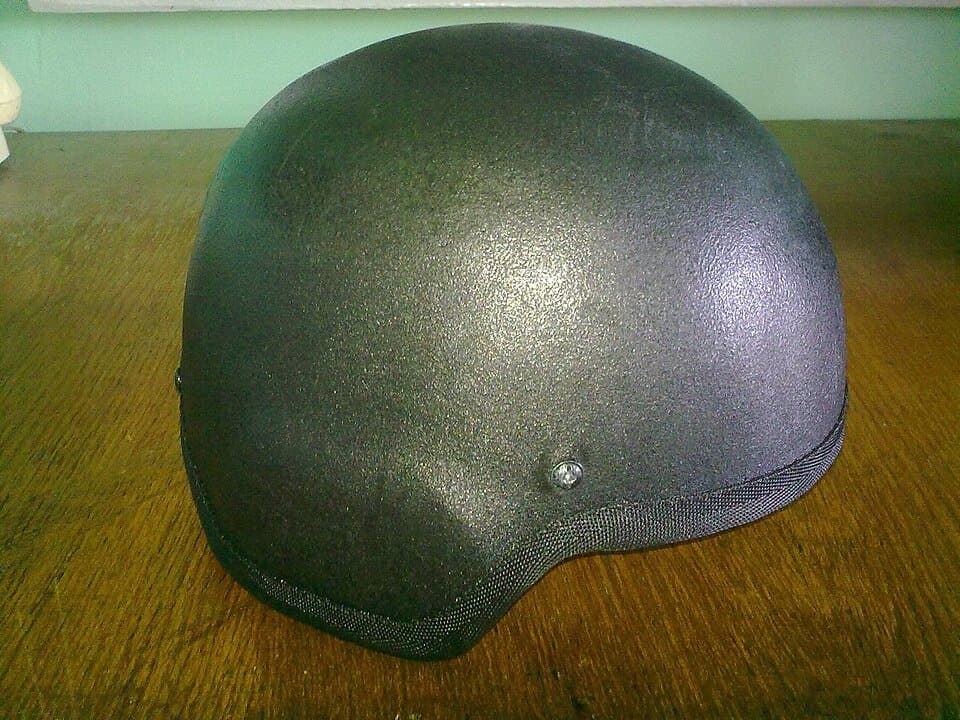
Protective equipmentIn service
Combat Helmet
Kaska-1M is a combat Helmet originating in Ukraine. It was built by TEMP-3000. Reported operators include Ukraine.

Combat Helmet
Ukraine
2013 – Current
Ukraine
War in Donbas Russo-Ukrainian war (2022–present)
TEMP-3000
2000s
TEMP-3000
2013 – 2024
1.25 kg (Small) 1.30 kg (Medium) 1.40 kg (Large) 1.60 kg (X-Large)
Ukraine :
The Kaska-1M is a combined-arms bulletproof Kevlar helmet, developed and manufactured by the Ukrainian company NPP TEMP-3000 LLC.
The development of a protective helmet made of para-aramid material was started by "TEMP-3000" in the mid-1990s and completed in the 2000s, when the company mastered the technology for the production of a composite bulletproof helmet made of polymer-coated Ultra-high-molecular-weight polyethylene . Later, using computer simulation, several prototypes of the helmet were made, which were submitted for shooting tests. The reference sample of the tested variant of the bulletproof helmet (which was later called "Kaska-1M") withstood five hits of bullets of the 9 × 19 mm "Parabellum" cartridge, fired from a distance of 5 meters.
Before the war in Donbas in the spring of 2014, the Ukrainian armed forces did not have any Kaska-1M helmets. After the outbreak of hostilities, the needs of the Ukrainian army for personal protective equipment increased. In the first half of 2014, the Ministry of Defense of Ukraine concluded a series of contracts for the supply of Kaska-1M helmets for the Armed Forces of Ukraine (according to official data from the Ministry of Defense of Ukraine, in the period up to 6 June 2014, 10,000 helmets were ordered for the Ukrainian Ground Forces at a price of 2,800 hryvnia per unit) and began to be delivered to the troops.
In the first half of 2015, the Armed Forces of Ukraine received another 64,580 Kaska-1M helmets. Subsequently, the supply of helmets to the troops continued. In the period from 1 January to 8 September 2015, the Armed Forces of Ukraine received 75,000 Kaska-1M helmets. In addition, in 2015, the helmets began to be purchased for the National Guard of Ukraine . However, as of early 2017, the bulk of the helmets in service with the Armed Forces and the National Guard of Ukraine were still Soviet-made.
In 2017, a production helmet was tested in the Teijin Twaron ballistic laboratory in Wuppertal , Germany , in accordance with the STANAG 2920 standard for NATO personal protective equipment . It was found that when the helmet was fired upon with a 1.1 gram FSP fragment simulator, the V50 parameter (the average speed at which the protective equipment is pierced through in 50% of cases) is 660 m/s.
In September 2017, helmets of this type were tested by Russian Naval Infantry , specifically the 810th Guards Naval Infantry Brigade , of the Black Sea Fleet . These tests included firing weapons at and striking the helmets. It was found that the protective properties of helmets decreased with use faster than those in storage. In general, after three or four years, the helmets' V50 parameter would decrease to 588 m/s.
In March 2019, the selling price of Kaska-1M helmets was UAH 3,149/piece (9% more expensive than November 2018).
Structurally, the helmet consists of a package of ballistic fabric with good thermostability (it is reported that the presence of a Kaska-1M helmet on the head makes the soldier's head less visible to thermal imaging), an outer coating (polyurethane waterproof compound painted with matte paint), and a four-point fastening belt harness system to fix the helmet on the head. Along the lower contour, the helmet is framed with a polymer piping.
"Kaska-1M kit no. 7" (TOR-D) - a lightweight helmet for paratroopers with a reduced protection area, equipped with a BOA suspension system made in the USA.
In 2017, a production helmet was tested in the Teijin Twaron ballistic laboratory in Wuppertal , Germany , in accordance with the STANAG 2920 standard for NATO personal protective equipment . It was found that when the helmet was fired upon with a 1.1 gram FSP fragment simulator, the V50 parameter (the average speed at which the protective equipment is pierced through in 50% of cases) is 660 m/s.
Reference text from Wikipedia contributors, used under CC BY-SA 4.0.
Kaska-1M equipment records. Variants, orders and quantities are shown as reported in each inventory source; coverage is incomplete.
 South Korea
 United States
 United Kingdom
 Israel
 France