FORCETALLY
Loading the evidence…
Preparing your view.


Preparing your view.
Protective equipmentIn service
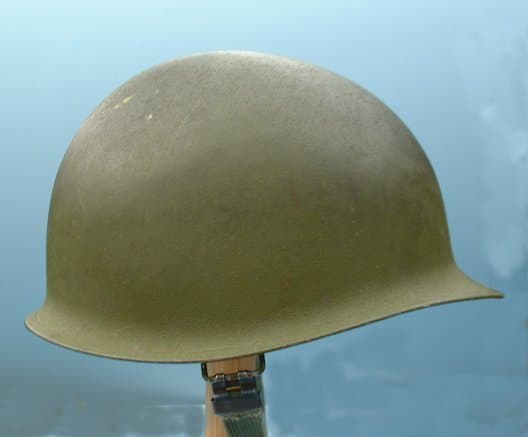
Combat helmet
M1 helmet is a combat helmet originating in United States. It was built by McCord Radiator and Manufacturing Company and Schlueter Manufacturing Company. Reported operators include China, Republic of, Colombia, Dominican Republic, India, Iran, Guatemala, Japan, Panama, Philippines, South Korea, Türkiye, Uruguay, Vietnam.
 United States
Technical data
Combat helmet
United States
1941–1985 (US)
See Users for details
World War II Chinese Civil War Indonesian National Revolution Internal conflict in Myanmar Korean War Hukbalahap Rebellion First Indochina War Cuban Revolution Algerian War Civil conflict in the Philippines Vietnam War Suez Crisis Laotian Civil War Congo Crisis Guatemalan Civil War Portuguese Colonial War Nicaraguan Revolution Colombian conflict South African Border War Dominican Civil War Six-Day War Nigerian Civil War Football War Cambodian Civil War Ethiopian Civil War Ogaden War Eritrean War of Independence War of Attrition Black September Yom Kippur War Indo-Pakistani War of 1965 Indo-Pakistani War of 1971 Turkish invasion of Cyprus Western Sahara War Lebanese Civil War Salvadoran Civil War Sino-Vietnamese War Internal conflict in Peru 1982 Lebanon War Iran–Iraq War Falklands War United States invasion of Grenada United States invasion of Panama Somali Civil War Gulf War Croatian War of Independence Bosnian War Insurgency in Khyber Pakhtunkhwa
Major Harold G. Sydenham
McCord Radiator and Manufacturing Company and Schlueter Manufacturing Company
22 million (1945)
China, Republic of
Colombia
Dominican Republic
India
Iran
Guatemala
Japan
Panama
Philippines
South Korea
Turkey
Uruguay
Vietnam
Argentina : Used by the Armed Forces of the Argentine Republic before they were replaced.
Australia : The Australian Defence Force used Australian and American-made M1 helmets from the 1960s to the 1990s. Replaced by the Australian-made M91 PASGT helmet in the early 1990s.
Austria : Used by the Austrian Armed Forces after it was reformed in 1955, with 30,000 M1 helmets supplied by the U.S. Ulbrichts Witwe began producing M1 helmets in 1958, designated as the Stahlhelm 2 (M.58), with another variant made in the 1970s with a German helmet suspension.
Belgium : Used Ulbrichts-made M1 helmets.
Bosnia and Herzegovina : Formerly used by the Army of the Republic of Bosnia and Herzegovina with M81 Woodland camouflage. Croatian Republic of Herzeg-Bosnia : Formerly used by the Croatian Defence Council with M81 Woodland camouflage during the Bosnian War .
Croatian Republic of Herzeg-Bosnia : Formerly used by the Croatian Defence Council with M81 Woodland camouflage during the Bosnian War .
Brazil : Formerly used U.S. and Brazilian-made M1 helmets.
Bolivia : Used U.S. and Brazilian-made M1 helmets before being removed from service.
Canada : Used by the Canadian Armed Forces until the 1990s, when it was replaced by the CG634 helmet.
Chile : Formerly used by the Chilean Armed Forces , with liners made by Baselli Hnos.
Costa Rica : Formerly used U.S.-made M1 helmets.
Democratic Republic of the Congo - Used during the Congo Crisis
Croatia : Used during the Croatian War of Independence , with some remaining in service until the 2000s.
Cuba : Used by the Cuban National Army until the Cuban Revolution , at which point they were retired by the Cuban Revolutionary Armed Forces and replaced by Warsaw Pact -made helmets.
Denmark : Used Ulbrichts-made M1 helmets, designated the Staalhjelm model 48 (m/48).
Ecuador : Formerly used by the Armed Forces of Ecuador .
El Salvador : Provided by the U.S. in the 1970s as part of military aid, now replaced by the PASGT helmet.
Ethiopia : First entered service with the Kagnew Battalion during the Korean War. Later saw service in the Ogaden War and the Ethiopian Civil War .
France : Formerly used by the French Armed Forces, superseded by Modèle 1951 helmet in early 1950s.
Greece : Adopted by the Hellenic Armed Forces in 1952.
Haiti : Formerly used by the Armed Forces of Haiti .
Honduras : Formerly used by Armed Forces of Honduras after signing the Rio Treaty .
Indonesia : Obtained from the Netherlands after the Indonesian National Revolution in 1949 and used by the Indonesian Army until the 1990s.
Israel : Formerly used by the Israel Defense Forces , supplied by the U.S., UK, and France. Some M1s used have a combination of American and Israeli parts with Kasda variants with "British" 3-point suspension strap offering improved support.
Lebanon : Formerly used by the Lebanese Armed Forces . Replaced by the PASGT helmet.
Liberia : Used by the Armed Forces of Liberia until the 2000s.
Libyan Arab Jamahiriya : Seen in use by Libyan troops in Chad.
Luxembourg : Formerly used by the Luxembourg Armed Forces .
Malaysia : Used locally produced M1 helmets in the 1970s and 1980s.
Mexico : Formerly used by the Mexican Army .
New Zealand : Used by the New Zealand Army from 1961 to the 2000s. Gradually replaced by the PASGT helmet in the 1990s.
Netherlands : Used Ulbrichts-made M1 helmets.
Nicaragua : The Guardia Nacional de Nicaragua used M1 helmets supplied by the U.S. from 1954 to 1979.
Nigeria : Formerly used by the Nigerian Armed Forces .
Norway : Used Ulbrichts-made M1 helmets.
Paraguay : Adopted the M1 helmet after signing the Rio Treaty.
Peru : Formerly used M1 helmets supplied by the U.S., Israel, and West Germany.
Saudi Arabia : Taiwan-produced copies were used by the Armed Forces of Saudi Arabia as late as the Gulf War .
Singapore : Formerly used by the Singapore Armed Forces from the late 1950s to the mid-1980s, with inner liners made locally. Gradually replaced by a helmet similar to the PASGT helmet in the 1990s.
Spain : Used M1 helmets made in the U.S. and Europe, modified for use by the Spanish Marine Infantry and Paratroopers Brigade "Almogávares" VI as the "Calimero" Casco Español Mº 65 (OTAN).
South Vietnam : Used by the Army of the Republic of Vietnam until their dissolution after the fall of Saigon in 1975.
United States : Formerly used by the U.S. Army , Marine Corps , Navy , and Coast Guard from 1941 to 1985 as the M1, with the Air Force using their own variants for flak protection designated the M3 and later the M5 . Replaced by the PASGT helmet in all branches in 1985, though some reportedly remained in National Guard and Army Reserve inventories into the late 1980s and early 1990s, apparently seeing limited use in the invasion of Panama .
Venezuela : Used by the Venezuelan military, now replaced. Majority made in the U.S. and South Korea.
West Germany : Formerly used by the Bundeswehr , produced locally by the F. W. Quist Company. The original West German copy was a "two-piece steel helmet" ("zweiteiliger Stahlhelm ") designated the M-62 Stahlhelm . In 1958, the M-62 was remade as a one-piece helmet and renamed the Stahlhelm M1A1, produced in three sizes: 66, 68, and 71. The M1A1 was issued until 1981, when a modified version was released and renamed the Helm1A1 ; modifications included a three-point chin strap with the third point connecting at the nape, extra large sizes, and a further adjustable liner. Use seemingly ended after German reunification in the 1990s.
The outer shell should not be worn by itself. The liner can be worn by itself, providing protection similar to a hard hat, and was often worn in such fashion by military policemen, Assistant Drill Instructors (known as AIs), and rifle/machine gun/pistol range staff, although they were supposed to wear steel at the range. The liner is sometimes worn in U.S. military ceremonies and parades , painted white or chromed. The depth of the helmet is 7 inches (180 mm), the width is 9.5 inches (240 mm), and length is 11 inches (280 mm), the steel shell thickness is 0.044 in (1.1 mm), The weight of a World War II-era M1 is approximately 3 pounds (1.4 kg), including the liner and chinstrap.
The non-magnetic Hadfield manganese steel for M1 helmet shells was smelted at the Carnegie Steel Company or the Sharon Steel Company of Pennsylvania . After being poured into fifteen-ton ingots (also called "heats"), the steel was divided into 216-inch by 36-inch by 4-inch blocks, known as "lifts," which were then cut into three equal 72-inch pieces to make them easier to handle. The cut lifts were sent to the Gary Works in Gary, Indiana for further processing, after which they were each reduced into 250 68-inch by 36-inch by 0.044-inch sheets, which were cut into 16.5-inch circles. The helmet discs were oiled and banded into lots of 400 for delivery by rail to McCord or Schlueter for pressing and final assembly.
The helmet discs were drawn to a depth of seven inches to create the rough helmet shape, or "shell," and the edges were trimmed.
The weight of a World War II-era M1 is approximately 3 pounds (1.4 kg), including the liner and chinstrap.
Accordingly, the board, under the direction of Brigadier General Courtney Hodges , [ 10 ] took the M1917 shell as the basis of the new prototype, trimmed off the brim, and added a visor and skirt-like extensions to protect the back and sides of the wearer's head. [ 11 ] Rejecting the conventional systems of cradles, the new helmet was given a Riddell type liner and suspension system, based on the contemporary style of football helmet , with an adjustable strap for the nape of the neck to prevent the helmet from rocking. [ 12 ] The resulting prototype was designated the TS-3, and the McCord Radiator Company manufactured the first examples from Hadfield steel . In tests, they were found to be able to resist a .45 ACP pistol bullet fired at point-blank range , exceeding the initial specification. The TS-3 was given official approval on June 6, 1941, and was designated "Helmet, Steel, M1". Full-scale production commenced almost immediately. [ 13 ]
Reference text from Wikipedia contributors, used under CC BY-SA 4.0.
M1 helmet equipment records. Variants, orders and quantities are shown as reported in each inventory source; coverage is incomplete.
 Argentina
 Colombia
 Dominican Republic
 Greece
 Guatemala
 India
 Indonesia
 Iran
 Japan
 Panama
 Philippines
 Singapore
 South Korea
 Türkiye
 Uruguay
 Vietnam
China, Republic of, Colombia, Dominican Republic, India, Iran, Guatemala, Japan, Panama, Philippines, South Korea, Türkiye, Uruguay, Vietnam
Equipment reference ↗ United Kingdom
 Israel
 France