FORCETALLY
Loading the evidence…
Preparing your view.


Preparing your view.
Protective equipmentIn service
Combat helmet
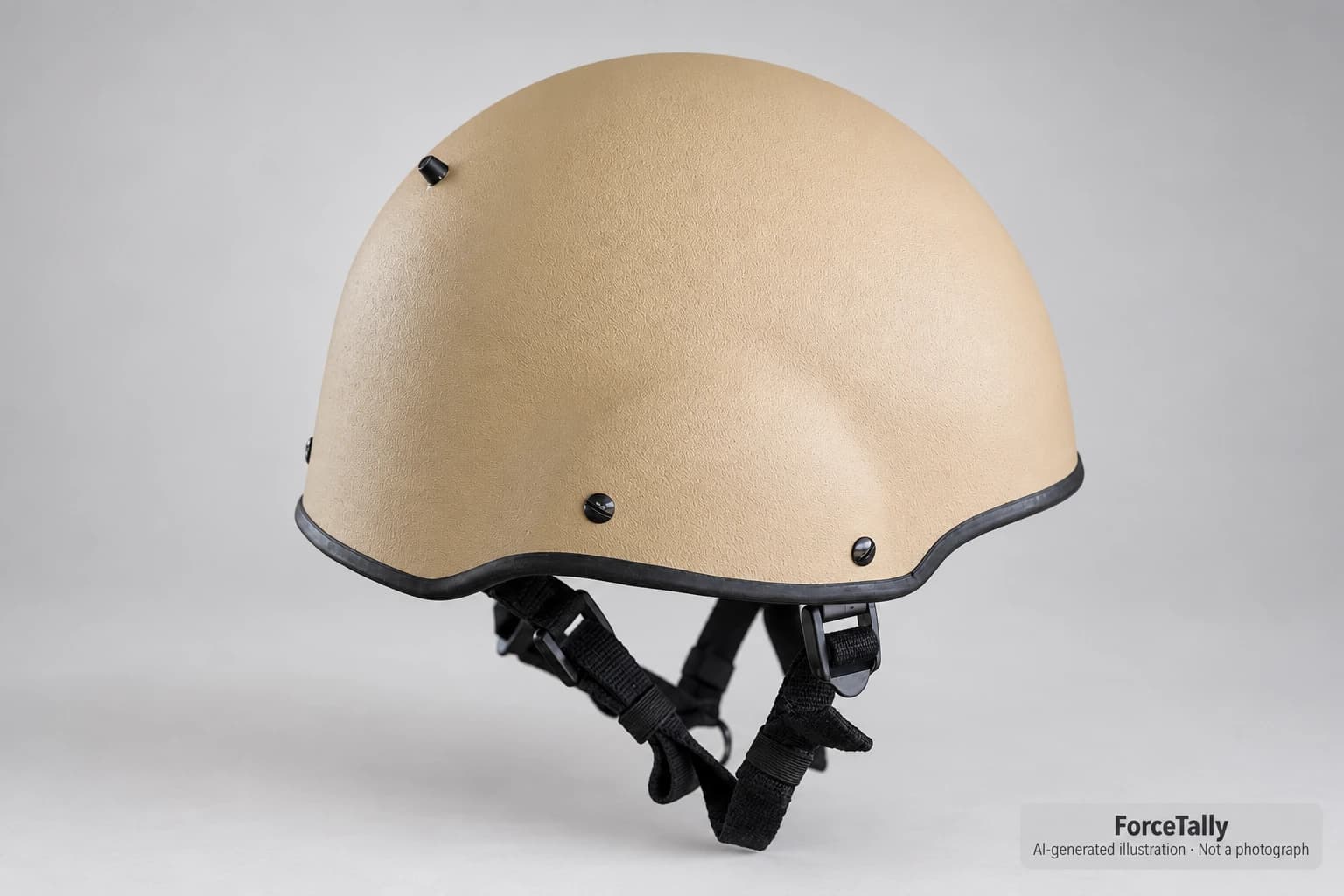
Mk 7 helmet is a combat helmet originating in United Kingdom. It was built by NP Aerospace. Reported operators include Ukraine, United Kingdom.
 United Kingdom
AI-generated illustration · Not a photograph — Mk7 helmet, the sand-coloured bare-shell configuration in the original2009 MOD reference; no camouflage cover or later accessory configuration. Exterior detail is illustrative; not engineering verified.
ForceTally · AI-generated illustration · Not a photograph · Reference: Mk VII Helmet MOD 45150536.jpg by Andrew Linnett, OGL v1.0 (http://NationalArchives.gov.uk/doc/open-government-licence/version/1/), https://commons.wikimedia.org/wiki/File:Mk_VII_Helmet_MOD_45150536.jpg. Changes: Supporting hand and gabion backdrop removed; neutral studio setting and disclosure added. · ForceTally · AI-generated illustration · Source ↗ · ModifiedCombat helmet
United Kingdom
June 2009
See Users
NP Aerospace
Ukraine : In 2014, around 84,000 Mk 7 helmets donated for Ukrainian troops.
United Kingdom : Issued the Mk 7 together with the Osprey body armor in June 2009.
In November 2010, three soldiers from the Royal Irish Regiment credited the helmet for saving their lives when they engaged in a gunfight with Taliban forces. In July 2011, a soldier from the Brigade Reconnaissance Force also credited the helmet with nearly being killed during a gunfight in Helmand province. Defence Science and Technology Laboratory, based in Afghanistan, was asked to assess the damage done to his helmet. Several Mk 7 helmets were donated to the Ukrainian military in 2014.
The helmet weighs one kilogram (35 oz), significantly less than its 1.5-kilogram (53 oz) predecessor. It also has better chin strapping for stability and is produced in a new colour - tan , unlike the Mk 6A in black and Mk 6 in olive . The Mk 7 is constructed out of Kevlar , rather than the Mk 6, which was produced using ballistic nylon , and the Mk 6A, which used a combination of ballistic nylon and additional layers of Aramid fibres over the top.
The mean penetration velocity (V 50 ) for the Mk 7 is about 650 metres per second (2,100 ft/s). This is the velocity at which half (50%) of projectiles are expected to penetrate, and is a measure of the helmet's ballistic protection.
The helmet weighs one kilogram (35 oz), significantly less than its 1.5-kilogram (53 oz) predecessor. It also has better chin strapping for stability and is produced in a new colour - tan , unlike the Mk 6A in black and Mk 6 in olive . The Mk 7 is constructed out of Kevlar , rather than the Mk 6, which was produced using ballistic nylon , and the Mk 6A, which used a combination of ballistic nylon and additional layers of Aramid fibres over the top.
The mean penetration velocity (V 50 ) for the Mk 7 is about 650 metres per second (2,100 ft/s). [ citation needed ] This is the velocity at which half (50%) of projectiles are expected to penetrate, and is a measure of the helmet's ballistic protection.
Reference text from Wikipedia contributors, used under CC BY-SA 4.0.
Mk 7 helmet equipment records. Variants, orders and quantities are shown as reported in each inventory source; coverage is incomplete.
 Ukraine
 Israel
 France