FORCETALLY
Loading the evidence…
Preparing your view.


Preparing your view.
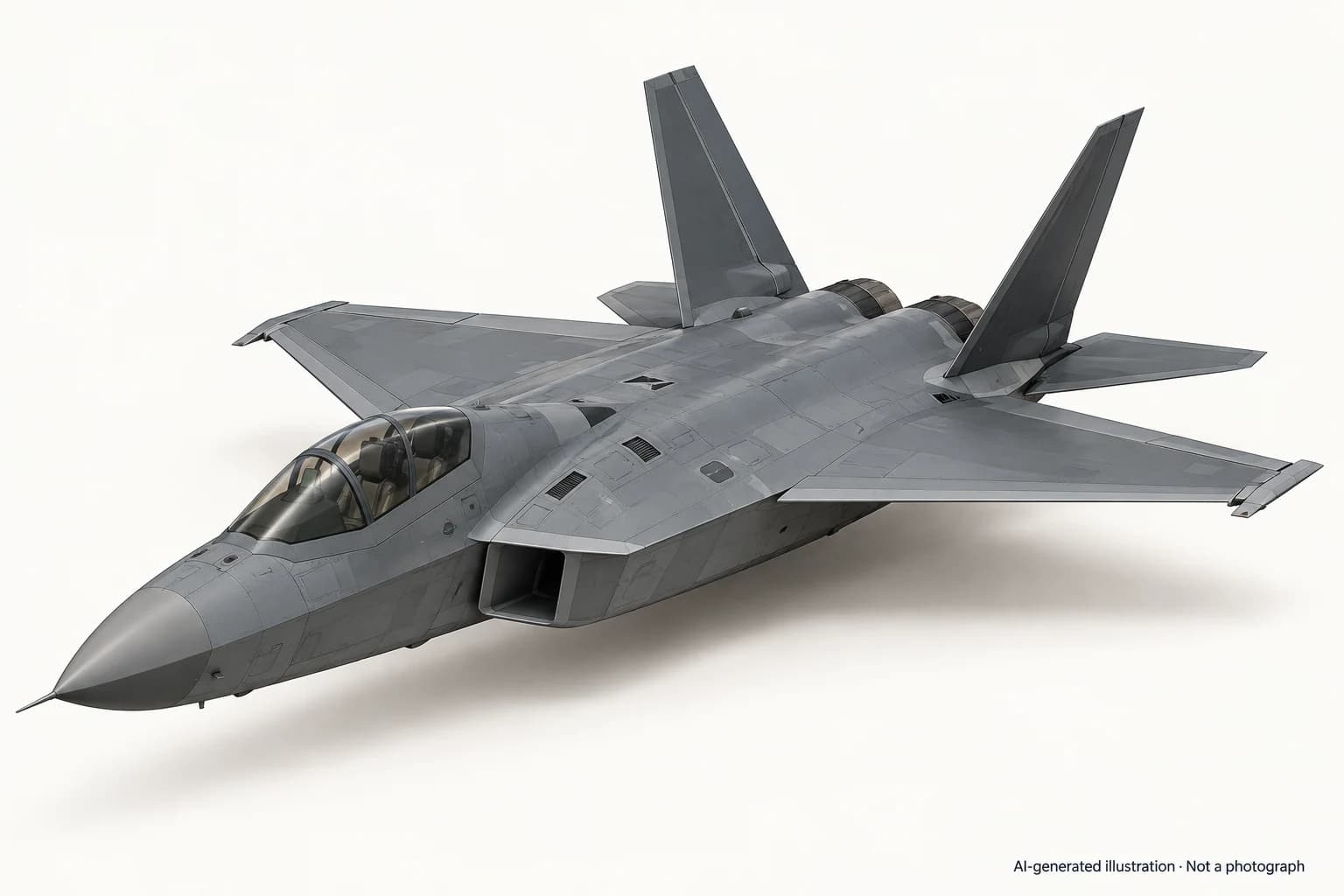
Combat aircraftIn service
Block 1 : Air superiority fighter Block 2 : Multirole combat aircraft Block 3 : Stealth multirole combat aircraft
KAI KF-21 Boramae is a block 1 : Air superiority fighter Block 2 : Multirole combat aircraft Block 3 : Stealth multirole combat aircraft originating in South Korea. It was built by Korea Aerospace Industries.
 South Korea
AI-generated illustration · Not a photograph — Representative exterior of KAI KF-21 Boramae; geometry is illustrative. Not evidence for specifications.
ForceTally · AI-generated illustration · Not a photograph · AI-generated · OpenAI output terms · Source ↗ · ModifiedTechnical data
Block 1 : Air superiority fighter Block 2 : Multirole combat aircraft Block 3 : Stealth multirole combat aircraft
South Korea
Korea Aerospace Industries
Agency for Defense Development
In service
Republic of Korea Air Force
KAI : 6 prototypes ROKAF : 1 (40 orders)
2024–present
22 September 2026
19 July 2022
1 or 2
16.9 m (55 ft 4 in)
11.2 m (36 ft 7 in)
4.7 m (15 ft 4 in)
True scale
Sourced dimensions beside a 1.75 m human reference.
Points represent sourced observations, including revisions. Revisions on the same effective date are not separate inventory events. Ranges appear in the table and are not plotted as exact points.
| Observation / report period | Value | Source | Claim state |
|---|---|---|---|
| 28 Sept 2026 | 1,000 km | Wikipedia contributors | superseded |
46.5 m 2 (501 sq ft)
11,800 kg (26,015 lb)
17,200 kg (37,920 lb)
25,600 kg (56,400 lb)
6,000 kg (13,227 lb) internal
7,700 kg (17,000 lb) external
2 × General Electric F414-GE-400K (manufactured under license by Hanwha Aerospace ) turbofan , 57.8 kN (13,000 lbf) thrust each dry, 97.9 kN (22,000 lbf) with afterburner
2,200 km/h (1,400 mph, 1,200 kn)
1,000 km (620 mi, 540 nmi) (estimated)
2,900 km (1,800 mi, 1,550 nmi)
1× 20 mm M61A2 Vulcan rotary autocannon , 480 rounds
10 (6 under-wing hardpoints and 4 under-fuselage hardpoints)
+9.0
Air-to-air missiles: Meteor IRIS-T LRAAM (Long-Range Air-to-Air Missile, In development) SRAAM (Short-Range Air-to-Air Missile, in development) AIM-120 AMRAAM (Approved) AIM-9X Sidewinder (Approved) Air-to-surface missiles: KALCM Cheonryong (Block 2, in development) Anti-ship missiles: Korean Hypersonic anti-ship missile (In development)
GBU-12 Paveway II (Block 2) GBU-31 Joint Direct Attack Munition (Block 2) GBU-38 Joint Direct Attack Munition (Block 2) GBU-39 Small Diameter Bomb (Block 2) GBU-54 Joint Direct Attack Munition (Block 2) GBU-56 Joint Direct Attack Munition (Block 2) KGGB (Block 2) Mark 82 bomb (Block 2) Mark 84 bomb (Block 2)
The initial goal for the program was to develop a single-seat twin-engine multirole fighter with stealth capabilities exceeding the Dassault Rafale , Eurofighter Typhoon , F-16 Fighting Falcon , but less than those of the Lockheed Martin F-35 Lightning II . The Weapon Systems Concept Development and Application Research Center of Konkuk University advised that the KF-X should be superior to the F-16 Fighting Falcon , with 50% greater combat range, 34% longer airframe lifespan, better avionics, active electronically scanned array (AESA) radar, more-effective electronic warfare, and data link capabilities. Their recommendations specified approximately 50,000 pounds-force (220,000 N) of thrust from two engines, supersonic interception and cruising capabilities, and multi-role capabilities. The Block I configuration requirements were later finalised by the ROKAF and DAPA to a 4.5 generation fighter with semi-stealth capabilities.
A critical structural advantage for the KF-21 in this role is the existence of its tandem-seat (twin-seat) variant. Simultaneously developing both single and twin-seat variants is a deliberate strategic decision, as it necessitates a significant increase in development assets, including a larger fleet of specialized prototypes for concurrent flight testing. Unlike the single-seat-only F-35, Su-57, or J-35, the KF-21's twin-seat configuration allows for a specialized division of labor: while the front pilot focuses on flight operations and immediate threats, the rear-seat officer can act as a dedicated mission commander for the unmanned swarm. This second operator manages the complex tactical data and command-and-control (C2) requirements of the "Loyal Wingmen," ensuring that the cognitive load of controlling multiple assets does not overwhelm the pilot during high-intensity combat.
The MUCCA (Medium Unmanned Collaborative Combat Aircraft) is a 5.4-ton multi-role platform designed to conduct high-risk air-to-air and air-to-ground missions alongside manned fighters, effectively acting as an attritable yet high-performance force multiplier.
In contrast, the SUCA (Small Unmanned Combat Aircraft) is an ultralight 220 kg platform specialized in reconnaissance and electronic warfare support.
A key milestone was the first supersonic flight on January 17, 2023, where the KF-21 broke the sound barrier at an altitude of 40,000 feet.
On 19 July 2022, the KF-21 successfully completed its maiden flight. The KF-21 took off at 3:40 PM and landed at 4:13 PM, marking a successful 33-minute first flight. It will undergo approximately 2,000 flight tests in the future to verify various performance aspects and weapons compatibility.
On 10 November 2022, the second prototype took off from Sacheon Air Base in South Gyeongsang Province , tested its flight performance for 35 minutes, and landed safely.
On 3 January 2023, the third prototype successfully completed its first test flight. The third prototype took off from the 3rd Training Wing in Sacheon, South Gyeongsang Province at 1:01 PM and landed at 1:38 PM. The first test flight recorded a maximum speed of 370 km/h and a maximum altitude of 4,600 meters, which is similar to the levels achieved by the first and second prototypes. The third prototype is equipped with speed and structural load expansion measurement systems. It is expected to facilitate smoother speed and structural load expansion tests, which constitute a significant portion of the KF-21 system development flight tests.
On 17 January 2023, the KF-21 successfully achieved its first supersonic flight. The KF-21 first prototype took off from the ROKAF's 3rd Training Wing and broke the sound barrier (Mach 1.0, approximately 1,224 km/h) for the first time while flying at an altitude of about 40,000 feet over the South Sea.
On 20 February 2023, DAPA announced that the fourth prototype of the KF-21 successfully completed its maiden flight, taking off from the 3rd Training Wing in Sacheon at 11:19 AM and landing at 11:53 AM after a 34-minute flight.
On 28 June, DAPA announced that the sixth prototype successfully completed its maiden flight, taking off from the 3rd Training Wing in Sacheon, and flying for 33 minutes from 3:49 PM to 4:22 PM. With the successful maiden flight of the sixth prototype, all six KF-21 flight test prototypes have now completed their first flights. This milestone comes 11 months after the first prototype's successful flight on 19 July 2022.
On 20 October 2023, at the Seoul ADEX, the KF-21 showcased its technological capabilities during a five-minute demonstration, performing manoeuvres such as horizontal sharp turns and inverted flights. This was the first time the aircraft's flight performance was revealed to the public.
On 12 January 2024, the KF-21 second prototype successfully conducted a high angle of attack (AOA) flight stability test. The aircraft maintained a maximum pitch angle of approximately 70 degrees, flew to an altitude of over 38,000 feet, and then successfully returned to a stable flight condition after reaching a low-speed state (below approximately 20 KCAS).
On 8 May 2024, a KF-21 equipped with a Meteor missile successfully completed its test from Sacheon Airport. The same day, it also aced an AIM-2000 missile test, tracking a drone 87 km away and passing within 1 meter using AESA radar. Later that month, a KF-21 successfully fired an IRIS-T missile for the first time, following earlier tests with an unguided dummy missile of the same type in 2023.
On 19 February 2025, Air Force Chief of Staff Lee Young-su participated in a KF-21 Boramae test flight at Sacheon Air Base, becoming the first non-test pilot to fly aboard the aircraft. Gen. Lee flew at an altitude of approximately 4,500 meters over the southern coast at a speed exceeding 1,000 km/h, assessing the KF-21's stable aerial operational capabilities. Additionally, he flew alongside a KF-16 to verify its tactical interoperability with other aircraft.
On August 5, 2025, Hanwha Systems rolls out the first mass-produced AESA radar. The resulting domestically produced radar, the APY-016K is equipped with approximately 1,000 transmit-receive modules, enabling it to detect targets from 150 to 200 km away and track about 20 targets simultaneously, allowing the KF-21 to engage multiple enemies effectively.
On October 17, 2025, during the first public day of the Seoul ADEX 2025, the KF-21 Boramae successfully demonstrated a series of high-difficulty aerial maneuvers at Seoul Airport, showcasing its advanced combat agility. Unlike previous exhibitions, this flight was conducted with G-force restrictions lifted, allowing the indigenous supersonic fighter to perform high-speed sharp turns, inverted flights, vertical climbs, and rolls, as well as a low-altitude flyby reaching speeds of approximately 1,000 km/h. Military officials and observers noted that while the KF-21 had appeared at the previous year's event, this latest performance utilized more sophisticated piloting and intensified maneuverability to definitively prove the aircraft's operational stability and superior flight performance to the public.
After high level talks between Presidents Lee Jae Myung and Prabowo Subianto agreeing to expand defense cooperation ties to special comprehensive strategic partnership, South Korea mulled on transferring a single seated prototype of the aircraft to Indonesia. DAPA announced that they will decide on the transfer schedule once Indonesia has fulfilled their 600 million won contribution. As of 8 April 2026, Indonesia has paid 536 million won and is expected to pay the remaining 64 million won in June 2026 in order to make the transfer possible. On 10 June 2026, Ambassador Cecep Herawan announced that one KF-21 prototype will be transferred to Indonesia with outstanding payments has been concluded. KAI confirms the prototype transfer will be conducted with both sides discussed about the transfer mechanism. However, Indonesian Ministry of Defense announced that the co-production of KF-21 with PTDI has been cancelled and has instead opted to purchase the aircraft as a regular customer, ending all contributions despite concluding payment on the remaining contribution.
On 13 June 2025, South Korea agreed to reduce Indonesia's contribution to 600 billion won ($439 million) through the signing of a memorandum of understanding at Indo Defence Expo & Forum 2024 in Jakarta . DAPA had also met with Indonesian Minister of Defence Sjafrie Sjamsoeddin to reaffirm the joint partnership, while KAI and Indonesian Aerospace agreed to strengthen practical cooperation in production and marketing for the IF-21 variant.
Will serve as an electronic warfare aircraft / escort jammer comparable to the EA-18G Growler .
Length: 16.9 m (55 ft 4 in)
Wingspan: 11.2 m (36 ft 7 in)
Height: 4.7 m (15 ft 4 in)
Wing area: 46.5 m 2 (501 sq ft)
Empty weight: 11,800 kg (26,015 lb)
Gross weight: 17,200 kg (37,920 lb)
Max takeoff weight: 25,600 kg (56,400 lb)
Fuel capacity: 6,000 kg (13,227 lb) internal
Payload : 7,700 kg (17,000 lb) external
Powerplant: 2 × General Electric F414-GE-400K (manufactured under license by Hanwha Aerospace ) turbofan , 57.8 kN (13,000 lbf) thrust each dry, 97.9 kN (22,000 lbf) with afterburner
Maximum speed: 2,200 km/h (1,400 mph, 1,200 kn)
Combat range: 1,000 km (620 mi, 540 nmi) (estimated)
Ferry range: 2,900 km (1,800 mi, 1,550 nmi)
Guns: 1× 20 mm M61A2 Vulcan rotary autocannon , 480 rounds
The KAI KF-21 Boramae ( Korean : KF-21 보라매 ; lit. ' KF-21 Hunting Hawk ' ; formerly KF-X ; commonly KF-21 ) is a South Korean twin-engine fighter aircraft .
Block I is the initial production KF‑21 configuration, optimized for air‑to‑air missions as a 4.5‑generation “semi‑stealth” fighter, carrying Meteor and IRIS‑T missiles on semi‑recessed belly stations and wing pylons. South Korea plans to field about 40 Block I aircraft by around 2028, with Block I jets already entering service with the Republic of Korea Air Force (ROKAF) in 2026.
Block II uses the same airframe but adds full multirole capability with a wider set of precision air‑to‑ground and anti‑ship weapons, and Block I aircraft can be upgraded to Block II largely via software and systems integration.
Block III (sometimes referred to by the project name KF‑XX) is planned as a significantly more advanced “5+ generation” evolution with internal weapons bays, improved stealth (including radar‑absorbent coatings), and upgraded AESA radar and avionics. This configuration is also closely linked to the KF‑21EX concept, which explicitly adds an internal weapons bay sized for Meteor air‑to‑air missiles or multiple small air‑to‑ground munitions to bring the aircraft’s low‑observable performance closer to fifth‑generation fighters like the F‑35. Future Block III/KF‑21EX aircraft are intended to operate in manned‑unmanned teaming networks and use an indigenous KTF16000 engine, replacing the current GE F414s and further enhancing performance and export flexibility.
South Korea is developing a dedicated electronic warfare variant designated KF‑21EA, based on a highly modified two‑seat KF‑21B airframe with a specialized rear cockpit for an Electronic Warfare Officer (EWO). The KF‑21EA is planned to carry multiple Electronic Support Measures (ESM) and Electronic Attack (EA) systems, enabling missions such as electronic intelligence collection and suppression of enemy air defenses (SEAD) using weapons like the AARGM‑ER anti‑radiation missile. This EW version is intended to complement baseline KF‑21 fighters by providing stand‑off jamming and battlefield electronic support within South Korea’s next‑generation air combat system.
The KF‑21SA variant is being designed specifically for export customers, retaining the core performance and airframe of ROKAF versions but allowing flexible customization of weapons, sensors, and internal equipment to match each country’s requirements. Indonesia, a junior development partner in the KF‑21 program, is negotiating for Block II‑level multirole aircraft and is widely expected to be the first foreign operator, with a contract framework for at least 16 production fighters plus one prototype transfer. Other potential KF‑21SA customers under discussion include the Philippines and several Southeast Asian states, with Korean industry reporting over 200 export aircraft currently in various stages of negotiation.
A KF‑21B-based variant is planned for the ROKAF Black Eagles aerobatic team, providing a high‑performance successor to the T‑50B that adds aerial refueling capability to support longer‑range demonstration deployments. In addition to single‑seat fighters, the program envisions twin‑seat configurations for training, complex mission management, or roles like controlling collaborative combat aircraft (loyal wingmen) from the back seat in future Block III aircraft.
KF-21 Boramae; KF-21 Hunting Hawk; KF-X; KAI KF-21 Boramae
Fighter Aircraft
Korea Aerospace Industries
1-2
2
10 (6 under-wing hardpoints and 4 under-fuselage hardpoints
7,700 kg
A key achievement of the KF‑21 program is the development of an indigenous active electronically scanned array (AESA) radar, led by South Korea’s Agency for Defense Development and companies like Hanwha Systems. The radar, designated APY‑016K in some sources, uses advanced gallium‑nitride transmit/receive modules and supports air‑to‑air, maritime search, synthetic‑aperture radar (SAR), and terrain‑following modes. The aircraft integrates modern digital avionics, sensor fusion, electronic warfare systems, and an infrared search and track (IRST) sensor to improve situational awareness. These systems are designed to network with other platforms, enabling cooperative engagements and data‑linked operations typical of contemporary high‑end fighters.
16.9 m
4.7 m
11.2 m
46.5 m2
11,800 kg
17,200 kg
25,600 kg
2 × General Electric F414-GE-400K
Turbofan
57.8 kN (13,000 lbf) thrust each, dry, 97.9 kN (22,000 lbf) with afterburner
6,000 kg
1,000 km (620 mi, 540 nmi)
2,200 km/h (1,400 mph, 1,200 kn)
2,900 km (1,800 mi, 1,550 nmi)
+9.0
16,800 m
The KF‑21 carries an internal 20 mm M61A2 Vulcan rotary cannon, mounted with approximately 480 rounds for close‑range engagements and strafing. Externally, the aircraft has 10 hardpoints—six under the wings and four under the fuselage—for missiles, bombs, and fuel tanks. It has been integrated with a suite of modern air‑to‑air missiles, including the short‑range IRIS‑T (known in ROKAF service as AIM‑2000), the AIM‑9X Sidewinder, the medium‑range AIM‑120 AMRAAM, and the long‑range MBDA Meteor ramjet missile. Meteor separation tests began in 2023, and subsequent trials included guided engagements of target drones, demonstrating beyond‑visual‑range capabilities cued by the AESA radar. Block I aircraft emphasize air‑to‑air missions, with fully operational missile capability, while Block II variants are planned to add long‑range precision‑guided air‑to‑ground and anti‑ship weapons. Domestic weapons like the KGGB precision glide bomb are expected to be integrated alongside Western munitions, giving flexibility for South Korean and export customers.
The KF‑21 has a reduced‑radar‑signature airframe with stealth‑influenced shaping, though it carries weapons on external hardpoints rather than internal bays in current blocks. This approach provides some radar cross‑section reduction and modern survivability features, but not the full stealth level of fifth‑generation aircraft.
INA
INA
Yes
Korea, Republic of (South)
Reference text from Wikipedia contributors, used under CC BY-SA 4.0.
KAI KF-21 Boramae equipment records. Variants, orders and quantities are shown as reported in each inventory source; coverage is incomplete.
 Indonesia
Reported count for KAI KF-21 Boramae. Service scope: Indonesian Air Force; does not replace a national total. 1 distinct quantity component(s) from the same source list; shared rowspan cells counted once. Explicit source inventory scope: ordered; no other stock status or total inferred. Count column(s): in service: + 1. Origin: South Korea / Indonesia. The listed variants/roles are the scope, not an immediately deployable count. Dates are the count-cell citations' stated source period (2026), not the article revision. Cited source 2026-04-07. Edition or publication years do not claim an exact inventory census day.
Reported count for KAI KF-21 Boramae. Service scope: Indonesian Air Force; does not replace a national total. 1 distinct quantity component(s) from the same source list; shared rowspan cells counted once. Explicit source inventory scope: active; no other stock status or total inferred. Count column(s): in service: 0. Origin: South Korea / Indonesia. The listed variants/roles are the scope, not an immediately deployable count. The components do not establish one inventory census date; the stored date is the retrieved source snapshot.
South KoreaReported count for KF-21 Boramae · Block 1. Service scope: Republic of Korea Air Force; does not replace a national total. 1 distinct count cell(s) from the same source list; shared rowspan cells counted once. Excludes retired/reserve/on-order rows. Count column(s): in service: 6 prototypes, 1 in service. Origin: Republic of Korea. The listed variants/roles are the scope, not an immediately deployable count. The components do not establish one inventory census date; the stored date is the retrieved source snapshot.
Keep exploring
Stealth multirole / air superiority fighter
Air superiority fighter , multirole fighter
Compare with KAI KF-21 BoramaeMultirole fighter , air superiority fighter
Compare with KAI KF-21 BoramaeAir superiority fighter , Multirole fighter
 RussiaCompare with KAI KF-21 Boramae
Multirole fighter , air superiority fighter
 United StatesCompare with KAI KF-21 Boramae
Multirole fighter , air superiority fighter , fighter-bomber
Compare with KAI KF-21 Boramae