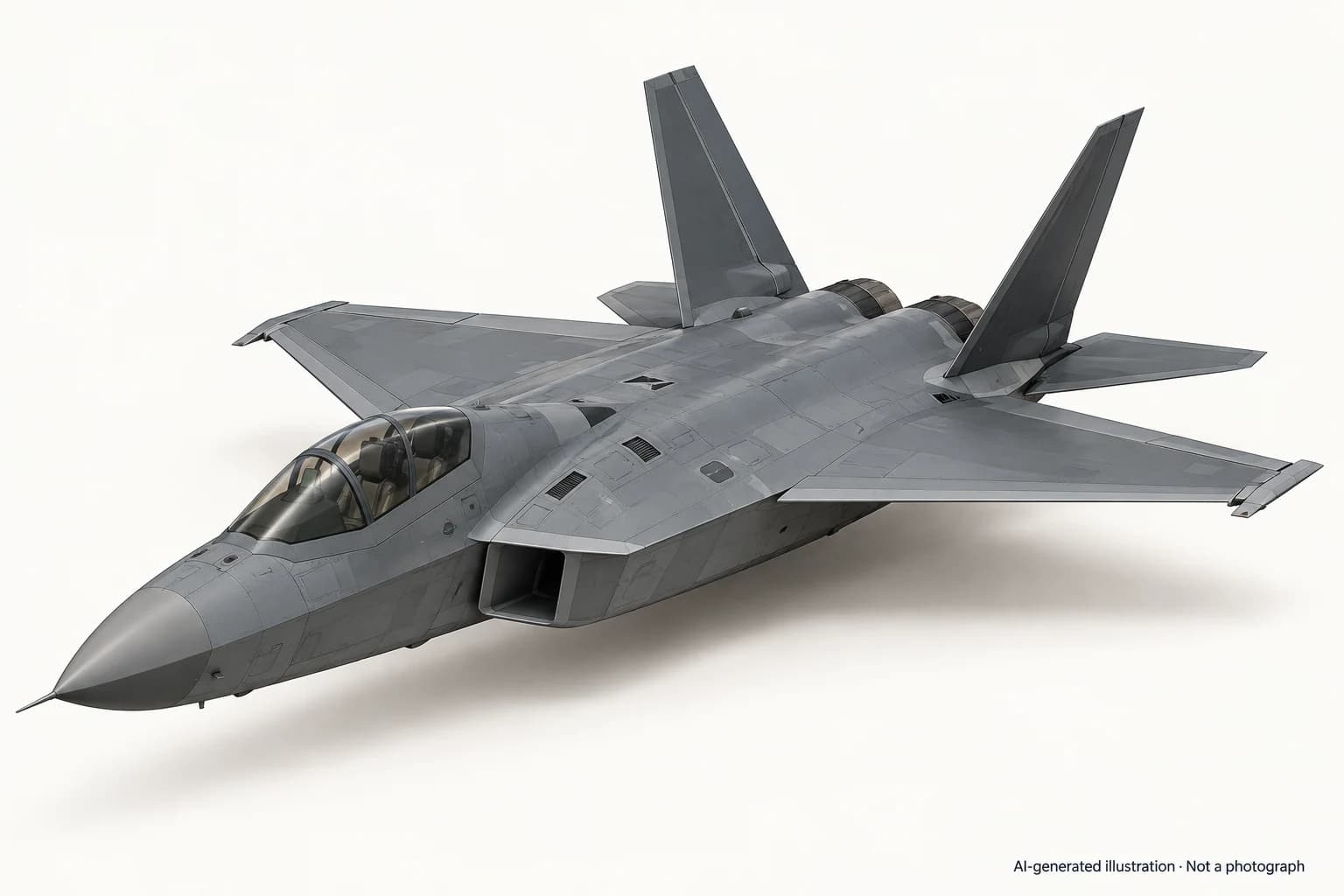
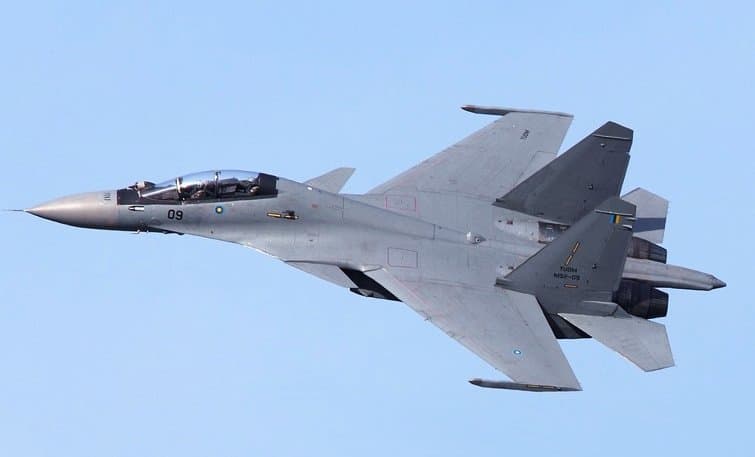
| Source measurement | The initial goal for the program was to develop a single-seat twin-engine multirole fighter with stealth capabilities exceeding the Dassault Rafale , Eurofighter Typhoon , F-16 Fighting Falcon , but less than those of the Lockheed Martin F-35 Lightning II . The Weapon Systems Concept Development and Application Research Center of Konkuk University advised that the KF-X should be superior to the F-16 Fighting Falcon , with 50% greater combat range, 34% longer airframe lifespan, better avionics, active electronically scanned array (AESA) radar, more-effective electronic warfare, and data link capabilities. Their recommendations specified approximately 50,000 pounds-force (220,000 N) of thrust from two engines, supersonic interception and cruising capabilities, and multi-role capabilities. The Block I configuration requirements were later finalised by the ROKAF and DAPA to a 4.5 generation fighter with semi-stealth capabilities.[source]KAI KF-21 Boramae · Design and development; only the objects and conditions stated in this passage A critical structural advantage for the KF-21 in this role is the existence of its tandem-seat (twin-seat) variant. Simultaneously developing both single and twin-seat variants is a deliberate strategic decision, as it necessitates a significant increase in development assets, including a larger fleet of specialized prototypes for concurrent flight testing. Unlike the single-seat-only F-35, Su-57, or J-35, the KF-21's twin-seat configuration allows for a specialized division of labor: while the front pilot focuses on flight operations and immediate threats, the rear-seat officer can act as a dedicated mission commander for the unmanned swarm. This second operator manages the complex tactical data and command-and-control (C2) requirements of the "Loyal Wingmen," ensuring that the cognitive load of controlling multiple assets does not overwhelm the pilot during high-intensity combat.[source]KAI KF-21 Boramae · Design and development / Manned-Unmanned Teaming and AI pilot; only the objects and conditions stated in this passage The MUCCA (Medium Unmanned Collaborative Combat Aircraft) is a 5.4-ton multi-role platform designed to conduct high-risk air-to-air and air-to-ground missions alongside manned fighters, effectively acting as an attritable yet high-performance force multiplier.[source]KAI KF-21 Boramae · Design and development / Manned-Unmanned Teaming and AI pilot; only the objects and conditions stated in this passage In contrast, the SUCA (Small Unmanned Combat Aircraft) is an ultralight 220 kg platform specialized in reconnaissance and electronic warfare support.[source]KAI KF-21 Boramae · Design and development / Manned-Unmanned Teaming and AI pilot; only the objects and conditions stated in this passage A key milestone was the first supersonic flight on January 17, 2023, where the KF-21 broke the sound barrier at an altitude of 40,000 feet.[source]KAI KF-21 Boramae · Design and development / Prototype production and testing; only the objects and conditions stated in this passage On 19 July 2022, the KF-21 successfully completed its maiden flight. The KF-21 took off at 3:40 PM and landed at 4:13 PM, marking a successful 33-minute first flight. It will undergo approximately 2,000 flight tests in the future to verify various performance aspects and weapons compatibility.[source]KAI KF-21 Boramae · Design and development / Prototype production and testing / Testing achievements; only the objects and conditions stated in this passage On 10 November 2022, the second prototype took off from Sacheon Air Base in South Gyeongsang Province , tested its flight performance for 35 minutes, and landed safely.[source]KAI KF-21 Boramae · Design and development / Prototype production and testing / Testing achievements; only the objects and conditions stated in this passage On 3 January 2023, the third prototype successfully completed its first test flight. The third prototype took off from the 3rd Training Wing in Sacheon, South Gyeongsang Province at 1:01 PM and landed at 1:38 PM. The first test flight recorded a maximum speed of 370 km/h and a maximum altitude of 4,600 meters, which is similar to the levels achieved by the first and second prototypes. The third prototype is equipped with speed and structural load expansion measurement systems. It is expected to facilitate smoother speed and structural load expansion tests, which constitute a significant portion of the KF-21 system development flight tests.[source]KAI KF-21 Boramae · Design and development / Prototype production and testing / Testing achievements; only the objects and conditions stated in this passage On 17 January 2023, the KF-21 successfully achieved its first supersonic flight. The KF-21 first prototype took off from the ROKAF's 3rd Training Wing and broke the sound barrier (Mach 1.0, approximately 1,224 km/h) for the first time while flying at an altitude of about 40,000 feet over the South Sea.[source]KAI KF-21 Boramae · Design and development / Prototype production and testing / Testing achievements; only the objects and conditions stated in this passage On 20 February 2023, DAPA announced that the fourth prototype of the KF-21 successfully completed its maiden flight, taking off from the 3rd Training Wing in Sacheon at 11:19 AM and landing at 11:53 AM after a 34-minute flight.[source]KAI KF-21 Boramae · Design and development / Prototype production and testing / Testing achievements; only the objects and conditions stated in this passage On 28 June, DAPA announced that the sixth prototype successfully completed its maiden flight, taking off from the 3rd Training Wing in Sacheon, and flying for 33 minutes from 3:49 PM to 4:22 PM. With the successful maiden flight of the sixth prototype, all six KF-21 flight test prototypes have now completed their first flights. This milestone comes 11 months after the first prototype's successful flight on 19 July 2022.[source]KAI KF-21 Boramae · Design and development / Prototype production and testing / Testing achievements; only the objects and conditions stated in this passage On 20 October 2023, at the Seoul ADEX, the KF-21 showcased its technological capabilities during a five-minute demonstration, performing manoeuvres such as horizontal sharp turns and inverted flights. This was the first time the aircraft's flight performance was revealed to the public.[source]KAI KF-21 Boramae · Design and development / Prototype production and testing / Testing achievements; only the objects and conditions stated in this passage On 12 January 2024, the KF-21 second prototype successfully conducted a high angle of attack (AOA) flight stability test. The aircraft maintained a maximum pitch angle of approximately 70 degrees, flew to an altitude of over 38,000 feet, and then successfully returned to a stable flight condition after reaching a low-speed state (below approximately 20 KCAS).[source]KAI KF-21 Boramae · Design and development / Prototype production and testing / Testing achievements; only the objects and conditions stated in this passage On 8 May 2024, a KF-21 equipped with a Meteor missile successfully completed its test from Sacheon Airport. The same day, it also aced an AIM-2000 missile test, tracking a drone 87 km away and passing within 1 meter using AESA radar. Later that month, a KF-21 successfully fired an IRIS-T missile for the first time, following earlier tests with an unguided dummy missile of the same type in 2023.[source]KAI KF-21 Boramae · Design and development / Prototype production and testing / Testing achievements; only the objects and conditions stated in this passage On 19 February 2025, Air Force Chief of Staff Lee Young-su participated in a KF-21 Boramae test flight at Sacheon Air Base, becoming the first non-test pilot to fly aboard the aircraft. Gen. Lee flew at an altitude of approximately 4,500 meters over the southern coast at a speed exceeding 1,000 km/h, assessing the KF-21's stable aerial operational capabilities. Additionally, he flew alongside a KF-16 to verify its tactical interoperability with other aircraft.[source]KAI KF-21 Boramae · Design and development / Prototype production and testing / Testing achievements; only the objects and conditions stated in this passage On August 5, 2025, Hanwha Systems rolls out the first mass-produced AESA radar. The resulting domestically produced radar, the APY-016K is equipped with approximately 1,000 transmit-receive modules, enabling it to detect targets from 150 to 200 km away and track about 20 targets simultaneously, allowing the KF-21 to engage multiple enemies effectively.[source]KAI KF-21 Boramae · Design and development / Serial production; only the objects and conditions stated in this passage On October 17, 2025, during the first public day of the Seoul ADEX 2025, the KF-21 Boramae successfully demonstrated a series of high-difficulty aerial maneuvers at Seoul Airport, showcasing its advanced combat agility. Unlike previous exhibitions, this flight was conducted with G-force restrictions lifted, allowing the indigenous supersonic fighter to perform high-speed sharp turns, inverted flights, vertical climbs, and rolls, as well as a low-altitude flyby reaching speeds of approximately 1,000 km/h. Military officials and observers noted that while the KF-21 had appeared at the previous year's event, this latest performance utilized more sophisticated piloting and intensified maneuverability to definitively prove the aircraft's operational stability and superior flight performance to the public.[source]KAI KF-21 Boramae · Design and development / Serial production; only the objects and conditions stated in this passage After high level talks between Presidents Lee Jae Myung and Prabowo Subianto agreeing to expand defense cooperation ties to special comprehensive strategic partnership, South Korea mulled on transferring a single seated prototype of the aircraft to Indonesia. DAPA announced that they will decide on the transfer schedule once Indonesia has fulfilled their 600 million won contribution. As of 8 April 2026, Indonesia has paid 536 million won and is expected to pay the remaining 64 million won in June 2026 in order to make the transfer possible. On 10 June 2026, Ambassador Cecep Herawan announced that one KF-21 prototype will be transferred to Indonesia with outstanding payments has been concluded. KAI confirms the prototype transfer will be conducted with both sides discussed about the transfer mechanism. However, Indonesian Ministry of Defense announced that the co-production of KF-21 with PTDI has been cancelled and has instead opted to purchase the aircraft as a regular customer, ending all contributions despite concluding payment on the remaining contribution.[source]KAI KF-21 Boramae · Design and development / Program funding / Indonesia's contributions and financial challenges; only the objects and conditions stated in this passage On 13 June 2025, South Korea agreed to reduce Indonesia's contribution to 600 billion won ($439 million) through the signing of a memorandum of understanding at Indo Defence Expo & Forum 2024 in Jakarta . DAPA had also met with Indonesian Minister of Defence Sjafrie Sjamsoeddin to reaffirm the joint partnership, while KAI and Indonesian Aerospace agreed to strengthen practical cooperation in production and marketing for the IF-21 variant.[source]KAI KF-21 Boramae · Challenges and setbacks / Indonesian renegotiation; only the objects and conditions stated in this passage Will serve as an electronic warfare aircraft / escort jammer comparable to the EA-18G Growler .[source]KAI KF-21 Boramae · Variants / Potential variants; only the objects and conditions stated in this passage Length: 16.9 m (55 ft 4 in)[source]KAI KF-21 Boramae · Specifications (single seat aircraft); only the objects and conditions stated in this passage Wingspan: 11.2 m (36 ft 7 in)[source]KAI KF-21 Boramae · Specifications (single seat aircraft); only the objects and conditions stated in this passage Height: 4.7 m (15 ft 4 in)[source]KAI KF-21 Boramae · Specifications (single seat aircraft); only the objects and conditions stated in this passage Wing area: 46.5 m 2 (501 sq ft)[source]KAI KF-21 Boramae · Specifications (single seat aircraft); only the objects and conditions stated in this passage Empty weight: 11,800 kg (26,015 lb)[source]KAI KF-21 Boramae · Specifications (single seat aircraft); only the objects and conditions stated in this passage Gross weight: 17,200 kg (37,920 lb)[source]KAI KF-21 Boramae · Specifications (single seat aircraft); only the objects and conditions stated in this passage Max takeoff weight: 25,600 kg (56,400 lb)[source]KAI KF-21 Boramae · Specifications (single seat aircraft); only the objects and conditions stated in this passage Fuel capacity: 6,000 kg (13,227 lb) internal[source]KAI KF-21 Boramae · Specifications (single seat aircraft); only the objects and conditions stated in this passage Payload : 7,700 kg (17,000 lb) external[source]KAI KF-21 Boramae · Specifications (single seat aircraft); only the objects and conditions stated in this passage Powerplant: 2 × General Electric F414-GE-400K (manufactured under license by Hanwha Aerospace ) turbofan , 57.8 kN (13,000 lbf) thrust each dry, 97.9 kN (22,000 lbf) with afterburner[source]KAI KF-21 Boramae · Specifications (single seat aircraft); only the objects and conditions stated in this passage Maximum speed: 2,200 km/h (1,400 mph, 1,200 kn)[source]KAI KF-21 Boramae · Specifications (single seat aircraft); only the objects and conditions stated in this passage Combat range: 1,000 km (620 mi, 540 nmi) (estimated)[source]KAI KF-21 Boramae · Specifications (single seat aircraft); only the objects and conditions stated in this passage Ferry range: 2,900 km (1,800 mi, 1,550 nmi)[source]KAI KF-21 Boramae · Specifications (single seat aircraft); only the objects and conditions stated in this passage Guns: 1× 20 mm M61A2 Vulcan rotary autocannon , 480 rounds[source]KAI KF-21 Boramae · Specifications (single seat aircraft); only the objects and conditions stated in this passage Block I is the initial production KF‑21 configuration, optimized for air‑to‑air missions as a 4.5‑generation “semi‑stealth” fighter, carrying Meteor and IRIS‑T missiles on semi‑recessed belly stations and wing pylons. South Korea plans to field about 40 Block I aircraft by around 2028, with Block I jets already entering service with the Republic of Korea Air Force (ROKAF) in 2026.[source]KF-21 Boramae South Korean Fighter Aircraft · Variants Block II uses the same airframe but adds full multirole capability with a wider set of precision air‑to‑ground and anti‑ship weapons, and Block I aircraft can be upgraded to Block II largely via software and systems integration.[source]KF-21 Boramae South Korean Fighter Aircraft · Variants Block III (sometimes referred to by the project name KF‑XX) is planned as a significantly more advanced “5+ generation” evolution with internal weapons bays, improved stealth (including radar‑absorbent coatings), and upgraded AESA radar and avionics. This configuration is also closely linked to the KF‑21EX concept, which explicitly adds an internal weapons bay sized for Meteor air‑to‑air missiles or multiple small air‑to‑ground munitions to bring the aircraft’s low‑observable performance closer to fifth‑generation fighters like the F‑35. Future Block III/KF‑21EX aircraft are intended to operate in manned‑unmanned teaming networks and use an indigenous KTF16000 engine, replacing the current GE F414s and further enhancing performance and export flexibility.[source]KF-21 Boramae South Korean Fighter Aircraft · Variants South Korea is developing a dedicated electronic warfare variant designated KF‑21EA, based on a highly modified two‑seat KF‑21B airframe with a specialized rear cockpit for an Electronic Warfare Officer (EWO). The KF‑21EA is planned to carry multiple Electronic Support Measures (ESM) and Electronic Attack (EA) systems, enabling missions such as electronic intelligence collection and suppression of enemy air defenses (SEAD) using weapons like the AARGM‑ER anti‑radiation missile. This EW version is intended to complement baseline KF‑21 fighters by providing stand‑off jamming and battlefield electronic support within South Korea’s next‑generation air combat system.[source]KF-21 Boramae South Korean Fighter Aircraft · Variants The KF‑21SA variant is being designed specifically for export customers, retaining the core performance and airframe of ROKAF versions but allowing flexible customization of weapons, sensors, and internal equipment to match each country’s requirements. Indonesia, a junior development partner in the KF‑21 program, is negotiating for Block II‑level multirole aircraft and is widely expected to be the first foreign operator, with a contract framework for at least 16 production fighters plus one prototype transfer. Other potential KF‑21SA customers under discussion include the Philippines and several Southeast Asian states, with Korean industry reporting over 200 export aircraft currently in various stages of negotiation.[source]KF-21 Boramae South Korean Fighter Aircraft · Variants A KF‑21B-based variant is planned for the ROKAF Black Eagles aerobatic team, providing a high‑performance successor to the T‑50B that adds aerial refueling capability to support longer‑range demonstration deployments. In addition to single‑seat fighters, the program envisions twin‑seat configurations for training, complex mission management, or roles like controlling collaborative combat aircraft (loyal wingmen) from the back seat in future Block III aircraft.[source]KF-21 Boramae South Korean Fighter Aircraft · Variants KF-21 Boramae; KF-21 Hunting Hawk; KF-X; KAI KF-21 Boramae[source]KF-21 Boramae South Korean Fighter Aircraft · System Fighter Aircraft[source]KF-21 Boramae South Korean Fighter Aircraft · System Korea Aerospace Industries[source]KF-21 Boramae South Korean Fighter Aircraft · System 1-2[source]KF-21 Boramae South Korean Fighter Aircraft · System · units: ea 2[source]KF-21 Boramae South Korean Fighter Aircraft · System · units: ea 10 (6 under-wing hardpoints and 4 under-fuselage hardpoints[source]KF-21 Boramae South Korean Fighter Aircraft · System 7,700 kg[source]KF-21 Boramae South Korean Fighter Aircraft · System A key achievement of the KF‑21 program is the development of an indigenous active electronically scanned array (AESA) radar, led by South Korea’s Agency for Defense Development and companies like Hanwha Systems. The radar, designated APY‑016K in some sources, uses advanced gallium‑nitride transmit/receive modules and supports air‑to‑air, maritime search, synthetic‑aperture radar (SAR), and terrain‑following modes. The aircraft integrates modern digital avionics, sensor fusion, electronic warfare systems, and an infrared search and track (IRST) sensor to improve situational awareness. These systems are designed to network with other platforms, enabling cooperative engagements and data‑linked operations typical of contemporary high‑end fighters.[source]KF-21 Boramae South Korean Fighter Aircraft · System 46.5 m2[source]KF-21 Boramae South Korean Fighter Aircraft · Dimensions 2 × General Electric F414-GE-400K[source]KF-21 Boramae South Korean Fighter Aircraft · Automotive · Engine Name 57.8 kN (13,000 lbf) thrust each, dry, 97.9 kN (22,000 lbf) with afterburner[source]KF-21 Boramae South Korean Fighter Aircraft · Automotive · Engine Power 6,000 kg[source]KF-21 Boramae South Korean Fighter Aircraft · Automotive · Fuel Capacity 1,000 km (620 mi, 540 nmi)[source]KF-21 Boramae South Korean Fighter Aircraft · Automotive · Maximum Range +9.0[source]KF-21 Boramae South Korean Fighter Aircraft · Automotive · G Limits The KF‑21 carries an internal 20 mm M61A2 Vulcan rotary cannon, mounted with approximately 480 rounds for close‑range engagements and strafing. Externally, the aircraft has 10 hardpoints—six under the wings and four under the fuselage—for missiles, bombs, and fuel tanks. It has been integrated with a suite of modern air‑to‑air missiles, including the short‑range IRIS‑T (known in ROKAF service as AIM‑2000), the AIM‑9X Sidewinder, the medium‑range AIM‑120 AMRAAM, and the long‑range MBDA Meteor ramjet missile. Meteor separation tests began in 2023, and subsequent trials included guided engagements of target drones, demonstrating beyond‑visual‑range capabilities cued by the AESA radar. Block I aircraft emphasize air‑to‑air missions, with fully operational missile capability, while Block II variants are planned to add long‑range precision‑guided air‑to‑ground and anti‑ship weapons. Domestic weapons like the KGGB precision glide bomb are expected to be integrated alongside Western munitions, giving flexibility for South Korean and export customers.[source]KF-21 Boramae South Korean Fighter Aircraft · Main Weapon System The KF‑21 has a reduced‑radar‑signature airframe with stealth‑influenced shaping, though it carries weapons on external hardpoints rather than internal bays in current blocks. This approach provides some radar cross‑section reduction and modern survivability features, but not the full stealth level of fifth‑generation aircraft.[source]KF-21 Boramae South Korean Fighter Aircraft · Protection INA[source]KF-21 Boramae South Korean Fighter Aircraft · Protection INA[source]KF-21 Boramae South Korean Fighter Aircraft · Protection Yes[source]KF-21 Boramae South Korean Fighter Aircraft · Protection Korea, Republic of (South)[source]KF-21 Boramae South Korean Fighter Aircraft | The Sukhoi Su-30MKM ( NATO reporting name : Flanker-H ) is a twin-engine supermaneuverable fighter of the Royal Malaysian Air Force (RMAF). It is a variant of the Su-30 series fighters, with many significant improvements over the original Su-30MK export version. The Su-30MKM was developed by the Sukhoi Design Bureau and is based on the Su-30MKI of the Indian Air Force . Both aircraft have common airframe , thrust vectoring engines and a digital fly-by-wire system, however the MKM version differs from the MKI mainly in the composition of the onboard avionics . It can carry up to 8,000 kg (17,637 lb) payload over a 1,296 km (805 mi; 700 nmi) un-refueled combat radius.[source]Sukhoi Su-30MKM · Lead; only the objects and conditions stated in this passage According to Malaysian defense Minister Mohamad Sabu, Malaysia has grounded 14 of 18 Su-30MKM due to engine problems and unavailability of spare parts in 2018. To overcome this problem and increase the readiness of the Su-30MKM fleets, Malaysia has approved the budget worth RM2.2 billion for the Su-30MKM to be upgraded locally by Aerospace Technology Systems Corporation . The first upgraded aircraft was received in 2019 in LIMA 2019 exhibition. The program was completed in January 2025.[source]Sukhoi Su-30MKM · Development; only the objects and conditions stated in this passage The Su-30MKM was developed by the Sukhoi Design Bureau and is based on the Su-30MKI . The MKM version differs from the MKI mainly in the composition of its onboard avionics . Thales Group supplies the Head-up display (HUD), navigational forward-looking IR system NAVFLIR and the Damocles targeting pod . The aircraft carries missile approach warning sensor (MAWS) and laser warning sensor (LWS) manufactured by Avitronics (South Africa). It can carry up to 8,000 kg/ 17,650 lb of weapons and payloads over 700 nmi unrefueled combat radius.[source]Sukhoi Su-30MKM · Design; only the objects and conditions stated in this passage The Su-30MKM can legitimately claim super-maneuverability via digital fly-by-wire, canards , and two Saturn AL-31 FP engines with thrust vectoring producing 27,500 lb thrust each with afterburners. This gives them an edge in close-in dogfights, allowing the pilot to rapidly point the plane at potential targets to draw them within the AA-11/ R-73 Archer’s wide infrared seeker cone, then launch and quickly change energy state and direction. |
|---|