FORCETALLY
Loading the evidence…
Preparing your view.


Preparing your view.
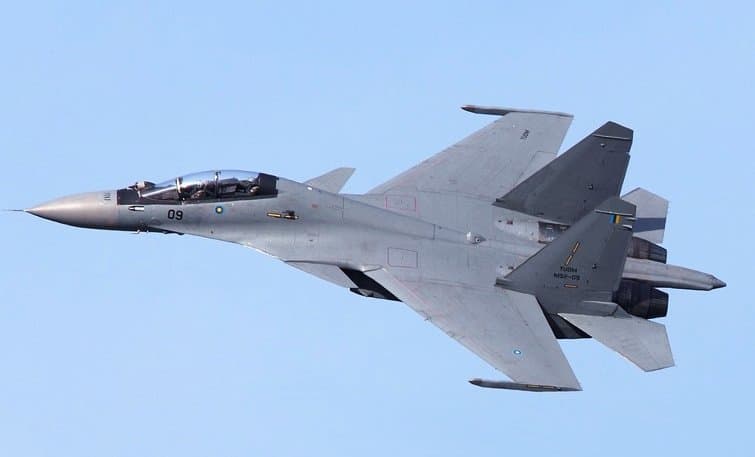
Combat aircraftIn service
Air superiority fighter , Multirole fighter
Sukhoi Su-30MKM is a air superiority fighter , Multirole fighter originating in Russia. Reported operators include Royal Malaysian Air Force.
 Russia
Air superiority fighter , Multirole fighter
Russia
Sukhoi
Irkut Corporation
In service
Royal Malaysian Air Force
18
2007
August 2003 ( 2003-08 )
Sukhoi Su-30 Sukhoi Su-30MKI
2
21.935 m (72 ft 0 in)
14.7 m (48 ft 3 in)
6.36 m (20 ft 10 in)
62 m 2 (670 sq ft)
18,400 kg (40,565 lb)
26,090 kg (57,519 lb) typical mission weight
38,800 kg (85,539 lb)
2 × Lyulka AL-31FP afterburning turbofan engines, 123 kN (28,000 lbf) with afterburner
2,120 km/h (1,320 mph, 1,140 kn) / M 2.0 at high altitude
3,000 km (1,900 mi, 1,600 nmi) at high altitude
8,000 km (5,000 mi, 4,300 nmi) with two in-flight refuellings
17,300 m (56,800 ft)
+ 9g
300 m/s (59,000 ft/min) +
401 kg/m 2 (82 lb/sq ft)
0.96
1 × 30 mm Gryazev-Shipunov GSh-30-1 autocannon
12 hardpoints (2 × wingtip AAM rails, 6 × under-wing pylons, 2 × pylon under-engine nacelles , and 2 × pylons in tandem in the "arch" between the engines. It can be increased to 14 using multiple ejector racks.) with a capacity of up to 8,130 kg (17,920 lb), with provisions to carry combinations of:
4 × B-8 rocket pods for 80 × S-8 rockets 4 × B-13 rocket pods for 20 × S-13 rockets
Air-to-air missiles : 10 × R-77 6 × R-27ER/ET 2 × R-27R/T 6 × R-73 Air-to-surface missiles : 3 × Kh-59ME 6 × Kh-29T/L Anti-ship missiles : 3 × Kh-59MK 4 × Kh-31A Anti-radiation missiles : 6 × Kh-31P
8 × KAB-500L laser-guided bombs 3 × KAB-1500L laser-guided bombs 8 × FAB-500T bombs 28 × OFAB-250-270 bombs 32 × OFAB-100-120 bombs 4 × GBU-12 Paveway II laser-guided bomb
The Sukhoi Su-30MKM ( NATO reporting name : Flanker-H ) is a twin-engine supermaneuverable fighter of the Royal Malaysian Air Force (RMAF).
The Sukhoi Su-30MKM ( NATO reporting name : Flanker-H ) is a twin-engine supermaneuverable fighter of the Royal Malaysian Air Force (RMAF). It is a variant of the Su-30 series fighters, with many significant improvements over the original Su-30MK export version. The Su-30MKM was developed by the Sukhoi Design Bureau and is based on the Su-30MKI of the Indian Air Force . Both aircraft have common airframe , thrust vectoring engines and a digital fly-by-wire system, however the MKM version differs from the MKI mainly in the composition of the onboard avionics . It can carry up to 8,000 kg (17,637 lb) payload over a 1,296 km (805 mi; 700 nmi) un-refueled combat radius.
According to Malaysian defense Minister Mohamad Sabu, Malaysia has grounded 14 of 18 Su-30MKM due to engine problems and unavailability of spare parts in 2018. To overcome this problem and increase the readiness of the Su-30MKM fleets, Malaysia has approved the budget worth RM2.2 billion for the Su-30MKM to be upgraded locally by Aerospace Technology Systems Corporation . The first upgraded aircraft was received in 2019 in LIMA 2019 exhibition. The program was completed in January 2025.
The Su-30MKM was developed by the Sukhoi Design Bureau and is based on the Su-30MKI . The MKM version differs from the MKI mainly in the composition of its onboard avionics . Thales Group supplies the Head-up display (HUD), navigational forward-looking IR system NAVFLIR and the Damocles targeting pod . The aircraft carries missile approach warning sensor (MAWS) and laser warning sensor (LWS) manufactured by Avitronics (South Africa). It can carry up to 8,000 kg/ 17,650 lb of weapons and payloads over 700 nmi unrefueled combat radius.
The Su-30MKM can legitimately claim super-maneuverability via digital fly-by-wire, canards , and two Saturn AL-31 FP engines with thrust vectoring producing 27,500 lb thrust each with afterburners. This gives them an edge in close-in dogfights, allowing the pilot to rapidly point the plane at potential targets to draw them within the AA-11/ R-73 Archer’s wide infrared seeker cone, then launch and quickly change energy state and direction.
The electronic warfare (EW) systems, phased array radars , and optical-location systems with laser rangefinder were all produced by leading Russian manufacturers. At that time, officers from the RMAF formed a Su-30MKM Project Team which was based in Moscow; the team actively participated in the integration of all the avionics systems. The aircraft is capable of conducting SEAD missions when equipped with two KNIRTI SAP-518 jamming pods and Kh-31P anti-radiation missiles. The KNIRTI SAP-518 covers NATO surface-to-air and air-to-air threats in the G-J bands. It is equipped with NIIP N011M phased array radar for long range aerial combat which can track up to 15 targets and engage four targets simultaneously. It can also be equipped with a Thales Damocles Laser Designation surveillance and targeting Pod for precision ground attack. It has a rear-facing radar, Thales HUD, and French NAVFLIR (Navigation Forward Looking Infra-red). Missile Approach Warning System (MAWS) and laser warning sensor (LWS) are supplied by Avitronics of South Africa.
Length: 21.935 m (72 ft 0 in)
Wingspan: 14.7 m (48 ft 3 in)
Height: 6.36 m (20 ft 10 in)
Wing area: 62 m 2 (670 sq ft)
Empty weight: 18,400 kg (40,565 lb)
Gross weight: 26,090 kg (57,519 lb) typical mission weight
Max takeoff weight: 38,800 kg (85,539 lb)
Powerplant: 2 × Lyulka AL-31FP afterburning turbofan engines, 123 kN (28,000 lbf) with afterburner
Maximum speed: 2,120 km/h (1,320 mph, 1,140 kn) / M 2.0 at high altitude
1,350 km/h (840 mph; 730 kn) / M1.09 at low altitude
Range: 3,000 km (1,900 mi, 1,600 nmi) at high altitude
1,270 km (790 mi; 690 nmi) at low altitude
Ferry range: 8,000 km (5,000 mi, 4,300 nmi) with two in-flight refuellings
Service ceiling: 17,300 m (56,800 ft)
g limits: + 9g
Rate of climb: 300 m/s (59,000 ft/min) +
Guns: 1 × 30 mm Gryazev-Shipunov GSh-30-1 autocannon
Hardpoints: 12 hardpoints (2 × wingtip AAM rails, 6 × under-wing pylons, 2 × pylon under-engine nacelles , and 2 × pylons in tandem in the "arch" between the engines. It can be increased to 14 using multiple ejector racks.) with a capacity of up to 8,130 kg (17,920 lb), with provisions to carry combinations of: Rockets: 4 × B-8 rocket pods for 80 × S-8 rockets 4 × B-13 rocket pods for 20 × S-13 rockets Missiles: Air-to-air missiles : 10 × R-77 6 × R-27ER/ET 2 × R-27R/T 6 × R-73 Air-to-surface missiles : 3 × Kh-59ME 6 × Kh-29T/L Anti-ship missiles : 3 × Kh-59MK 4 × Kh-31A Anti-radiation missiles : 6 × Kh-31P Bombs: 8 × KAB-500L laser-guided bombs 3 × KAB-1500L laser-guided bombs 8 × FAB-500T bombs 28 × OFAB-250-270 bombs 32 × OFAB-100-120 bombs 4 × GBU-12 Paveway II laser-guided bomb
{"datatype": "wikibase-item", "datavalue": {"type": "wikibase-entityid", "value": {"entity-type": "item", "id": "Q420842", "numeric-id": 420842}}, "hash": "9393b4889578791a9c4224c32a975668a340ff2e", "property": "P176", "snaktype": "value"}
Reference text from Wikipedia contributors, used under CC BY-SA 4.0.
True scale
Sourced dimensions beside a 1.75 m human reference.
See it in your room. Scan with your phone to open this model in 3D, then place it in your space.
Points represent sourced observations, including revisions. Revisions on the same effective date are not separate inventory events. Ranges appear in the table and are not plotted as exact points.
| Observation / report period | Value | Source | Claim state |
|---|---|---|---|
| 1 Oct 2026 | 2 people | Wikipedia contributors | superseded |
| 1 Oct 2026 | 2 people | Wikipedia contributors | superseded |
| 1 Oct 2026 | 2 people | Wikipedia contributors | superseded |
| 1 Oct 2026 | 2 people | Wikipedia contributors | approved |
Sukhoi Su-30MKM equipment records. Variants, orders and quantities are shown as reported in each inventory source; coverage is incomplete.
 Malaysia
Air Force exact named equipment holdings: Su-30MKM (some serviceability in doubt). Active, operational-reserve and training units excluding equipment in store; November 2025 IISS assessment. Named service only; no parent-force or national total inferred. Source role: AIRCRAFT / FGA. Original estimates, ranges, reporting names, reserve, lease and employment scopes retained; nested included counts are not added. Missile-system quantities mean launchers, not rounds. No readiness, crew, carried weapon, payload, factory-production or future order count inherited.
Keep exploring
Air superiority fighter , multirole fighter
Compare with Sukhoi Su-30MKMMultirole fighter , air superiority fighter
 United StatesCompare with Sukhoi Su-30MKM
Multirole fighter , air superiority fighter
Compare with Sukhoi Su-30MKMMultirole fighter , air superiority fighter , fighter-bomber
Compare with Sukhoi Su-30MKMStealth multirole / air superiority fighter
Interceptor , air superiority , and multirole fighter
United StatesCompare with Sukhoi Su-30MKM