Design and role
Lockheed Martin identifies the APG-83 electronically scanned radar as a feature of Block 70/72. Its description concerns the modern production offering, not every aircraft carrying the F-16 name.


Preparing your view.
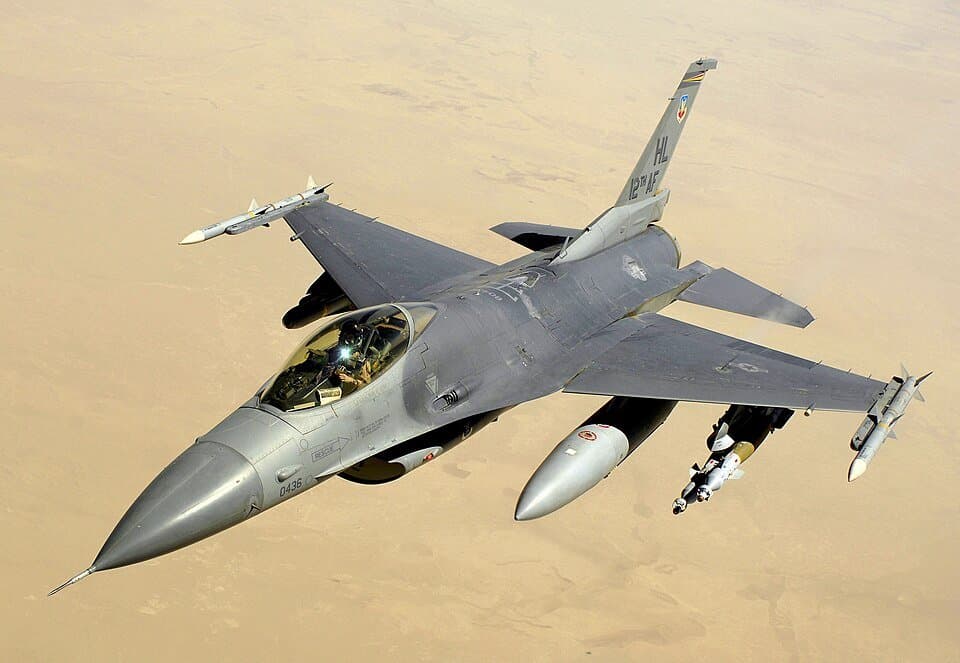
Combat aircraftIn service
Multirole fighter , air superiority fighter
General Dynamics F-16 Fighting Falcon is a multirole fighter , air superiority fighter originating in United States. The cited manufacturer or builder is General Dynamics (1974–1993) Lockheed Corporation (1993–1995) Lockheed Martin (1995–2017, 2019-present).
 United States
General Dynamics F-16 Fighting Falcon
Master Sgt. Andy Dunaway · Public domain · Resized · Public domain · Source ↗ · ModifiedTechnical data
Multirole fighter , air superiority fighter
United States
General Dynamics (1974–1993) Lockheed Corporation (1993–1995) Lockheed Martin (1995–2017, 2019-present)
SABCA (1979–1985) Fokker (1979–1982) KAI (1994–2004) TUSAŞ (1987–2011)
In service
United States Air Force 25 other users (see operators page )
4,604
1973–2017, 2019–present
17 August 1978 ( 1978-08-17 )
20 January 1974 ( 1974-01-20 ) (unplanned); 2 February 1974 ( 1974-02-02 ) (official)
General Dynamics X-62 VISTA
Vought Model 1600 General Dynamics F-16XL Mitsubishi F-2 Lockheed Martin F-16V Viper
1
True scale
Sourced dimensions beside a 1.75 m human reference.
The system in detail
Lockheed Martin identifies the APG-83 electronically scanned radar as a feature of Block 70/72. Its description concerns the modern production offering, not every aircraft carrying the F-16 name.
An upgrade announcement, a signed order and an aircraft in operational service are different records. Operator inventory claims need delivery dates and a precise block designation.
49 ft 5 in (15.06 m)
32 ft 8 in (9.96 m)
16 ft (4.9 m)
300 sq ft (28 m 2 )
18,900 lb (8,573 kg)
26,500 lb (12,020 kg)
42,300 lb (19,187 kg)
7,000 pounds (3,200 kg) internal
1 × General Electric F110-GE-129 for Block 50 aircraft , 17,155 lbf (76.31 kN) thrust dry, 29,500 lbf (131 kN) with afterburner (1 × Pratt & Whitney F100-PW-229 for Block 52 aircraft, 17,800 lbf (79 kN) thrust dry and 29,160 lbf (129.7 kN) with afterburner.)
Mach 2.05, 1,176 kn (1,353 mph; 2,178 km/h) at 40,000 feet, clean Mach 1.2, 800 kn (921 mph; 1,482 km/h) at sea level
504 kn (580 mph, 933 km/h)
295 nmi (339 mi, 546 km) on a hi-lo-hi mission with 4 × 1,000 lb (454 kg) bombs
2,277 nmi (2,620 mi, 4,217 km) with three drop tanks
50,000 ft (15,000 m)
1 × 20 mm (0.787 in) M61A1 Vulcan 6-barrel rotary cannon , 500 rounds
2 × wing-tip air-to-air missile launch rails, 6 × under-wing, and 3 × under-fuselage pylon (2 of 3 for sensors) stations with a capacity of up to 17,000 lb (7,700 kg) of stores
Argentina
Bahrain
Belgium
Bulgaria
Chile
Egypt
Greece
Indonesia
Iraq
Israel
Jordan
Morocco
Oman
Pakistan
Peru
Poland
Portugal
Republic of China
Romania
Singapore
Slovakia
South Korea
Thailand
Turkey
Ukraine
United Arab Emirates
United States
Venezuela
NACA 64A204
+9
324°/s
88.3 lb/sq ft (431 kg/m 2 )
1.095 (1.24 with loaded weight & 50% internal fuel)
4 × LAU-61/LAU-68 rocket pods (each with 19/7 × Hydra 70 mm/ APKWS rockets, respectively) 4 × LAU-5003 rocket pods (each with 19 × CRV7 70 mm rockets) 4 × LAU-10 rocket pods (each with 4 × Zuni 127 mm rockets)
Air-to-air missiles : 6 × AIM-9 Sidewinder 6 × AIM-120 AMRAAM 6 × IRIS-T 6 × Python-4 6 × Python-5 2 × AIM-7 Sparrow and 4 × AIM-9 Sidewinder Air-to-surface missiles : 6 × AGM-65 Maverick 2 × AGM-88 HARM AGM-158 JASSM (JASSM) Anti-ship missiles : 2 × AGM-84 Harpoon 4 × AGM-119 Penguin Joint Strike Missile (to be integrated)
8 × CBU-87 Combined Effects Munition 8 × CBU-89 Gator mine 8 × CBU-97 Sensor Fuzed Weapon 4 × Mark 84 general-purpose bombs 8 × Mark 83 GP bombs 12 × Mark 82 GP bombs 8 × GBU-39 Small Diameter Bomb (SDB) 4 × GBU-10 Paveway II 6 × GBU-12 Paveway II 4 × GBU-24 Paveway III 4 × GBU-27 Paveway III 4 × Joint Direct Attack Munition (JDAM) series 4 × AGM-154 Joint Standoff Weapon (JSOW) Wind Corrected Munitions Dispenser (WCMD) B61 nuclear bomb B83 nuclear bomb
ADM-160 MALD SUU-42A/A flares/infrared decoys dispenser pod and chaff pod or AN/ALQ-131 & AN/ALQ-184 ECM pods on centerline or LANTIRN , Lockheed Martin Sniper XR & Litening targeting pods or AN/ASQ-213 HARM targeting system (HTS) Pod (typically configured on station 5L with Sniper XR pod on station 5R) or Up to 3 × 300/330/370/600 US gallon (1,135, 1,250, 1,400, 2,270 L) Sargent Fletcher drop tanks for ferry flight/extended range/loitering time or UTC Aerospace DB-110 long range EO/IR sensor pod on centerline
Mach 2.05, 1,176 kn (1,353 mph; 2,178 km/h) at 40,000 feet, clean
Bahrain - Royal Bahraini Air Force operates 16 single-seat F-16C Block 40s and 4 dual-seat F-16D Block 40s.
Jordan - Royal Jordanian Air Force operates 44 F-16AM Block 20 MLU and 15-18 F-16BM Block 20 MLU.
Morocco - The Royal Moroccan Air Force is converting its 23 F-16C/D Block 52+ to F-16Vs.
Poland - The Polish Air Force is converting its 48 Block 52+ to F-16Vs.
Republic of China - Republic of China Air Force operates 139 F-16V converted from its F-16 Block 20s.
Romania - operates 64 F-16 MLUs + 1 for ground training.
Denmark – Royal Danish Air Force sold 24 F-16s to Argentine Air Force in 2024. 19 F-16s donated to Ukrainian Air Force .
Italy – Italian Air Force used up to 30 F-16As and 4 F-16Bs of the Block 15 ADF variant, leased from the U.S. Air Force, from 2003 to 2012.
Netherlands – Royal Netherlands Air and Space Force originally bought 213 aircraft. Later sold six F-16s to Royal Jordanian Air Force , and 36 F-16s to Chilean Air Force in 2005. It donated the remaining operational fleet of 24 aircraft to Ukraine as part of the F-16 training coalition in 2024-25.
Norway – Royal Norwegian Air Force (RNoAF) on 6 January 2022, Norway announced that all F-16s had been retired and replaced with the F-35 . The RNoAF sold 32 of their F-16s to Romanian Air Force , with the remaining operational aircraft being donated to Ukraine.
The General Dynamics (now Lockheed Martin ) F-16 Fighting Falcon is an American single-engine supersonic multirole fourth-generation fighter aircraft developed by General Dynamics and produced by multiple companies, including General Dynamics until 1993 and Lockheed Martin until 2017.
The aircraft was first developed by General Dynamics in 1974. In 1993, General Dynamics sold its aircraft manufacturing business to Lockheed , which became part of Lockheed Martin after a 1995 merger with Martin Marietta . The F-16's key features include a frameless bubble canopy for enhanced cockpit visibility, a side-stick to ease control while maneuvering, an ejection seat reclined 30 degrees from vertical to reduce the effect of g-forces on the pilot, and the first use of a relaxed static stability / fly-by-wire flight control system that helps to make it an agile aircraft. The fighter has a single turbofan engine, an internal M61 Vulcan cannon and 11 hardpoints . Although officially named "Fighting Falcon", the aircraft is commonly known by the nickname "Viper" among its crews and pilots.
The F-16 primarily performed strike and suppression of enemy air defenses (SEAD) missions, and in the latter role, it replaced the F-4G Wild Weasel by 1996.
The request for proposals issued on 6 January 1972 called for a 20,000-pound (9,100 kg) class air-to-air day fighter with a good turn rate, acceleration, and range, and optimized for combat at speeds of Mach 0.6–1.6 and altitudes of 30,000–40,000 feet (9,100–12,000 m).
Its 90-minute maiden flight was made at the Air Force Flight Test Center at Edwards AFB , California, on 2 February 1974.
The test pilot, Phil Oestricher , decided to lift off to avoid a potential crash, safely landing six minutes later.
During the flyoff, the YF-16s completed 330 sorties for a total of 417 flight hours; the YF-17s flew 288 sorties, covering 345 hours.
Increased interest turned the LWF into a serious acquisition program. NATO allies Belgium, Denmark, the Netherlands, and Norway were seeking to replace their F-104G Starfighter fighter-bombers . In early 1974, they reached an agreement with the U.S. that if the USAF ordered the LWF winner, they would consider ordering it as well. The USAF also needed to replace its F-105 Thunderchief and F-4 Phantom II fighter-bombers. The U.S. Congress sought greater commonality in fighter procurements by the Air Force and Navy, and in August 1974 redirected Navy funds to a new Navy Air Combat Fighter program that would be a naval fighter-bomber variant of the LWF. The four NATO allies had formed the Multinational Fighter Program Group (MFPG) and pressed for a U.S. decision by December 1974; thus, the USAF accelerated testing.
The U.S. Air Force initially ordered 15 full-scale development (FSD) aircraft (11 single-seat and four two-seat models) for its flight test program which was reduced to eight (six F-16A single-seaters and two F-16B two-seaters). The YF-16 design was altered for the production F-16. The fuselage was lengthened by 10.6 in (0.269 m), a larger nose radome was fitted for the AN/APG-66 radar, wing area was increased from 280 to 300 sq ft (26 to 28 m 2 ), the tailfin height was decreased, the ventral fins were enlarged, two more stores stations were added, and a single door replaced the original nosewheel double doors. The F-16's weight was increased by 25% over the YF-16 by these modifications.
The FSD F-16s were manufactured by General Dynamics in Fort Worth, Texas , at United States Air Force Plant 4 in late 1975; the first F-16A rolled out on 20 October 1976 and first flew on 8 December. The initial two-seat model achieved its first flight on 8 August 1977. The initial production-standard F-16A flew for the first time on 7 August 1978 and its delivery was accepted by the USAF on 6 January 1979. The aircraft entered USAF operational service with the 34th Tactical Fighter Squadron , 388th Tactical Fighter Wing , at Hill AFB in Utah, on 1 October 1980.
Two European production lines, one in the Netherlands at Fokker 's Schiphol-Oost facility and the other at SABCA's Gosselies plant in Belgium, would produce 184 and 164 units respectively.
During the late 1980s and 1990s, Turkish Aerospace Industries (TAI) produced 232 Block 30/40/50 F-16s on a production line in Ankara under license for the Turkish Air Force . TAI also produced 46 Block 40s for Egypt in the mid-1990s and 30 Block 50s from 2010 onwards. Korean Aerospace Industries opened a production line for the KF-16 program, producing 140 Block 52s from the mid-1990s to mid-2000s (decade). If India had selected the F-16IN for its Medium Multi-Role Combat Aircraft procurement, a sixth F-16 production line would have been built in India. In May 2013, Lockheed Martin stated there were currently enough orders to keep producing the F-16 until 2017.
In the 1980s, the Multinational Staged Improvement Program (MSIP) was conducted to evolve the F-16's capabilities, mitigate risks during technology development, and ensure the aircraft's worth. The program upgraded the F-16 in three stages. The MSIP process permitted the quick introduction of new capabilities, at lower costs and with reduced risks compared to traditional independent upgrade programs. In 2012, the USAF had allocated $2.8 billion (~$3.77 billion in 2024) to upgrade 350 F-16s while waiting for the F-35 to enter service. One key upgrade has been an auto-GCAS ( ground collision avoidance system ) to reduce instances of controlled flight into terrain . Onboard power and cooling capacities limit the scope of upgrades, which often involve the addition of more power-hungry avionics.
The F-16 is a single-engine, highly maneuverable, supersonic, multirole tactical fighter aircraft. It is much smaller and lighter than its predecessors but uses advanced aerodynamics and avionics, including the first use of a relaxed static stability / fly-by-wire (RSS/FBW) flight control system, to achieve enhanced maneuver performance. Highly agile, the F-16 was the first fighter aircraft purpose-built to pull 9- g maneuvers and can reach a maximum speed of over Mach 2. Innovations include a frameless bubble canopy for better visibility, a side-mounted control stick, and a reclined seat to reduce g-force effects on the pilot. It is armed with an internal 20 mm M61 Vulcan cannon in the left wing root and has multiple locations for mounting various missiles, bombs and pods. It has a thrust-to-weight ratio greater than one, providing power to climb and vertical acceleration.
Although the LWF program called for a structural life of 4,000 flight hours, capable of achieving 7.33- g with 80% internal fuel; GD's engineers decided to design the F-16's airframe life for 8,000 hours and for 9- g maneuvers on full internal fuel. This proved advantageous when the aircraft's mission changed from solely air-to-air combat to multirole operations. Changes in operational use and additional systems have increased weight, necessitating multiple structural strengthening programs.
As the F-16 was being optimized for high combat agility, GD's designers chose a slender cropped-delta wing with a leading-edge sweep of 40° and a straight trailing edge.
Early F-16s could be armed with up to six AIM-9 Sidewinder heat-seeking short-range air-to-air missiles (AAM) by employing rail launchers on each wingtip, as well as radar-guided AIM-7 Sparrow medium-range AAMs in a weapons mix. More recent versions support the AIM-120 AMRAAM , and US aircraft often mount that missile on their wingtips to reduce wing flutter . The aircraft can carry various other AAMs, a wide variety of air-to-ground missiles, rockets or bombs; electronic countermeasures (ECM), navigation, targeting or weapons pods ; and fuel tanks on 9 hardpoints – six under the wings, two on wingtips, and one under the fuselage. Two other locations under the fuselage are available for sensor or radar pods. The F-16 carries a 20 mm (0.79 in) M61A1 Vulcan cannon , which is mounted inside the fuselage to the left of the cockpit.
To counter the tendency to depart from controlled flight and avoid the need for constant trim inputs by the pilot, the F-16 has a quadruplex (four-channel) fly-by-wire (FBW) flight control system (FLCS). The flight control computer (FLCC) accepts pilot input from the stick and rudder controls and manipulates the control surfaces in such a way as to produce the desired result without inducing control loss. The FLCC conducts thousands of measurements per second on the aircraft's flight attitude to automatically counter deviations from the pilot-set flight path. The FLCC further incorporates limiters governing movement in the three main axes based on attitude, airspeed, and angle of attack (AOA)/ g ; these prevent control surfaces from inducing instability such as slips or skids , or a high AOA inducing a stall. The limiters also prevent maneuvers that would exert more than a 9- g load.
Flight testing revealed that "assaulting" multiple limiters at high AOA and low speed can result in an AOA far exceeding the 25° limit, colloquially referred to as "departing"; this causes a deep stall; a near-freefall at 50° to 60° AOA, either upright or inverted. While at a very high AOA, the aircraft's attitude is stable but control surfaces are ineffective. The pitch limiter locks the stabilators at an extreme pitch-up or pitch-down attempting to recover . This can be overridden so the pilot can "rock" the nose via pitch control to recover.
A key feature of the F-16's cockpit is the exceptional field of view. The single-piece, bird-proof polycarbonate bubble canopy provides 360° all-round visibility, with a 40° look-down angle over the side of the aircraft, and 15° down over the nose (compared to the common 12–13° of preceding aircraft); the pilot's seat is elevated for this purpose. Additionally, the F-16's canopy omits the forward bow frame found on many fighters, which is an obstruction to a pilot's forward vision. The F-16's ACES II zero/zero ejection seat is reclined at an unusual tilt-back angle of 30°; most fighters have a tilted seat at 13–15°. The tilted seat can accommodate taller pilots and increases g -force tolerance; however, it has been associated with reports of neck aches, possibly caused by incorrect headrest usage. Subsequent U.S. fighters have adopted more modest tilt-back angles of 20°. Because of the seat angle and the canopy's thickness, the ejection seat lacks canopy-breakers for emergency egress; instead the entire canopy is jettisoned prior to the seat's rocket firing.
The APG-68 has greater range and resolution, as well as 25 operating modes, including ground-mapping, Doppler beam-sharpening, ground moving target indication , sea target, and track while scan (TWS) for up to 10 targets.
The initial powerplant selected for the single-engined F-16 was the Pratt & Whitney F100-PW-200 afterburning turbofan , a modified version of the F-15's F100-PW-100, rated at 23,830 lbf (106.0 kN) thrust.
The OCU introduced the 23,770 lbf (105.7 kN) F100-PW-220, later installed on Block 32 and 42 aircraft: the main advance being a Digital Electronic Engine Control (DEEC) unit, which improved reliability and reduced stall occurrence.
The F100-PW-220/220E was the result of the USAF's Alternate Fighter Engine (AFE) program (colloquially known as "the Great Engine War"), which also saw the entry of General Electric as an F-16 engine provider. Its F110-GE-100 turbofan was limited by the original inlet to a thrust of 25,735 lbf (114.47 kN), the Modular Common Inlet Duct allowed the F110 to achieve its maximum thrust of 28,984 lbf (128.93 kN). (To distinguish between aircraft equipped with these two engines and inlets, from the Block 30 series on, blocks ending in "0" (e.g., Block 30) are powered by GE, and blocks ending in "2" (e.g., Block 32) are fitted with Pratt & Whitney engines.)
The Increased Performance Engine (IPE) program led to the 29,588 lbf (131.61 kN) F110-GE-129 on the Block 50 and 29,160 lbf (129.7 kN) F100-PW-229 on the Block 52. F-16s began flying with these IPE engines in the early 1990s. Altogether, of the 1,446 F-16C/Ds ordered by the USAF, 556 were fitted with F100-series engines and 890 with F110s. The United Arab Emirates' Block 60 is powered by the General Electric F110-GE-132 turbofan with a maximum thrust of 32,500 lbf (145 kN), the highest thrust engine developed for the F-16.
The U.S. Air Force, including the Air Force Reserve and the Air National Guard, flew the F-16 in combat during Operation Desert Storm in 1991 and in the Balkans during the Yugoslav Wars later in the 1990s. During the NATO bombing of Yugoslavia , on 2 May 1999 an F-16 piloted by David L. Goldfein , later Chief of Staff of the United States Air Force , was shot down over western Serbia by the 250th Air Defence Missile Brigade . F-16s also patrolled the no-fly zones in Iraq during Operation Northern Watch and Operation Southern Watch and served during the War in Afghanistan and the War in Iraq from 2001 and 2003 respectively. In 2011, Air Force F-16s took part in the intervention in Libya .
Israeli F-16s have been instrumental in operations against Houthi targets in Yemen, taking advantage of the F-16's extended operational range and strategic reach, flying a distance of approximately 1,700 kilometers (about 1,056 miles). Notably, on 26 December 2024, as part of Operation Tzelilei HaKerem , the IAF conducted airstrikes targeting Sana'a International Airport and other strategic locations, responding to Houthi missile and drone attacks on Israeli territory.
Turkish F-16s have participated in Bosnia-Herzegovina and Kosovo since 1993 in support of United Nations resolutions.
During the Syrian Civil War , Turkish F-16s were tasked with airspace protection on the Syrian border. After the RF-4 downing in June 2012 Turkey changed its rules of engagement against Syrian aircraft, resulting in scrambles and downings of Syrian combat aircraft. On 16 September 2013, a Turkish Air Force F-16 shot down a Syrian Arab Air Force Mil Mi-17 helicopter near the Turkish border. On 23 March 2014, a Turkish Air Force F-16 shot down a Syrian Arab Air Force MiG-23 when it allegedly entered Turkish air space during a ground attack mission against Al Qaeda -linked insurgents. On 16 May 2015, two Turkish Air Force F-16s shot down a Syrian Mohajer 4 UAV firing two AIM-9 missiles after it trespassed into Turkish airspace for 5 minutes. A Turkish Air Force F-16 shot down a Russian Air Force Sukhoi Su-24 on the Turkey-Syria border on 24 November 2015.
On 24 July 2026, an F-16 Fighting Falcon of the Romanian Air Force shot down an unmanned aircraft. The UAV was a Shahed -type ( Geran-2 ) one-way attack drone used by Russian forces in the war against Ukraine. On 25 July 2026, another drone was shot down by the same pilot. On 26 July 2026, a Romanian F-16 shot down a third UAV over Romania's territorial waters in another airspace violation incident . A Romanian F-16 further destroyed a Russian unmanned surface vehicle close to the Neptun Deep offshore platform with its 20 mm cannon on 20 August, marking the first time a Romanian F-16 destroyed a maritime drone.
On 13 December 2024, the Ukrainian Air Force stated that an F-16 shot down six Russian cruise missiles. Two were downed with "medium-range missiles", another two with "short-range missiles", and two were claimed to be downed by 20 mm cannon.
On 11 October 2023, Deputy Assistant Secretary for Regional Security Mira Resnick confirmed to Jorge Argüello , Argentinean ambassador to the US, that the State Department has approved the transfer of 38 F-16s from Denmark . On 16 April 2024, it was announced by defense minister Luis Petri that the country went through with the purchase of 24+1 Danish F-16s, that are to be brought up to date before they are sent to Argentina. The 25th plane, an F-16B MLU Block 10, meant for mechanics training, came disassembled in an Argentinian C-130 in late December 2024. The first aircraft, a F-16B, was unveiled in Buenos Aires on 24 February 2025.
F-16C Block 50M of the Chilean Air Force The F-16C (single seat) and F-16D (two seat) variants entered production in 1984. The first C/D version was the Block 25 with improved cockpit avionics and radar which added all-weather capability with beyond-visual-range (BVR) AIM-7 and AIM-120 air-air missiles. Block 30/32, 40/42, and 50/52 were later C/D versions. The F-16C/D had a unit cost of US$18.8 million (1998). Operational cost per flight hour has been estimated at $7,000 to $22,470 or $24,000, depending on the calculation method.
F-16IN
For the Indian MRCA competition for the Indian Air Force , Lockheed Martin offered the F-16IN Super Viper . The F-16IN is based on the F-16E/F Block 60 and features conformal fuel tanks; AN/APG-80 AESA radar, General Electric F110-GE-132A engine with FADEC controls; electronic warfare suite and infrared search and track (IRST) unit; updated glass cockpit; and a helmet-mounted cueing system. As of 2011, the F-16IN is no longer in the competition. In 2016, Lockheed Martin offered the new F-16 Block 70/72 version to India under the Make in India program. In 2016, the Indian government offered to purchase 200 (potentially up to 300) fighters in a deal worth $13–15bn. As of 2017, Lockheed Martin has agreed to manufacture F-16 Block 70 fighters in India with the Indian defense firm Tata Advanced Systems Limited. The new production line could be used to build F-16s for India and for exports.
In September 2010, the Defense Security Cooperation Agency informed the United States Congress of a possible Foreign Military Sale of 18 F-16IQ aircraft along with the associated equipment and services to the newly reformed Iraqi Air Force . The total value of sale was estimated at US$4.2 billion . The Iraqi Air Force purchased those 18 jets in the second half of 2011, then later exercised an option to purchase 18 more for a total of 36 F-16IQs. As of 2021 , the Iraqi had lost two in accidents. By 2023, the US government reported that these jets were Iraq's most capable airborne platforms with a 66 percent mission-capable rate. Their maintenance was being supported by private contractors. At the same time, Iraq's Russian-made systems were suffering from sanctions imposed in the wake of Russia's invasion of Ukraine .
In addition, the aircraft's 20 mm cannon has been removed, as has the airborne self-protection jammer (ASPJ), and they carry no missiles.
Greece announced the upgrade of 84 F-16C/D Block 52+ and Block 52+ Advanced (Block 52M) to the latest V (Block 70/72) variant in October 2017.
F-16G
On 8 May 1975, while practicing a 9- g aerial display maneuver with the second YF-16 (tail number 72-1568 ) at Fort Worth, Texas , prior to being sent to the Paris Air Show , one of the main landing gears jammed. The test pilot, Neil Anderson, had to perform an emergency gear-up landing and chose to do so in the grass, hoping to minimize damage and avoid injuring any observers. The aircraft was only slightly damaged, but because of the mishap, the first prototype was sent to the Paris Air Show in its place.
On 15 September 2003, a United States Air Force Thunderbirds F-16C crashed during an air show at Mountain Home AFB , Idaho. Captain Christopher Stricklin attempted a " split S " maneuver based on an incorrect mean-sea-level altitude of the airfield. Climbing to only 1,670 ft (510 m) above ground level instead of 2,500 ft (760 m), Stricklin had insufficient altitude to complete the maneuver, but was able to guide the aircraft away from spectators and ejected less than one second before impact. Stricklin survived with only minor injuries; the aircraft was destroyed. USAF procedure for demonstration "Split-S" maneuvers was changed, requiring both pilots and controllers to use above-ground-level (AGL) altitudes.
On 7 July 2015, an F-16CJ collided with a Cessna 150M over Moncks Corner, South Carolina, U.S. The pilot of the F-16 ejected safely, but both people in the Cessna were killed.
On 22 September 2026, while on approach to its home base at Spangdahlem Air Base , F-16C (AF Serial No. 96-0083) of the 52nd Fighter Wing / 480th Fighter Squadron crashed approximately 400 m short of the runway. The pilot ejected successfully, but the aircraft was destroyed.
Length: 49 ft 5 in (15.06 m)
Wingspan: 32 ft 8 in (9.96 m)
Height: 16 ft (4.9 m)
Wing area: 300 sq ft (28 m 2 )
Empty weight: 18,900 lb (8,573 kg)
Gross weight: 26,500 lb (12,020 kg)
Max takeoff weight: 42,300 lb (19,187 kg)
Fuel capacity: 7,000 pounds (3,200 kg) internal
Powerplant: 1 × General Electric F110-GE-129 for Block 50 aircraft , 17,155 lbf (76.31 kN) thrust dry, 29,500 lbf (131 kN) with afterburner (1 × Pratt & Whitney F100-PW-229 for Block 52 aircraft, 17,800 lbf (79 kN) thrust dry and 29,160 lbf (129.7 kN) with afterburner.)
Maximum speed: Mach 2.05, 1,176 kn (1,353 mph; 2,178 km/h) at 40,000 feet, clean Mach 1.2, 800 kn (921 mph; 1,482 km/h) at sea level
Cruise speed: 504 kn (580 mph, 933 km/h)
Combat range: 295 nmi (339 mi, 546 km) on a hi-lo-hi mission with 4 × 1,000 lb (454 kg) bombs
Ferry range: 2,277 nmi (2,620 mi, 4,217 km) with three drop tanks
Service ceiling: 50,000 ft (15,000 m)
Guns: 1 × 20 mm (0.787 in) M61A1 Vulcan 6-barrel rotary cannon , 500 rounds
Hardpoints: 2 × wing-tip air-to-air missile launch rails, 6 × under-wing, and 3 × under-fuselage pylon (2 of 3 for sensors) stations with a capacity of up to 17,000 lb (7,700 kg) of stores
Rockets: 4 × LAU-61/LAU-68 rocket pods (each with 19/7 × Hydra 70 mm/ APKWS rockets, respectively) 4 × LAU-5003 rocket pods (each with 19 × CRV7 70 mm rockets) 4 × LAU-10 rocket pods (each with 4 × Zuni 127 mm rockets)
AN/ALR-56M radar warning receiver, being replaced on US Air Force F-16C/D Block 40/42 and 50/52 by AN/ALR-69A(V)
Reference text from Wikipedia contributors, used under CC BY-SA 4.0.
F-16 Fighting Falcon equipment records. Variants, orders and quantities are shown as reported in each inventory source; coverage is incomplete.
 Argentina
 Bahrain
Reported count for F-16 Fighting Falcon · F-16D. Service scope: Royal Bahraini Air Force; does not replace a national total. 1 distinct quantity component(s) from the same source list; shared rowspan cells counted once. Explicit source inventory scope: active; no other stock status or total inferred. Count column(s): in service: 4. Origin: United States. The listed variants/roles are the scope, not an immediately deployable count. Explicitly named source subset; this is not a whole-family total and does not cover other listed designs. Dates are the count-cell citations' stated source period (2025), not the article revision. 2025 cited publication year. Edition or publication years do not claim an exact inventory census day.
 Belgium
F-16 aircraft reported in the Belgian Air Force brochure's 2026 composition column. The same row's 45 F-35 is a separate 2035 plan and is excluded. This is the brochure's reported fleet scope, not a confirmed September 2026 census or a mission-readiness count.
 Bulgaria
 Chile
Number column of the Wikipedia list table under "Combat aircraft". The list's own wording applies; it is a compiled secondary source, not an official census.
 Egypt
Air Force exact named equipment holdings: F-16A Fighting Falcon; F-16B Fighting Falcon. Active, operational-reserve and training units excluding equipment in store; November 2025 IISS assessment. Named service only; no parent-force or national total inferred. Source role: AIRCRAFT / FTR. Original estimates, ranges, reporting names, reserve, lease and employment scopes retained; nested included counts are not added. Missile-system quantities mean launchers, not rounds. No readiness, crew, carried weapon, payload, factory-production or future order count inherited.
 Greece
Directory active-fleet estimate for the source types F-16C; F-16D, grouped under F-16 Fighting Falcon. Sums only the listed service and role rows; includes training and special-mission versions where explicitly listed. Excludes the separate Ordered column, aircraft in storage, aircraft undergoing or awaiting upgrades, and the directory's other exclusions. This is the dated directory coverage of these types, not a complete owned-fleet census or a readiness count.
 Indonesia
Reported count for General Dynamics F-16 Fighting Falcon · F-16AM / General Dynamics F-16 Fighting Falcon · F-16BM / General Dynamics F-16 Fighting Falcon · F-16C / General Dynamics F-16 Fighting Falcon · F-16D. Service scope: Indonesian Air Force; does not replace a national total. 4 distinct quantity component(s) from the same source list; shared rowspan cells counted once. Explicit source inventory scope: active; no other stock status or total inferred. Count column(s): in service: 7 / in service: 3 / in service: 18 / in service: 5. Origin: United States. The listed variants/roles are the scope, not an immediately deployable count. Dates are the count-cell citations' stated source period (2026), not the article revision. 2026 cited source edition. Edition or publication years do not claim an exact inventory census day.
 Iraq
Air Force exact named equipment holdings: F-16C/D Fighting Falcon. Active, operational-reserve and training units excluding equipment in store; November 2025 IISS assessment. Named service only; no parent-force or national total inferred. Source role: AIRCRAFT / FGA. Original estimates, ranges, reporting names, reserve, lease and employment scopes retained; nested included counts are not added. Missile-system quantities mean launchers, not rounds. No readiness, crew, carried weapon, payload, factory-production or future order count inherited.
 Israel
Air Force exact named equipment holdings: F-16C Fighting Falcon (Barak); F-16D Fighting Falcon (Barak). Active, operational-reserve and training units excluding equipment in store; November 2025 IISS assessment. Named service only; no parent-force or national total inferred. Source role: AIRCRAFT / FGA. Original estimates, ranges, reporting names, reserve, lease and employment scopes retained; nested included counts are not added. Missile-system quantities mean launchers, not rounds. No readiness, crew, carried weapon, payload, factory-production or future order count inherited.
 Jordan
Dated directory active-fleet estimate for F-16A/V; F-16B, grouped under F-16 Fighting Falcon. Only the explicitly listed service/role Active cells are included. Ordered, stored and upgrade aircraft are excluded. This is the directory coverage of these source types, not a national total, complete owned-fleet census or readiness count.
 Morocco
Air Force exact named equipment holdings: F-16C Fighting Falcon; F-16D Fighting Falcon. Active, operational-reserve and training units excluding equipment in store; November 2025 IISS assessment. Named service only; no parent-force or national total inferred. Source role: AIRCRAFT / FGA. Original estimates, ranges, reporting names, reserve, lease and employment scopes retained; nested included counts are not added. Missile-system quantities mean launchers, not rounds. No readiness, crew, carried weapon, payload, factory-production or future order count inherited.
 Oman
Reported count for F-16 · F-16C Block 50 / F-16 · F-16D Block 50. Service scope: Royal Air Force of Oman; does not replace a national total. 2 distinct quantity component(s) from the same source list; shared rowspan cells counted once. Explicit source inventory scope: active; no other stock status or total inferred. Count column(s): in service: 17 / in service: 6. Origin: United States. The listed variants/roles are the scope, not an immediately deployable count. Dates are the count-cell citations' stated source period (2026), not the article revision. 2026 cited source edition. Edition or publication years do not claim an exact inventory census day.
 Pakistan
Air Force exact named equipment holdings: F-16B MLU. Active, operational-reserve and training units excluding equipment in store; November 2025 IISS assessment. Named service only; no parent-force or national total inferred. Source role: AIRCRAFT / FGA. Original estimates, ranges, reporting names, reserve, lease and employment scopes retained; nested included counts are not added. Missile-system quantities mean launchers, not rounds. No readiness, crew, carried weapon, payload, factory-production or future order count inherited.
 Peru
 Poland
Polish F-16 C/D aircraft remaining after the 2025 crash. The General Staff briefing explicitly corrects the earlier 48-aircraft fleet to 47 aircraft for modernization. This is the surviving existing fleet on 25 September 2025, not the future F-16V configuration or an immediate readiness count.
 Portugal
Dated directory active-fleet estimate for F-16A; F-16B, grouped under F-16 Fighting Falcon. Only the explicitly listed service/role Active cells are included. Ordered, stored and upgrade aircraft are excluded. This is the directory coverage of these source types, not a national total, complete owned-fleet census or readiness count.
 Romania
 Singapore
Dated directory active-fleet estimate for F-16C/D, grouped under F-16 Fighting Falcon. Only the explicitly listed service/role Active cells are included. Ordered, stored and upgrade aircraft are excluded. This is the directory coverage of these source types, not a national total, complete owned-fleet census or readiness count.
 Slovakia
 South Korea
Directory active-fleet estimate for the source types F-16C; F-16D, grouped under F-16 Fighting Falcon. Sums only the listed service and role rows; includes training and special-mission versions where explicitly listed. Excludes the separate Ordered column, aircraft in storage, aircraft undergoing or awaiting upgrades, and the directory's other exclusions. This is the dated directory coverage of these types, not a complete owned-fleet census or a readiness count.
 Taiwan
Directory active-fleet estimate for the source types F-16A/V; F-16B/V, grouped under F-16 Fighting Falcon. Sums only the listed service and role rows; includes training and special-mission versions where explicitly listed. Excludes the separate Ordered column, aircraft in storage, aircraft undergoing or awaiting upgrades, and the directory's other exclusions. This is the dated directory coverage of these types, not a complete owned-fleet census or a readiness count.
 Thailand
Air Force exact named equipment holdings: F-16A Fighting Falcon; F-16B Fighting Falcon. Active, operational-reserve and training units excluding equipment in store; November 2025 IISS assessment. Named service only; no parent-force or national total inferred. Source role: AIRCRAFT / FTR. Original estimates, ranges, reporting names, reserve, lease and employment scopes retained; nested included counts are not added. Missile-system quantities mean launchers, not rounds. No readiness, crew, carried weapon, payload, factory-production or future order count inherited.
 Türkiye
Reported count for F-16 Fighting Falcon · F-16C/D Block 30TM / F-16 Fighting Falcon · F-16C/DM Block 40 & 50 / F-16 Fighting Falcon · F-16C/D Block 50+. Service scope: Turkish Air Force aircraft; does not replace a national total. 3 distinct quantity component(s) from the same source list; shared rowspan cells counted once. Explicit source inventory scope: active; no other stock status or total inferred. Count column(s): in service: 34 / in service: 172 / in service: 29. Origin: United States Turkey. The listed variants/roles are the scope, not an immediately deployable count. Dates are the count-cell citations' stated source period (2025), not the article revision. 2025 cited publication year. Edition or publication years do not claim an exact inventory census day.
 Ukraine
Reported count for General Dynamics F-16 · A/AM. Service scope: Ukrainian Air Force; does not replace a national total. 1 distinct count cell(s) from the same source list; shared rowspan cells counted once. Excludes retired/reserve/on-order rows. Count column(s): in service: 39. Origin: United States. The listed variants/roles are the scope, not an immediately deployable count. Dates are the count-cell citations' stated source period (2026), not the article revision. Cited source 2026-04-17. Edition or publication years do not claim an exact inventory census day.
 United Arab Emirates
Reported count for F-16 Fighting Falcon · E Block 60. Service scope: United Arab Emirates Air Force; does not replace a national total. 1 distinct count cell(s) from the same source list; shared rowspan cells counted once. Retired, wholly reserve and on-order rows are excluded; the reported count retains any explicitly mixed stock scope in the quoted row. Count column(s): in service: 55. Origin: United States. The listed variants/roles are the scope, not an immediately deployable count. Explicitly named source subset; this is not a whole-family total and does not cover other listed designs. Dates are the count-cell citations' stated source period (2025), not the article revision. 2025 cited publication year. Edition or publication years do not claim an exact inventory census day.
United StatesUS Air Force (USAF) exact named equipment holdings: F-16C Fighting Falcon; F-16D Fighting Falcon. Active, operational-reserve and training units excluding equipment in store; November 2025 IISS assessment. Named service only; no parent-force or national total inferred. Source role: AIRCRAFT / FGA. Original estimates, ranges, reporting names, reserve, lease and employment scopes retained; nested included counts are not added. Missile-system quantities mean launchers, not rounds. No readiness, crew, carried weapon, payload, factory-production or future order count inherited.
 Venezuela
Air Force exact named equipment holdings: F-16A Fighting Falcon (of which 12†); F-16B Fighting Falcon (of which 2†). Active, operational-reserve and training units excluding equipment in store; November 2025 IISS assessment. Named service only; no parent-force or national total inferred. Source role: AIRCRAFT / FTR. Original estimates, ranges, reporting names, reserve, lease and employment scopes retained; nested included counts are not added. Missile-system quantities mean launchers, not rounds. No readiness, crew, carried weapon, payload, factory-production or future order count inherited.
United States Air Force 25 other users (see operators page )
Equipment reference ↗Keep exploring
Multirole fighter , air superiority fighter
Compare with General Dynamics F-16 Fighting FalconAir superiority fighter , multirole fighter
Compare with General Dynamics F-16 Fighting FalconAir superiority fighter , Multirole fighter
 RussiaCompare with General Dynamics F-16 Fighting Falcon
Multirole fighter , air superiority fighter , fighter-bomber
Compare with General Dynamics F-16 Fighting FalconStealth multirole / air superiority fighter
Interceptor , air superiority , and multirole fighter
Air Force exact named equipment holdings: F-16C Fighting Falcon; F-16D Fighting Falcon. Active, operational-reserve and training units excluding equipment in store; November 2025 IISS assessment. Named service only; no parent-force or national total inferred. Source role: AIRCRAFT / FGA. Original estimates, ranges, reporting names, reserve, lease and employment scopes retained; nested included counts are not added. Missile-system quantities mean launchers, not rounds. No readiness, crew, carried weapon, payload, factory-production or future order count inherited.
Reported count for F-16 Fighting Falcon · F-16C/D Block 70. Service scope: Turkish Air Force aircraft; does not replace a national total. 1 distinct quantity component(s) from the same source list; shared rowspan cells counted once. Explicit source inventory scope: ordered; no other stock status or total inferred. Count column(s): in service: 40. Origin: United States Turkey. The listed variants/roles are the scope, not an immediately deployable count. Dates are the count-cell citations' stated source period (2025), not the article revision. 2025 cited publication year. Edition or publication years do not claim an exact inventory census day.
Naval Aviation Reserve exact named equipment holdings: F-16C Fighting Falcon. Active, operational-reserve and training units excluding equipment in store; November 2025 IISS assessment. Named service only; no parent-force or national total inferred. Source role: AIRCRAFT / FGA. Original estimates, ranges, reporting names, reserve, lease and employment scopes retained; nested included counts are not added. Missile-system quantities mean launchers, not rounds. No readiness, crew, carried weapon, payload, factory-production or future order count inherited.
Naval Aviation exact named equipment holdings: F-16A Fighting Falcon; F-16B Fighting Falcon. Active, operational-reserve and training units excluding equipment in store; November 2025 IISS assessment. Named service only; no parent-force or national total inferred. Source role: AIRCRAFT / FTR. Original estimates, ranges, reporting names, reserve, lease and employment scopes retained; nested included counts are not added. Missile-system quantities mean launchers, not rounds. No readiness, crew, carried weapon, payload, factory-production or future order count inherited.
United States