FORCETALLY
Loading the evidence…
Preparing your view.


Preparing your view.
Ballistic missilesIn service
Intermediate-range ballistic missile
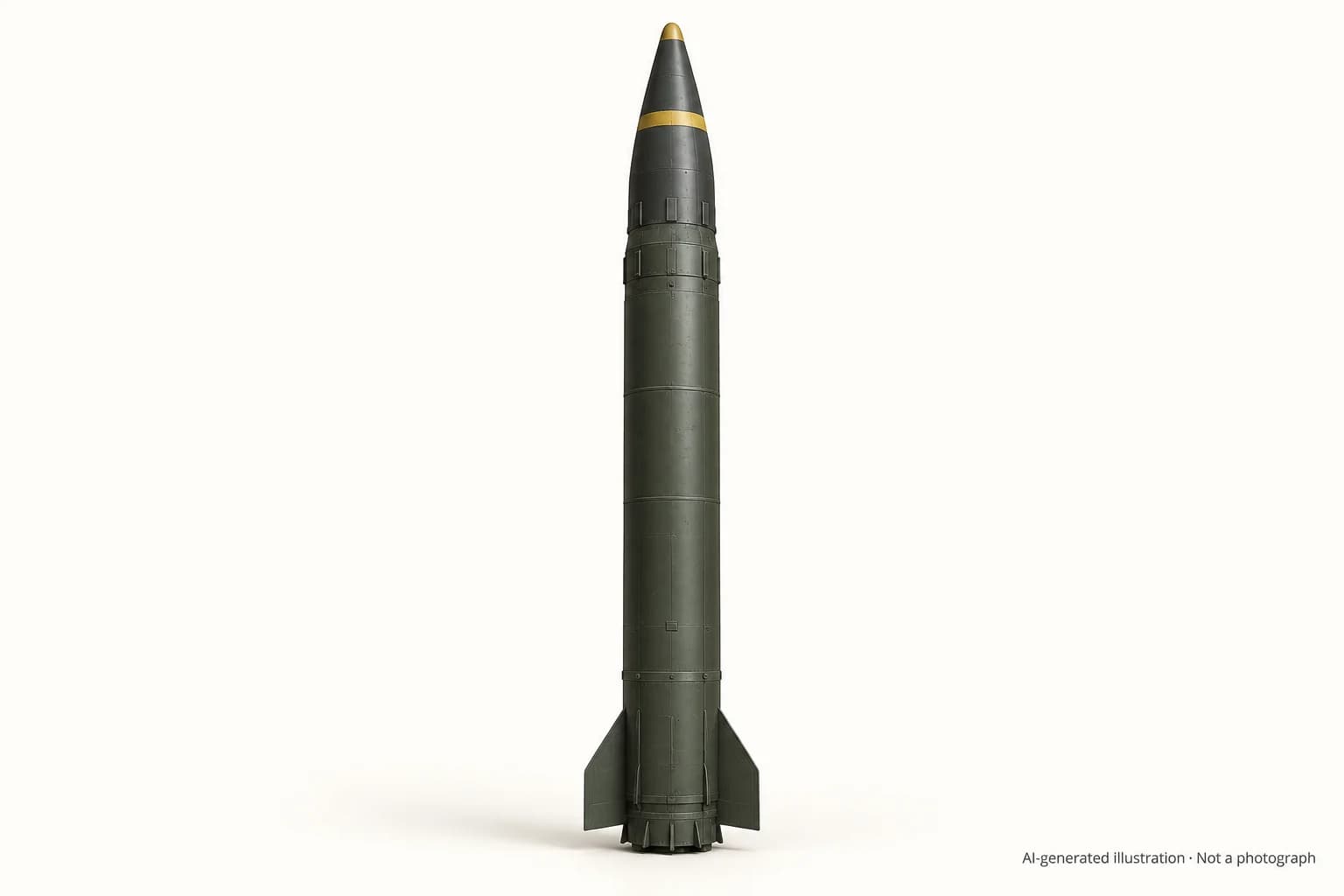
Hwasong-12 is a intermediate-range ballistic missile originating in North Korea. It was built by North Korea. Reported operators include Korean People's Army Strategic Force.
 North Korea
AI-generated illustration · Not a photograph. Representative exterior illustration; details are illustrative and do not establish specifications.
ForceTally · AI-generated illustration · Not a photograph · AI-generated · OpenAI output terms · Source ↗ · ModifiedTechnical data
Intermediate-range ballistic missile
North Korea
2017–present
Korean People's Army Strategic Force
North Korea
June 2017
24.7 tons (estimated)
16.5 m (54 ft) (estimated)
1.5 m (4.9 ft) (estimated)
Conventional; possibly nuclear-capable
500–650 kg (1,100–1,430 lb) (estimated)
Liquid-propellant rocket , single chamber variant of Paektusan 464.1 kN (104,300 lb f )
Hypergolic combination of unsymmetrical dimethylhydrazine (UDMH) as fuel, and either Dinitrogen tetroxide ( N 2 O 4 )
3,700–6,000 km (2,300–3,700 mi) (estimated)
2,111.5 km (1,312.0 mi) (lofted trajectory)
Mach 17 (20,800 km/h; 12,900 mph; 5,780 m/s)
Inertial
greater than 5 km (3.1 mi) CEP
MAZ-based vehicle
《화성-12》형
火 星 十 二 型
Hwaseong-12
Hwasŏng-12
North Korea
The Hwasong-12 ( Korean : 《화성-12》형 ; lit. ' Mars Type 12 ' ) is a mobile intermediate-range ballistic missile developed by North Korea.
Initial estimates suggest the Hwasong-12 would have a maximum range from between 3,700 kilometres (2,300 mi) with a 650 kg (1,430 lb) payload and 4,500 km (2,800 mi) with a 500 kg (1,100 lb) payload to as much as 6,000 km (3,700 mi). The missile is also claimed to have a circular error probable of greater than 5 km (3.1 mi).
The missile apparently flew on a depressed trajectory, reaching an apogee of 30 km (19 mi) and a range of 200 km (120 mi), although it is likely that a part of the missile's path would have been untraceable with radar due to its ability to maneuver.
However, the missile allegedly failed to actually achieve hypersonic flight, with South Korean intelligence determining it only reached Mach 2.5-3, whereas hypersonic weapons are considered to travel at a speed of at least Mach 5 (1.7 km/s; 6,100 km/h) although actual data on the flight was not publicly released.
At 07:23 a.m. Pyongyang Standard Time on 4 October 2022, North Korea launched a ballistic missile from Mupyong-ni Arms Factory, Jagang Province . The missile overflew the Japan's Aomori Prefecture , flew for 21 minutes with a maximum speed of Mach 17 (20,800 km/h; 12,900 mph), reached 970 km (600 mi) apogee and landed 4,500 km (2,800 mi) away in the Pacific Ocean, east of Japan. According to the Korean Central News Agency 's statement on 10 October 2022, the Kim Jong Un -supervised launch was a part of a missile launch campaign occurred between 25 September and 9 October. The missile, fired to "send more powerful and clear warning to the enemies", was a "new-type ground-to-ground intermediate-range ballistic missile", with the official designation remaining undisclosed.
Estimated maximum operational range of the Hwasong-12: from 3,700 km (2,300 mi) (inner circle) to 6,000 km (3,700 mi) (outer circle)
길이 16 m
길이: 17 m
길이 16 m
길이: 17 m
길이 16 m
길이: 17 m
길이 16 m
길이: 17 m
Length 17.4 m
Diameter 1.65 m
Range 4,500 km
Reference text from Wikipedia contributors, used under CC BY-SA 4.0.
True scale
Sourced dimensions beside a 1.75 m human reference.
Points represent sourced observations, including revisions. Revisions on the same effective date are not separate inventory events. Ranges appear in the table and are not plotted as exact points.
| Observation / report period | Value | Source | Claim state |
|---|---|---|---|
| 28 Sept 2026 | 1.5 m | Wikipedia contributors | superseded |
Hwasong-12 equipment records. Variants, orders and quantities are shown as reported in each inventory source; coverage is incomplete.
Keep exploring
Intermediate-range ballistic missile
 Russia
Intermediate-range ballistic missile
 Iran
Intermediate-range ballistic missile
 India
Intermediate Range Ballistic Missile
IndiaMedium-range ballistic missile
North KoreaMedium-range ballistic missile
Iran