FORCETALLY
Loading the evidence…
Preparing your view.


Preparing your view.
Ballistic missilesIn service
Intermediate-range ballistic missile
Oreshnik (missile) is a intermediate-range ballistic missile originating in Russia. Reported operators include Russia.
 Russia
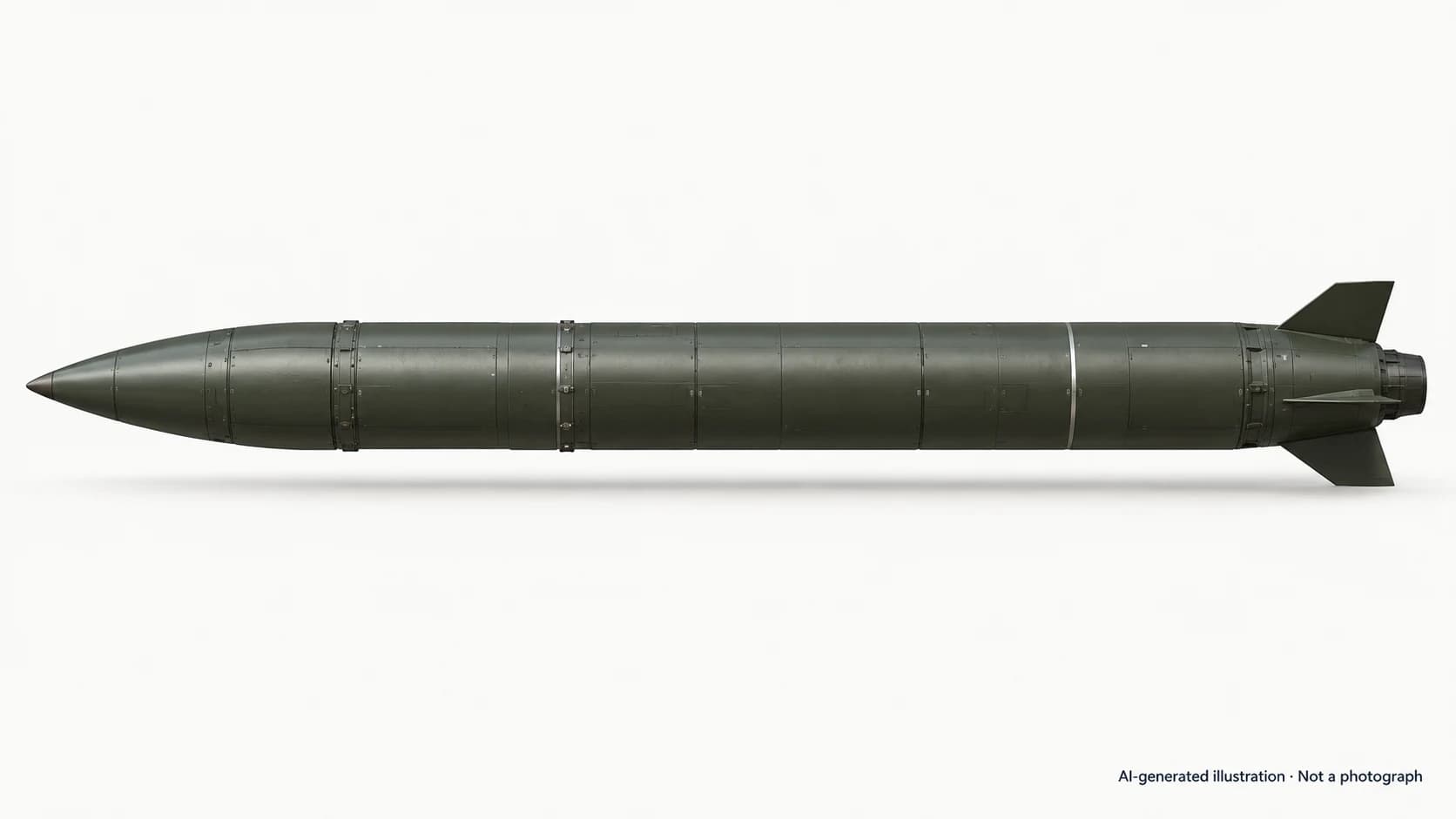
AI-generated illustration · Not a photograph — Representative exterior of Oreshnik (missile); geometry is illustrative. Not evidence for specifications. — Representative Oreshnik concept exterior; detailed external geometry and dimensions not verified; no parent dimensions copied.
ForceTally · AI-generated illustration · Not a photograph · AI-generated · OpenAI output terms · Source ↗ · ModifiedTechnical data
Intermediate-range ballistic missile
Russia
2024–Present
Russia
Russo-Ukrainian war
2020s
RS-26 Rubezh
Unknown
2024–Present
Nuclear / conventional
Intermediate
Over Mach 10 (12,300 km/h; 7,610 mph; 3.40 km/s)
Range 3,500-5,470 km
Range 3,500-5,470 km
Oreshnik
Intermediate-Range Ballistic Missile
Moscow Institute of Thermal Technology
INA
The missile is equipped with multiple independently targetable reentry vehicles (MIRVs), allowing it to carry several warheads—either conventional or nuclear—capable of striking multiple targets simultaneously.
It reportedly travels at speeds exceeding Mach 10, making it highly challenging to intercept with current defense systems.
Its range is estimated to be between 1,000 and 5,500 kilometers, enabling it to reach targets across Europe and parts of Asia.
INA
INA
Guidance Systems The Oreshnik missile uses an inertial navigation system (INS) integrated with satellite correction via Russia’s GLONASS system. This combination provides midcourse accuracy with potential terminal-phase adjustments. Russian sources suggest the missile may feature reentry vehicle maneuverability or decoy deployment to evade interception by missile defense systems. The system is designed to function effectively in electronic warfare environments and GPS-denied conditions, allowing independent navigation throughout its flight path.
Type Intermediate-range ballistic missile (IRBM)
Country users Russia
Designer Country Russia
Combat Equipment Heater, NBC protection system, white searchlight.
Hersteller Moskauer Institut für Wärmetechnik
Länge 15–18,5 m
Durchmesser 1.860 mm
Geschwindigkeit 12.300 km/h ( Mach 10 )
Reichweite 2.000–5.000 km
Vitesse Mach 10
Peso 30 000-40 000 kg
Longitud 15-18.5 m
Diámetro 1860 mm
Velocidad máxima Mach 10-12
Peso: 30 000–40 000 kg.
Longitud: 15-18.5 m.
Diámetro: 1860 mm.
Velocidad máxima: Mach 10‑12.
Reference text from Wikipedia contributors, used under CC BY-SA 4.0.
True scale
Sourced dimensions beside a 1.75 m human reference.
Points represent sourced observations, including revisions. Revisions on the same effective date are not separate inventory events. Ranges appear in the table and are not plotted as exact points.
| Observation / report period | Value | Source | Claim state |
|---|---|---|---|
| 18 Oct 2026 | 1.86 m | Army Recognition | approved |
INA
Russia (RUS)
Propulsion Solid-fueled rocket motor, two-stage configuration
Launch Weight An estimated 30,000 to 40,000 kg (unconfirmed)
Speed Reported Mach 10 to Mach 11+ (approximately 13,000–14,000 km/h)
Launcher Assets Road-mobile Transporter-Erector-Launcher (TEL)
Range Estimated 3,000 to 5,500 kilometers (depending on payload)
Dimensions Length: Estimated 15 to 18.5 m; Diameter: Estimated 1.86 m
Length: Estimated 15 to 18.5 m; Diameter: Estimated 1.86 m
Length: Estimated 15 to 18.5 m; Diameter: Estimated 1.86 m
The Oreshnik is designed as a two-stage, solid-fueled ballistic missile launched from a mobile Transporter-Erector-Launcher. The Oreshnik features a cylindrical structure with a reentry-vehicle section that can accommodate multiple warheads or submunitions. The missile’s body is believed to be built from high-strength alloys and composites to reduce weight while ensuring survivability under extreme thermal and aerodynamic loads. Its thermal shielding is reportedly optimized for hypersonic reentry at speeds exceeding Mach 10. The Oreshnik’s estimated dimensions range between 15 and 18.5 meters in length and approximately 1.86 meters in diameter. The TEL provides high strategic mobility, enabling rapid relocation, off-road launch capability, and concealed field deployment.
The Oreshnik missile is assessed as capable of supporting dual-mode payloads for both nuclear and conventional missions. In its nuclear configuration, the Oreshnik is reportedly capable of carrying three to six Multiple Independently Targetable Reentry Vehicles (MIRVs), each with a low- to medium-yield warhead. For conventional missions, the missile is believed to carry up to six reentry vehicles, each potentially equipped with six high-explosive submunitions. These warheads are protected by thermal shielding designed to withstand reentry conditions with surface temperatures up to 4,000 degrees Celsius. The missile’s modular warhead bay allows mission-specific configuration based on operational needs and target types.
The Oreshnik misile is powered by a solid-fuel rocket propulsion system believed to be arranged in two stages. The first stage provides high-thrust boost to escape the launcher, while the second stage sustains ballistic flight toward the terminal phase. Solid-fuel technology allows for rapid launch readiness, long-term storage, and simplified maintenance. Reported flight data from its 2024 combat use suggests terminal velocities exceeding Mach 10 and an operational range estimated between 3,000 and 5,500 kilometers, although exact performance parameters remain classified.
Oreshnik (missile) equipment records. Variants, orders and quantities are shown as reported in each inventory source; coverage is incomplete.
Keep exploring
 Iran
 India
 North Korea