FORCETALLY
Loading the evidence…
Preparing your view.


Preparing your view.
Ballistic missilesIn service
Intermediate-range ballistic missile
Sejjil is a intermediate-range ballistic missile originating in Iran. It was built by Iran. Reported operators include Iran.

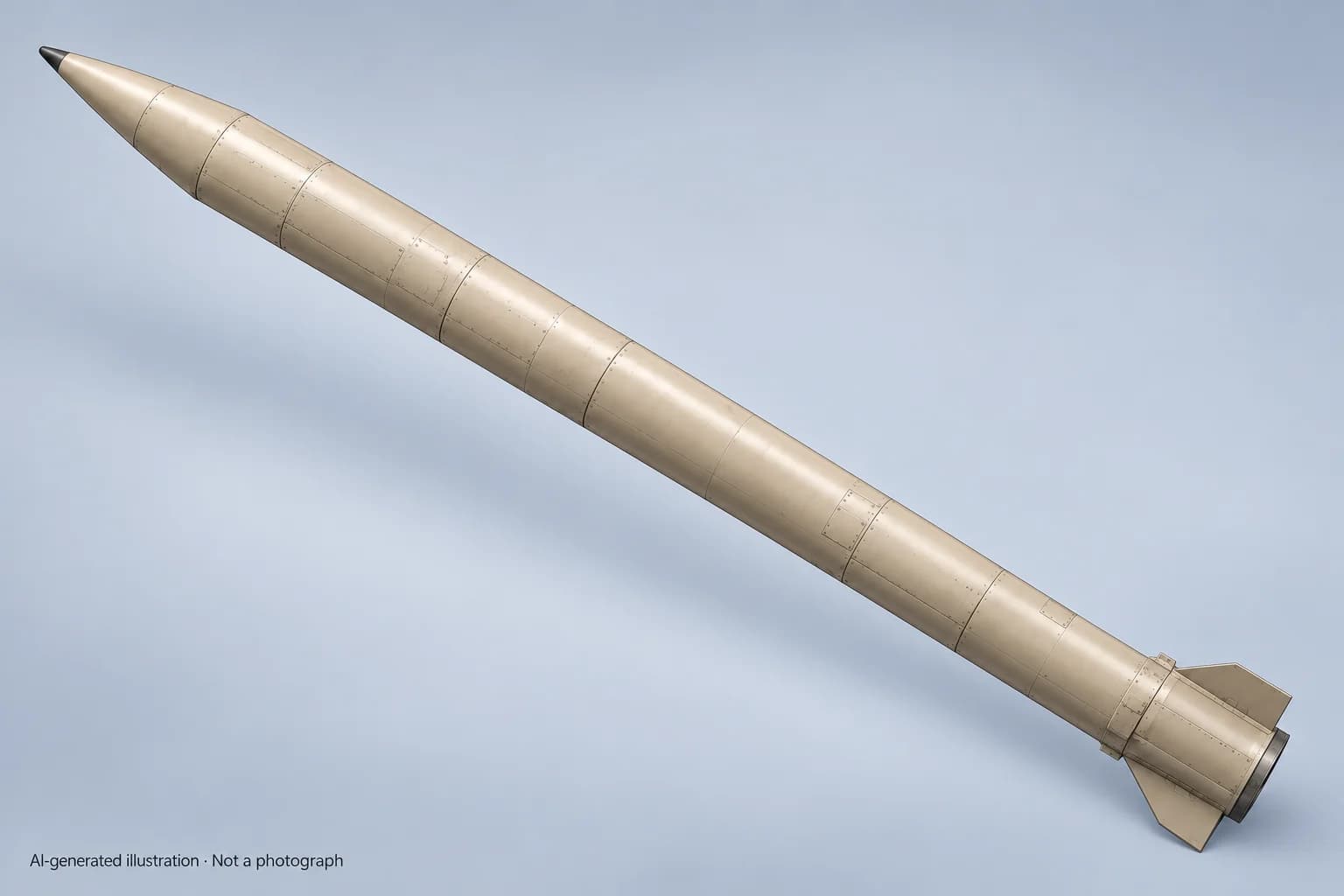
Sejjil — AI-generated illustration · Not a photograph
ForceTally · AI-generated adaptation of reference photographs by Vahid Reza Alaei and Soheil Sahranavard · CC BY 4.0 · CC BY 4.0 · AI-generated adaptation · Source ↗ · ModifiedIntermediate-range ballistic missile
Iran
Not disclosed
Iran
Iran
22.5 tonnes
18.2 m
1.25 m
500–1,500 kg
Solid fuel
2,000 (but see text)
to 50m
Mobile launcher
The Sejil is a two-stage, solid-propellant, surface-to-surface missile (SSM) produced by Iran with a reported 2,000 km (1,200 mi) range. Institute for the Study of War and Defense Intelligence Agency report a 2,000 km range , but Iran Watch reports a range of up to 2,500 km.
Iran claims that if launched from the city of Natanz , it could reach Tel Aviv in less than seven minutes.
Sejil-3 : According to CSIS Missile Threat, unconfirmed reports about the development of a Sejil-3 state that it would reportedly have three stages, a maximum range of 4,000 km, and a launch weight of 38,000 kg.
Sejil , or Sejjil , ( Persian : سجیل , lit. ' brimstone ' ) is an Iranian two-staged solid-fueled intermediate-range ballistic missile .
Lenkung Inertiales Navigationssystem
Reference text from Wikipedia contributors, used under CC BY-SA 4.0.
True scale
Sourced dimensions beside a 1.75 m human reference.
Points represent sourced observations, including revisions. Revisions on the same effective date are not separate inventory events. Ranges appear in the table and are not plotted as exact points.
| Observation / report period | Value | Source | Claim state |
|---|---|---|---|
| 28 Sept 2026 | 1.25 m | Wikipedia contributors | superseded |
| 28 Sept 2026 | 1.25 m | Wikipedia contributors | superseded |
| 28 Sept 2026 | 1.25 m | Wikipedia contributors | approved |
Sejjil equipment records. Variants, orders and quantities are shown as reported in each inventory source; coverage is incomplete.
Keep exploring
Intermediate-range ballistic missile
 India
Intermediate-range ballistic missile
 North Korea
Intermediate-range ballistic missile
 Russia
Intermediate Range Ballistic Missile
IndiaMedium Range Ballistic Missile
IndiaMedium-range ballistic missile
India