FORCETALLY
Loading the evidence…
Preparing your view.


Preparing your view.
Ballistic missilesIn service
Medium-range ballistic missile
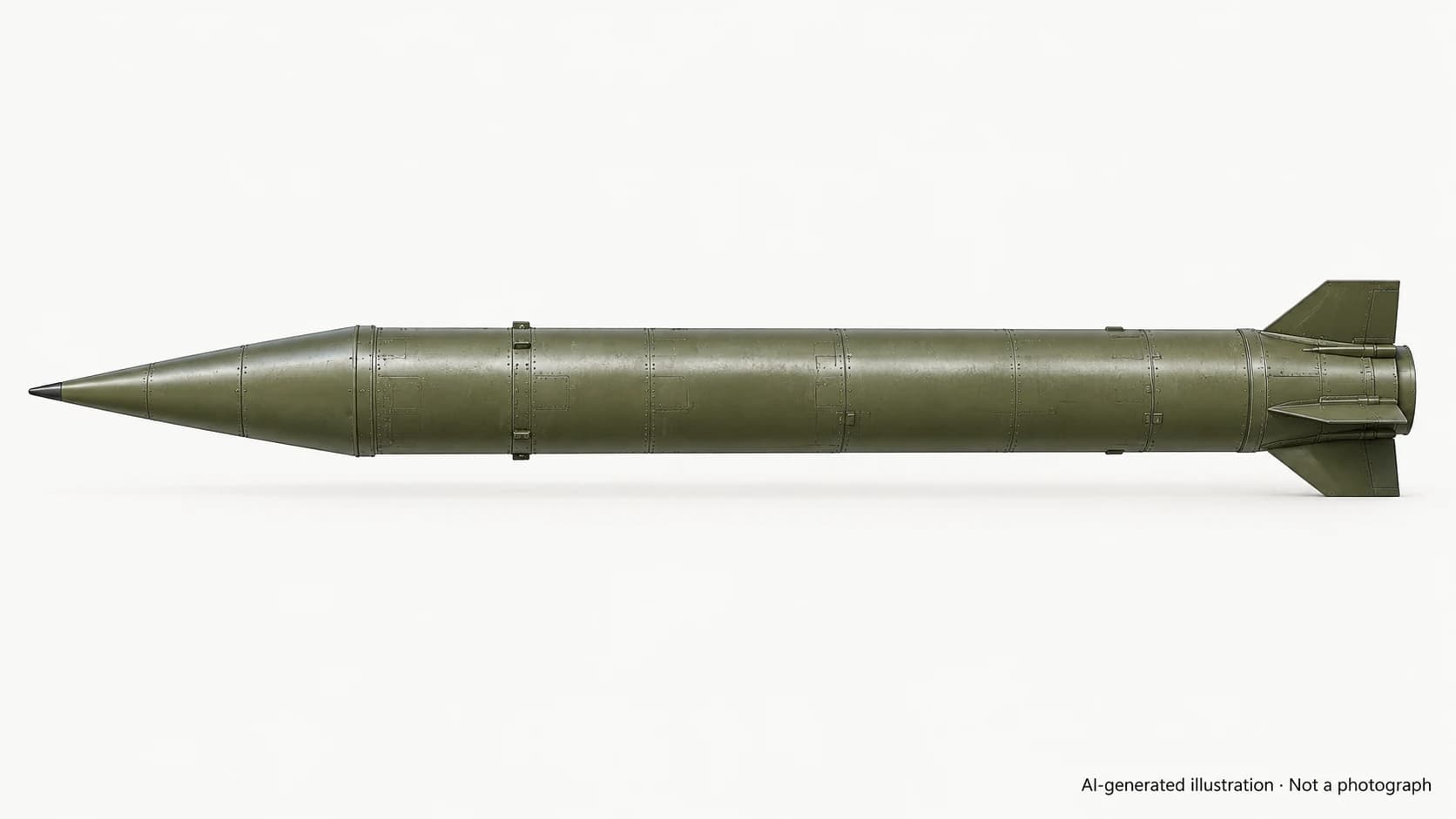
Hwasong-7 is a medium-range ballistic missile originating in North Korea. Reported operators include Iran, North Korea, Pakistan, Egypt, Ba'athist Syria, Iraq.
 North Korea
AI-generated illustration · Not a photograph — Representative exterior of Hwasong-7; geometry is illustrative. Not evidence for specifications.
ForceTally · AI-generated illustration · Not a photograph · AI-generated · OpenAI output terms · Source ↗ · ModifiedMedium-range ballistic missile
North Korea
1998−present
See § Operators
1990–present
15.6 m (51 ft)
1.25 m (4 ft 1 in)
Conventional, possibly nuclear
700–1,000 kg (1,500–2,200 lb) (estimated)
TM-185 and AK-27I
1,000–1,500 km (620–930 mi) (estimated)
160 km (99 mi) ( lofted trajectory )
Inertial
190–2,000 m (620–6,560 ft) CEP
Iran
North Korea
Pakistan
Egypt
Ba'athist Syria
Iraq
The Hwasong-7 ( Korean : 《화성-7》형 ; lit. ' Mars Type 7 ' ) is a single- stage , mobile liquid propellant medium-range ballistic missile developed by North Korea .
Hwasong-7 is a larger variant of the R-17, scaled up so its cross-sectional area is about doubled, with a diameter of 1.25 metres (4 ft) and a length of 15.6 metres (51 ft). The precise capabilities and specifications of the missile are unknown; even the fact of its production and deployment are controversial.
Its aerodynamic design is stable, reducing the need for modern active stabilization systems while the missile is flying in the denser lower atmosphere. The Hwasong-7 uses the liquid propellant combination of TM-185 (20% gasoline and 80% kerosene ) and AK-27I (27% N 2 O 4 and 73% HNO 3 ). Unlike modern missiles, Hwasong-7 can only be fueled when vertical, meaning it cannot be fueled before transport. With a 1,000 kg (2,200 lb) warhead, its range is estimated to be 900 km (560 mi). Further range analysis includes a range of 1,000–1,500 km (620–930 mi) to a high-end estimation of 2,000 km (1,200 mi), meaning all South Korean territories, as well as Japan, Russia and China are covered by Hwasong-7's range.
It has an estimated circular error probable (CEP) of 1,000–2,000 m (3,300–6,600 ft), but it can be reduced to between 190 m (620 ft) and 1,000 m (3,300 ft) with GPS guidance. North Korea is believed to possess some 300 Hwasong-7 missiles and fewer than 50 mobile launchers.
Hwasong-7 has a variant with white livery for reconnaissance satellite cameras testing. On 18 December 2022, North Korea launched two medium-range ballistic missiles from Sohae Satellite Launching Station , flying 500 km (310 mi) with an apogee of 550 km (340 mi). According to North Korea, the test was organized by the National Aerospace Development Administration to evaluate reconnaissance satellite components, including camera and data transmission system. Released images included an photo indicating the missiles appeared to be a derivation from Hwasong-7 or Scud missile .
It is believed North Korea obtained R-17 designs from Egypt , and possibly modified designs from China, allowing them to reverse-engineer them into a larger and longer-distance weapon. United States reconnaissance satellites first detected this type in May 1990 at the Musudan-ri test launch facility, in northeastern North Korea. A test launch happened at the same time, but likely failed, since burn marks were captured by photographs at the launch site. Later, low-rate production started in January 1991 and North Korea conducted another test-fire of Hwasong-7 in May 1993 . Also, between 1993 and 1994, North Korea had produced a sufficient number of Hwasong-7 missiles to be considered operational, and five years later, Hwasong-7 became deployed.
North Korea test-fired Hwasong-7 missiles in 2006 , 2009 , as well as 2014, in which North Korea fires two missiles that flew 650 km (400 mi).
Although it has an estimated range of 1,000–1,500 km (620–930 mi), launches in March 2014 flew only 650 km (400 mi), as the missiles flew to an altitude of 160 km (99 mi) because of lofted trajectory . The missiles achieved a maximum speed of Mach 7 (8,600 km/h). U.S. and South Korean Patriot PAC-2/3 interceptors are more specialized to hit ballistic missiles up to 400 km (250 mi).
On 5 September 2016, North Korea fired three missiles into the Sea of Japan , these missiles achieved about 1,000 km (620 mi) range. Initially, these missiles were believed to be Hwasong-7, however, it was later revealed that the missiles used for this launch were Hwasong-9 (Scud-ER). The United States strongly condemned the launch.
길이 16.00 m
사거리 1,800 km (1,200 kg 탄두)
길이 16.00 m
사거리 1,800 km (1,200 kg 탄두)
길이 16.00 m
사거리 1,800 km (1,200 kg 탄두)
길이 16.00 m
사거리 1,800 km (1,200 kg 탄두)
길이 16.00 m
사거리 1,800 km (1,200 kg 탄두)
길이 16.00 m
사거리 1,800 km (1,200 kg 탄두)
길이 16.00 m
사거리 1,800 km (1,200 kg 탄두)
길이 16.00 m
사거리 1,800 km (1,200 kg 탄두)
Länge 15,80–16,00 m
Durchmesser 1.320–1.350 mm
Reichweite 1.200 km
Lenkung Trägheitsnavigationsplattform
生产商 朝鮮國防科學院
重量 16250公斤
直径 1.35米
Longitud 15.6 m
Diámetro 1.25 m
Peso 15 852-16 250 kg
Lunghezza 15,852-16 m
Diametro 1,32-1,35 m
Length 16.2 m
Diameter 1.36 m
Range 1,200 – 1,500 km
Launch weight 16,500 kg
Reference text from Wikipedia contributors, used under CC BY-SA 4.0.
True scale
Sourced dimensions beside a 1.75 m human reference.
Points represent sourced observations, including revisions. Revisions on the same effective date are not separate inventory events. Ranges appear in the table and are not plotted as exact points.
| Observation / report period | Value | Source | Claim state |
|---|---|---|---|
| 28 Sept 2026 | 1.25 m | Wikipedia contributors | superseded |
| 28 Sept 2026 | 1.25 m | Wikipedia contributors | superseded |
| 28 Sept 2026 | 1.25 m | Wikipedia contributors | superseded |
| 28 Sept 2026 | 1.25 m | Wikipedia contributors | superseded |
| 28 Sept 2026 | 1.25 m | Wikipedia contributors | superseded |
| 28 Sept 2026 | 1.25 m | Wikipedia contributors | superseded |
| 14 Oct 2026 | 1.25 m | Wikipedia contributors | superseded |
| 14 Oct 2026 | 1.32–1.35 m | Wikipedia contributors | approved |
Hwasong-7 equipment records. Variants, orders and quantities are shown as reported in each inventory source; coverage is incomplete.
 Egypt
 Iran
 Iraq North Korea
Strategic Forces exact named equipment holdings: Hwasong-7 (Nodong mod 1/mod 2). Active, operational-reserve and training units excluding equipment in store; November 2025 IISS assessment. Named service only; no parent-force or national total inferred. Source role: GROUND-LAUNCHED MISSILES / MRBM. Original estimates, ranges, reporting names, reserve, lease and employment scopes retained; nested included counts are not added. Missile-system quantities mean launchers, not rounds. No readiness, crew, carried weapon, payload, factory-production or future order count inherited.
 Pakistan
Iran, North Korea, Pakistan, Egypt, Ba'athist Syria, Iraq
Equipment reference ↗Keep exploring
Medium-range ballistic missile
IranMedium-range ballistic missile
 India
Medium-range ballistic missile
IranMedium Range Ballistic Missile
IndiaShort-range ballistic missile Medium-range ballistic missile
Short-range ballistic missile
India