FORCETALLY
Loading the evidence…
Preparing your view.


Preparing your view.
Armoured vehiclesIn service
Infantry fighting vehicle
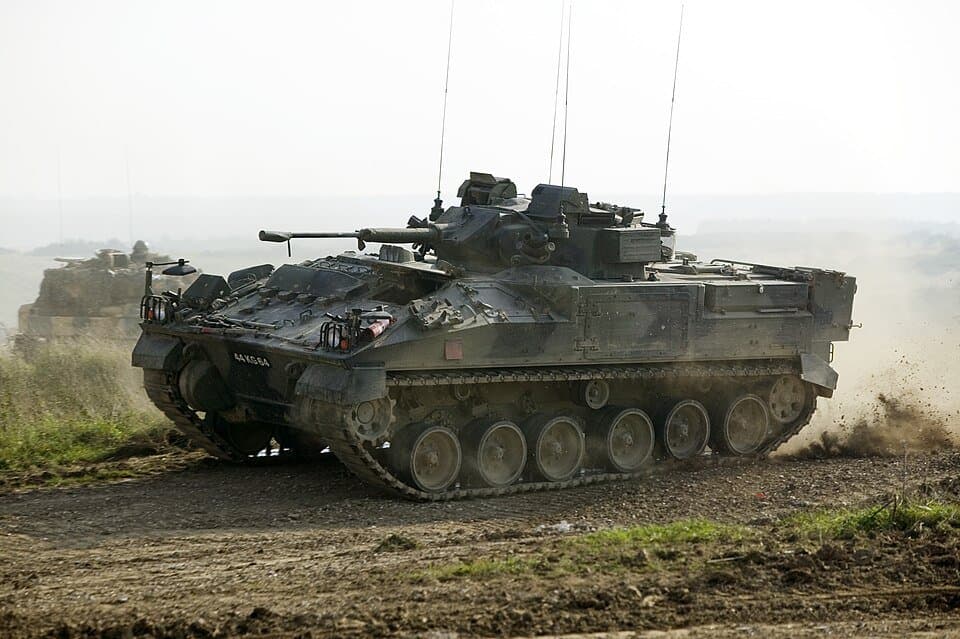
FV510 Warrior is a infantry fighting vehicle originating in United Kingdom. It was built by GKN Sankey/BAE Systems. Reported operators include British Army, Kuwaiti Army.
 United Kingdom
Infantry fighting vehicle
United Kingdom
1987–present
GKN Sankey / GKN Defence
1972–1980
GKN Sankey/BAE Systems
1986-present
1,043 (total) (as of 1995)
25.4 tonnes (25.0 long tons ; 28.0 short tons )
6.3 m (20 ft 8 in)
3.03 m (9 ft 11 in)
2.8 m (9 ft 2 in)
3 (commander, gunner, driver) + 7 troops or full section 10 troops
Aluminium and appliqué
30 mm L21A1 RARDEN cannon
coaxial 7.62 mm L94A1 chain gun 2x4 66mm smoke grenades
Perkins V-8 Condor Diesel 550 hp (410 kW)
22 hp/t
Torsion bar with hydraulic damper
410 miles (660 km)
46 mph (75 km/h) on road, 31 mph (50 km/h) off road
British Army – 789 received between 1987 and 1995.
Kuwaiti Army – 254 Desert Warriors received between 1995 and 1997.
The FV510 Warrior tracked vehicle family is a series of British armoured vehicles, originally developed to replace FV430 series armoured vehicles.
The crew of a Warrior comprises the driver, seated in the front hull and the gunner and commander in the turret. The embarked infantry section can number up to seven soldiers, who are seated facing each other in the rear hull compartment. Passenger access is through an electric ram powered door at the rear of the hull, rather than a drop-down ramp as in the US M113 APC and M2 Bradley IFV. Warrior Section Vehicles are able to carry seven fully equipped soldiers together with supplies and weapons, including a number of anti-tank weapons, for a 48-hour battlefield day in nuclear/biological/chemical conditions.
The Warrior is driven by a Perkins - Rolls-Royce V8 Condor engine through a four-speed automatic gearbox. It is capable of a road speed of 46 miles per hour (74 km/h). The Warrior has the speed and performance to keep up with a Challenger 2 main battle tank over the most difficult terrain.
The vehicle is fitted with a two-man GKN Sankey turret, armed with a non- stabilised L21A1 30 mm RARDEN cannon capable of destroying some APCs at a maximum range of 1,500 m (1,600 yd), and an L94A1 EX-34 7.62 mm Hughes Helicopters coaxial chain gun. It is fitted with two clusters of four defensive grenade launchers (usually used with Visual and Infrared Screening Smoke – VIRSS).
The protection against small arms , missiles , rocket-propelled grenades and anti-tank mines was shown during the UN operations in Bosnia . Two Warriors were destroyed during the First Gulf War , with nine soldiers killed, in a friendly fire incident when hit by AGM-65 Maverick missiles launched in error by two American Fairchild Republic A-10 Thunderbolt II ground attack aircraft.
As of 17 November 2008, 22 soldiers had been killed while travelling in Warrior IFVs in Afghanistan or Iraq. On 7 March 2012, six British soldiers were killed in an explosion that hit a Warrior IFV in Helmand .
FV512 Mechanised Combat Repair Vehicle. Operated by REME detachments in Armoured Infantry battalions. It is equipped with a 6.5-tonne crane plus power tools and is able to tow a trailer carrying two Warrior power packs or one Challenger power pack. A total of 105 of these were produced.
FV513 Mechanised Recovery Vehicle (Repair). Also operated by REME detachments in Armoured Infantry battalions. It is equipped with a 20-tonne winch and 6.5-tonne crane plus power tools and (like the FV512) is able to tow a trailer carrying two Warrior power packs or one Challenger power pack. 39 of these were produced.
FV514 Mechanised Artillery Observation Vehicle. This is operated by the Royal Artillery as an Artillery Observation Post Vehicle (OPV) and is fitted with mast-mounted Man-packable Surveillance and Target Acquisition Radar (MSTAR) and Position and Azimuth Determining System (PADS), with image intensifying and infra-red equipment. The only armament is the 7.62 mm machine gun, as the 30 mm RARDEN cannon is replaced by a dummy weapon. This allows space for the targeting and surveillance equipment while still keeping largely the same outward appearance of a standard Warrior in order to avoid becoming a priority target. 52 of these were produced.
Desert Warrior. This was an export version adapted for operations in hostile desert conditions. It was fitted with the Delco turret as used on the LAV-25 wheeled IFV, mounting a stabilised 25 mm M242 Bushmaster chain gun with coaxial 7.62 mm chain gun and two Hughes TOW ATGM launchers (one mounted on each side). In 1993, Kuwait purchased 254 Desert Warrior vehicles.
Warrior 2000. This was a new version developed for the Swiss Army . It did not enter production. It featured an all-welded aluminium hull, increased armour, digital fire control system and more powerful engine. It was fitted with the Delco turret, or a Land Systems Hagglunds E30 turret with Alliant Techsystems 30 mm Bushmaster II Mk 44 cannon.
VERDI-2 (Vehicle Electronics Research Defence Initiative) was a technology demonstrator built on the hull of an FV510 in 1993. It features a dummy 30mm. the main armament was eight Starstreak missiles in two quad launchers, as well as the ADAD system later seen on the Stormer HVM . It did not enter production.
Under the WFLI programme, the existing turret including the unstabilised Rarden gun, would be replaced by a turret mounting a stabilised 40 mm weapon developed by the Anglo-French firm CTA International and firing Cased telescoped ammunition . This weapon would also equip the Ajax armoured vehicle.
By March 2020 Warrior CSP was in the "demonstration phase", demonstrating capability for a range of military missions set by the MoD. A total of £430m had been spent so far. No in-service date had been set, but the demonstration phase was due to finish in 2021. In June 2020 the House of Commons Defence Select Committee described the project as running over three years late and £227 million over budget.
In March 2021, the MoD announced that the CSP had been cancelled and that all of the British Army's Warrior vehicles would be replaced by the middle of the decade with Boxer armoured fighting vehicles . In April 2021, Lockheed Martin announced that as a result up to 158 jobs would be lost at Ampthill. It had previously been reported in October 2020 that the UK may procure Boxer vehicles that are fitted with the 40mm CTA International CT40 cannon .
Following the cancellation of the CSP, Leicestershire-based Digital Concepts Engineering has proposed a system to stabilise the Warrior’s 30mm Rarden cannon, allowing the vehicle to fire on the move. The upgrade would additionally provide a digital turret interface facilitating the addition of a vehicle battle management system and ‘slew to cue’ capability to reduce the cognitive burden on the gunner.
Reference text from Wikipedia contributors, used under CC BY-SA 4.0.
True scale
Sourced dimensions beside a 1.75 m human reference.
See it in your room. Scan with your phone to open this model in 3D, then place it in your space.
Points represent sourced observations, including revisions. Revisions on the same effective date are not separate inventory events. Ranges appear in the table and are not plotted as exact points.
| Observation / report period | Value | Source | Claim state |
|---|---|---|---|
| 28 Sept 2026 | 3 people | Wikipedia contributors | superseded |
| 28 Sept 2026 | 3 people | Wikipedia contributors | superseded |
| 28 Sept 2026 | 3 people | Wikipedia contributors | approved |
FV510 Warrior equipment records. Variants, orders and quantities are shown as reported in each inventory source; coverage is incomplete.
 Kuwait
Army exact named equipment holdings: Desert Warrior† (incl variants). Active, operational-reserve and training units excluding equipment in store; November 2025 IISS assessment. Named service only; no parent-force or national total inferred. Source role: ARMOURED FIGHTING VEHICLES / IFV. Original estimates, ranges, reporting names, reserve, lease and employment scopes retained; nested included counts are not added. Missile-system quantities mean launchers, not rounds. No readiness, crew, carried weapon, payload, factory-production or future order count inherited.
United KingdomReported land equipment holdings; excludes vehicles used exclusively for training or ceremonial use. Does not distinguish active, stored or maintenance status. Not assessed as Accredited Official Statistics. Platforms included: Warrior.
Keep exploring
Infantry fighting vehicle
 South KoreaCompare with FV510 Warrior
Infantry Fighting Vehicle
 CanadaCompare with FV510 Warrior
Infantry fighting vehicle
CanadaCompare with FV510 Warrior Infantry fighting vehicle
 United StatesCompare with FV510 Warrior
Infantry fighting vehicle
United StatesCompare with FV510 Warrior Infantry fighting vehicle
Compare with FV510 Warrior