


Preparing your view.
At a glance
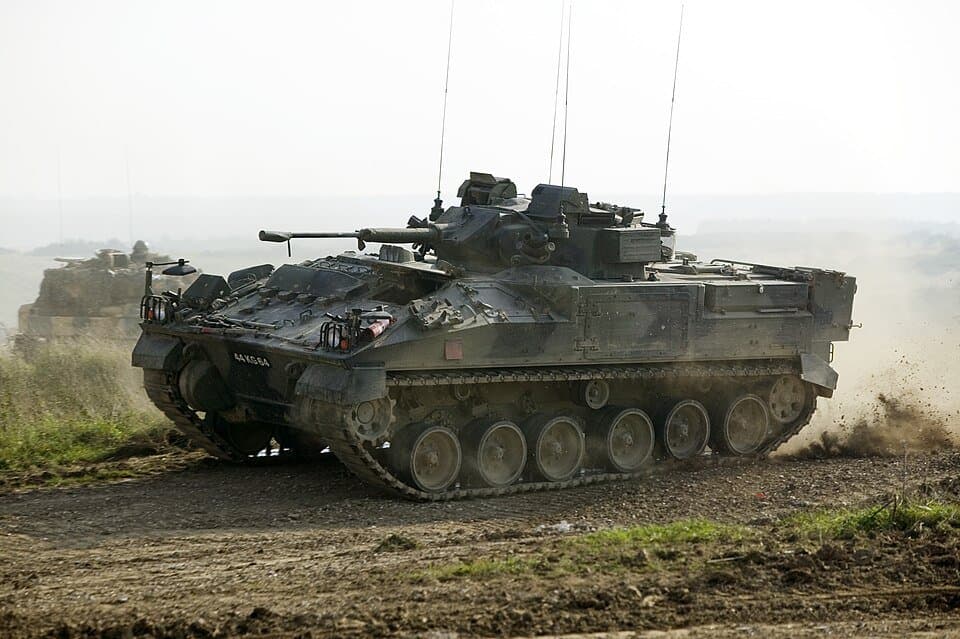
FV510 Warriorlarger figure on 1 of 4
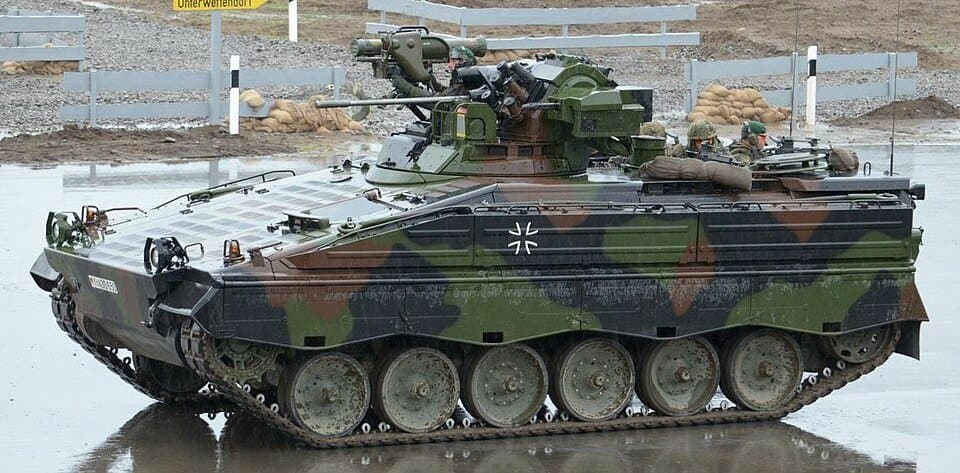
Marder (infantry fighting vehicle)larger figure on 3 of 4
Counts only measures both sources give with the same scope. A larger figure is not a better system.
True scale
Side by side. From every angle. A human reference for perspective.
3.73 MB · Loads when you open it| Model | Length | Width / span | Height |
|---|---|---|---|
| FV510 Warrior | ≈ 6.3 m | ≈ 3.03 m (Width) | ≈ 2.67 m |
| Marder (infantry fighting vehicle) | ≈ 6.88 m | ≈ 3.38 m (Width) | ≈ 2.89 m |
Scaled uniformly to the sourced length of 6.3 m. Thin antennas or poles standing above the body were pressed down to it, so they do not set the height; the width was fitted to the sourced 3.03 m. Not an official model or a measured survey.
ForceTally · All rights reserved
Scaled uniformly to the sourced length of 6.88 m. The width was fitted to the sourced 3.38 m. Not an official model or a measured survey.
ForceTally · All rights reserved
The human reference is a generic 1.75 m figure. Models describe external size, not combat performance.
Measured figures
Length
Single source6.3 m (20 ft 8 in)[source]
Length
Single sourceConfiguration
| Specification | FV510 Warrior | Marder (infantry fighting vehicle) |
|---|---|---|
| Type | Infantry fighting vehicle[source] | Infantry fighting vehicle[source] |
| Place of origin | United Kingdom[source] | West Germany[source] |
| In service | 1987–present[source] | 1971–present[source] |
| Designer | GKN Sankey / GKN Defence[source] |
Schützenpanzer Marder 1 · Length · Länge
Single sourceMass
Single source25.4 tonnes (25.0 long tons ; 28.0 short tons )[source]
A2 Marder 1A3
Single sourceA2 Marder 1A5
Single sourceMarder 1A1/
Single source28.5 t (31.4 short tons) Marder 1A1/A2 33.5 t (36.9 short tons) Marder 1A3 37.4 t (41.2 short tons) Marder 1A5[source]
Maximum; Off-road
Single sourceMaximum; On road
Single source46 mph (75 km/h) on road, 31 mph (50 km/h) off road[source]
Maximum; Marder 1A2
Single sourceMaximum; Marder 1A3
Single sourceOperational; Operational range
Single source410 miles (660 km)[source]
Perkins V-8 Condor Diesel
Single sourcePerkins V-8 Condor Diesel 550 hp (410 kW)[source]
Bars compare reported quantities only. A larger figure does not make a system better; configurations and test conditions differ.
Rheinmetall Landsysteme[source] |
| Designed | 1972–1980[source] | 1959–1969[source] |
|---|
| Manufacturer | GKN Sankey/BAE Systems[source] | Rheinmetall Landsysteme Maschinenbau Kiel[source] |
|---|
| Produced | 1986-present[source] | 1969–1975[source] |
|---|
| No. built | 1,043 (total) (as of 1995)[source] | 2,137 (incl. Marder 2 prototype)[source] |
|---|
| Armour | Aluminium and appliqué[source] | — |
|---|
| Main armament | 30 mm L21A1 RARDEN cannon[source] | 20 mm Rheinmetall MK 20 Rh 202 automatic cannon 1,250 rounds MILAN ATGM launcher[source] |
|---|
| Secondary armament | coaxial 7.62 mm L94A1 chain gun 2x4 66mm smoke grenades[source] | 7.62 mm MG3 machine gun 5,000 rounds[source] |
|---|
| Power/weight | 22 hp/t[source] | 15.7 kW/t (21.1 hp/t)[source] |
|---|
| Suspension | Torsion bar with hydraulic damper[source] | Torsion bar[source] |
|---|
| Role | series of British armoured vehicles, originally[source] | tracked German infantry fighting vehicle[source] |
|---|
| Source measurement | The crew of a Warrior comprises the driver, seated in the front hull and the gunner and commander in the turret. The embarked infantry section can number up to seven soldiers, who are seated facing each other in the rear hull compartment. Passenger access is through an electric ram powered door at the rear of the hull, rather than a drop-down ramp as in the US M113 APC and M2 Bradley IFV. Warrior Section Vehicles are able to carry seven fully equipped soldiers together with supplies and weapons, including a number of anti-tank weapons, for a 48-hour battlefield day in nuclear/biological/chemical conditions.[source]FV510 Warrior · Description; only the objects and conditions stated in this passage The Warrior is driven by a Perkins - Rolls-Royce V8 Condor engine through a four-speed automatic gearbox. It is capable of a road speed of 46 miles per hour (74 km/h). The Warrior has the speed and performance to keep up with a Challenger 2 main battle tank over the most difficult terrain.[source]FV510 Warrior · Description; only the objects and conditions stated in this passage The vehicle is fitted with a two-man GKN Sankey turret, armed with a non- stabilised L21A1 30 mm RARDEN cannon capable of destroying some APCs at a maximum range of 1,500 m (1,600 yd), and an L94A1 EX-34 7.62 mm Hughes Helicopters coaxial chain gun. It is fitted with two clusters of four defensive grenade launchers (usually used with Visual and Infrared Screening Smoke – VIRSS).[source]FV510 Warrior · Description; only the objects and conditions stated in this passage The protection against small arms , missiles , rocket-propelled grenades and anti-tank mines was shown during the UN operations in Bosnia . Two Warriors were destroyed during the First Gulf War , with nine soldiers killed, in a friendly fire incident when hit by AGM-65 Maverick missiles launched in error by two American Fairchild Republic A-10 Thunderbolt II ground attack aircraft.[source]FV510 Warrior · Combat history; only the objects and conditions stated in this passage As of 17 November 2008, 22 soldiers had been killed while travelling in Warrior IFVs in Afghanistan or Iraq. On 7 March 2012, six British soldiers were killed in an explosion that hit a Warrior IFV in Helmand .[source]FV510 Warrior · Combat history; only the objects and conditions stated in this passage FV512 Mechanised Combat Repair Vehicle. Operated by REME detachments in Armoured Infantry battalions. It is equipped with a 6.5-tonne crane plus power tools and is able to tow a trailer carrying two Warrior power packs or one Challenger power pack. A total of 105 of these were produced.[source]FV510 Warrior · Variants; only the objects and conditions stated in this passage FV513 Mechanised Recovery Vehicle (Repair). Also operated by REME detachments in Armoured Infantry battalions. It is equipped with a 20-tonne winch and 6.5-tonne crane plus power tools and (like the FV512) is able to tow a trailer carrying two Warrior power packs or one Challenger power pack. 39 of these were produced.[source]FV510 Warrior · Variants; only the objects and conditions stated in this passage FV514 Mechanised Artillery Observation Vehicle. This is operated by the Royal Artillery as an Artillery Observation Post Vehicle (OPV) and is fitted with mast-mounted Man-packable Surveillance and Target Acquisition Radar (MSTAR) and Position and Azimuth Determining System (PADS), with image intensifying and infra-red equipment. The only armament is the 7.62 mm machine gun, as the 30 mm RARDEN cannon is replaced by a dummy weapon. This allows space for the targeting and surveillance equipment while still keeping largely the same outward appearance of a standard Warrior in order to avoid becoming a priority target. 52 of these were produced.[source]FV510 Warrior · Variants; only the objects and conditions stated in this passage Desert Warrior. This was an export version adapted for operations in hostile desert conditions. It was fitted with the Delco turret as used on the LAV-25 wheeled IFV, mounting a stabilised 25 mm M242 Bushmaster chain gun with coaxial 7.62 mm chain gun and two Hughes TOW ATGM launchers (one mounted on each side). In 1993, Kuwait purchased 254 Desert Warrior vehicles.[source]FV510 Warrior · Variants; only the objects and conditions stated in this passage Warrior 2000. This was a new version developed for the Swiss Army . It did not enter production. It featured an all-welded aluminium hull, increased armour, digital fire control system and more powerful engine. It was fitted with the Delco turret, or a Land Systems Hagglunds E30 turret with Alliant Techsystems 30 mm Bushmaster II Mk 44 cannon.[source]FV510 Warrior · Variants; only the objects and conditions stated in this passage VERDI-2 (Vehicle Electronics Research Defence Initiative) was a technology demonstrator built on the hull of an FV510 in 1993. It features a dummy 30mm. the main armament was eight Starstreak missiles in two quad launchers, as well as the ADAD system later seen on the Stormer HVM . It did not enter production.[source]FV510 Warrior · Variants; only the objects and conditions stated in this passage Under the WFLI programme, the existing turret including the unstabilised Rarden gun, would be replaced by a turret mounting a stabilised 40 mm weapon developed by the Anglo-French firm CTA International and firing Cased telescoped ammunition . This weapon would also equip the Ajax armoured vehicle.[source]FV510 Warrior · Warrior Capability Sustainment Programme; only the objects and conditions stated in this passage By March 2020 Warrior CSP was in the "demonstration phase", demonstrating capability for a range of military missions set by the MoD. A total of £430m had been spent so far. No in-service date had been set, but the demonstration phase was due to finish in 2021. In June 2020 the House of Commons Defence Select Committee described the project as running over three years late and £227 million over budget.[source]FV510 Warrior · Warrior Capability Sustainment Programme; only the objects and conditions stated in this passage In March 2021, the MoD announced that the CSP had been cancelled and that all of the British Army's Warrior vehicles would be replaced by the middle of the decade with Boxer armoured fighting vehicles . In April 2021, Lockheed Martin announced that as a result up to 158 jobs would be lost at Ampthill. It had previously been reported in October 2020 that the UK may procure Boxer vehicles that are fitted with the 40mm CTA International CT40 cannon .[source]FV510 Warrior · Warrior Capability Sustainment Programme / Cancellation; only the objects and conditions stated in this passage Following the cancellation of the CSP, Leicestershire-based Digital Concepts Engineering has proposed a system to stabilise the Warrior’s 30mm Rarden cannon, allowing the vehicle to fire on the move. The upgrade would additionally provide a digital turret interface facilitating the addition of a vehicle battle management system and ‘slew to cue’ capability to reduce the cognitive burden on the gunner.[source]FV510 Warrior · Warrior Capability Sustainment Programme / Cancellation; only the objects and conditions stated in this passage | A more reliable 20 mm cannon.[source]Marder (infantry fighting vehicle) · Development; only the objects and conditions stated in this passage Initially, development contracts were awarded to two groups of companies: the Rheinstahl group (Rheinstahl- Hanomag , Ruhrstahl, Witten-Annen, Büro Warnecke) and the second group comprising Henschel Werke and the Swiss MOWAG company. This resulted in the production of seven prototype vehicles. A second set of eight prototype vehicles were built between 1961 and 1963. Development priority was then switched for a while to the development of the Jagdpanzer 90 mm Kanone .[source]Marder (infantry fighting vehicle) · Development; only the objects and conditions stated in this passage A number of upgrade programs were carried out, that included fitting night vision equipment and a thermal imager , as well as an upgraded ammunition feed to the 20 mm cannon.[source]Marder (infantry fighting vehicle) · Development; only the objects and conditions stated in this passage Improved armour, weighing 1,600 kg, intended to protect against the 30 mm 2A42 cannon on the Russian BMP-2 . The armour provided additional protection against cluster bomblets .[source]Marder (infantry fighting vehicle) · Development; only the objects and conditions stated in this passage The new total weight was 35,000 kg.[source]Marder (infantry fighting vehicle) · Development; only the objects and conditions stated in this passage |
|---|
| Used by | — | Bundeswehr Armed Forces of Ukraine[source] |
|---|
| Wars | — | Kosovo War Prizren incident War in Afghanistan Russo-Ukrainian War Russian invasion of Ukraine[source] |
|---|
| Unit cost | — | $390,000 2.33 million[source] |
|---|
| Armor | — | Welded steel, protection up to 20 mm APDS DM43 from 0 m and 25 mm APDS from 200 m (220 yd)[source] |
|---|
| Transmission | — | RENK HSWL 194[source] |
|---|
| Ground clearance | — | 0.45 m (18 in)[source] |
|---|
| Fuel capacity | — | 652 L (143 imp gal; 172 US gal)[source] |
|---|
| Former operator · Brazil | — | Brazil[source] |
|---|
| Reported engine rating | — | 441 kW / 600 PS[source]Schützenpanzer Marder 1 · Motorleistung |
|---|
| Reported occupants | — | 3+6[source]Schützenpanzer Marder 1 · BesatzungSource text · numeric interpretation needs review |
|---|
| Reported operators |
| — |
|---|
75 km/h (47 mph)Marder 1A2 65 km/h (40 mph) Marder 1A3[source]
65 km/ h[source]Schützenpanzer Marder 1 · Geschwindigkeit
The hull of the Marder 1 is all welded steel, giving protection from small-arms fire and shell fragments . The front of the hull provided protection from up to 20 mm armour-piercing discarding sabot (APDS) rounds. Later variants increased protection up to 30mm APDS, in response to the 30 mm autocannon armed BMP-2 and the development of top-attack cluster bomblets.[source]Marder (infantry fighting vehicle) · Description; only the objects and conditions stated in this passage
The Marder is a relatively conventional design, with the driver sitting at the front left side of the hull with the engine to the driver's right. The driver has three day periscopes mounted in a hatch that opens to the right. The center periscope can be replaced by a passive night vision device. Behind the driver is a seat for a single infantryman. In early versions of the Marder, this infantryman had a hatch that opened to the right and a periscope that could be rotated through 360 degrees. This hatch was removed in the 1A3 variant onwards.[source]Marder (infantry fighting vehicle) · Description; only the objects and conditions stated in this passage
The Marder is capable of fording in up to 1.5 meters of water unprepared. It can be fitted with a kit allowing it to ford water up to 2.5 meters deep.[source]Marder (infantry fighting vehicle) · Description; only the objects and conditions stated in this passage
The vehicle is powered by an MTU MB 833 Ea-500 six-cylinder liquid-cooled sequentially turbocharged diesel engine which delivers approximately 441 kW (600 PS; 591 hp) at 2,200 rpm. The cooling radiators are mounted at the rear of the hull, either side of the exit ramp. The engine is coupled to a Renk four speed HSWL 194 planetary gear box , with four forward and four reverse gears. The transmission also provides steering and braking via a stepless hydrostatic unit, which transmits power to two drive units mounted at the front of the hull. The vehicle carries 652 liters of fuel, giving it a road range of around 500 kilometres. Early Marders could achieve a road speed of 75 km/h in 4th gear, but the extra armour of later vehicles reduced this to 65 km/h.[source]Marder (infantry fighting vehicle) · Description; only the objects and conditions stated in this passage
The primary armament is the 20 mm Rheinmetall MK 20 Rh202 autocannon . It is mounted in the small two-man turret and can fire either armour-piercing or HE rounds. Mounted coaxially to the left of the cannon is a 7.62 mm MG 3 machine gun . The turret has 360 degree traverse, and can elevate from −17 degrees to +65 degrees, at a rate of 40 degrees per second while traversing at a rate of 60 degrees a second.[source]Marder (infantry fighting vehicle) · Description / Armament; only the objects and conditions stated in this passage
Early production Marders, up to and including version 1A1 had a second, rear-facing MG 3 mounted on the rear deck in a remote controlled pod and operated by one of the mounted infantry using a co-axial PERI-Z12 periscope sight (with a 180° horizontal traverse arc and a vertical arc of -15° to +55°). Typically, 1,250 rounds are carried for the 20 mm cannon, along with a further 5,000 rounds for the MG3.[source]Marder (infantry fighting vehicle) · Description / Armament; only the objects and conditions stated in this passage
Six 76-millimeter-diameter smoke grenade dischargers can create a visual and infrared blocking smoke screen .[source]Marder (infantry fighting vehicle) · Description / Armament; only the objects and conditions stated in this passage
Two Marders were damaged by the use of an improvised explosive device in the course of a German-led offensive on Taliban fighters in Quatliam, on 31 October 2010. Later in the battle, code-named by the Coalition " Operation Halmazag ", a single Marder beat off a Taliban attempt to outflank positions held by German paratroopers. On 2 June 2011, a German Marder was destroyed near Kunduz by a 200 kg (440.91 lbs.) IED, killing one soldier and injuring five others.[source]Marder (infantry fighting vehicle) · Combat service; only the objects and conditions stated in this passage
Marder 1 A1(+) (1979–1982): Dual feed for the 20 mm cannon enabling choice of ammunition, night vision equipment including image intensifiers and a thermal pointer.[source]Marder (infantry fighting vehicle) · Variants / Main-IFV models; only the objects and conditions stated in this passage
A Marder 1A3 of Panzergrenadier Battalion 391 in 2006.[source]Marder (infantry fighting vehicle) · Variants / Main-IFV models; only the objects and conditions stated in this passage
The Marder is used as a carrier for the Roland air defence system. The Kanonenjagdpanzer and Raketenjagdpanzer 2 started development as part of the Marder family but were realised based on the second batch of prototypes using different engines etc. The Kanonenjagdpanzer built for Belgium are a hybrid between the original Bundeswehr version and Marder parts. Some 4–6 test models of a 120 mm mortar on a Marder chassis were built, and at least one is in use as a firefighting vehicle at the WTS Meppen. Tests with an AAA tank were performed but the high weight of the system resulted in a switch to the heavier Standardpanzer chassis, resulting in the Gepard AAA system. At least one first or second generation prototype was equipped with the 110 mm artillery rocket system that later became the truck-mounted LARS system.[source]Marder (infantry fighting vehicle) · Variants / Derivative models; only the objects and conditions stated in this passage
During the Eurosatory Show 2012 , Rheinmetall Landsysteme GmbH offered two further upgrades as part of the Marder Evolution family . The first upgrade was the Marder APC which features a new M151 Protector remotely controlled weapon, replacing the original Rheinmetall MK 20 Rh 202 automatic cannon, ballistic protection comparable to STANAG Level 4+, and mine protection comparable to Level 3a/3b+. The top deck has been lifted to enable improved ergonomics and uses a 440 kW (600 PS) MTU MB883 diesel. The other upgrade was the Marder Medium Tank which features a rifled, stabilized 105 mm OTO-Melara gun in a new turret.[source]Marder (infantry fighting vehicle) · Variants / Derivative models; only the objects and conditions stated in this passage
At Indo Defence 2016 , Rheinmetall exhibited the Marder Medium Tank RI ("RI" stands for "Republic of Indonesia"), which was offered to the Indonesian Army, at the time already operating the Marder 1A3. The tank used the Marder 1A3 hull, with the three-crew Leonardo HITFACT turret armed with an OTO-Melara 105 mm gun and two 7.62 mm machine guns used in coaxial and roof-mounted positions. The HITFACT turret was equipped with an advanced fire control system, linked with the commander and gunner sights, a laser rangefinder, and day/thermal sights for both the commander and gunner. Improvements included upgraded suspension, a new MTU diesel engine with 690 hp (510 kW), and the availability to mount a modular armour package.[source]Marder (infantry fighting vehicle) · Variants / Derivative models; only the objects and conditions stated in this passage