FORCETALLY
Loading the evidence…
Preparing your view.


Preparing your view.
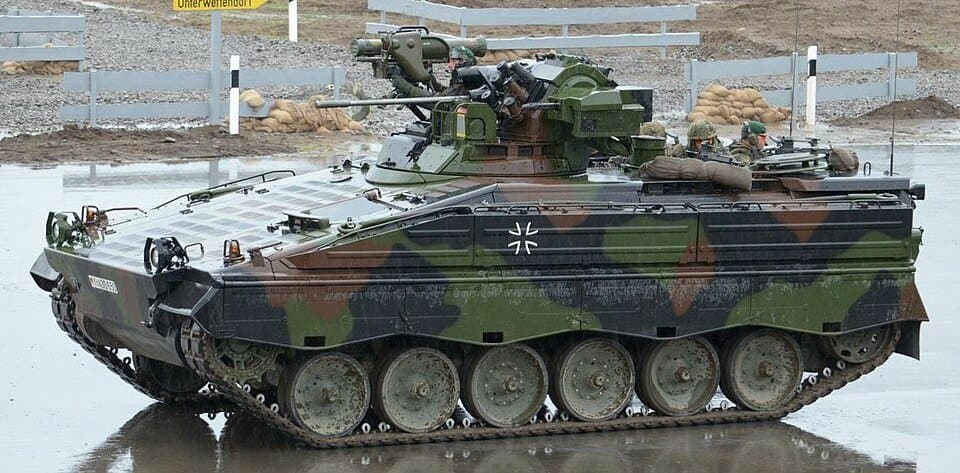
Armoured vehiclesIn service
Infantry fighting vehicle
Marder (infantry fighting vehicle) is a infantry fighting vehicle originating in West Germany. It was built by Rheinmetall Landsysteme Maschinenbau Kiel. Reported operators include Bundeswehr Armed Forces of Ukraine.
Technical data
Infantry fighting vehicle
West Germany
1971–present
Bundeswehr Armed Forces of Ukraine
Kosovo War Prizren incident War in Afghanistan Russo-Ukrainian War Russian invasion of Ukraine
Rheinmetall Landsysteme
1959–1969
Rheinmetall Landsysteme Maschinenbau Kiel
$390,000 2.33 million
1969–1975
2,137 (incl. Marder 2 prototype)
28.5 t (31.4 short tons) Marder 1A1/A2 33.5 t (36.9 short tons) Marder 1A3 37.4 t (41.2 short tons) Marder 1A5
True scale
Sourced dimensions beside a 1.75 m human reference.
See it in your room. Scan with your phone to open this model in 3D, then place it in your space.
Points represent sourced observations, including revisions. Revisions on the same effective date are not separate inventory events. Ranges appear in the table and are not plotted as exact points.
| Observation / report period | Value | Source | Claim state |
|---|---|---|---|
| 28 Sept 2026 | 3 people | Wikipedia contributors | superseded |
| 28 Sept 2026 | 3 people | Wikipedia contributors | superseded |
| 28 Sept 2026 | 3 people | Wikipedia contributors | superseded |
| 28 Sept 2026 | 3 people | Wikipedia contributors | approved |
6.79 m (22 ft 3 in)
3.24 m (10 ft 8 in)
2.98 m (9 ft 9 in)
3 crew + 6 passengers (prior to MILAN: 3+7)
Welded steel, protection up to 20 mm APDS DM43 from 0 m and 25 mm APDS from 200 m (220 yd)
20 mm Rheinmetall MK 20 Rh 202 automatic cannon 1,250 rounds MILAN ATGM launcher
7.62 mm MG3 machine gun 5,000 rounds
MTU MB 833 Ea-500 diesel engine 441 kW (591 hp)
15.7 kW/t (21.1 hp/t)
RENK HSWL 194
Torsion bar
0.45 m (18 in)
652 L (143 imp gal; 172 US gal)
520 km
75 km/h (47 mph)Marder 1A2 65 km/h (40 mph) Marder 1A3
Brazil had purchased 4 Roland 2 systems on the German Marder 1A2 chassis along with 50 missiles in the late 1970s, with all 4 being retired from service in 2001. In 2024, the Brazilian Army restored one of the vehicles for historical purposes.
The Schützenpanzer Marder 1 ( German pronunciation: [ˈʃʏt͜sn̩ˌpant͜sɐ ˈmaʁdɐ ˈaɪ̯ns] ; "Infantry fighting vehicle Marten 1" ) is a tracked German infantry fighting vehicle designed for use with the West German Panzergrenadiere units, mechanized infantry specialized for IFV combat.
A more reliable 20 mm cannon.
Initially, development contracts were awarded to two groups of companies: the Rheinstahl group (Rheinstahl- Hanomag , Ruhrstahl, Witten-Annen, Büro Warnecke) and the second group comprising Henschel Werke and the Swiss MOWAG company. This resulted in the production of seven prototype vehicles. A second set of eight prototype vehicles were built between 1961 and 1963. Development priority was then switched for a while to the development of the Jagdpanzer 90 mm Kanone .
A number of upgrade programs were carried out, that included fitting night vision equipment and a thermal imager , as well as an upgraded ammunition feed to the 20 mm cannon.
Improved armour, weighing 1,600 kg, intended to protect against the 30 mm 2A42 cannon on the Russian BMP-2 . The armour provided additional protection against cluster bomblets .
The new total weight was 35,000 kg.
The hull of the Marder 1 is all welded steel, giving protection from small-arms fire and shell fragments . The front of the hull provided protection from up to 20 mm armour-piercing discarding sabot (APDS) rounds. Later variants increased protection up to 30mm APDS, in response to the 30 mm autocannon armed BMP-2 and the development of top-attack cluster bomblets.
The Marder is a relatively conventional design, with the driver sitting at the front left side of the hull with the engine to the driver's right. The driver has three day periscopes mounted in a hatch that opens to the right. The center periscope can be replaced by a passive night vision device. Behind the driver is a seat for a single infantryman. In early versions of the Marder, this infantryman had a hatch that opened to the right and a periscope that could be rotated through 360 degrees. This hatch was removed in the 1A3 variant onwards.
The Marder is capable of fording in up to 1.5 meters of water unprepared. It can be fitted with a kit allowing it to ford water up to 2.5 meters deep.
The vehicle is powered by an MTU MB 833 Ea-500 six-cylinder liquid-cooled sequentially turbocharged diesel engine which delivers approximately 441 kW (600 PS; 591 hp) at 2,200 rpm. The cooling radiators are mounted at the rear of the hull, either side of the exit ramp. The engine is coupled to a Renk four speed HSWL 194 planetary gear box , with four forward and four reverse gears. The transmission also provides steering and braking via a stepless hydrostatic unit, which transmits power to two drive units mounted at the front of the hull. The vehicle carries 652 liters of fuel, giving it a road range of around 500 kilometres. Early Marders could achieve a road speed of 75 km/h in 4th gear, but the extra armour of later vehicles reduced this to 65 km/h.
The vehicle carries 652 liters of fuel, giving it a road range of around 500 kilometres.
The primary armament is the 20 mm Rheinmetall MK 20 Rh202 autocannon . It is mounted in the small two-man turret and can fire either armour-piercing or HE rounds. Mounted coaxially to the left of the cannon is a 7.62 mm MG 3 machine gun . The turret has 360 degree traverse, and can elevate from −17 degrees to +65 degrees, at a rate of 40 degrees per second while traversing at a rate of 60 degrees a second.
Early production Marders, up to and including version 1A1 had a second, rear-facing MG 3 mounted on the rear deck in a remote controlled pod and operated by one of the mounted infantry using a co-axial PERI-Z12 periscope sight (with a 180° horizontal traverse arc and a vertical arc of -15° to +55°). Typically, 1,250 rounds are carried for the 20 mm cannon, along with a further 5,000 rounds for the MG3.
Six 76-millimeter-diameter smoke grenade dischargers can create a visual and infrared blocking smoke screen .
Two Marders were damaged by the use of an improvised explosive device in the course of a German-led offensive on Taliban fighters in Quatliam, on 31 October 2010. Later in the battle, code-named by the Coalition " Operation Halmazag ", a single Marder beat off a Taliban attempt to outflank positions held by German paratroopers. On 2 June 2011, a German Marder was destroyed near Kunduz by a 200 kg (440.91 lbs.) IED, killing one soldier and injuring five others.
Marder 1 A1(+) (1979–1982): Dual feed for the 20 mm cannon enabling choice of ammunition, night vision equipment including image intensifiers and a thermal pointer.
A Marder 1A3 of Panzergrenadier Battalion 391 in 2006.
The Marder is used as a carrier for the Roland air defence system. The Kanonenjagdpanzer and Raketenjagdpanzer 2 started development as part of the Marder family but were realised based on the second batch of prototypes using different engines etc. The Kanonenjagdpanzer built for Belgium are a hybrid between the original Bundeswehr version and Marder parts. Some 4–6 test models of a 120 mm mortar on a Marder chassis were built, and at least one is in use as a firefighting vehicle at the WTS Meppen. Tests with an AAA tank were performed but the high weight of the system resulted in a switch to the heavier Standardpanzer chassis, resulting in the Gepard AAA system. At least one first or second generation prototype was equipped with the 110 mm artillery rocket system that later became the truck-mounted LARS system.
During the Eurosatory Show 2012 , Rheinmetall Landsysteme GmbH offered two further upgrades as part of the Marder Evolution family . The first upgrade was the Marder APC which features a new M151 Protector remotely controlled weapon, replacing the original Rheinmetall MK 20 Rh 202 automatic cannon, ballistic protection comparable to STANAG Level 4+, and mine protection comparable to Level 3a/3b+. The top deck has been lifted to enable improved ergonomics and uses a 440 kW (600 PS) MTU MB883 diesel. The other upgrade was the Marder Medium Tank which features a rifled, stabilized 105 mm OTO-Melara gun in a new turret.
At Indo Defence 2016 , Rheinmetall exhibited the Marder Medium Tank RI ("RI" stands for "Republic of Indonesia"), which was offered to the Indonesian Army, at the time already operating the Marder 1A3. The tank used the Marder 1A3 hull, with the three-crew Leonardo HITFACT turret armed with an OTO-Melara 105 mm gun and two 7.62 mm machine guns used in coaxial and roof-mounted positions. The HITFACT turret was equipped with an advanced fire control system, linked with the commander and gunner sights, a laser rangefinder, and day/thermal sights for both the commander and gunner. Improvements included upgraded suspension, a new MTU diesel engine with 690 hp (510 kW), and the availability to mount a modular armour package.
Höhe 3,23 m
Länge 6,88 m
Breite 3,38 m
Motorleistung 441 kW / 600 PS
Motorleistung 441 kW / 600 PS
Geschwindigkeit 65 km/ h
Besatzung 3+6
Reference text from Wikipedia contributors, used under CC BY-SA 4.0.
Marder (infantry fighting vehicle) equipment records. Variants, orders and quantities are shown as reported in each inventory source; coverage is incomplete.
 Chile
Army exact named equipment holdings: Marder 1A3. Active, operational-reserve and training units excluding equipment in store; November 2025 IISS assessment. Named service only; no parent-force or national total inferred. Source role: ARMOURED FIGHTING VEHICLES / IFV. Original estimates, ranges, reporting names, reserve, lease and employment scopes retained; nested included counts are not added. Missile-system quantities mean launchers, not rounds. No readiness, crew, carried weapon, payload, factory-production or future order count inherited.
 Germany
Army exact named equipment holdings: Marder 1A5. Active, operational-reserve and training units excluding equipment in store; November 2025 IISS assessment. Named service only; no parent-force or national total inferred. Source role: ARMOURED FIGHTING VEHICLES / IFV. Original estimates, ranges, reporting names, reserve, lease and employment scopes retained; nested included counts are not added. Missile-system quantities mean launchers, not rounds. No readiness, crew, carried weapon, payload, factory-production or future order count inherited.
 Greece
Army exact named equipment holdings: Marder 1A3. Active, operational-reserve and training units excluding equipment in store; November 2025 IISS assessment. Named service only; no parent-force or national total inferred. Source role: ARMOURED FIGHTING VEHICLES / IFV. Original estimates, ranges, reporting names, reserve, lease and employment scopes retained; nested included counts are not added. Missile-system quantities mean launchers, not rounds. No readiness, crew, carried weapon, payload, factory-production or future order count inherited.
 Indonesia
Army exact named equipment holdings: Marder 1A3. Active, operational-reserve and training units excluding equipment in store; November 2025 IISS assessment. Named service only; no parent-force or national total inferred. Source role: ARMOURED FIGHTING VEHICLES / IFV. Original estimates, ranges, reporting names, reserve, lease and employment scopes retained; nested included counts are not added. Missile-system quantities mean launchers, not rounds. No readiness, crew, carried weapon, payload, factory-production or future order count inherited.
 Jordan
Army exact named equipment holdings: Marder 1A3. Active, operational-reserve and training units excluding equipment in store; November 2025 IISS assessment. Named service only; no parent-force or national total inferred. Source role: ARMOURED FIGHTING VEHICLES / IFV. Original estimates, ranges, reporting names, reserve, lease and employment scopes retained; nested included counts are not added. Missile-system quantities mean launchers, not rounds. No readiness, crew, carried weapon, payload, factory-production or future order count inherited.
 Ukraine
Army exact named equipment holdings: Marder 1A3. Active, operational-reserve and training units excluding equipment in store; November 2025 IISS assessment. Named service only; no parent-force or national total inferred. Source role: ARMOURED FIGHTING VEHICLES / IFV. Original estimates, ranges, reporting names, reserve, lease and employment scopes retained; nested included counts are not added. Missile-system quantities mean launchers, not rounds. No readiness, crew, carried weapon, payload, factory-production or future order count inherited.
Keep exploring
Infantry fighting vehicle
 RomaniaCompare with Marder (infantry fighting vehicle)
Infantry fighting vehicle
Compare with Marder (infantry fighting vehicle)Infantry fighting vehicle
 SwedenCompare with Marder (infantry fighting vehicle)
Infantry fighting vehicle
GermanyCompare with Marder (infantry fighting vehicle) Infantry fighting vehicle
 South AfricaCompare with Marder (infantry fighting vehicle)
Infantry fighting vehicle
 ChinaCompare with Marder (infantry fighting vehicle)