


Preparing your view.

At a glance
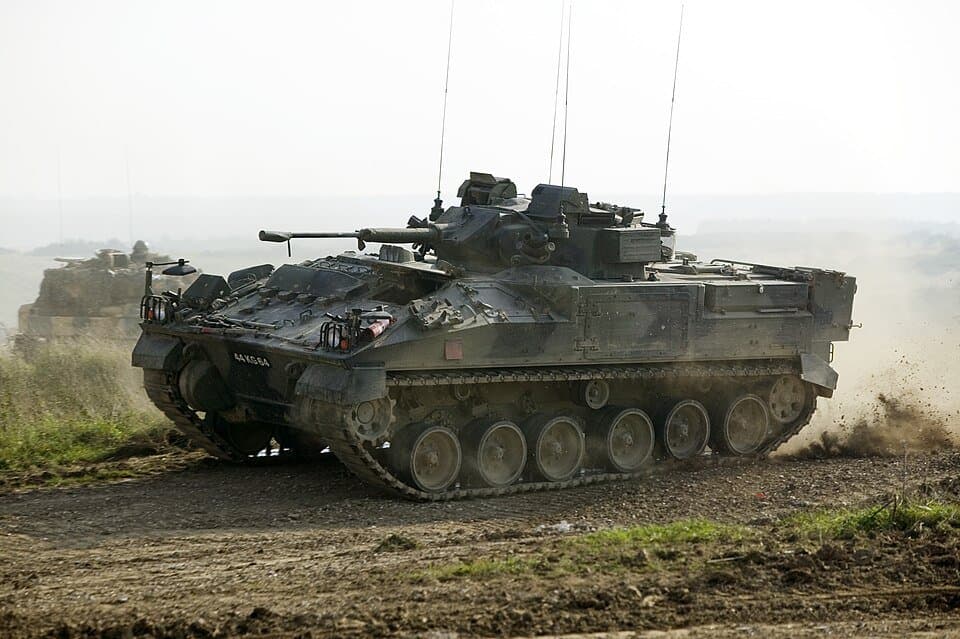
FV510 Warriorlarger figure on 3 of 4
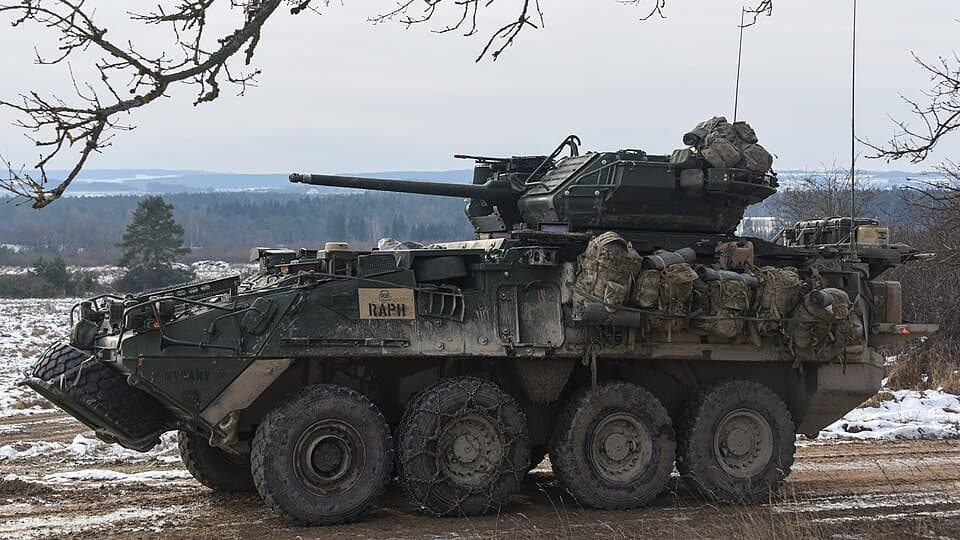
M1296 Dragoonlarger figure on 1 of 4
Counts only measures both sources give with the same scope. A larger figure is not a better system.
Measured figures
Length
Single source6.3 m (20 ft 8 in)[source]
Length
Single sourceConfiguration
| Specification | FV510 Warrior | M1296 Dragoon |
|---|---|---|
| Type | Infantry fighting vehicle[source] | Infantry fighting vehicle[source] |
| Place of origin | United Kingdom[source] | United States[source] |
| In service | 1987–present[source] | 2018-present[source] |
| Designer | GKN Sankey / GKN Defence[source] | — |
M1296龍騎兵步兵運輸車 M1296 Infantry Carrier Vehicle Dragoon · 22英尺10英寸
Single source6.95 m (22 ft 10 in)[source]
6.95米(22英尺10英寸)[source]M1296龍騎兵步兵運輸車 M1296 Infantry Carrier Vehicle Dragoon · 22英尺10英寸
6.95米(22英尺10英寸)[source]M1296龍騎兵步兵運輸車 M1296 Infantry Carrier Vehicle Dragoon · 22英尺10英寸
Width
Single source3.03 m (9 ft 11 in)[source]
Width
Single sourceM1296龍騎兵步兵運輸車 M1296 Infantry Carrier Vehicle Dragoon · 8英尺11英寸
Single source2.72 m (8 ft 11 in)[source]
2.72米(8英尺11英寸)[source]M1296龍騎兵步兵運輸車 M1296 Infantry Carrier Vehicle Dragoon · 8英尺11英寸
2.72米(8英尺11英寸)[source]M1296龍騎兵步兵運輸車 M1296 Infantry Carrier Vehicle Dragoon · 8英尺11英寸
Height
Single source2.8 m (9 ft 2 in)[source]
Hull
Single sourceM1296龍騎兵步兵運輸車 M1296 Infantry Carrier Vehicle Dragoon · (8英尺8英寸)(車體高)
Single source2.64 m (8 ft 8 in)(hull)[source]
2.64米(8英尺8英寸)(車體高)[source]M1296龍騎兵步兵運輸車 M1296 Infantry Carrier Vehicle Dragoon · (8英尺8英寸)(車體高)
2.64米(8英尺8英寸)(車體高)[source]M1296龍騎兵步兵運輸車 M1296 Infantry Carrier Vehicle Dragoon · (8英尺8英寸)(車體高)
Mass
Single source25.4 tonnes (25.0 long tons ; 28.0 short tons )[source]
(commander, gunner, driver) + 7 troops or full section 10 troops
Single source3 (commander, gunner, driver) + 7 troops or full section 10 troops[source]
Maximum; Off-road
Single sourceMaximum; On road
Single source46 mph (75 km/h) on road, 31 mph (50 km/h) off road[source]
Maximum; M1296龍騎兵步兵運輸車 M1296 Infantry Carrier Vehicle Dragoon
Single sourceMaximum; Maximum speed
Single sourceBars compare reported quantities only. A larger figure does not make a system better; configurations and test conditions differ.
| Designed |
|---|
1972–1980[source] |
| — |
| Manufacturer | GKN Sankey/BAE Systems[source] | General Dynamics Land Systems[source]M1296 Dragoon |
|---|
| Produced | 1986-present[source] | — |
|---|
| No. built | 1,043 (total) (as of 1995)[source] | — |
|---|
| Armour | Aluminium and appliqué[source] | — |
|---|
| Main armament | 30 mm L21A1 RARDEN cannon[source] | XM813 30 mm autocannon (156 ready rounds)[source] |
|---|
| Secondary armament | coaxial 7.62 mm L94A1 chain gun 2x4 66mm smoke grenades[source] | M240C 7.62 mm coaxial machine gun (400 ready rounds)[source] |
|---|
| Power/weight | 22 hp/t[source] | — |
|---|
| Suspension | Torsion bar with hydraulic damper[source] | 8×8 wheeled[source] |
|---|
| Role | series of British armoured vehicles, originally[source] | — |
|---|
| Source measurement | The crew of a Warrior comprises the driver, seated in the front hull and the gunner and commander in the turret. The embarked infantry section can number up to seven soldiers, who are seated facing each other in the rear hull compartment. Passenger access is through an electric ram powered door at the rear of the hull, rather than a drop-down ramp as in the US M113 APC and M2 Bradley IFV. Warrior Section Vehicles are able to carry seven fully equipped soldiers together with supplies and weapons, including a number of anti-tank weapons, for a 48-hour battlefield day in nuclear/biological/chemical conditions.[source]FV510 Warrior · Description; only the objects and conditions stated in this passage The Warrior is driven by a Perkins - Rolls-Royce V8 Condor engine through a four-speed automatic gearbox. It is capable of a road speed of 46 miles per hour (74 km/h). The Warrior has the speed and performance to keep up with a Challenger 2 main battle tank over the most difficult terrain.[source]FV510 Warrior · Description; only the objects and conditions stated in this passage The vehicle is fitted with a two-man GKN Sankey turret, armed with a non- stabilised L21A1 30 mm RARDEN cannon capable of destroying some APCs at a maximum range of 1,500 m (1,600 yd), and an L94A1 EX-34 7.62 mm Hughes Helicopters coaxial chain gun. It is fitted with two clusters of four defensive grenade launchers (usually used with Visual and Infrared Screening Smoke – VIRSS).[source]FV510 Warrior · Description; only the objects and conditions stated in this passage The protection against small arms , missiles , rocket-propelled grenades and anti-tank mines was shown during the UN operations in Bosnia . Two Warriors were destroyed during the First Gulf War , with nine soldiers killed, in a friendly fire incident when hit by AGM-65 Maverick missiles launched in error by two American Fairchild Republic A-10 Thunderbolt II ground attack aircraft.[source]FV510 Warrior · Combat history; only the objects and conditions stated in this passage As of 17 November 2008, 22 soldiers had been killed while travelling in Warrior IFVs in Afghanistan or Iraq. On 7 March 2012, six British soldiers were killed in an explosion that hit a Warrior IFV in Helmand .[source]FV510 Warrior · Combat history; only the objects and conditions stated in this passage FV512 Mechanised Combat Repair Vehicle. Operated by REME detachments in Armoured Infantry battalions. It is equipped with a 6.5-tonne crane plus power tools and is able to tow a trailer carrying two Warrior power packs or one Challenger power pack. A total of 105 of these were produced.[source]FV510 Warrior · Variants; only the objects and conditions stated in this passage FV513 Mechanised Recovery Vehicle (Repair). Also operated by REME detachments in Armoured Infantry battalions. It is equipped with a 20-tonne winch and 6.5-tonne crane plus power tools and (like the FV512) is able to tow a trailer carrying two Warrior power packs or one Challenger power pack. 39 of these were produced.[source]FV510 Warrior · Variants; only the objects and conditions stated in this passage FV514 Mechanised Artillery Observation Vehicle. This is operated by the Royal Artillery as an Artillery Observation Post Vehicle (OPV) and is fitted with mast-mounted Man-packable Surveillance and Target Acquisition Radar (MSTAR) and Position and Azimuth Determining System (PADS), with image intensifying and infra-red equipment. The only armament is the 7.62 mm machine gun, as the 30 mm RARDEN cannon is replaced by a dummy weapon. This allows space for the targeting and surveillance equipment while still keeping largely the same outward appearance of a standard Warrior in order to avoid becoming a priority target. 52 of these were produced.[source]FV510 Warrior · Variants; only the objects and conditions stated in this passage Desert Warrior. This was an export version adapted for operations in hostile desert conditions. It was fitted with the Delco turret as used on the LAV-25 wheeled IFV, mounting a stabilised 25 mm M242 Bushmaster chain gun with coaxial 7.62 mm chain gun and two Hughes TOW ATGM launchers (one mounted on each side). In 1993, Kuwait purchased 254 Desert Warrior vehicles.[source]FV510 Warrior · Variants; only the objects and conditions stated in this passage Warrior 2000. This was a new version developed for the Swiss Army . It did not enter production. It featured an all-welded aluminium hull, increased armour, digital fire control system and more powerful engine. It was fitted with the Delco turret, or a Land Systems Hagglunds E30 turret with Alliant Techsystems 30 mm Bushmaster II Mk 44 cannon.[source]FV510 Warrior · Variants; only the objects and conditions stated in this passage VERDI-2 (Vehicle Electronics Research Defence Initiative) was a technology demonstrator built on the hull of an FV510 in 1993. It features a dummy 30mm. the main armament was eight Starstreak missiles in two quad launchers, as well as the ADAD system later seen on the Stormer HVM . It did not enter production.[source]FV510 Warrior · Variants; only the objects and conditions stated in this passage Under the WFLI programme, the existing turret including the unstabilised Rarden gun, would be replaced by a turret mounting a stabilised 40 mm weapon developed by the Anglo-French firm CTA International and firing Cased telescoped ammunition . This weapon would also equip the Ajax armoured vehicle.[source]FV510 Warrior · Warrior Capability Sustainment Programme; only the objects and conditions stated in this passage By March 2020 Warrior CSP was in the "demonstration phase", demonstrating capability for a range of military missions set by the MoD. A total of £430m had been spent so far. No in-service date had been set, but the demonstration phase was due to finish in 2021. In June 2020 the House of Commons Defence Select Committee described the project as running over three years late and £227 million over budget.[source]FV510 Warrior · Warrior Capability Sustainment Programme; only the objects and conditions stated in this passage In March 2021, the MoD announced that the CSP had been cancelled and that all of the British Army's Warrior vehicles would be replaced by the middle of the decade with Boxer armoured fighting vehicles . In April 2021, Lockheed Martin announced that as a result up to 158 jobs would be lost at Ampthill. It had previously been reported in October 2020 that the UK may procure Boxer vehicles that are fitted with the 40mm CTA International CT40 cannon .[source]FV510 Warrior · Warrior Capability Sustainment Programme / Cancellation; only the objects and conditions stated in this passage Following the cancellation of the CSP, Leicestershire-based Digital Concepts Engineering has proposed a system to stabilise the Warrior’s 30mm Rarden cannon, allowing the vehicle to fire on the move. The upgrade would additionally provide a digital turret interface facilitating the addition of a vehicle battle management system and ‘slew to cue’ capability to reduce the cognitive burden on the gunner.[source]FV510 Warrior · Warrior Capability Sustainment Programme / Cancellation; only the objects and conditions stated in this passage | The M1296 Infantry Carrier Vehicle Dragoon (ICVD) is an upgraded variant of the Stryker infantry carrier vehicle (ICV), designed to enhance the firepower of U.S. Army Stryker brigade combat teams (SBCTs). The vehicle integrates a 30 mm XM813 Bushmaster II autocannon in a Kongsberg MCT-30 remote turret, significantly increasing its lethality over the standard Stryker Infantry Carrier Vehicle (ICV). First delivered in December 2017, the ICVD was developed in response to operational demands for a more heavily armed Stryker capable of countering evolving threats on the battlefield. It is operated by two crewman and can carry up to 9 dismounts.[source]M1296 Dragoon · Lead; only the objects and conditions stated in this passage The Stryker infantry carrier vehicle (ICV) was initially equipped with lighter armament, but efforts were made to enhance its firepower by integrating a remote turret with a 30 mm autocannon onto the Stryker ICV. This upgrade aimed to compensate for the reduced number of Mobile Gun System (MGS) vehicles per brigade by increasing the lethality of individual ICVs without compromising dismount capacity, as the remote turret does not occupy space within the hull. The U.S. Army began testing stabilized 30 mm cannons in early 2014, including Kongsberg Protech Systems' Medium Caliber Remote Weapons Station (MCRWS). In 2015, the Army approved the upgrade of 81 Strykers in the 2nd Cavalry Regiment with this system, incorporating the Orbital ATK XM813 variant of the Mk44 Bushmaster II . The first upgraded Stryker, designated XM1296 Dragoon, was delivered for testing in October 2016. After its adoption, the vehicle was redesignated M1296 ICVD, and the first vehicles were delivered to the 2nd Cavalry Regiment in Germany in December 2017.[source]M1296 Dragoon · Development; only the objects and conditions stated in this passage Modifications were made to the hull roof of the Stryker in order to install a Kongsberg unmanned turret with an XM813 30 mm cannon, which can engage targets out to 3,000 meters (1.9 mi), with a rate of fire of 100-200 rounds per minute (RPM).[source]M1296 Dragoon · Design / Firepower; only the objects and conditions stated in this passage This added around two tons of weight to the vehicle. |
|---|
| Used by | — | United States (see Operators below for details)[source] |
|---|
| Armor | — | With bolt-on ceramic armor: all-around 14.5×114mm protection[source] |
|---|
| Reported operators |
|
|---|
100 km/h (62 mph)[source]
100 km/h(62 mph)[source]M1296龍騎兵步兵運輸車 M1296 Infantry Carrier Vehicle Dragoon
100 km/h(62 mph)[source]M1296龍騎兵步兵運輸車 M1296 Infantry Carrier Vehicle Dragoon
The XM813 30 mm autocannon fires two types of service rounds, the Mk 238 high-explosive incendiary – tracer (HEI-T) and the Mk 258 armor piercing fin-stabilized discarding sabot – tracer (APFSDS-T).[source]M1296 Dragoon · Design / Firepower; only the objects and conditions stated in this passage
The M1296 is also equipped with a 7.62 mm M240C coaxial machine gun , which has a cyclic rate of fire of 650–950 rounds per minute and has 400 rounds ready to fire in the turret.[source]M1296 Dragoon · Design / Firepower; only the objects and conditions stated in this passage
The Stryker ICVD's survivability is comparable to the legacy Stryker flat-bottom hull ICV equipped with the same protection kits. The hull armor is constructed from a high-hardness steel, which offers a basic level of protection against 14.5mm rounds on the frontal arc and all-around protection against 7.62mm ball ammunition. There is also appliqué armor , which is bolt-on ceramic armor that offers all-around protection against 14.5mm armor-piercing ammunition and artillery fragments from 152mm high-explosive rounds.[source]M1296 Dragoon · Design / Armor and protection; only the objects and conditions stated in this passage
The M1296 ICVD was first fielded by the U.S. Army's 2nd Cavalry Regiment in Europe in 2018. It comprises 50 percent of the regiment's rifle and scout platoon vehicles, totaling 81 in service. Its deployment aimed to enhance the regiment's combat capabilities in response to evolving threats in the region.[source]M1296 Dragoon · Operational history; only the objects and conditions stated in this passage
The M1296 Dragoon is set to be replaced by the M1304 ICVVA1-30mm . The U.S. Army plans to field 269 M1304s across three Stryker brigade combat teams (SBCTs). The first M1304s were delivered on January 15, 2025, to the 1st Battalion, 17th Infantry Regiment , also known as the "Buffaloes".[source]M1296 Dragoon · Operational history; only the objects and conditions stated in this passage