FORCETALLY
Loading the evidence…
Preparing your view.


Preparing your view.
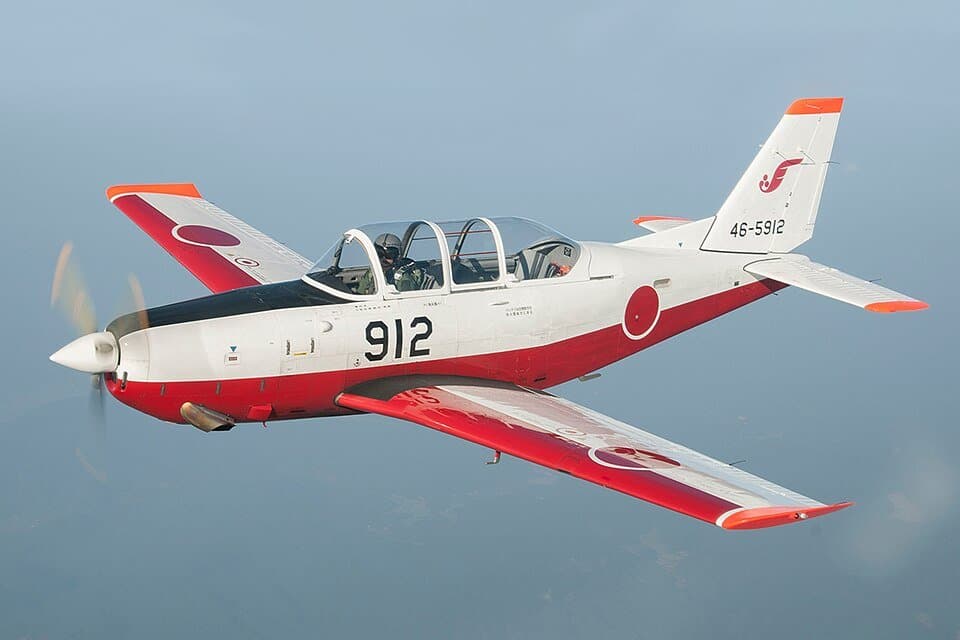
Trainer aircraftIn service
Primary/Basic Trainer
Fuji T-7 is a primary/Basic Trainer originating in Japan. It was built by Fuji Heavy Industries. Reported operators include Japan Air Self-Defense Force.
 Japan
Primary/Basic Trainer
Japan
Fuji Heavy Industries
Active
Japan Air Self-Defense Force
49
2002-present
Fuji T-3
2
8.59 m (28 ft 2 in)
10.04 m (32 ft 11 in)
2.96 m (9 ft 9 in)
16.5 m 2 (178 sq ft)
1,585 kg (3,494 lb)
1 × Rolls-Royce 250-B17F turboprop engine, 336 kW (451 hp)
298 km/h (185 mph, 161 kn) at 915 m (3,002 ft)
root: NACA 23016.5 ; tip: NACA 23012
3-bladed constant-speed propeller, 2.12 m (6 ft 11 in) diameter
104 km/h (65 mph, 56 kn) flaps and gear down
96.1 kg/m 2 (19.7 lb/sq ft)
0.2114 kW/kg (0.1286 hp/lb)
608 m (1,995 ft)
566 m (1,857 ft)
The Fuji T-7 (previously T-3 Kai ) is a Japanese primary trainer aircraft built by Fuji Heavy Industries for the Japan Air Self-Defense Force .
The T-7 was selected in preference to the Pilatus PC-7 in 1998, but this decision was cancelled and the competition restarted after a corruption scandal arose, with several managers from Fuji being arrested for bribing an official in Japan's ruling Liberal Democratic Party . Fuji re-entered the T-7 (then known as the T-3 Kai) and again won the restarted competition in September 2000.
Length: 8.59 m (28 ft 2 in)
Wingspan: 10.04 m (32 ft 11 in)
Height: 2.96 m (9 ft 9 in)
Wing area: 16.5 m 2 (178 sq ft)
Max takeoff weight: 1,585 kg (3,494 lb)
Powerplant: 1 × Rolls-Royce 250-B17F turboprop engine, 336 kW (451 hp)
Propellers: 3-bladed constant-speed propeller, 2.12 m (6 ft 11 in) diameter
Cruise speed: 298 km/h (185 mph, 161 kn) at 915 m (3,002 ft)
Stall speed: 104 km/h (65 mph, 56 kn) flaps and gear down
Take-off distance to 15 m (49 ft): 608 m (1,995 ft)
Landing distance from 15 m (49 ft): 566 m (1,857 ft)
分類 初等練習機
乗員 2人
全幅 10.04m
全長 8.59m
全高 2.96m
搭載数 1基
名称 250-B17F
最大速度 約203kt
航続距離 約950km
Reference text from Wikipedia contributors, used under CC BY-SA 4.0.
True scale
Sourced dimensions beside a 1.75 m human reference.
See it in your room. Scan with your phone to open this model in 3D, then place it in your space.
Points represent sourced observations, including revisions. Revisions on the same effective date are not separate inventory events. Ranges appear in the table and are not plotted as exact points.
| Observation / report period | Value | Source | Claim state |
|---|---|---|---|
| 28 Sept 2026 | 2 people | Wikipedia contributors | superseded |
| 28 Sept 2026 | 2 people | Wikipedia contributors | superseded |
| 28 Sept 2026 | 2 people | Wikipedia contributors | superseded |
| 28 Sept 2026 | 2 people | Wikipedia contributors | superseded |
| 28 Sept 2026 | 2 people | Wikipedia contributors | superseded |
| 28 Sept 2026 | 2 people | Wikipedia contributors | superseded |
| 28 Sept 2026 | 2 people | Wikipedia contributors | approved |
Fuji T-7 equipment records. Variants, orders and quantities are shown as reported in each inventory source; coverage is incomplete.
JapanReported count for Fuji T-7. Service scope: Japan Air Self-Defense Force; does not replace a national total. 1 distinct count cell(s) from the same source list; shared rowspan cells counted once. Excludes retired/reserve/on-order rows. Count column(s): in service: 49. Origin: Japan. The listed variants/roles are the scope, not an immediately deployable count. Dates are the count-cell citations' stated source period (2026), not the article revision. 2026 cited source edition. Edition or publication years do not claim an exact inventory census day.
Keep exploring
Primary trainer
 SwedenCompare with Fuji T-7
Basic Trainer
 ChinaCompare with Fuji T-7
Basic trainer
JapanCompare with Fuji T-7 Primary pilot trainer
 United StatesCompare with Fuji T-7
Fixed-wing Primary trainer
 New ZealandCompare with Fuji T-7
Trainer
 GermanyCompare with Fuji T-7