


Preparing your view.

At a glance
True scale
Side by side. From every angle. A human reference for perspective.
3.32 MB · Loads when you open it| Model | Length | Width / span | Height |
|---|---|---|---|
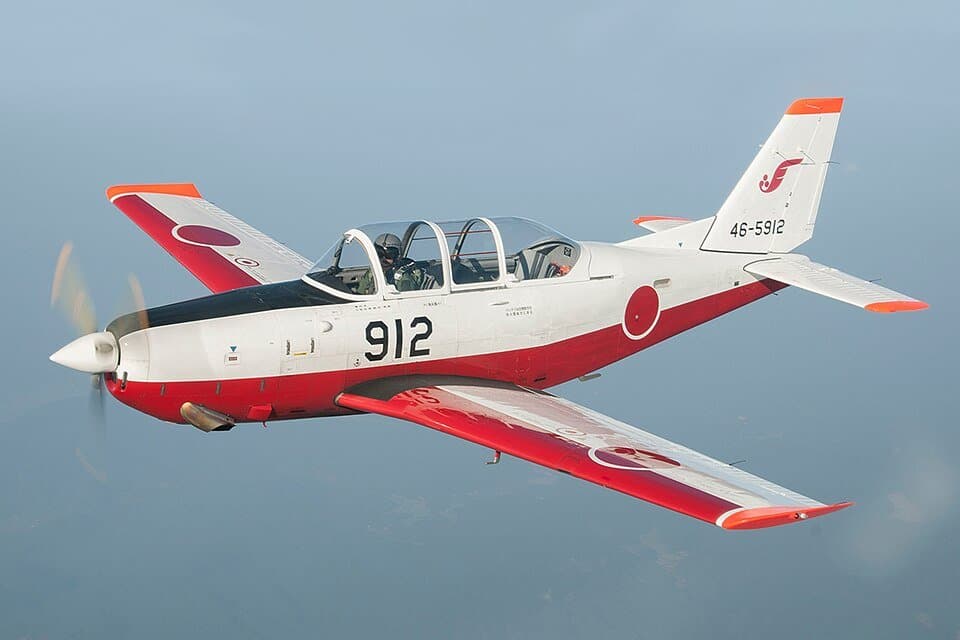
| Fuji T-7 | ≈ 8.59 m | ≈ 10.04 m (Wingspan) | ≈ 2.96 m |
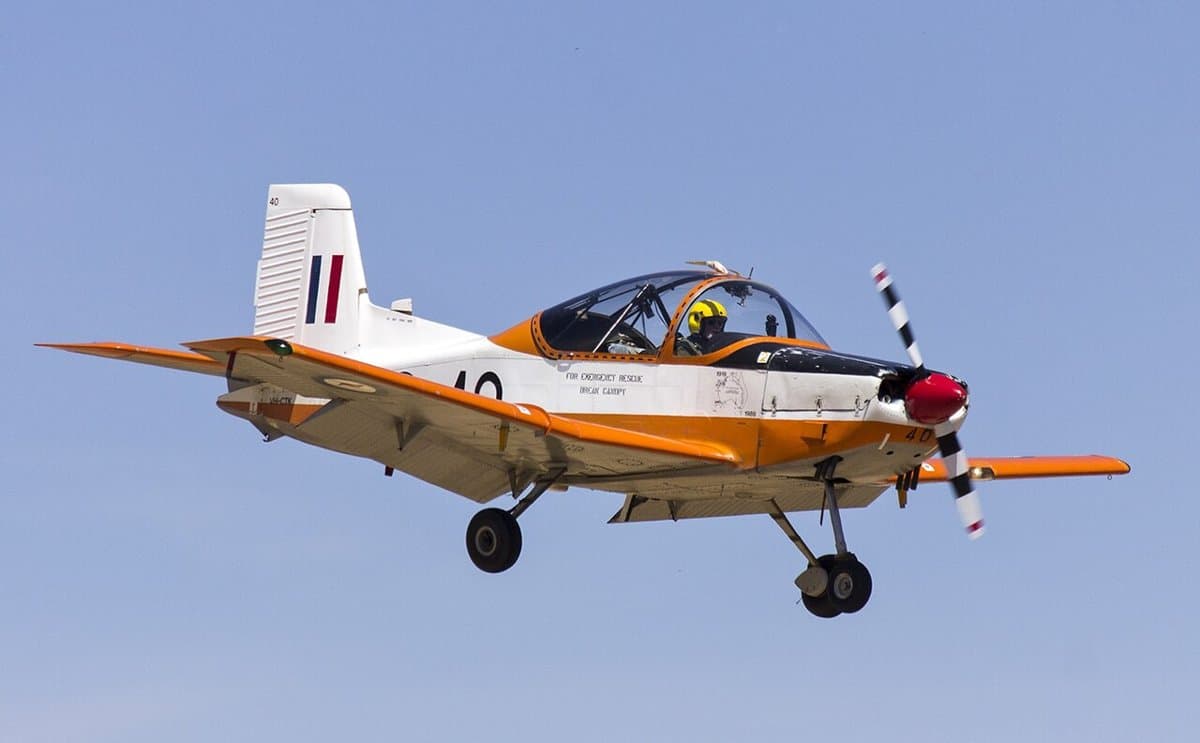
| PAC CT/4 Airtrainer | ≈ 7.2 m | ≈ 7.92 m (Wingspan) | ≈ 2.99 m |
Scaled uniformly to the sourced length of 8.59 m. The shape was turned square to the axes; the height was fitted to the sourced 2.96 m; the width was fitted to the sourced 10.04 m wingspan. Not an official model or a measured survey.
ForceTally · All rights reserved
Scaled uniformly to the sourced length of 7.201 m. The shape was turned square to the axes; the width was fitted to the sourced 7.92 m wingspan. Not an official model or a measured survey.
ForceTally · All rights reserved
The human reference is a generic 1.75 m figure. Models describe external size, not combat performance.
Measured figures
T-7
Single sourceT-7 · Length
Single sourceConfiguration
| Specification | Fuji T-7 | PAC CT/4 Airtrainer |
|---|---|---|
| Type | Primary/Basic Trainer[source] | Fixed-wing Primary trainer[source] |
| National origin | Japan[source] | New Zealand[source] |
| Manufacturer | Fuji Heavy Industries[source] | Pacific Aerospace NZAero[source] |
| Status | Active[source] | Currently manufactured by NZAero |
CT4E · Length
Single source7.201 m (23 ft 7.5 in)[source]
Maximum take-off; T-7 · Max takeoff weight
Single source1,585 kg (3,494 lb)[source]
CT4E · Service ceiling
Single source5,550 m (18,200 ft)[source]
CT4E · 1,830 ft/min
Single source9.3 m/s (1,830 ft/min)[source]
Bars compare reported quantities only. A larger figure does not make a system better; configurations and test conditions differ.
| Primary user | Japan Air Self-Defense Force[source] | — |
|---|
| Number built | 49[source] | 154[source] |
|---|
| Manufactured | 2002-present[source] | 1972–2008 2026-present[source] |
|---|
| Developed from | Fuji T-3[source] | Victa Aircruiser[source] |
|---|
| Airfoil | root: NACA 23016.5 ; tip: NACA 23012[source] | — |
|---|
| Propellers | 3-bladed constant-speed propeller, 2.12 m (6 ft 11 in) diameter[source] | Hartzell Propeller HC-C3YR-4BF / FC7663-2R 1 per engine[source] |
|---|
| Stall speed | 104 km/h (65 mph, 56 kn) flaps and gear down[source] | 82 km/h (51 mph, 44 kn) (flaps down)[source] |
|---|
| Wing loading | 96.1 kg/m 2 (19.7 lb/sq ft)[source] | — |
|---|
| Power/mass | 0.2114 kW/kg (0.1286 hp/lb)[source] | — |
|---|
| Take-off distance to 15 m (49 ft) | 608 m (1,995 ft)[source] | — |
|---|
| Landing distance from 15 m (49 ft) | 566 m (1,857 ft)[source] | — |
|---|
| Role | Japanese primary trainer aircraft[source] | — |
|---|
| Source measurement | The T-7 was selected in preference to the Pilatus PC-7 in 1998, but this decision was cancelled and the competition restarted after a corruption scandal arose, with several managers from Fuji being arrested for bribing an official in Japan's ruling Liberal Democratic Party . Fuji re-entered the T-7 (then known as the T-3 Kai) and again won the restarted competition in September 2000.[source]Fuji T-7 · Design and development; only the objects and conditions stated in this passage Length: 8.59 m (28 ft 2 in)[source]Fuji T-7 · Specifications (T-7); only the objects and conditions stated in this passage Wingspan: 10.04 m (32 ft 11 in)[source]Fuji T-7 · Specifications (T-7); only the objects and conditions stated in this passage Height: 2.96 m (9 ft 9 in)[source]Fuji T-7 · Specifications (T-7); only the objects and conditions stated in this passage Wing area: 16.5 m 2 (178 sq ft)[source]Fuji T-7 · Specifications (T-7); only the objects and conditions stated in this passage Max takeoff weight: 1,585 kg (3,494 lb)[source]Fuji T-7 · Specifications (T-7); only the objects and conditions stated in this passage Powerplant: 1 × Rolls-Royce 250-B17F turboprop engine, 336 kW (451 hp)[source]Fuji T-7 · Specifications (T-7); only the objects and conditions stated in this passage Propellers: 3-bladed constant-speed propeller, 2.12 m (6 ft 11 in) diameter[source]Fuji T-7 · Specifications (T-7); only the objects and conditions stated in this passage Cruise speed: 298 km/h (185 mph, 161 kn) at 915 m (3,002 ft)[source]Fuji T-7 · Specifications (T-7); only the objects and conditions stated in this passage Stall speed: 104 km/h (65 mph, 56 kn) flaps and gear down[source]Fuji T-7 · Specifications (T-7); only the objects and conditions stated in this passage Take-off distance to 15 m (49 ft): 608 m (1,995 ft)[source]Fuji T-7 · Specifications (T-7); only the objects and conditions stated in this passage Landing distance from 15 m (49 ft): 566 m (1,857 ft)[source]Fuji T-7 · Specifications (T-7); only the objects and conditions stated in this passage | — |
|---|
| 分類 | 初等練習機[source]T-7 10.04m[source]T-7 1基[source]T-7 / エンジン 250-B17F[source]T-7 / エンジン | — |
|---|
| Primary users | — | Royal New Zealand Air Force (historical) Royal Australian Air Force BAE Systems Australia Royal Thai Air Force[source] |
|---|
| First flight | — | 23 February 1972[source] |
|---|
| Retired | — | Royal New Zealand Air Force , 4 December 2014[source] |
|---|
| Aspect ratio | — | 5.2:1[source] |
|---|
| Never exceed speed | — | 387 km/h (240 mph, 209 kn)[source] |
|---|