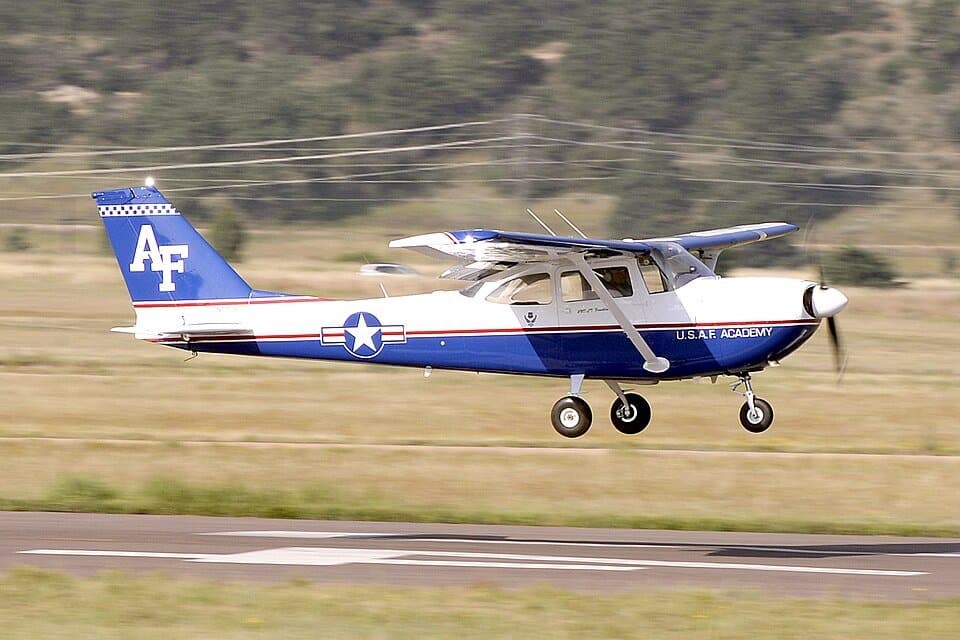

Credit
US Air Force · Public domain · Resized · Public domain · Source ↗ · Modified


Preparing your view.

At a glance
Measured figures
T-41C · Length
Single source26 ft 11 in (8.20 m)[source]
Configuration
| Specification | Cessna T-41 Mescalero | Fuji T-7 |
|---|---|---|
| Type | Primary pilot trainer[source] | Primary/Basic Trainer[source] |
| National origin | United States[source] | Japan[source] |
| Manufacturer | Cessna[source] | Fuji Heavy Industries[source] |
| Status | In service[source] | Active[source] |
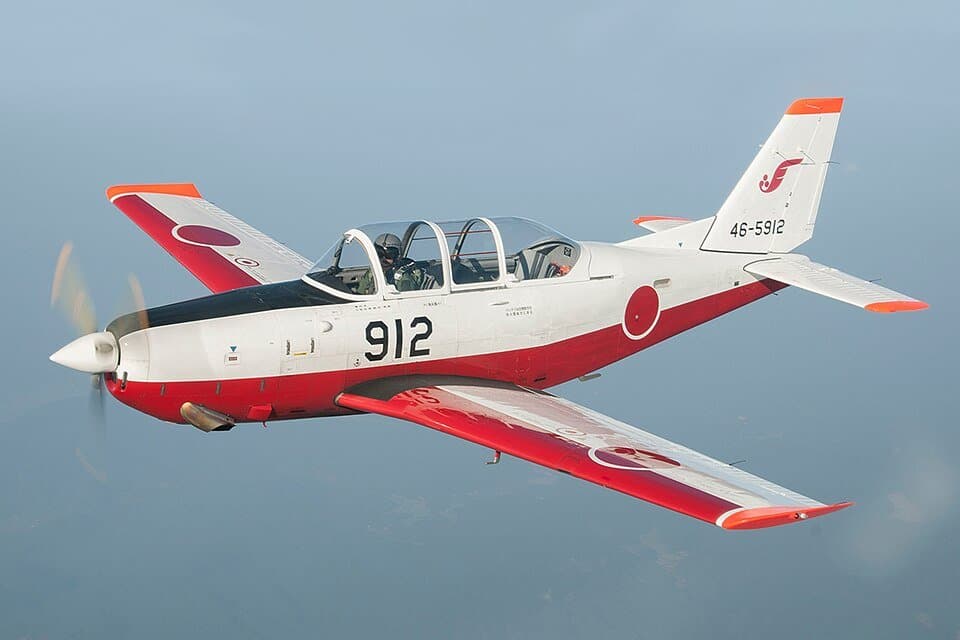
T-7
T-7 · Length
Single sourceEmpty; T-41C · Empty weight
Single sourceGross; T-41C · Gross weight
Single sourceMaximum take-off; Cessna T-41B Mescalero · own technical specification card, Cessna Flyer December2023 p42; no transfer to T-41A/C/D configurations
Single source1,363 lb (618 kg)[source]
2,500 lb (1,134 kg)[source]
2,500 pounds[source]Cessna T-41B Mescalero · own technical specification card, Cessna Flyer December2023 p42; no transfer to T-41A/C/D configurations
Maximum take-off; T-7 · Max takeoff weight
Single source1,585 kg (3,494 lb)[source]
T-41C · 1 × Continental IO-360-D Six-cylinder air-cooled horizontally-opposed piston engine
Single source1 × Continental IO-360-D Six-cylinder air-cooled horizontally-opposed piston engine, 210 hp (160 kW)[source]
T-7 · 1 × Rolls-Royce 250-B17F turboprop engine
Single source1 × Rolls-Royce 250-B17F turboprop engine, 336 kW (451 hp)[source]
T-41C · Service ceiling
Single source17,000 ft (5,200 m)[source]
T-41C · 880 ft/min (
Single source880 ft/min (4.5 m/s)[source]
Bars compare reported quantities only. A larger figure does not make a system better; configurations and test conditions differ.
| Primary users | United States Air Force United States Army Indonesian Air Force Turkish Air Force[source] | — |
|---|
| Number built | T-41A : 230 T-41B : 255 T-41C : 52 T-41D : 299[source] | 49[source] |
|---|
| Manufactured | 1964–1996[source] | 2002-present[source] |
|---|
| Introduction date | 1964[source] | — |
|---|
| Developed from | Cessna 172 Cessna R172[source] | Fuji T-3[source] |
|---|
| Capacity | three passengers[source] | — |
|---|
| Propellers | 2-bladed variable-pitch propeller[source] | 3-bladed constant-speed propeller, 2.12 m (6 ft 11 in) diameter[source] |
|---|
| Alternative designation | T-41 Mescalero[source] | — |
|---|
| Source measurement | The T-41B was the US Army version, with a 210 hp (160 kW) Continental IO-360 engine and constant-speed propeller in place of the 145 hp (108 kW) Continental O-300 and 7654 fixed-pitch propeller used in the 172 and the T-41A.[source]Cessna T-41 Mescalero · Design and development; only the objects and conditions stated in this passage In 1968, the USAF acquired 52 of the more powerful T-41Cs, which used 210 hp (160 kW) Continental IO-360 and a fixed-pitch climb propeller, for use at the United States Air Force Academy (USAFA).[source]Cessna T-41 Mescalero · Design and development; only the objects and conditions stated in this passage A number of air forces, including Saudi Arabia and Singapore , purchased various civilian models of the Cessna 172 for use in military training, transport, and liaison roles. While similar to the T-41 and named as such, these aircraft were not actually T-41s from a technical standpoint and were powered by the standard 172 powerplants available in the model year purchased, including the Continental O-300 in pre-1968 aircraft and the Lycoming O-320 in later 172s.[source]Cessna T-41 Mescalero · Design and development; only the objects and conditions stated in this passage United States Air Force version of the Cessna 172F , 172G, and 172H for undergraduate pilot training, powered by 145 hp Continental O-300. 230 built; 170 (172F), 26 (172G), and 34 (172H).[source]Cessna T-41 Mescalero · Variants; only the objects and conditions stated in this passage United States Army version powered by a fuel-injected 210 hp (157 kW) Continental IO-360-D or -DE driving a constant-speed propeller and featuring a 28V electrical system, jettisonable doors, an openable right front window, a 6.00x6 nose wheel tire, and military avionics. The baggage door was removed. 255 built (all Model R172E ).[source]Cessna T-41 Mescalero · Variants; only the objects and conditions stated in this passage Capacity: three passengers[source]Cessna T-41 Mescalero · Specifications (T-41C); only the objects and conditions stated in this passage Length: 26 ft 11 in (8.20 m)[source]Cessna T-41 Mescalero · Specifications (T-41C); only the objects and conditions stated in this passage Wingspan: 35 ft 10 in (10.92 m)[source]Cessna T-41 Mescalero · Specifications (T-41C); only the objects and conditions stated in this passage Height: 8 ft 10 in (2.69 m)[source]Cessna T-41 Mescalero · Specifications (T-41C); only the objects and conditions stated in this passage Wing area: 159 sq ft (14.8 m 2 )[source]Cessna T-41 Mescalero · Specifications (T-41C); only the objects and conditions stated in this passage Empty weight: 1,363 lb (618 kg)[source]Cessna T-41 Mescalero · Specifications (T-41C); only the objects and conditions stated in this passage Gross weight: 2,500 lb (1,134 kg)[source]Cessna T-41 Mescalero · Specifications (T-41C); only the objects and conditions stated in this passage Powerplant: 1 × Continental IO-360-D Six-cylinder air-cooled horizontally-opposed piston engine, 210 hp (160 kW)[source]Cessna T-41 Mescalero · Specifications (T-41C); only the objects and conditions stated in this passage Maximum speed: 125 kn (144 mph, 232 km/h)[source]Cessna T-41 Mescalero · Specifications (T-41C); only the objects and conditions stated in this passage Range: 626 nmi (720 mi, 1,159 km)[source]Cessna T-41 Mescalero · Specifications (T-41C); only the objects and conditions stated in this passage Service ceiling: 17,000 ft (5,200 m)[source]Cessna T-41 Mescalero · Specifications (T-41C); only the objects and conditions stated in this passage Rate of climb: 880 ft/min (4.5 m/s)[source]Cessna T-41 Mescalero · Specifications (T-41C); only the objects and conditions stated in this passage | The T-7 was selected in preference to the Pilatus PC-7 in 1998, but this decision was cancelled and the competition restarted after a corruption scandal arose, with several managers from Fuji being arrested for bribing an official in Japan's ruling Liberal Democratic Party . Fuji re-entered the T-7 (then known as the T-3 Kai) and again won the restarted competition in September 2000.[source]Fuji T-7 · Design and development; only the objects and conditions stated in this passage Length: 8.59 m (28 ft 2 in)[source]Fuji T-7 · Specifications (T-7); only the objects and conditions stated in this passage Wingspan: 10.04 m (32 ft 11 in)[source]Fuji T-7 · Specifications (T-7); only the objects and conditions stated in this passage Height: 2.96 m (9 ft 9 in)[source]Fuji T-7 · Specifications (T-7); only the objects and conditions stated in this passage Wing area: 16.5 m 2 (178 sq ft)[source]Fuji T-7 · Specifications (T-7); only the objects and conditions stated in this passage Max takeoff weight: 1,585 kg (3,494 lb)[source]Fuji T-7 · Specifications (T-7); only the objects and conditions stated in this passage Powerplant: 1 × Rolls-Royce 250-B17F turboprop engine, 336 kW (451 hp) |
|---|
| Primary user | — | Japan Air Self-Defense Force[source] |
|---|
| Airfoil | — | root: NACA 23016.5 ; tip: NACA 23012[source] |
|---|
| Stall speed | — | 104 km/h (65 mph, 56 kn) flaps and gear down[source] |
|---|
| Wing loading | — | 96.1 kg/m 2 (19.7 lb/sq ft)[source] |
|---|
| Power/mass | — | 0.2114 kW/kg (0.1286 hp/lb)[source] |
|---|
| Take-off distance to 15 m (49 ft) | — | 608 m (1,995 ft)[source] |
|---|
| Landing distance from 15 m (49 ft) | — | 566 m (1,857 ft)[source] |
|---|
| Role | — | Japanese primary trainer aircraft[source] |
|---|
| 分類 | — | 初等練習機[source]T-7 10.04m[source]T-7 1基[source]T-7 / エンジン 250-B17F[source]T-7 / エンジン |
|---|
Propellers: 3-bladed constant-speed propeller, 2.12 m (6 ft 11 in) diameter[source]Fuji T-7 · Specifications (T-7); only the objects and conditions stated in this passage
Cruise speed: 298 km/h (185 mph, 161 kn) at 915 m (3,002 ft)[source]Fuji T-7 · Specifications (T-7); only the objects and conditions stated in this passage
Stall speed: 104 km/h (65 mph, 56 kn) flaps and gear down[source]Fuji T-7 · Specifications (T-7); only the objects and conditions stated in this passage
Take-off distance to 15 m (49 ft): 608 m (1,995 ft)[source]Fuji T-7 · Specifications (T-7); only the objects and conditions stated in this passage
Landing distance from 15 m (49 ft): 566 m (1,857 ft)[source]Fuji T-7 · Specifications (T-7); only the objects and conditions stated in this passage