FORCETALLY
Loading the evidence…
Preparing your view.


Preparing your view.
Support aircraftIn production
Motor glider
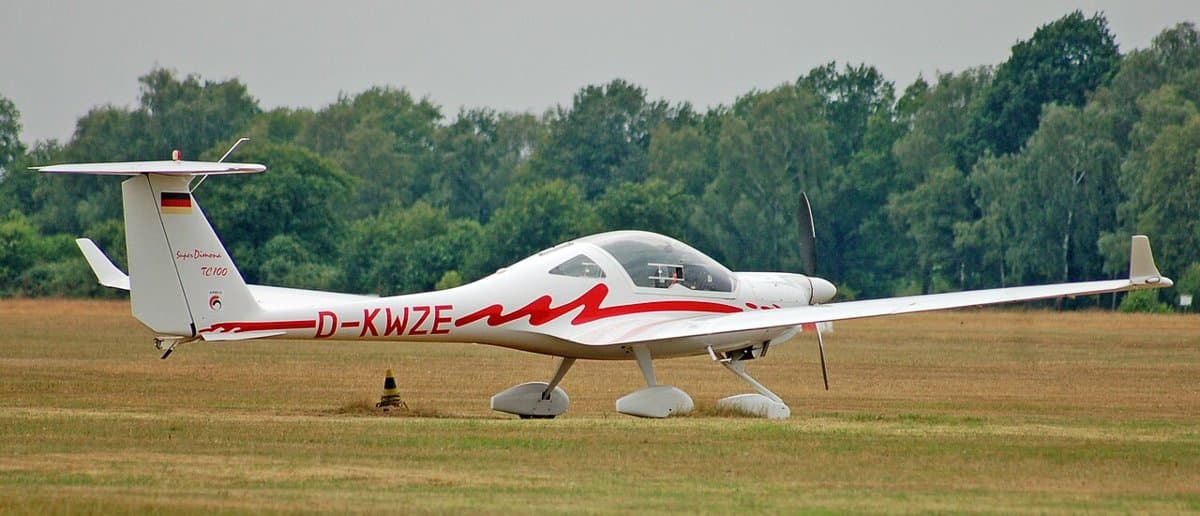
Diamond HK36 Super Dimona is a motor glider originating in Austria. It was built by Diamond Aircraft Industries.
 Austria
Technical data
Motor glider
Austria
Diamond Aircraft Industries
Wolf Hoffmann
In production (HK36 Super Dimona)
more than 900
1980–present
9 October 1980 (H36) October 1989 (HK36R)
Diamond DV20
one
one passenger
True scale
Sourced dimensions beside a 1.75 m human reference.
See it in your room. Scan with your phone to open this model in 3D, then place it in your space.
Points represent sourced observations, including revisions. Revisions on the same effective date are not separate inventory events. Ranges appear in the table and are not plotted as exact points.
| Observation / report period | Value | Source | Claim state |
|---|---|---|---|
| 10 Oct 2026 | 1 people | European Union Aviation Safety Agency | approved |
16.0 m (52 ft 6 in)
15.24 m 2 (164.0 sq ft)
16.8:1
Wortmann FX 63-137
497 kg (1,096 lb)
770 kg (1,698 lb)
80 liters (18 imp gal ; 21 U.S. gal )
2-bladed Hoffmann HO-V 62-R/L 160 T, three position, fully feathering
182 km/h (113 mph, 98 kn)
275 km/h (171 mph, 148 kn) sea level to 6000 feet
1,090 km (680 mi, 590 nmi)
27:1 at 105 km/h (65 mph)
0.91 m/s (179 ft/min) at 79 km/h (49 mph)
48.56 kg/m 2 (9.95 lb/sq ft)
Built entirely from fibreglass , the H36 family all use a Wortmann FX 63-137 airfoil . The wings feature top-surface Schempp-Hirth -style airbrakes . Optionally, the wings can be folded by two people in a few minutes to allow storage. The original H36 has 16.0 m (52.5 ft) wings, while the later members of the family added slightly greater span. The H36 offers a 27:1 glide ratio , while later variants improved that by one point, to 28:1 by adding winglets increasing the span to 16.33 m (53.6 ft). Cockpit accommodation seats two in side-by-side configuration , under a hinged bubble canopy that is pushed up and backwards.
When equipped with the larger available engines, particularly the 86 kW (115 hp) Rotax 914 turbocharged powerplant, the aircraft can be used for glider towing . A commercial success, more than 900 H36s and HK36s have been completed.
In 1991, an HK36, flown by Peter Urach in Austria, set an absolute altitude record in its class for a piston engined aircraft of 36,188 ft (11,030 m). The record held until surpassed in 2002 by the Bohannon B-1 .
Original version produced by Hoffmann and later by HOAC , with a 16.0 m (52.5 ft) wingspan, conventional landing gear , 27:1 glide ratio and powered by a Limbach L2000 EB1C engine of 60 kW (80 hp), a Rotax 912A of 60 kW (80 hp) or Limbach L2400 EB of 65 kW (87 hp). Applied for US FAA certificate on 4 April 1982 and received on 9 July 1986 in the utility category at a gross weight of 770 kg (1,698 lb).
Developed from the H36, with a carbon-fibre spar , modified fuselage , 16.2 m (53.1 ft) wingspan and 60 kW (80 hp) Rotax 912A engine. Optional wing tips can extend the span to 17.6 m (57.7 ft). Received US FAA type approval on 23 July 1993 in the utility category at a gross weight of 770 kg (1,698 lb).
Developed from the HK36 R Super Dimona, the HK36TS has a 60 kW (80 hp) Rotax 912 A3 engine, 16.6 m (54.5 ft) wingspan, 28:1 glide ratio and conventional landing gear . Received US FAA type approval on 25 September 1997 in the utility category at a gross weight of 770 kg (1,698 lb). Marketed as the Katana Xtreme in Canada and the USA.
The HK36TC has a 60 kW (80 hp) Rotax 912 A3 engine. Received US FAA type approval on 25 September 1997 in the utility category at a gross weight of 770 kg (1,698 lb). Marketed as the Katana Xtreme in Canada and the USA.
The HK36TC-100 has a 74 kW (99 hp) Rotax 912 S3 engine. Applied for US FAA type approval on 16 January 2003 and received on 12 January 2004 in the utility category at a gross weight of 770 kg (1,698 lb). Minimum sink rate: 1.18 m/s at 97 km/h, glide ratio 1:27 at 105 km/h Marketed as the Katana Xtreme in Canada and the USA.
The HK36TTS has an 86 kW (115 hp) Rotax 914 F3 or F4 turbocharged engine, a Muhlbauer MTV-21-A-C-F/CF 175-05 propeller , 16.6 m (54.5 ft) wingspan, 28:1 glide ratio, and conventional landing gear . Received US FAA type approval on 25 September 1997 in the utility category at a gross weight of 770 kg (1,698 lb). Marketed as the Katana Xtreme in Canada and the USA.
The HK36TTC has an 86 kW (115 hp) Rotax 914 F3 or F4 turbocharged engine, 16.6 m (54.5 ft) wingspan, 28:1 glide ratio, and tricycle landing gear . Received US FAA type approval on 25 September 1997 in the utility category at a gross weight of 770 kg (1,698 lb). Marketed as the Katana Xtreme in Canada and the USA.
Special mission version of the HK36 for the surveillance role, it is equipped with a gimbal-mounted Wescam camera and cockpit display, an 86 kW (115 hp) Rotax 914 F3 or F4 turbocharged engine and a Muhlbauer MTV-21-A-C-F/CF 175-05 propeller. Received US FAA type approval on 29 March 1999 in the utility category at a gross weight of 770 kg (1,698 lb) and 21 December 2000 in the restricted category, limited to aerial photography only, at a gross weight of 930 kg (2,050 lb). Marketed as the Multi Purpose Xtreme in Canada.
Developed by Siemens, EADS and Diamond Aircraft to reduce fuel consumption and emissions by up to 25 percent, using a serial hybrid drive that turns the aircraft's prop with a Siemens 70 kW (94 hp) electric motor, from power generated by a 40 hp (30 kW) Austro Engines Wankel rotary engine and generator, stored in batteries. The prototype first flew 8 June 2011.
Wingspan: 16.0 m (52 ft 6 in)
Wing area: 15.24 m 2 (164.0 sq ft)
Empty weight: 497 kg (1,096 lb)
Gross weight: 770 kg (1,698 lb)
Fuel capacity: 80 liters (18 imp gal ; 21 U.S. gal )
Cruise speed: 182 km/h (113 mph, 98 kn)
Never exceed speed : 275 km/h (171 mph, 148 kn) sea level to 6000 feet
Range: 1,090 km (680 mi, 590 nmi)
Maximum glide ratio: 27:1 at 105 km/h (65 mph)
Rate of sink: 0.91 m/s (179 ft/min) at 79 km/h (49 mph)
Length 7.1 m
Height 1.76 m
Length 7.22 m
Height 1.76 m
Length 7.28 m
Height 1.78 m
Length 7.28 m
Height 1.78 m
Length 7.28 m
Height 1.78 m
Length 7.28 m
Height 1.78 m
Length 7.28 m
Height 1.78 m
Engine Model L 2400 EB 1.C or L 2400 EB 1.AC (see Note 4)
Maximum Masses Take-off 770 kg
Minimum Flight Crew 1 (Pilot)
Reference text from Wikipedia contributors, used under CC BY-SA 4.0.
Diamond HK36 Super Dimona equipment records. Variants, orders and quantities are shown as reported in each inventory source; coverage is incomplete.
 France
Air and Space Force exact named equipment holdings: Super Dimona HK36. Active, operational-reserve and training units excluding equipment in store; November 2025 IISS assessment. Named service only; no parent-force or national total inferred. Source role: AIRCRAFT / TRG. Original estimates, ranges, reporting names, reserve, lease and employment scopes retained; nested included counts are not added. Missile-system quantities mean launchers, not rounds. No readiness, crew, carried weapon, payload, factory-production or future order count inherited.
Keep exploring
Tiltrotor military transport aircraft
 United States
Aerobatic monoplane
 Germany
Twin-engine cabin monoplane
United StatesMulti-role tanker / transport
Trainer
 ChileCompare with Diamond HK36 Super Dimona
Two-seat aerobatic monoplane
 United KingdomCompare with Diamond HK36 Super Dimona