FORCETALLY
Loading the evidence…
Preparing your view.


Preparing your view.
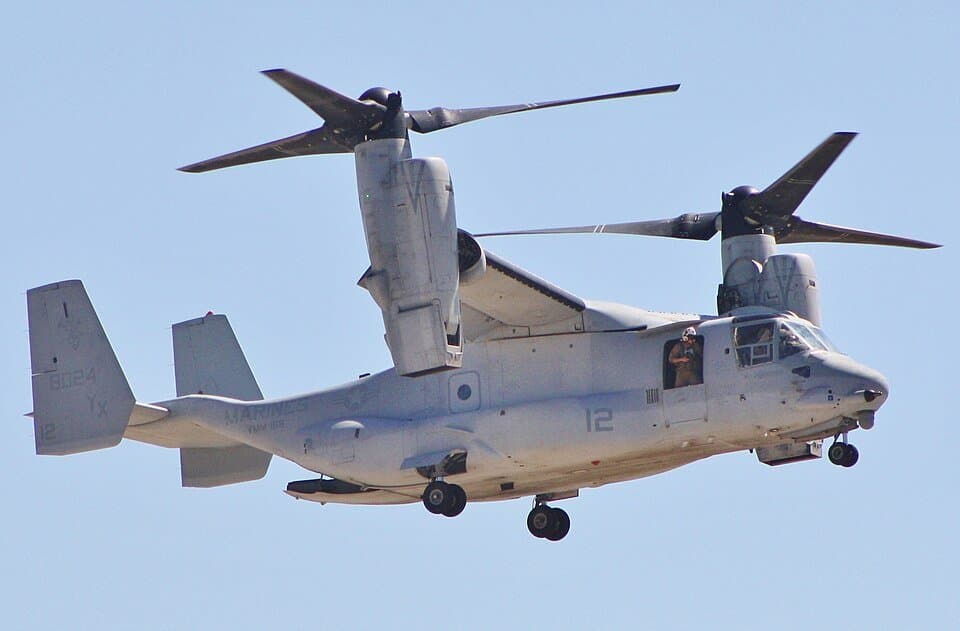
Support aircraftIn service
Tiltrotor military transport aircraft
Bell–Boeing V-22 Osprey is a tiltrotor military transport aircraft originating in United States. The cited manufacturer or builder is Bell Helicopter Boeing Defense, Space & Security.
 United States
Technical data
Tiltrotor military transport aircraft
United States
Bell Helicopter Boeing Defense, Space & Security
In service
United States Marine Corps United States Air Force United States Navy Japan Ground Self-Defense Force
400 as of 2020
1988–present
13 June 2007
19 March 1989
Bell XV-15
Bell Boeing Quad TiltRotor
3–4 (pilot, copilot and 1 or 2 flight engineers/crew chiefs/loadmasters/gunners)
24 troops (seated), 32 troops (floor loaded), or 20,000 pounds (9,100 kg) of internal cargo, or up to 15,000 pounds (6,800 kg) of external cargo (dual hook) 1× M1161 Growler light internally transportable ground vehicle
True scale
Sourced dimensions beside a 1.75 m human reference.
See it in your room. Scan with your phone to open this model in 3D, then place it in your space.
Points represent sourced observations, including revisions. Revisions on the same effective date are not separate inventory events. Ranges appear in the table and are not plotted as exact points.
| Observation / report period | Value | Source | Claim state |
|---|---|---|---|
| 28 Sept 2026 | 720 km | Wikipedia contributors | superseded |
57 ft 4 in (17.48 m) Length folded: 62 ft 7.6 in (19.091 m)
45 ft 10 in (13.97 m)
84 ft 6.8 in (25.776 m) including rotors
22 ft 1 in (6.73 m) engine nacelles vertical;
301.4 sq ft (28.00 m 2 )
31,818 lb (14,432 kg)
39,500 lb (17,917 kg)
Ferry maximum: 4,451 US gal (3,706 imp gal; 16,850 L) of JP-4 / JP-5 / JP-8 to MIL-T-5624
2 × Rolls-Royce T406-AD-400 turboprop / turboshaft engines, 6,150 hp (4,590 kW) each maximum at 15,000 rpm at sea level, 59 °F (15 °C)
2 × 38 ft 1 in (11.61 m)
275 kn (316 mph, 509 km/h)
879 nmi (1,012 mi, 1,628 km)
390 nmi (450 mi, 720 km)
2,230 nmi (2,570 mi, 4,130 km)
25,000 ft (7,600 m)
2,320–4,000 ft/min (11.8–20.3 m/s)
18 ft 5 in (5.61 m)
18 ft 1 in (5.51 m)
32,623 lb (14,798 kg)
42,712 lb (19,374 kg)
52,600 lb (23,859 kg)
57,000 lb (25,855 kg)
60,500 lb (27,442 kg)
2,268 sq ft (210.7 m 2 ) 3-bladed
110 kn (130 mph, 200 km/h)
+ 4 max / − 1 min
4.5:1
20.9 lb/sq ft (102 kg/m 2 ) at 47,500 lb (21,546 kg)
0.259 hp/lb (0.426 kW/kg)
The Bell Boeing V-22 Osprey is an American multi-use, tiltrotor military transport and cargo aircraft with both vertical takeoff and landing ( VTOL ) and short takeoff and landing ( STOL ) capabilities.
The first of six prototypes first flew on 19 March 1989 in the helicopter mode and on 14 September 1989 in fixed-wing mode. The third and fourth prototypes successfully completed the first sea trials on USS Wasp in December 1990. The fourth and fifth prototypes crashed in 1991–92. From October 1992 to April 1993, the V-22 was redesigned to reduce empty weight, simplify manufacture, and reduce build costs; it was designated V-22B. Flights resumed in June 1993 after safety changes were made to the prototypes. Bell Boeing received a contract for the engineering manufacturing development (EMD) phase in June 1994. The prototypes were also modified to resemble the V-22B standard. At this stage, testing focused on flight envelope expansion, measuring flight loads, and supporting the EMD redesign. Flight testing with the early V-22s continued into 1997.
U.S. Naval Air Systems Command (NAVAIR) worked on software upgrades to increase the maximum speed from 250 to 270 knots (460 to 500 km/h; 290 to 310 mph), increase helicopter mode altitude limit from 10,000 to 12,000 feet (3,000 to 3,700 m) or 14,000 feet (4,300 m), and increase lift performance. By 2012, changes had been made to the hardware, software, and procedures in response to hydraulic fires in the nacelles, vortex ring state control issues, and opposed landings; reliability has improved accordingly.
The average cost per flight hour is US$9,156 , whereas the Sikorsky CH-53E Super Stallion cost about $20,000 (~$29,063 in 2024) per flight hour in 2007.
While technically capable of autorotation if both engines fail in helicopter mode, a safe landing is difficult. In 2005, a director of the Pentagon's testing office stated that in a loss of power while hovering below 1,600 feet (490 m), emergency landings "are not likely to be survivable." V-22 pilot Captain Justin "Moon" McKinney stated that: "We can turn it into a plane and glide it down, just like a C-130 ." A complete loss of power requires both engines to fail, as one engine can power both proprotors via interconnected drive shafts. Though vortex ring state (VRS) contributed to a deadly V-22 accident , flight testing found it to be less susceptible to VRS than conventional helicopters. A GAO report stated that the V-22 is "less forgiving than conventional helicopters" during VRS. Several test flights to explore VRS characteristics were canceled. The USMC trains pilots in the recognition of and recovery from VRS, and has instituted operational envelope limits and instrumentation to help avoid VRS conditions.
On 12 June 2013, the U.S. DoD awarded a $4.9 billion contract for 99 V-22s in production Lots 17 and 18, including 92 MV-22s for the USMC, for completion in September 2019. A provision gives NAVAIR the option to order 23 more Ospreys. As of June 2013, the combined value of all contracts placed totaled $6.5 billion. In 2013, Bell laid off production staff following the US's order being cut to about half of the planned number. Production rate went from 40 in 2012 to 22 planned for 2015. Manufacturing robots have replaced older automated machines for increased accuracy and efficiency; large parts are held in place by suction cups and measured electronically.
In March 2014, Air Force Special Operations Command issued a Combat Mission Need Statement for armor to protect V-22 passengers. NAVAIR worked with a Florida-based composite armor company and the Army Aviation Development Directorate to develop and deliver the advanced ballistic stopping system (ABSS) by October 2014. Costing $270,000, the ABSS consists of 66 plates fitting along interior bulkheads and deck, adding 800 lb (360 kg) to the aircraft's weight, affecting payload and range. The ABSS can be installed or removed when needed in hours and partially assembled in pieces for partial protection of specific areas. As of May 2015, 16 kits had been delivered to the USAF.
The Osprey is the world's first production tiltrotor aircraft, with one three-bladed proprotor , turboshaft engine, and transmission nacelle mounted on each wingtip. It is classified as a powered lift aircraft by the Federal Aviation Administration . For takeoff and landing, it typically operates as a helicopter with the nacelles vertical and rotors horizontal. Once airborne, the nacelles rotate forward 90° in as little as 12 seconds for horizontal flight, converting the V-22 to a more fuel-efficient, higher-speed aircraft, like a turboprop aircraft. STOL rolling-takeoff and landing capability is achieved by having the nacelles tilted forward up to 45°. Other orientations are possible. Pilots describe the V-22 in airplane mode as comparable to the C-130 in feel and speed. It has a ferry range of over 2,100 nmi. Its operational range is 1,100 nmi.
Composite materials make up 43% of the airframe , and the proprotor blades also use composites. For storage, the V-22's rotors fold in 90 seconds and its wing rotates to align, front-to-back, with the fuselage. Because of the requirement for folding rotors, their 38-foot (12 m) diameter is 5 feet (1.5 m) less than would be optimal for an aircraft of this size to conduct vertical takeoff, resulting in high disk loading . Most missions use fixed wing flight 75% or more of the time, reducing wear and tear and operational costs. This fixed wing flight is higher than typical helicopter missions allowing longer range line-of-sight communications for improved command and control .
In September 2013, Rolls-Royce announced that it had increased the AE-1107C engine's power by 17% via the adoption of a new Block 3 turbine, increased fuel valve flow capacity, and software updates; it should also improve reliability in high-altitude, high-heat conditions and boost maximum payload limitations from 6,000 to 8,000 ft (1,800 to 2,400 m). A Block 4 upgrade is reportedly being examined, which may increase power by up to 26%, producing close to 10,000 shp (7,500 kW), and improve fuel consumption.
In August 2014, the U.S. military issued a request for information for a potential drop-in replacement for the AE-1107C engines. Submissions must have a power rating of no less than 6,100 shp (4,500 kW) at 15,000 rpm, operate at up to 25,000 ft (7,600 m) at up to 130 degrees Fahrenheit (54 degrees Celsius), and fit into the existing wing nacelles with minimal structural or external modifications. In September 2014, the U.S. Navy, who already purchase engines separately to airframes, was reportedly considering an alternative engine supplier to reduce costs. The General Electric GE38 is one option, giving commonality with the Sikorsky CH-53K King Stallion .
The V-22 has a maximum rotor downwash speed of over 80 knots (92 mph; 150 km/h), more than the 64-knot (74 mph; 119 km/h) lower limit of a hurricane .
V-22s must keep at least 25 ft (7.6 m) of vertical separation between each other to avoid each other's rotor wake, which causes turbulence and potentially control loss.
The extreme rotor downwash of the V-22 has caused incidents when rappelling or fast roping from the aircraft, including a soldier being blown 3 meters away from his intended dismount point by the force of the downwash.
The V-22 is equipped with a glass cockpit , which incorporates four multi-function displays (MFDs, compatible with night-vision goggles ) and one shared central display unit, to display various images including: digimaps, imagery from the Turreted forward-looking infrared system primary flight instruments, navigation ( TACAN , VOR , ILS , GPS , INS ), and system status. The flight director panel of the cockpit management system allows for fully coupled (autopilot) functions that take the aircraft from forward flight into a 50 ft (15 m) hover with no pilot interaction other than programming the system. The fuselage is not pressurized , and personnel must wear on-board oxygen masks above 10,000 feet.
The V-22 has triple-redundant fly-by-wire flight control systems; these have computerized damage control to automatically isolate damaged areas. With the nacelles pointing straight up in conversion mode at 90° the flight computers command it to fly like a helicopter, cyclic forces being applied to a conventional swashplate at the rotor hub. With the nacelles in airplane mode (0°) the flaperons , rudder, and elevator fly similar to an airplane. This is a gradual transition, occurring over the nacelles' rotation range; the lower the nacelles, the greater effect of the airplane-mode control surfaces. The nacelles can rotate past vertical to 97.5° for rearward flight. The V-22 can use the "80 Jump" orientation with the nacelles at 80° for takeoff to quickly achieve high altitude and speed. The controls automate to the extent that it can hover in low wind without hands on the controls.
The V-22 can be armed with one 7.62×51mm NATO ( .308 in caliber ) M240 machine gun or .50 in caliber (12.7 mm) M2 machine gun on the rear loading ramp. A 12.7 mm (.50 in) GAU-19 three-barrel Gatling gun mounted below the nose was studied. BAE Systems developed a belly-mounted, remotely operated gun turret system, the Interim Defense Weapon System (IDWS); it is remotely operated by a gunner, targets are acquired via a separate pod using color television and forward looking infrared imagery. The IDWS was installed on half of the V-22s deployed to Afghanistan in 2009; it found limited use because of its 800 lb (360 kg) weight and restrictive rules of engagement .
In 2014, the USMC studied new weapons with "all-axis, stand-off, and precision capabilities", akin to the AGM-114 Hellfire , AGM-176 Griffin , Joint Air-to-Ground Missile , and GBU-53/B SDB II. In November 2014, Bell Boeing conducted self-funded weapons tests, equipping a V-22 with a pylon on the front fuselage and replacing the AN/AAQ-27A EO camera with an L-3 Wescam MX-15 sensor/ laser designator . 26 unguided Hydra 70 rockets, two guided APKWS rockets, and two Griffin B missiles were fired over five flights. The USMC and USAF sought a traversable nose-mounted weapon connected to a helmet-mounted sight; recoil complicated integrating a forward-facing gun. A pylon could carry 300 lb (140 kg) of munitions. However, by 2019, the USMC opted for IDWS upgrades over adopting new weapons.
The high-speed version of the hose/drogue refueling system can be deployed at 185 knots (213 mph; 343 km/h) and function at up to 250 knots (290 mph; 460 km/h). A mix of tanks and a roll-on/roll-off bladder house up to 12,000 lb (5,400 kg) of fuel. The ramp must open to extend the hose, then raised once extended. It can refuel rotorcraft, needing a separate drogue used specifically by helicopters and a converted nacelle. Many USMC ground vehicles can run on aviation fuel; a refueling V-22 could service these. In late 2014, it was stated that V-22 tankers could be in use by 2017, but contract delays pushed IOC to late 2019. As part of a 26 May 2016 contract award to Boeing, Cobham was contracted to adapt their FR-300 hose drum unit as used by the KC-130 in October 2016. In May 2025, the Navy confirmed that V-22s were not training for aerial refueling missions, and that neither NAVAIR nor the V-22 program office intends to pursue such a capability as there was no interest from the fleet.
V-22s in Iraq's Anbar province were used for transport and scout missions. General David Petraeus , the top U.S. military commander in Iraq, used one to visit troops on Christmas Day 2007; as did Barack Obama during his 2008 presidential campaign tour in Iraq . USMC Col. Kelly recalled how visitors were reluctant to fly on the unfamiliar aircraft, but after seeing its speed and ability to fly above ground fire, "All of a sudden, the entire flight schedule was booked. No senior officer wanted to go anywhere unless they could fly on the V-22". Obtaining spares proved problematic. By July 2008, the V-22 had flown 3,000 sorties totaling 5,200 hours in Iraq. General George J. Trautman III praised its greater speed and range over legacy helicopters, saying "it turned his battle space from the size of Texas into the size of Rhode Island." Despite attacks by man-portable air-defense systems and small arms, none were lost to enemy fire by late 2009.
The USAF's first operational CV-22 was delivered to the 58th Special Operations Wing (58th SOW) at Kirtland Air Force Base , New Mexico , in March 2006. Early aircraft were delivered to the 58th SOW and used for training personnel for special operations use. On 16 November 2006, the USAF officially accepted the CV-22 in a ceremony conducted at Hurlburt Field , Florida. The USAF's first operational deployment sent four CV-22s to Mali in November 2008 in support of Exercise Flintlock. The CV-22s flew nonstop from Hurlburt Field, Florida, with in-flight refueling. AFSOC declared that the 8th Special Operations Squadron reached Initial Operational Capability in March 2009, with six CV-22s in service.
In December 2013, three CV-22s came under small arms fire while trying to evacuate American civilians in Bor, South Sudan , during the 2013 South Sudanese political crisis ; the aircraft flew 500 mi (800 km) to Entebbe , Uganda , after the mission was aborted. South Sudanese officials stated that the attackers were rebels. The CV-22s had flown to Bor over three countries across 790 nmi (910 mi; 1,460 km). The formation was hit 119 times, wounding four crew and causing flight control failures and hydraulic and fuel leaks on all three aircraft. Fuel leaks resulted in multiple air-to-air refuelings en route. After the incident, AFSOC developed optional armor floor panels.
The USAF found that "CV-22 wake modeling is inadequate for a trailing aircraft to make accurate estimations of safe separation [distance] from the preceding aircraft." In 2015, the USAF sought to configure the CV-22 to perform combat search and rescue in addition to its long-range special operations transport mission. It would complement the HH-60G Pave Hawk and planned HH-60W rescue helicopters, being employed in scenarios where high speed is better suited to search and rescue than more nimble but slower helicopters. In 2019, a plan was formulated for the USAF V-22 to use the AN/APQ-187 Silent Knight terrain avoidance radar, which was tested on the CV-22 at Eglin Air Force base by 2020. This radar is used on many Air Force aircraft, such as C-130 Hercules transport aircraft and MH-47 Chinook helicopters.
The V-22 program originally included Navy 48 HV-22s, but none were ordered. In 2009, it was proposed that it replace the C-2 Greyhound for carrier onboard delivery (COD) duties. One advantage of the V-22 is the ability to deliver supplies and people between non-carrier ships beyond helicopter range. Proponents said that it is capable of similar speed, payload capacity, and lift performance to the C-2, and can carry greater payloads over short ranges, up to 20,000 lb, including suspended external loads. The C-2 can only deliver cargo to carriers, requiring further distribution to smaller vessels via helicopters, while the V-22 is certified for operating upon amphibious ships, aircraft carriers, and logistics ships. It could also take some helicopter roles by fitting a 600 lb hoist to the ramp and a cabin configuration for 12 non-ambulatory patients and 5 seats for medical attendants. Bell and P&W designed a frame for the V-22 to transport the Pratt & Whitney F135 engine of the F-35.
On 5 January 2015, the Navy and USMC signed a memorandum of understanding to buy the V-22 for the COD mission. Initially designated HV-22, four aircraft were bought each year from 2018 to 2020. It incorporates an extended-range fuel system for an 1,150 nmi (1,320 mi; 2,130 km) unrefueled range, a high-frequency radio for over-the-horizon communications, and a public address system to communicate with passengers; the range increase comes from extra fuel bladders in larger external sponsons , the only external difference from other variants. Its primary mission is long-range logistics; other conceivable missions include personnel recovery and special warfare. In February 2016, the Navy officially designated it the CMV-22B . The Navy's Program of Record originally called for 48 aircraft, but it was later determined that only 44 were required. Production began in FY 2018, and deliveries started in 2020.
France showed some interest in the V-22 especially for naval operations. It tested the V-22 in operations on their Mistral -class ships, and also their aircraft carrier Charles de Gaulle . The French had a two-year-long program to insure that the V-22 could operate from their Mistral -class vessels working with USMC V-22.
U.S. Air Force variant for the U.S. Special Operations Command . It conducts long-range special operations such as combat search and rescue (CSAR) missions and is equipped with extra wing fuel tanks, an AN/APQ-186 terrain-following radar , and other equipment such as the AN/ALQ-211, and AN/AAQ-24 Nemesis Directional Infrared Counter Measures . The fuel capacity is increased by 588 gallons (2,230 L) with two inboard wing tanks; three auxiliary tanks (200 or 430 gal; 760 or 1,630 L) can also be added in the cabin. The CV-22 replaced the MH-53 Pave Low .
Proposed anti-submarine warfare variant. The U.S. Navy studied the SV-22 in the 1980s to replace S-3 and SH-2 aircraft.
Capacity: 24 troops (seated), 32 troops (floor loaded), or 20,000 pounds (9,100 kg) of internal cargo, or up to 15,000 pounds (6,800 kg) of external cargo (dual hook) 1× M1161 Growler light internally transportable ground vehicle
Length: 57 ft 4 in (17.48 m) Length folded: 62 ft 7.6 in (19.091 m)
Wingspan: 45 ft 10 in (13.97 m)
Width: 84 ft 6.8 in (25.776 m) including rotors
Width folded: 18 ft 5 in (5.61 m)
Height: 22 ft 1 in (6.73 m) engine nacelles vertical;
17 ft 7.8 in (5 m) to top of tailfins
Height folded: 18 ft 1 in (5.51 m)
Wing area: 301.4 sq ft (28.00 m 2 )
Empty weight: 31,818 lb (14,432 kg)
Operating weight, empty: 32,623 lb (14,798 kg)
Gross weight: 39,500 lb (17,917 kg)
Combat weight: 42,712 lb (19,374 kg)
Maximum take-off weight VTOL: 52,600 lb (23,859 kg)
Maximum take-off weight STOL: 57,000 lb (25,855 kg)
Maximum take-off weight STOL, ferry: 60,500 lb (27,442 kg)
Powerplant: 2 × Rolls-Royce T406-AD-400 turboprop / turboshaft engines, 6,150 hp (4,590 kW) each maximum at 15,000 rpm at sea level, 59 °F (15 °C)
5,890 hp (4,392 kW) maximum continuous at 15,000 rpm at sea level, 59 °F (15 °C)
Main rotor diameter: 2 × 38 ft 1 in (11.61 m)
Main rotor area: 2,268 sq ft (210.7 m 2 ) 3-bladed
Maximum speed: 275 kn (316 mph, 509 km/h)
305 kn (565 km/h; 351 mph) at 15,000 ft (4,600 m)
Stall speed: 110 kn (130 mph, 200 km/h)
Range: 879 nmi (1,012 mi, 1,628 km)
Combat range: 390 nmi (450 mi, 720 km)
Ferry range: 2,230 nmi (2,570 mi, 4,130 km)
Service ceiling: 25,000 ft (7,600 m)
Rate of climb: 2,320–4,000 ft/min (11.8–20.3 m/s)
Wing loading: 20.9 lb/sq ft (102 kg/m 2 ) at 47,500 lb (21,546 kg)
1 × 7.62 mm (.308 in) M240 machine gun or .50 in (12.7 mm) M2 Browning machine gun on ramp, removable
1 × 7.62 mm (.308 in) GAU-17 minigun , belly-mounted, retractable, video remote control in the Remote Guardian System [optional]
Reference text from Wikipedia contributors, used under CC BY-SA 4.0.
Bell–Boeing V-22 Osprey equipment records. Variants, orders and quantities are shown as reported in each inventory source; coverage is incomplete.
 Japan
Ground Self-Defense Force exact named equipment holdings: MV-22B Osprey. Active, operational-reserve and training units excluding equipment in store; November 2025 IISS assessment. Named service only; no parent-force or national total inferred. Source role: AIRCRAFT / TPT. Original estimates, ranges, reporting names, reserve, lease and employment scopes retained; nested included counts are not added. Missile-system quantities mean launchers, not rounds. No readiness, crew, carried weapon, payload, factory-production or future order count inherited.
Reported count for Bell Boeing V-22 Osprey. Service scope: Japan Ground Self-Defense Force; does not replace a national total. 1 distinct count cell(s) from the same source list; shared rowspan cells counted once. Retired, wholly reserve and on-order rows are excluded; the reported count retains any explicitly mixed stock scope in the quoted row. Count column(s): quantity: 17. Origin: United States. The listed variants/roles are the scope, not an immediately deployable count. Dates are the count-cell citations' stated source period (2025), not the article revision. 2025 cited source edition. Edition or publication years do not claim an exact inventory census day.
United StatesMarine Corps Aviation Reserve exact named equipment holdings: MV-22B Osprey. Active, operational-reserve and training units excluding equipment in store; November 2025 IISS assessment. Named service only; no parent-force or national total inferred. Source role: AIRCRAFT / TPT. Original estimates, ranges, reporting names, reserve, lease and employment scopes retained; nested included counts are not added. Missile-system quantities mean launchers, not rounds. No readiness, crew, carried weapon, payload, factory-production or future order count inherited.
United States Marine Corps United States Air Force United States Navy Japan Ground Self-Defense Force
Equipment reference ↗Naval Aviation exact named equipment holdings: CMV-22B Osprey. Active, operational-reserve and training units excluding equipment in store; November 2025 IISS assessment. Named service only; no parent-force or national total inferred. Source role: AIRCRAFT / TPT. Original estimates, ranges, reporting names, reserve, lease and employment scopes retained; nested included counts are not added. Missile-system quantities mean launchers, not rounds. No readiness, crew, carried weapon, payload, factory-production or future order count inherited.
Marine Corps Aviation exact named equipment holdings: MV-22B Osprey. Active, operational-reserve and training units excluding equipment in store; November 2025 IISS assessment. Named service only; no parent-force or national total inferred. Source role: AIRCRAFT / TPT. Original estimates, ranges, reporting names, reserve, lease and employment scopes retained; nested included counts are not added. Missile-system quantities mean launchers, not rounds. No readiness, crew, carried weapon, payload, factory-production or future order count inherited.
Reported count for CV-22B Osprey. Service scope: Air Force; does not replace a national total. 1 distinct count cell(s) from the same source list; shared rowspan cells counted once. Retired, wholly reserve and on-order rows are excluded; the reported count retains any explicitly mixed stock scope in the quoted row. Count column(s): inventory: 52. Origin: USA. The listed variants/roles are the scope, not an immediately deployable count. Dates are the count-cell citations' stated source period (2025), not the article revision. Cited source 2025-06-20. Edition or publication years do not claim an exact inventory census day.
Keep exploring
Military transport aircraft
United StatesCompare with Bell–Boeing V-22 Osprey Military transport aircraft
United StatesMilitary transport aircraft
United StatesCompare with Bell–Boeing V-22 Osprey Military transport aircraft
United StatesCompare with Bell–Boeing V-22 Osprey Military transport aircraft
United StatesCompare with Bell–Boeing V-22 Osprey Military transport aircraft
Compare with Bell–Boeing V-22 Osprey