FORCETALLY
Loading the evidence…
Preparing your view.


Preparing your view.
Support aircraftIn service
Twin-engine cabin monoplane
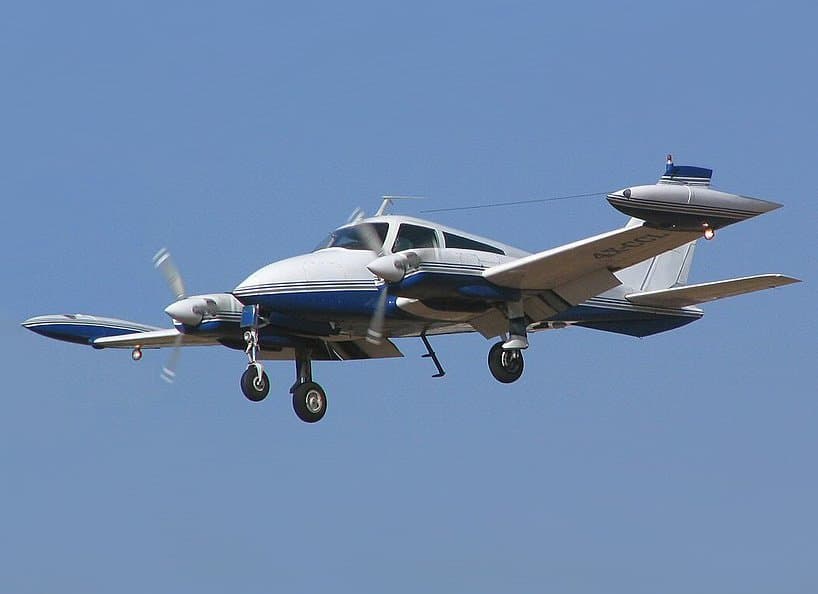
Cessna 310 is a twin-engine cabin monoplane originating in United States. It was built by Cessna. Reported operators include United States Air Force.
 United States
Technical data
Twin-engine cabin monoplane
Cessna
United States Air Force
5,449 (310) 577 (320)
1954–1980
1954
January 3, 1953
Cessna 340 Cessna 411
one
four passengers
27 ft 0 in (8.23 m)
35 ft 0 in (10.67 m)
10 ft 6 in (3.20 m)
175 sq ft (16.3 m 2 )
2,850 lb (1,293 kg)
4,600 lb (2,087 kg)
100 US gal (83 imp gal; 380 L)
2 × Continental O-470-B horizontally opposed piston engine, 240 hp (180 kW) each
220 mph (350 km/h, 190 kn)
205 mph (330 km/h, 178 kn)
1,000 mi (1,600 km, 870 nmi)
20,000 ft (6,100 m)
1,700 ft/min (8.6 m/s)
The Cessna 310 is an American four-to-six-seat, low-wing, twin-engine monoplane produced by Cessna between 1954 and 1980.
Typical of Cessna model naming conventions, a letter was added after the model number to identify changes to the original design over the years. The first significant upgrade to the 310 series was the 310C in 1959, which introduced more powerful 260 hp (194 kW) Continental IO-470-D engines. In 1960 the 310D featured swept-back vertical tail surfaces. An extra cabin window was added with the 310F.
The 310G was certified in 1961 and introduced the canted wingtip fuel tanks found on the majority of the Cessna twin-engine product line, marketed as "stabila-tip" tanks by Cessna, because they were meant to aid stability in flight. A single side window replaced the rear two windows on the 310K (certified in late 1965), with optional three-blade propellers being introduced as well. Subsequent developments included the 310Q and turbocharged T310Q with a redesigned rear cabin featuring a skylight window, and the final 310R and T310R, identifiable by a lengthened nose containing a baggage compartment. Production ended in 1980.
Over the years there were several modifications to the 310 to improve performance. Aircraft engineer Jack Riley produced two variants, The Riley Rocket 310 and the Riley Turbostream 310. Riley replaced the standard Continental 310 hp (230 kW) engines with 350 hp (261 kW) Lycoming TIO-540 engines. These turbocharged intercooled engines were installed with three-blade Hartzell propellers in a counter-rotating configuration to further increase performance and single-engine safety. At 5,400 lb (2,400 kg) gross weight the aircraft had a weight to power ratio of 7.71 lb (3.50 kg) per horsepower. This resulted in a cruising speed of 260 knots (480 km/h; 300 mph) at 18,000 feet (5,500 m) and a 3,000 ft/min (15 m/s) rate of climb.
The Cessna 310 was a common charter aircraft for the many air taxi firms that sprang up in the general aviation boom that followed World War II. The advantages of the Cessna 310 over its contemporaries, such as the Piper PA-23 , were its speed, operating costs and aftermarket modifications, such as the Robertson STOL kits that made it popular worldwide for its bush flying characteristics. It could use short runways, while at the same time carrying a large useful load of 2,000 lb (910 kg). or more, at speeds that were high for a twin engine piston aircraft.
In 1957, the United States Air Force (USAF) selected the Cessna 310 for service as a light utility aircraft for transport and administrative support. The USAF purchased 160 unmodified 310A aircraft with the designation L-27A and unofficially nicknamed Blue Canoe , later changed to U-3A in 1962. An additional 36 upgraded 310 designated L-27B (later U-3B ) were delivered in 1960–61; these aircraft were essentially military 310Fs and as such equipped with the more powerful 260 hp (194 kW) engines and can be identified by their extra cabin windows, longer nose and swept vertical fin. A USAF study after one year of operational service found the U-3A had direct operating costs of less than $12 an hour. The U-3 saw active service in a support role when the USAF deployed aircraft to South Vietnam during the Vietnam War , where they were used on courier flights between air bases . Some USAF aircraft were later transferred to the U.S. Army and U.S. Navy and the type continued in United States military service into the mid-1970s.
On December 19, 1992, Cuban defector Major Orestes Lorenzo Pérez returned to Cuba in a 1961 Cessna 310 to retrieve his wife and two sons. Flying without lights, at low speed and very low altitude to avoid Cuban radar, Pérez picked up his family by landing on the coastal highway of Varadero beach, Matanzas Province , 93 mi (150 km) east of Havana and managed a successful safe return to Marathon, Florida .
Initial production variant, powered by two 240 hp (180 kW) Continental O-470-B or O-470-M engines with carburetors, with maximum takeoff weight of 4,600 pounds (2,100 kg); in production for 1955-1957 model years, 547 built.
Military version of the 310 for the United States Air Force , designated L-27A and later U-3A; with Continental O-470-M engines and maximum takeoff weight of 4,830 pounds (2,190 kg); 161 built.
Model produced in 1958, with new instrument panel, O-470-M engines and maximum takeoff weight of 4,700 pounds (2,100 kg); 225 built.
Model produced in 1959, with 260 hp (190 kW) Continental IO-470-D fuel-injected engines and maximum takeoff weight increased to 4,830 pounds (2,190 kg); and minor changes; 260 built. Unit cost $59,950 in 1959
Military version of the 310F, designated the L-27B and later U-3B; with maximum takeoff weight of 4,990 pounds (2,260 kg); 36 built.
Model produced in 1961, with extra cabin window each side, pointed nose and other minor changes; maximum takeoff weight of 4,830 pounds (2,190 kg); 155 built.
310G
First model with canted slimline tip tanks and optional six-seat cabin, with maximum takeoff weight increased to 4,990 pounds (2,260 kg) and detail changes, 156 built in 1962.
310H
Model produced in 1963 with maximum takeoff weight increased to 5,100 pounds (2,300 kg) and enlarged cabin interior. 148 built.
Version of 310H with the 4,990-pound (2,260 kg) maximum takeoff weight of the 310G; combined total of 148 310H and E310H built.
Model produced in 1965 with minor detailed changes and maximum takeoff weight of 5,100 pounds (2,300 kg).
Version of 310J type-certified in the Utility Category; with maximum takeoff weight increased to 5,150 pounds (2,340 kg); seating limited to four people instead of the 310J's six; and reduced baggage weight limit.
Version of 310J with maximum takeoff weight reduced to 4,990 pounds (2,260 kg); combined total of 200 310J, 310J-1 and E310J built.
First model with optional three-blade propellers and long 'vista view' side windows; also increased maximum takeoff weight of 5,200 pounds (2,400 kg) with IO-470-V or IO-470-VO engines; 245 built in 1966.
310M
Version of 310P with turbocharged Continental TSIO-520-B or TSIO-520-BB engines producing 285 hp (213 kW) and maximum takeoff weight of 5,400 pounds (2,400 kg); combined total of 240 310P and T310P built.
Last short-nose model, introduced in 1970, with maximum takeoff weight increased to 5,300 lb (2,400 kg) and detailed changes, from the 401st aircraft fitted with a bulged rear cabin roof with rear view window.
Version of 310Q with turbocharged Continental TSIO-520-B or TSIO-520-BB engines and maximum takeoff weight increased to 5,500 lb (2,500 kg); combined total of 871 310Q and T310Q built.
Last production model, introduced in the 1975 model year, with 285 hp (213 kW) Continental IO-520-M or IO-520-MB engines; three-blade propellers as standard; lengthened nose containing a baggage compartment; and 5,500 lb (2,500 kg) maximum takeoff weight.
Model with reshaped rear windows and 285 hp (213 kW) TSIO-520-B engines; 130 built.
United States military designation for the 310E/310M, later changed to U-3B.
Conversion of models 310F to 310Q, replacing the engines with 350 hp (260 kW) Lycoming TIO-540-J2BDs driving four-bladed propellers.
Conversion offered for models 310 to 310G, replacing the engines with two 240-260 hp (179–194 kW) Continental O-470 Ds or -470Ms.
Conversion of Cessna 310/320 by fitting two 310 hp (231 kW) Continental TSIO-520J or 520N engines.
Conversion of Cessna 310 by fitting two 350 hp Lycoming engines.
Conversion of Cessna 310 by fitting two 290 hp (216 kW) Lycoming IO-540-A1A5 engines and more fuel capacity.
Riley Rocket with each engine fitted with two Riley-manufactured turbochargers . Cruise speed increased from 252 mph (219 kn; 406 km/h) to 302 mph (262 kn; 486 km/h).
On November 26, 1962, a Saab Scandia 90A-1 , aircraft registration PP-SRA of VASP on a scheduled domestic service in Brazil from São Paulo-Congonhas to Rio de Janeiro-Santos Dumont collided in the air over Paraibuna, São Paulo, with a private Cessna 310 PT-BRQ en route from Rio de Janeiro-Santos Dumont to São Paulo-Campo de Marte . Both were flying on the same airway in opposite directions and failed to have visual contact. The two aircraft crashed killing all 23 passengers and crew of the Saab and the four occupants of the Cessna.
On July 19, 1967, a Boeing 727 operating as Piedmont Airlines Flight 22 collided with a Cessna 310 near Hendersonville, North Carolina , killing all 79 people on board the Boeing 727 and the three people in the Cessna.
Capacity: four passengers
Length: 27 ft 0 in (8.23 m)
Wingspan: 35 ft 0 in (10.67 m)
Height: 10 ft 6 in (3.20 m)
Wing area: 175 sq ft (16.3 m 2 )
Empty weight: 2,850 lb (1,293 kg)
Gross weight: 4,600 lb (2,087 kg)
Powerplant: 2 × Continental O-470-B horizontally opposed piston engine, 240 hp (180 kW) each
Maximum speed: 220 mph (350 km/h, 190 kn)
Cruise speed: 205 mph (330 km/h, 178 kn)
Range: 1,000 mi (1,600 km, 870 nmi)
Service ceiling: 20,000 ft (6,100 m)
Rate of climb: 1,700 ft/min (8.6 m/s)
Initial production variant, powered by two 240 hp (180 kW) Continental O-470-B or O-470-M engines with carburetors, with maximum takeoff weight of 4,600 pounds (2,100 kg); in production for 1955-1957 model years, 547 built.
Military version of the 310 for the United States Air Force , designated L-27A and later U-3A; with Continental O-470-M engines and maximum takeoff weight of 4,830 pounds (2,190 kg); 161 built.
Model produced in 1958, with new instrument panel, O-470-M engines and maximum takeoff weight of 4,700 pounds (2,100 kg); 225 built.
Model produced in 1959, with 260 hp (190 kW) Continental IO-470-D fuel-injected engines and maximum takeoff weight increased to 4,830 pounds (2,190 kg); and minor changes; 260 built. Unit cost $59,950 in 1959
Military version of the 310F, designated the L-27B and later U-3B; with maximum takeoff weight of 4,990 pounds (2,260 kg); 36 built.
Model produced in 1961, with extra cabin window each side, pointed nose and other minor changes; maximum takeoff weight of 4,830 pounds (2,190 kg); 155 built.
First model with canted slimline tip tanks and optional six-seat cabin, with maximum takeoff weight increased to 4,990 pounds (2,260 kg) and detail changes, 156 built in 1962.
Model produced in 1963 with maximum takeoff weight increased to 5,100 pounds (2,300 kg) and enlarged cabin interior. 148 built.
Version of 310H with the 4,990-pound (2,260 kg) maximum takeoff weight of the 310G; combined total of 148 310H and E310H built.
Model produced in 1965 with minor detailed changes and maximum takeoff weight of 5,100 pounds (2,300 kg).
Version of 310J type-certified in the Utility Category; with maximum takeoff weight increased to 5,150 pounds (2,340 kg); seating limited to four people instead of the 310J's six; and reduced baggage weight limit.
Version of 310J with maximum takeoff weight reduced to 4,990 pounds (2,260 kg); combined total of 200 310J, 310J-1 and E310J built.
First model with optional three-blade propellers and long 'vista view' side windows; also increased maximum takeoff weight of 5,200 pounds (2,400 kg) with IO-470-V or IO-470-VO engines; 245 built in 1966.
Version of 310P with turbocharged Continental TSIO-520-B or TSIO-520-BB engines producing 285 hp (213 kW) and maximum takeoff weight of 5,400 pounds (2,400 kg); combined total of 240 310P and T310P built.
Last short-nose model, introduced in 1970, with maximum takeoff weight increased to 5,300 lb (2,400 kg) and detailed changes, from the 401st aircraft fitted with a bulged rear cabin roof with rear view window.
Version of 310Q with turbocharged Continental TSIO-520-B or TSIO-520-BB engines and maximum takeoff weight increased to 5,500 lb (2,500 kg); combined total of 871 310Q and T310Q built.
Last production model, introduced in the 1975 model year, with 285 hp (213 kW) Continental IO-520-M or IO-520-MB engines; three-blade propellers as standard; lengthened nose containing a baggage compartment; and 5,500 lb (2,500 kg) maximum takeoff weight.
Reference text from Wikipedia contributors, used under CC BY-SA 4.0.
True scale
Sourced dimensions beside a 1.75 m human reference.
See it in your room. Scan with your phone to open this model in 3D, then place it in your space.
Points represent sourced observations, including revisions. Revisions on the same effective date are not separate inventory events. Ranges appear in the table and are not plotted as exact points.
| Observation / report period | Value | Source | Claim state |
|---|---|---|---|
| 1 Oct 2026 | 3.2 m | Wikipedia contributors | superseded |
| 2 Oct 2026 | 3.2 m | Wikipedia contributors | approved |
Cessna 310 equipment records. Variants, orders and quantities are shown as reported in each inventory source; coverage is incomplete.
 El Salvador
National Civilian Police exact named equipment holdings: Cessna 310. Active, operational-reserve and training units excluding equipment in store; November 2025 IISS assessment. Named service only; no parent-force or national total inferred. Source role: AIRCRAFT / Light. Original estimates, ranges, reporting names, reserve, lease and employment scopes retained; nested included counts are not added. Missile-system quantities mean launchers, not rounds. No readiness, crew, carried weapon, payload, factory-production or future order count inherited.
 Kenya
Air Wing exact named equipment holdings: Cessna 310. Active, operational-reserve and training units excluding equipment in store; November 2025 IISS assessment. Named service only; no parent-force or national total inferred. Source role: AIRCRAFT / Light. Original estimates, ranges, reporting names, reserve, lease and employment scopes retained; nested included counts are not added. Missile-system quantities mean launchers, not rounds. No readiness, crew, carried weapon, payload, factory-production or future order count inherited.
 Madagascar
Air Force exact named equipment holdings: Cessna 310. Active, operational-reserve and training units excluding equipment in store; November 2025 IISS assessment. Named service only; no parent-force or national total inferred. Source role: AIRCRAFT / Light. Original estimates, ranges, reporting names, reserve, lease and employment scopes retained; nested included counts are not added. Missile-system quantities mean launchers, not rounds. No readiness, crew, carried weapon, payload, factory-production or future order count inherited.
 Paraguay
Air Force exact named equipment holdings: Cessna 310. Active, operational-reserve and training units excluding equipment in store; November 2025 IISS assessment. Named service only; no parent-force or national total inferred. Source role: AIRCRAFT / Light. Original estimates, ranges, reporting names, reserve, lease and employment scopes retained; nested included counts are not added. Missile-system quantities mean launchers, not rounds. No readiness, crew, carried weapon, payload, factory-production or future order count inherited.
 Saudi Arabia
Royal Flight exact named equipment holdings: Cessna 310. Active, operational-reserve and training units excluding equipment in store; November 2025 IISS assessment. Named service only; no parent-force or national total inferred. Source role: AIRCRAFT / Light. Original estimates, ranges, reporting names, reserve, lease and employment scopes retained; nested included counts are not added. Missile-system quantities mean launchers, not rounds. No readiness, crew, carried weapon, payload, factory-production or future order count inherited.
Naval Aviation exact named equipment holdings of Cessna 310. Active, operational-reserve and training units excluding equipment in store; November 2025 IISS assessment. Named service only, not a national or parent-force total or combat-readiness measure. Source role(s): AIRCRAFT / Light. No heading aggregate, carried armament, crew, payload, factory production or future order count inherited. The source declares a separate Naval Aviation subsection within Navy.
Keep exploring
Twin-engined utility
Compare with Cessna 310Twin engine light aircraft
 AustriaCompare with Cessna 310
Two-seat aerobatic monoplane
 United KingdomCompare with Cessna 310
Aerobatic monoplane
 GermanyCompare with Cessna 310
twin engine turboprop aircraft
United StatesTwin-engine turboprop utility aircraft
 ChinaCompare with Cessna 310