FORCETALLY
Loading the evidence…
Preparing your view.


Preparing your view.
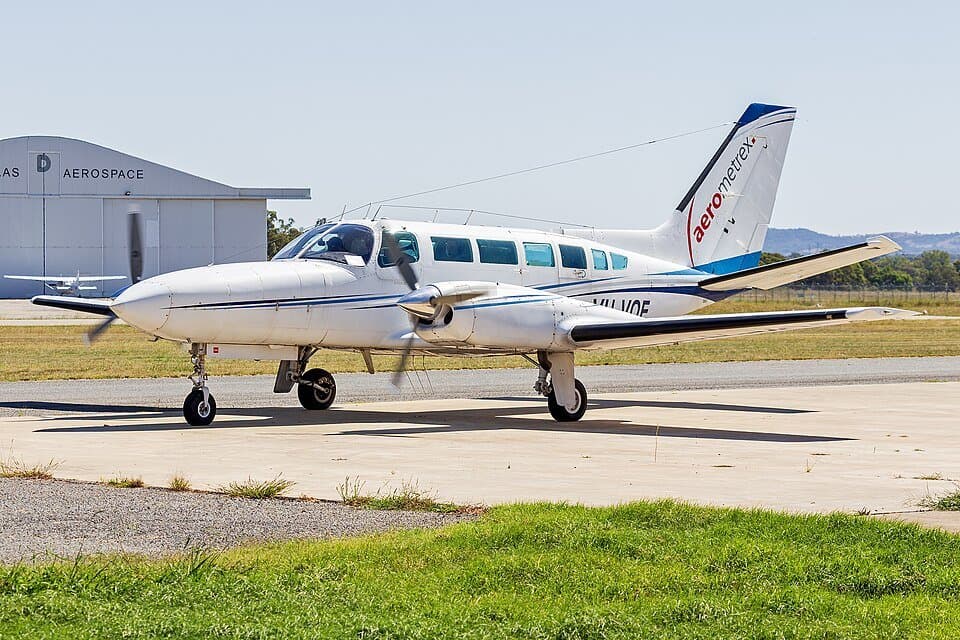
Support aircraftIn service
Light passenger/cargo aircraft
Cessna 404 Titan is a light passenger/cargo aircraft originating in United States. It was built by Cessna.
 United States
Light passenger/cargo aircraft
United States
Cessna
396
1976–1982
1976
February 26, 1975
Cessna 402
Reims-Cessna F406 Caravan II Cessna 441 Conquest II
2
6–8 passengers
39 ft 6 + 1 ⁄ 4 in (12.046 m)
46 ft 8 + 1 ⁄ 4 in (14.230 m)
13 ft 3 in (4.04 m)
242.0 sq ft (22.48 m 2 )
9.0:1
4,816 lb (2,185 kg)
8,400 lb (3,810 kg)
340 US gal (280 imp gal; 1,300 L)
267 mph (430 km/h, 232 kn) at 16,000 ft (4,900 m)
188 mph (302 km/h, 163 kn) (econ cruise) at 20,000 ft (6,100 m)
81 mph (130 km/h, 70 kn) flaps down, power off
274 mph (441 km/h, 238 kn) ( Calibrated airspeed )
2,120 mi (3,410 km, 1,840 nmi)
26,000 ft (7,900 m)
1,575 ft/min (8.00 m/s)
2,367 ft (721 m)
2,130 ft (650 m)
The Cessna 404 Titan is an American twin-engined, light aircraft built by Cessna Aircraft .
The Cessna 404 was a development of the Cessna 402 with an enlarged vertical tail and other changes. The prototype first flew on February 26, 1975. It is powered by two 375 hp/280 kW turbocharged Continental Motors GTSIO-520 piston engines. Two versions were offered originally; the Titan Ambassador passenger aircraft for ten passengers, and the Titan Courier utility aircraft for passengers or cargo. By early 1982 seven different variants were available, including a pure cargo version, the Titan Freighter . The Freighter was fitted with a strengthened floor, cargo doors, and its interior walls and ceiling were made from impact-resistant polycarbonate materials to minimize damage in the event of cargo breaking free in-flight.
On July 21, 1980 a Cessna 404 departing the Grand Canyon Airport for Phoenix, Arizona experienced an engine failure on take-off due to foreign material, improper maintenance, and improper procedures. All eight persons aboard (seven passengers and one crew member) were killed.
On June 27, 1989, a Cessna 404 Titan of Formosa Airlines on its way to Wang-an, Penghu crashed into nearby Cianjhen District streets shortly after takeoff. All 12 people on board were killed; there were no ground casualties.
On May 10, 1996, a Cessna 404 Titan (registred C-FPVB) on an Aerodat charter flight from Pucallpa to Cuzco disappeared. All three passengers were Canadians on an oil exploration trip. No traces of the aircraft were found.
On September 3, 1999, Edinburgh Air Charter Flight 3W had an engine failure shortly after takeoff, tried to return to Glasgow but crashed short of the runway. 8 of the 11 people on board died. The plane was carrying Airtours employees.
Capacity: 6–8 passengers
Length: 39 ft 6 + 1 ⁄ 4 in (12.046 m)
Wingspan: 46 ft 8 + 1 ⁄ 4 in (14.230 m)
Height: 13 ft 3 in (4.04 m)
Wing area: 242.0 sq ft (22.48 m 2 )
Empty weight: 4,816 lb (2,185 kg)
Max takeoff weight: 8,400 lb (3,810 kg)
Maximum speed: 267 mph (430 km/h, 232 kn) at 16,000 ft (4,900 m)
Cruise speed: 188 mph (302 km/h, 163 kn) (econ cruise) at 20,000 ft (6,100 m)
Stall speed: 81 mph (130 km/h, 70 kn) flaps down, power off
Never exceed speed : 274 mph (441 km/h, 238 kn) ( Calibrated airspeed )
Range: 2,120 mi (3,410 km, 1,840 nmi)
Service ceiling: 26,000 ft (7,900 m)
Rate of climb: 1,575 ft/min (8.00 m/s)
Take-off run to 50 ft (15 m): 2,367 ft (721 m)
Landing run from 50 ft (15 m): 2,130 ft (650 m)
The Cessna 404 was a development of the Cessna 402 with an enlarged vertical tail and other changes. The prototype first flew on February 26, 1975. It is powered by two 375 hp/280 kW turbocharged Continental Motors GTSIO-520 piston engines. Two versions were offered originally; the Titan Ambassador passenger aircraft for ten passengers, and the Titan Courier utility aircraft for passengers or cargo. By early 1982 seven different variants were available, including a pure cargo version, the Titan Freighter . The Freighter was fitted with a strengthened floor, cargo doors, and its interior walls and ceiling were made from impact-resistant polycarbonate materials to minimize damage in the event of cargo breaking free in-flight.
Reference text from Wikipedia contributors, used under CC BY-SA 4.0.
True scale
Sourced dimensions beside a 1.75 m human reference.
See it in your room. Scan with your phone to open this model in 3D, then place it in your space.
Cessna 404 Titan equipment records. Variants, orders and quantities are shown as reported in each inventory source; coverage is incomplete.
 Dominican Republic
Reported count for Cessna 404 Titan. Service scope: Dominican Air Force; does not replace a national total. 1 distinct quantity component(s) from the same source list; shared rowspan cells counted once. Explicit source inventory scope: active; no other stock status or total inferred. Count column(s): in service: 1. Origin: United States. The listed variants/roles are the scope, not an immediately deployable count. Dates are the count-cell citations' stated source period (2023), not the article revision. 2023 cited publication year. Edition or publication years do not claim an exact inventory census day.
 Nicaragua
Air Force exact named equipment holdings: Cessna 404 Titan (VIP). Active, operational-reserve and training units excluding equipment in store; November 2025 IISS assessment. Named service only; no parent-force or national total inferred. Source role: AIRCRAFT / Light. Original estimates, ranges, reporting names, reserve, lease and employment scopes retained; nested included counts are not added. Missile-system quantities mean launchers, not rounds. No readiness, crew, carried weapon, payload, factory-production or future order count inherited.
 Tanzania
Air Defence Command exact named equipment holdings: Cessna 404 Titan. Active, operational-reserve and training units excluding equipment in store; November 2025 IISS assessment. Named service only; no parent-force or national total inferred. Source role: AIRCRAFT / Light. Original estimates, ranges, reporting names, reserve, lease and employment scopes retained; nested included counts are not added. Missile-system quantities mean launchers, not rounds. No readiness, crew, carried weapon, payload, factory-production or future order count inherited.
Keep exploring
Passenger and cargo aircraft
 SwitzerlandCompare with Cessna 404 Titan
Cargo/passenger utility aircraft and light bomber
Compare with Cessna 404 TitanLight business/cargo aircraft
United StatesCompare with Cessna 404 Titan Light aircraft
United StatesCompare with Cessna 404 Titan Light aircraft
 AustriaCompare with Cessna 404 Titan
Light aircraft
 South Korea