FORCETALLY
Loading the evidence…
Preparing your view.


Preparing your view.
Support aircraftIn service
Cargo/passenger utility aircraft and light bomber
Lisunov Li-2 is a cargo/passenger utility aircraft and light bomber originating in Soviet Union. It was built by State Aircraft Plant No. 84.
Technical data
True scale
Sourced dimensions beside a 1.75 m human reference.
Points represent sourced observations, including revisions. Revisions on the same effective date are not separate inventory events. Ranges appear in the table and are not plotted as exact points.
| Observation / report period | Value | Source | Claim state |
|---|---|---|---|
| 28 Sept 2026 | 4 people | Wikipedia contributors | superseded |
| 28 Sept 2026 | 4 people | Wikipedia contributors | superseded |
| 28 Sept 2026 | 4 people | Wikipedia contributors | approved |
Cargo/passenger utility aircraft and light bomber
Soviet Union
State Aircraft Plant No. 84
Out of production; in limited service
Soviet Air Force Aeroflot
6,157 (per later research 4,937)
1939–1952
1939
Douglas DC-3
4 (5-6 Li-2T )
24 passengers / (20 troops Li-2T )
19.65 m (64 ft 6 in)
28.81 m (94 ft 6 in)
91.33 m 2 (983.1 sq ft)
7,700 kg (16,976 lb)
11,280 kg (24,868 lb)
2 × Shvetsov M-62 9-cylinder air-cooled radial piston engines, 670 kW (900 hp) each
280 km/h (170 mph, 150 kn)
245 km/h (152 mph, 132 kn)
2,500 km (1,600 mi, 1,300 nmi)
5,600 m (18,400 ft)
* 3× 7.62 mm (.30 in) ShKAS machine guns Li-2T / Li-2VV
root: NACA 2215 ; tip: NACA 2206
3-bladed variable-pitch propellers
* 1,000 kg bombs (normal load) Li-2VV
The Lisunov Li-2 (NATO reporting name: Cab ), originally designated PS-84 , is a license-built Soviet version of the Douglas DC-3 . It was produced by State Aircraft Plant No. 84 in Moscow-Khimki and, after the factory's evacuation in 1941, at the Tashkent Aviation Production Association in Tashkent . The project was directed by aeronautical engineer Boris Pavlovich Lisunov .
The Soviet Union received its first DC-2 in 1935. A total of 18 DC-3s had been ordered on 11 April 1936, and the government of the USSR purchased 21 DC-3s for operation by Aeroflot before World War II . A production licence was awarded to the government of the USSR on 15 July 1936. Lisunov spent two years at the Douglas Aircraft Company , between November 1936 and April 1939 translating the design. One of the engineers who accompanied him to Douglas was Vladimir Mikhailovich Myasishchev . Design work and production were undertaken at State Aviation Factory 84 in Khimki (now a suburb of Moscow). The Soviet version was given the designation PS-84 – Passazhirskiy Samolyot 84, passenger airplane 84 (i.e. made in GAZ / State Aircraft Plant No. 84).
By the time Germany invaded the USSR on 22 June 1941 , 237 PS-84s had been built at GAZ-84, all in civil passenger configuration. In response to the invasion, the Kremlin set in motion a plan to relocate much of the industrial capability of the Soviet Union to the East, with production of the Li-2 ending up at GAZ-33 in Tashkent , now the capital of Uzbekistan . After a monumental struggle, the factory was producing PS-84s again by January 1942.
Some military versions of the Li-2 also had bombing equipment—such as bomb sight and bomb racks, and defensive turret, unlike the military C-47 development of the DC-3, which was strictly an unarmed military transport. The defensive armaments consisted of MV-3 dorsal turret with a 7.62 mm (.30 in) ShKAS machine gun, later replaced with a 12.7 mm (.50 in) UBT heavy machine gun. Additionally two ShKAS machine guns on pivot mount could also be mounted on both sides of the rear fuselage near the cargo door. A version designated Li-2VV ( Voyenny Variant = military variant) had a redesigned nose for extra ShKAS machine gun and could carry up to four 250 kg (551 lb) bombs under the central fuselage. Smaller bombs could be carried inside the fuselage and thrown out of the cargo door by the crew.
The PS-84 had flown with Aeroflot primarily as a passenger transport before World War II. When Germany attacked the Soviet Union in 1941 many of the PS-84s were taken into military use and redesignated the Lisunov Li-2 in 1942. The military models were equipped with a machine gun on dorsal turret. The aircraft were used for transport, partisan supply, bombing, and as ambulance aircraft.
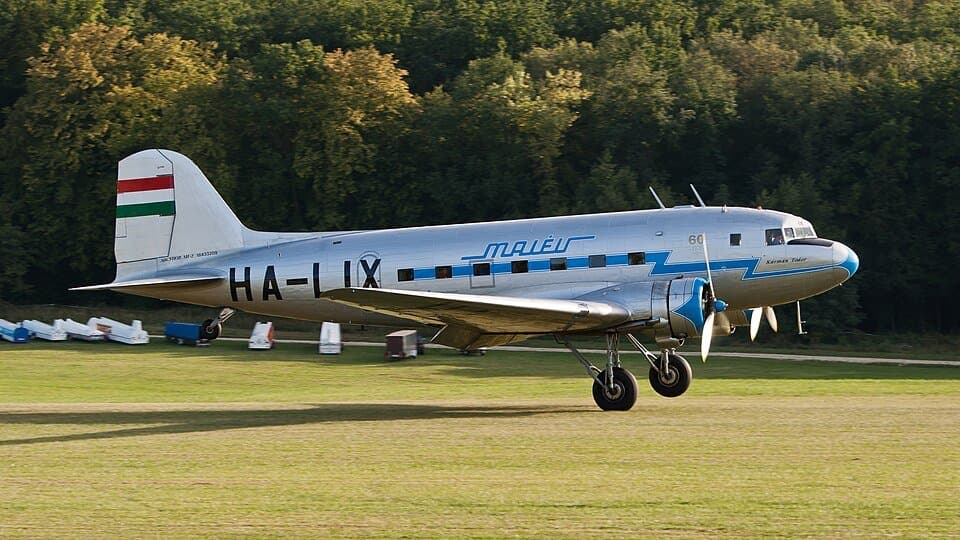
Only one Li-2 restored to airworthy condition exists in Europe. The Hungarian registered HA-LIX was built in 1949 in Airframe Factory Nr.84 (GAZ-84) of Tashkent, as serial number 18433209 and was operated by MALÉV till 1964. It was withdrawn to a museum in 1974 as an airforce parachute trainer airplane. After a complete reconstruction finished in 2001 it flies sightseeing tours and regularly participates at air shows. It is operated by the Goldtimer Foundation, based at Budaörs Airport , Budapest , Hungary . The North Korean Air Force is known to still use a number of Li-2s for transport , although they may have been decommissioned despite their continued presence on certain airbases.
Li-2G
Capacity: 24 passengers / (20 troops Li-2T )
Length: 19.65 m (64 ft 6 in)
Wingspan: 28.81 m (94 ft 6 in)
Wing area: 91.33 m 2 (983.1 sq ft)
Empty weight: 7,700 kg (16,976 lb)
Max takeoff weight: 11,280 kg (24,868 lb)
Powerplant: 2 × Shvetsov M-62 9-cylinder air-cooled radial piston engines, 670 kW (900 hp) each
Maximum speed: 280 km/h (170 mph, 150 kn)
Cruise speed: 245 km/h (152 mph, 132 kn)
Range: 2,500 km (1,600 mi, 1,300 nmi)
Service ceiling: 5,600 m (18,400 ft)
Guns: :* 3× 7.62 mm (.30 in) ShKAS machine guns Li-2T / Li-2VV
1× 12.7 mm (.50 in) Berezin UBK machine gun Li-2T / Li-2VV
Bombs: :* 1,000 kg bombs (normal load) Li-2VV
2,600 kg (5,732 lb) of bombs (short distances) Li-2VV
Altezza 5,17 m
Reference text from Wikipedia contributors, used under CC BY-SA 4.0.
Country inventory links have not yet been documented for this equipment.
Keep exploring
Light passenger/cargo aircraft
 United StatesCompare with Lisunov Li-2
Passenger and cargo aircraft
 SwitzerlandCompare with Lisunov Li-2
STOL passenger and utility aircraft
SwitzerlandCompare with Lisunov Li-2 Light utility aircraft
United StatesCompare with Lisunov Li-2 Light utility aircraft
United StatesCompare with Lisunov Li-2 Light utility aircraft
 Australia