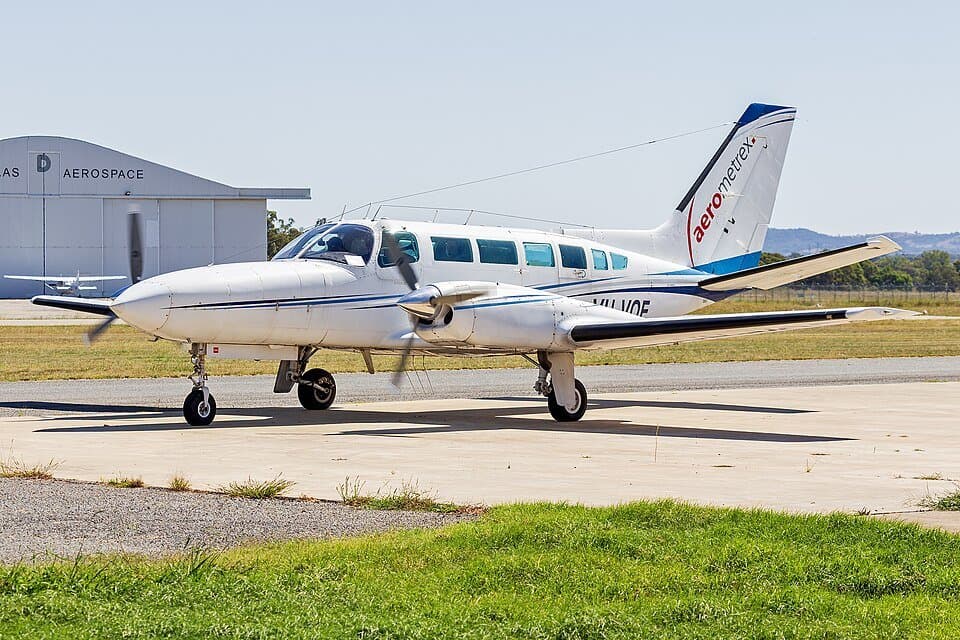

Credit
Bidgee · CC BY-SA 3.0 au · Resized · CC BY-SA 3.0 au · Source ↗ · Modified


Preparing your view.
At a glance
Measured figures
Ambassador I · Length
Single source39 ft 6 + 1 ⁄ 4 in (12.046 m)[source]
Configuration
| Specification | Cessna 404 Titan | Lisunov Li-2 |
|---|---|---|
| Type | Light passenger/cargo aircraft[source] | Cargo/passenger utility aircraft and light bomber[source] |
| National origin | United States[source] | Soviet Union[source] |
| Manufacturer | Cessna[source] | State Aircraft Plant No. 84[source] |
| Number built | 396[source] |
Li-2P · Length
19.65 m (64 ft 6 in)[source]
Cruise; Ambassador I · (econ cruise) at 20,000 ft (6,100 m)
Single sourceMaximum; Ambassador I · at 16,000 ft (4,900 m)
Single source267 mph (430 km/h, 232 kn) at 16,000 ft (4,900 m)[source]
188 mph (302 km/h, 163 kn) (econ cruise) at 20,000 ft (6,100 m)[source]
Cruise; Li-2P · Cruise speed
Single sourceMaximum; Li-2P · Maximum speed
Single sourceCessna 404 Titan · installed powerplant; two engines; stated rating per engine · two /280 kW turbocharged Continental Motors GTSIO-520 piston engines
Single sourcetwo 375 hp/280 kW turbocharged Continental Motors GTSIO-520 piston engines[source]Cessna 404 Titan · installed powerplant; two engines; stated rating per engine
Li-2P · 2 × Shvetsov M-62 9-cylinder air-cooled radial piston engines each
Single source2 × Shvetsov M-62 9-cylinder air-cooled radial piston engines, 670 kW (900 hp) each[source]
Ambassador I · 1,575 ft/min (
Single source1,575 ft/min (8.00 m/s)[source]
Bars compare reported quantities only. A larger figure does not make a system better; configurations and test conditions differ.
6,157 (per later research 4,937)[source]
| Manufactured | 1976–1982[source] | 1939–1952[source] |
|---|
| Introduction date | 1976[source] | 1939[source] |
|---|
| First flight | February 26, 1975[source] | — |
|---|
| Developed from | Cessna 402[source] | Douglas DC-3[source] |
|---|
| Developed into | Reims-Cessna F406 Caravan II Cessna 441 Conquest II[source] | — |
|---|
| Capacity | 6–8 passengers[source] | 24 passengers / (20 troops Li-2T )[source] |
|---|
| Aspect ratio | 9.0:1[source] | — |
|---|
| Fuel capacity | 340 US gal (280 imp gal; 1,300 L)[source] | — |
|---|
| Stall speed | 81 mph (130 km/h, 70 kn) flaps down, power off[source] | — |
|---|
| Never exceed speed | 274 mph (441 km/h, 238 kn) ( Calibrated airspeed )[source] | — |
|---|
| Take-off run to 50 ft (15 m) | 2,367 ft (721 m)[source] | — |
|---|
| Landing run from 50 ft (15 m) | 2,130 ft (650 m)[source] | — |
|---|
| Role | American twin-engined, light aircraft[source] | — |
|---|
| Source measurement | The Cessna 404 was a development of the Cessna 402 with an enlarged vertical tail and other changes. The prototype first flew on February 26, 1975. It is powered by two 375 hp/280 kW turbocharged Continental Motors GTSIO-520 piston engines. Two versions were offered originally; the Titan Ambassador passenger aircraft for ten passengers, and the Titan Courier utility aircraft for passengers or cargo. By early 1982 seven different variants were available, including a pure cargo version, the Titan Freighter . The Freighter was fitted with a strengthened floor, cargo doors, and its interior walls and ceiling were made from impact-resistant polycarbonate materials to minimize damage in the event of cargo breaking free in-flight.[source]Cessna 404 Titan · Design and development; only the objects and conditions stated in this passage On July 21, 1980 a Cessna 404 departing the Grand Canyon Airport for Phoenix, Arizona experienced an engine failure on take-off due to foreign material, improper maintenance, and improper procedures. All eight persons aboard (seven passengers and one crew member) were killed.[source]Cessna 404 Titan · Accidents and incidents; only the objects and conditions stated in this passage On June 27, 1989, a Cessna 404 Titan of Formosa Airlines on its way to Wang-an, Penghu crashed into nearby Cianjhen District streets shortly after takeoff. All 12 people on board were killed; there were no ground casualties.[source]Cessna 404 Titan · Accidents and incidents; only the objects and conditions stated in this passage On May 10, 1996, a Cessna 404 Titan (registred C-FPVB) on an Aerodat charter flight from Pucallpa to Cuzco disappeared. All three passengers were Canadians on an oil exploration trip. No traces of the aircraft were found.[source]Cessna 404 Titan · Accidents and incidents; only the objects and conditions stated in this passage On September 3, 1999, Edinburgh Air Charter Flight 3W had an engine failure shortly after takeoff, tried to return to Glasgow but crashed short of the runway. 8 of the 11 people on board died. The plane was carrying Airtours employees.[source]Cessna 404 Titan · Accidents and incidents; only the objects and conditions stated in this passage Capacity: 6–8 passengers[source]Cessna 404 Titan · Specifications (Ambassador I); only the objects and conditions stated in this passage Length: 39 ft 6 + 1 ⁄ 4 in (12.046 m)[source]Cessna 404 Titan · Specifications (Ambassador I); only the objects and conditions stated in this passage Wingspan: 46 ft 8 + 1 ⁄ 4 in (14.230 m)[source]Cessna 404 Titan · Specifications (Ambassador I); only the objects and conditions stated in this passage Height: 13 ft 3 in (4.04 m)[source]Cessna 404 Titan · Specifications (Ambassador I); only the objects and conditions stated in this passage Wing area: 242.0 sq ft (22.48 m 2 )[source]Cessna 404 Titan · Specifications (Ambassador I); only the objects and conditions stated in this passage Empty weight: 4,816 lb (2,185 kg)[source]Cessna 404 Titan · Specifications (Ambassador I); only the objects and conditions stated in this passage Max takeoff weight: 8,400 lb (3,810 kg)[source]Cessna 404 Titan · Specifications (Ambassador I); only the objects and conditions stated in this passage Maximum speed: 267 mph (430 km/h, 232 kn) at 16,000 ft (4,900 m)[source]Cessna 404 Titan · Specifications (Ambassador I); only the objects and conditions stated in this passage Cruise speed: 188 mph (302 km/h, 163 kn) (econ cruise) at 20,000 ft (6,100 m)[source]Cessna 404 Titan · Specifications (Ambassador I); only the objects and conditions stated in this passage Stall speed: 81 mph (130 km/h, 70 kn) flaps down, power off[source]Cessna 404 Titan · Specifications (Ambassador I); only the objects and conditions stated in this passage Never exceed speed : 274 mph (441 km/h, 238 kn) ( Calibrated airspeed )[source]Cessna 404 Titan · Specifications (Ambassador I); only the objects and conditions stated in this passage Range: 2,120 mi (3,410 km, 1,840 nmi)[source]Cessna 404 Titan · Specifications (Ambassador I); only the objects and conditions stated in this passage Service ceiling: 26,000 ft (7,900 m)[source]Cessna 404 Titan · Specifications (Ambassador I); only the objects and conditions stated in this passage Rate of climb: 1,575 ft/min (8.00 m/s)[source]Cessna 404 Titan · Specifications (Ambassador I); only the objects and conditions stated in this passage Take-off run to 50 ft (15 m): 2,367 ft (721 m)[source]Cessna 404 Titan · Specifications (Ambassador I); only the objects and conditions stated in this passage Landing run from 50 ft (15 m): 2,130 ft (650 m)[source]Cessna 404 Titan · Specifications (Ambassador I); only the objects and conditions stated in this passage | The Lisunov Li-2 (NATO reporting name: Cab ), originally designated PS-84 , is a license-built Soviet version of the Douglas DC-3 . It was produced by State Aircraft Plant No. 84 in Moscow-Khimki and, after the factory's evacuation in 1941, at the Tashkent Aviation Production Association in Tashkent . The project was directed by aeronautical engineer Boris Pavlovich Lisunov .[source]Lisunov Li-2 · Lead; only the objects and conditions stated in this passage The Soviet Union received its first DC-2 in 1935. A total of 18 DC-3s had been ordered on 11 April 1936, and the government of the USSR purchased 21 DC-3s for operation by Aeroflot before World War II . A production licence was awarded to the government of the USSR on 15 July 1936. Lisunov spent two years at the Douglas Aircraft Company , between November 1936 and April 1939 translating the design. One of the engineers who accompanied him to Douglas was Vladimir Mikhailovich Myasishchev . Design work and production were undertaken at State Aviation Factory 84 in Khimki (now a suburb of Moscow). The Soviet version was given the designation PS-84 – Passazhirskiy Samolyot 84, passenger airplane 84 (i.e. made in GAZ / State Aircraft Plant No. 84).[source]Lisunov Li-2 · Design and development; only the objects and conditions stated in this passage By the time Germany invaded the USSR on 22 June 1941 , 237 PS-84s had been built at GAZ-84, all in civil passenger configuration. In response to the invasion, the Kremlin set in motion a plan to relocate much of the industrial capability of the Soviet Union to the East, with production of the Li-2 ending up at GAZ-33 in Tashkent , now the capital of Uzbekistan . After a monumental struggle, the factory was producing PS-84s again by January 1942.[source]Lisunov Li-2 · Design and development; only the objects and conditions stated in this passage Some military versions of the Li-2 also had bombing equipment—such as bomb sight and bomb racks, and defensive turret, unlike the military C-47 development of the DC-3, which was strictly an unarmed military transport. The defensive armaments consisted of MV-3 dorsal turret with a 7.62 mm (.30 in) ShKAS machine gun, later replaced with a 12.7 mm (.50 in) UBT heavy machine gun. Additionally two ShKAS machine guns on pivot mount could also be mounted on both sides of the rear fuselage near the cargo door. A version designated Li-2VV ( Voyenny Variant = military variant) had a redesigned nose for extra ShKAS machine gun and could carry up to four 250 kg (551 lb) bombs under the central fuselage. Smaller bombs could be carried inside the fuselage and thrown out of the cargo door by the crew. |
|---|
| Status | — | Out of production; in limited service[source] |
|---|
| Primary users | — | Soviet Air Force Aeroflot[source] |
|---|
| Guns | — | * 3× 7.62 mm (.30 in) ShKAS machine guns Li-2T / Li-2VV[source] |
|---|
| Airfoil | — | root: NACA 2215 ; tip: NACA 2206[source] |
|---|
| Propellers | — | 3-bladed variable-pitch propellers[source] |
|---|
| Bombs | — | * 1,000 kg bombs (normal load) Li-2VV[source] |
|---|
The PS-84 had flown with Aeroflot primarily as a passenger transport before World War II. When Germany attacked the Soviet Union in 1941 many of the PS-84s were taken into military use and redesignated the Lisunov Li-2 in 1942. The military models were equipped with a machine gun on dorsal turret. The aircraft were used for transport, partisan supply, bombing, and as ambulance aircraft.[source]Lisunov Li-2 · Operational history; only the objects and conditions stated in this passage
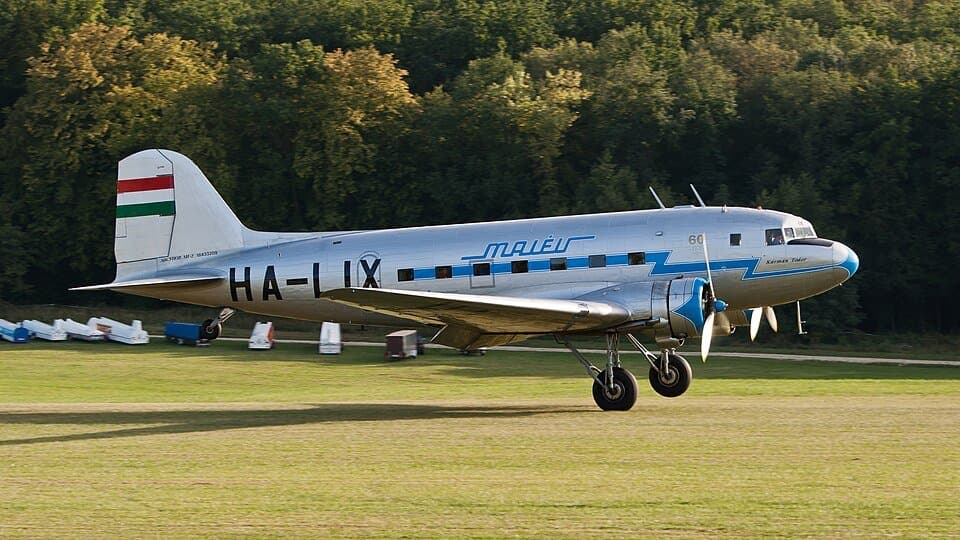
Only one Li-2 restored to airworthy condition exists in Europe. The Hungarian registered HA-LIX was built in 1949 in Airframe Factory Nr.84 (GAZ-84) of Tashkent, as serial number 18433209 and was operated by MALÉV till 1964. It was withdrawn to a museum in 1974 as an airforce parachute trainer airplane. After a complete reconstruction finished in 2001 it flies sightseeing tours and regularly participates at air shows. It is operated by the Goldtimer Foundation, based at Budaörs Airport , Budapest , Hungary . The North Korean Air Force is known to still use a number of Li-2s for transport , although they may have been decommissioned despite their continued presence on certain airbases.[source]Lisunov Li-2 · Operational history; only the objects and conditions stated in this passage
Li-2G[source]Lisunov Li-2 · Variants; only the objects and conditions stated in this passage
Capacity: 24 passengers / (20 troops Li-2T )[source]Lisunov Li-2 · Specifications (Li-2P); only the objects and conditions stated in this passage
Length: 19.65 m (64 ft 6 in)[source]Lisunov Li-2 · Specifications (Li-2P); only the objects and conditions stated in this passage
Wingspan: 28.81 m (94 ft 6 in)[source]Lisunov Li-2 · Specifications (Li-2P); only the objects and conditions stated in this passage
Wing area: 91.33 m 2 (983.1 sq ft)[source]Lisunov Li-2 · Specifications (Li-2P); only the objects and conditions stated in this passage
Empty weight: 7,700 kg (16,976 lb)[source]Lisunov Li-2 · Specifications (Li-2P); only the objects and conditions stated in this passage
Max takeoff weight: 11,280 kg (24,868 lb)[source]Lisunov Li-2 · Specifications (Li-2P); only the objects and conditions stated in this passage
Powerplant: 2 × Shvetsov M-62 9-cylinder air-cooled radial piston engines, 670 kW (900 hp) each[source]Lisunov Li-2 · Specifications (Li-2P); only the objects and conditions stated in this passage
Maximum speed: 280 km/h (170 mph, 150 kn)[source]Lisunov Li-2 · Specifications (Li-2P); only the objects and conditions stated in this passage
Cruise speed: 245 km/h (152 mph, 132 kn)[source]Lisunov Li-2 · Specifications (Li-2P); only the objects and conditions stated in this passage
Range: 2,500 km (1,600 mi, 1,300 nmi)[source]Lisunov Li-2 · Specifications (Li-2P); only the objects and conditions stated in this passage
Service ceiling: 5,600 m (18,400 ft)[source]Lisunov Li-2 · Specifications (Li-2P); only the objects and conditions stated in this passage
Guns: :* 3× 7.62 mm (.30 in) ShKAS machine guns Li-2T / Li-2VV[source]Lisunov Li-2 · Specifications (Li-2P); only the objects and conditions stated in this passage
1× 12.7 mm (.50 in) Berezin UBK machine gun Li-2T / Li-2VV[source]Lisunov Li-2 · Specifications (Li-2P); only the objects and conditions stated in this passage
Bombs: :* 1,000 kg bombs (normal load) Li-2VV[source]Lisunov Li-2 · Specifications (Li-2P); only the objects and conditions stated in this passage
2,600 kg (5,732 lb) of bombs (short distances) Li-2VV[source]Lisunov Li-2 · Specifications (Li-2P); only the objects and conditions stated in this passage