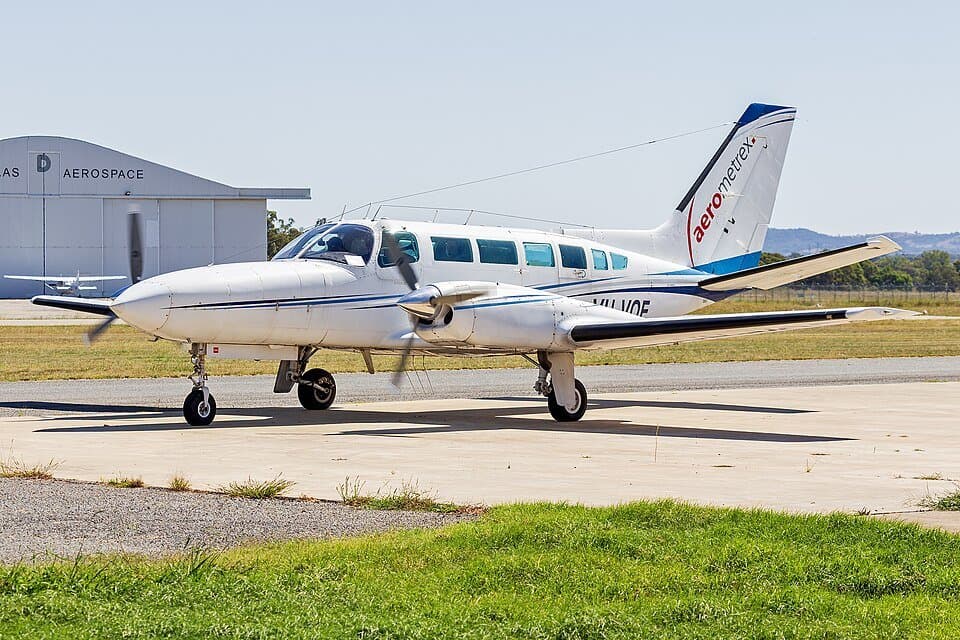

Credit
Bidgee · CC BY-SA 3.0 au · Resized · CC BY-SA 3.0 au · Source ↗ · Modified


Preparing your view.
At a glance
True scale
Side by side. From every angle. A human reference for perspective.
3.16 MB · Loads when you open it| Model | Length | Width / span | Height |
|---|---|---|---|
| Cessna 404 Titan | ≈ 12.05 m | ≈ 14.23 m (Width) | ≈ 4.04 m |
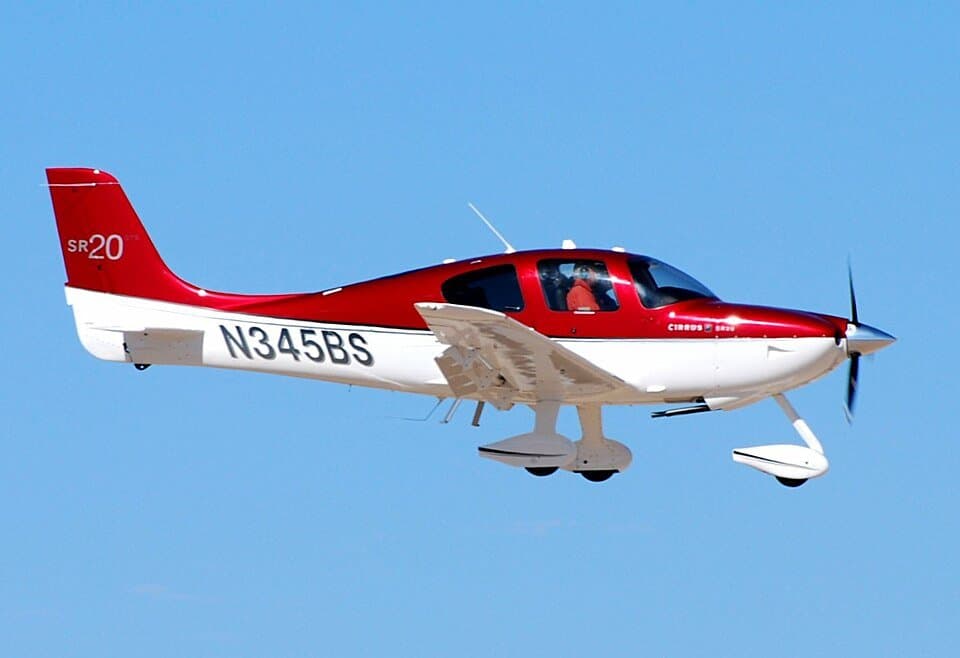
| Cirrus SR20 | ≈ 7.92 m | ≈ 11.68 m (Width) | ≈ 2.72 m |
Scaled uniformly to the sourced length of 12.046 m. The shape was turned square to the axes; the height was fitted to the sourced 4.04 m; the width was fitted to the sourced 14.23 m. Not an official model or a measured survey.
ForceTally · All rights reserved
Scaled uniformly to the sourced length of 7.92 m. The shape was turned square to the axes; the height was fitted to the sourced 2.72 m; the width was fitted to the sourced 11.68 m. Not an official model or a measured survey.
ForceTally · All rights reserved
The human reference is a generic 1.75 m figure. Models describe external size, not combat performance.
Measured figures
Ambassador I · Length
Single source39 ft 6 + 1 ⁄ 4 in (12.046 m)[source]
Configuration
| Specification | Cessna 404 Titan | Cirrus SR20 |
|---|---|---|
| Type | Light passenger/cargo aircraft[source] | Light aircraft[source] |
| National origin | United States[source] | United States[source] |
| Manufacturer | Cessna[source] | Cirrus Aircraft[source] |
| Number built | 396[source] | 2,084 (through 2025) |
SR20-G3 · Length
26 ft 0 in (7.92 m)[source]
Cruise; Ambassador I · (econ cruise) at 20,000 ft (6,100 m)
Single sourceMaximum; Ambassador I · at 16,000 ft (4,900 m)
Single source267 mph (430 km/h, 232 kn) at 16,000 ft (4,900 m)[source]
188 mph (302 km/h, 163 kn) (econ cruise) at 20,000 ft (6,100 m)[source]
Cruise; SR20-G3 · TAS
Single sourceCruise; SR20 only · manufacturer 2024 product configuration · maximum cruising speed · SR20 only · manufacturer 2024 product configuration · maximum cruising speed · SR20
Manufacturer claimCessna 404 Titan · installed powerplant; two engines; stated rating per engine · two /280 kW turbocharged Continental Motors GTSIO-520 piston engines
Single sourcetwo 375 hp/280 kW turbocharged Continental Motors GTSIO-520 piston engines[source]Cessna 404 Titan · installed powerplant; two engines; stated rating per engine
SR20-G3 · 1 × Continental IO-360-ES six cylinder, horizontally-opposed piston aircraft engine
Single sourceSR20 only · manufacturer 2024 product configuration; not SR22 or SR22T · SR20 only · manufacturer 2024 product configuration; not SR22 or SR22T · SR20 · Lycoming engine
Manufacturer claimAmbassador I · Wing area
Single source242.0 sq ft (22.48 m 2 )[source]
Ambassador I · Service ceiling
Single source26,000 ft (7,900 m)[source]
SR20-G3 · Service ceiling
Single sourceSR20 only · manufacturer 2024 product configuration · maximum operating altitude · SR20 only · manufacturer 2024 product configuration · maximum operating altitude · SR20
Manufacturer claim17,500 ft (5,300 m)[source]
17,500 feet[source]SR20 only · manufacturer 2024 product configuration · maximum operating altitude
Bars compare reported quantities only. A larger figure does not make a system better; configurations and test conditions differ.
| Manufactured | 1976–1982[source] | 1999–present[source] |
|---|
| Introduction date | 1976[source] | — |
|---|
| First flight | February 26, 1975[source] | 21 March 1995[source] |
|---|
| Developed from | Cessna 402[source] | — |
|---|
| Developed into | Reims-Cessna F406 Caravan II Cessna 441 Conquest II[source] | Cirrus SR22[source] |
|---|
| Capacity | 6–8 passengers[source] | 3 passengers (4 using 60/40 flex seating in post-2012 models)[source] |
|---|
| Aspect ratio | 9.0:1[source] | — |
|---|
| Fuel capacity | 340 US gal (280 imp gal; 1,300 L)[source] | — |
|---|
| Stall speed | 81 mph (130 km/h, 70 kn) flaps down, power off[source] | 56 kn (64 mph, 104 km/h) CAS[source] |
|---|
| Never exceed speed | 274 mph (441 km/h, 238 kn) ( Calibrated airspeed )[source] | — |
|---|
| Take-off run to 50 ft (15 m) | 2,367 ft (721 m)[source] | — |
|---|
| Landing run from 50 ft (15 m) | 2,130 ft (650 m)[source] | — |
|---|
| Role | American twin-engined, light aircraft[source] | — |
|---|
| Source measurement | The Cessna 404 was a development of the Cessna 402 with an enlarged vertical tail and other changes. The prototype first flew on February 26, 1975. It is powered by two 375 hp/280 kW turbocharged Continental Motors GTSIO-520 piston engines. Two versions were offered originally; the Titan Ambassador passenger aircraft for ten passengers, and the Titan Courier utility aircraft for passengers or cargo. By early 1982 seven different variants were available, including a pure cargo version, the Titan Freighter . The Freighter was fitted with a strengthened floor, cargo doors, and its interior walls and ceiling were made from impact-resistant polycarbonate materials to minimize damage in the event of cargo breaking free in-flight.[source]Cessna 404 Titan · Design and development; only the objects and conditions stated in this passage On July 21, 1980 a Cessna 404 departing the Grand Canyon Airport for Phoenix, Arizona experienced an engine failure on take-off due to foreign material, improper maintenance, and improper procedures. All eight persons aboard (seven passengers and one crew member) were killed.[source]Cessna 404 Titan · Accidents and incidents; only the objects and conditions stated in this passage On June 27, 1989, a Cessna 404 Titan of Formosa Airlines on its way to Wang-an, Penghu crashed into nearby Cianjhen District streets shortly after takeoff. All 12 people on board were killed; there were no ground casualties.[source]Cessna 404 Titan · Accidents and incidents; only the objects and conditions stated in this passage On May 10, 1996, a Cessna 404 Titan (registred C-FPVB) on an Aerodat charter flight from Pucallpa to Cuzco disappeared. All three passengers were Canadians on an oil exploration trip. No traces of the aircraft were found.[source]Cessna 404 Titan · Accidents and incidents; only the objects and conditions stated in this passage On September 3, 1999, Edinburgh Air Charter Flight 3W had an engine failure shortly after takeoff, tried to return to Glasgow but crashed short of the runway. 8 of the 11 people on board died. The plane was carrying Airtours employees.[source]Cessna 404 Titan · Accidents and incidents; only the objects and conditions stated in this passage Capacity: 6–8 passengers[source]Cessna 404 Titan · Specifications (Ambassador I); only the objects and conditions stated in this passage Length: 39 ft 6 + 1 ⁄ 4 in (12.046 m)[source]Cessna 404 Titan · Specifications (Ambassador I); only the objects and conditions stated in this passage Wingspan: 46 ft 8 + 1 ⁄ 4 in (14.230 m)[source]Cessna 404 Titan · Specifications (Ambassador I); only the objects and conditions stated in this passage Height: 13 ft 3 in (4.04 m)[source]Cessna 404 Titan · Specifications (Ambassador I); only the objects and conditions stated in this passage Wing area: 242.0 sq ft (22.48 m 2 )[source]Cessna 404 Titan · Specifications (Ambassador I); only the objects and conditions stated in this passage Empty weight: 4,816 lb (2,185 kg)[source]Cessna 404 Titan · Specifications (Ambassador I); only the objects and conditions stated in this passage Max takeoff weight: 8,400 lb (3,810 kg)[source]Cessna 404 Titan · Specifications (Ambassador I); only the objects and conditions stated in this passage Maximum speed: 267 mph (430 km/h, 232 kn) at 16,000 ft (4,900 m)[source]Cessna 404 Titan · Specifications (Ambassador I); only the objects and conditions stated in this passage Cruise speed: 188 mph (302 km/h, 163 kn) (econ cruise) at 20,000 ft (6,100 m)[source]Cessna 404 Titan · Specifications (Ambassador I); only the objects and conditions stated in this passage Stall speed: 81 mph (130 km/h, 70 kn) flaps down, power off[source]Cessna 404 Titan · Specifications (Ambassador I); only the objects and conditions stated in this passage Never exceed speed : 274 mph (441 km/h, 238 kn) ( Calibrated airspeed )[source]Cessna 404 Titan · Specifications (Ambassador I); only the objects and conditions stated in this passage Range: 2,120 mi (3,410 km, 1,840 nmi)[source]Cessna 404 Titan · Specifications (Ambassador I); only the objects and conditions stated in this passage Service ceiling: 26,000 ft (7,900 m)[source]Cessna 404 Titan · Specifications (Ambassador I); only the objects and conditions stated in this passage Rate of climb: 1,575 ft/min (8.00 m/s)[source]Cessna 404 Titan · Specifications (Ambassador I); only the objects and conditions stated in this passage Take-off run to 50 ft (15 m): 2,367 ft (721 m)[source]Cessna 404 Titan · Specifications (Ambassador I); only the objects and conditions stated in this passage Landing run from 50 ft (15 m): 2,130 ft (650 m)[source]Cessna 404 Titan · Specifications (Ambassador I); only the objects and conditions stated in this passage | One of the major selling points for the SR20 is its Garmin Cirrus Perspective avionics suite with dual 10-inch (250 mm) or 12-inch (300 mm) screens: one primary flight display (PFD) and one multifunction display (MFD), first introduced by the company in May 2008. This provides all standard communication , navigation ( GPS and conventional VHF), and surveillance ( Mode S transponder ) functions. Other avionics features include in-flight weather information and TCAS -like traffic information.[source]Cirrus SR20 · Design and development; only the objects and conditions stated in this passage In 2012, "60/40 flex seating" was introduced, allowing up to three passengers in the rear with a split fold-down seat arrangement. This five-seat configuration was optional in 2012, but became standard equipment for 2013 SR20 models.[source]Cirrus SR20 · Design and development; only the objects and conditions stated in this passage In January 2020, the company introduced a new mobile application for the SR series, called "Cirrus IQ", which enables remote aircraft communication including access to preflight status information such as fuel and oxygen levels, battery voltage, oil temperature, aircraft location, and flight hours. Upgrades also included a new stabilized approach-advisory system for the flight deck. In January 2022, speed and aesthetic improvements were added to the G6 SR-series, with a 9 knots (17 km/h) increased cruise speed, upgrades to the mobile IQ app, USB-A and USB-C charging ports and more.[source]Cirrus SR20 · Design and development; only the objects and conditions stated in this passage In 2011, the accident records of the SR20 and -22 were the subject of a detailed examination by Aviation Consumer magazine. The review concluded that the series has an overall accident record that is better than average for light aircraft, exceeded only by the Diamond DA40 and DA42 . However, its fatal accident rate is much worse at 1.6/100,000 hours, placing it higher than the U.S. general aviation rate of 1.2 and higher than the Diamond DA40 (0.35), Cessna 172 (0.45), Diamond DA42 (0.54), Cessna 182 (0.69), and Cessna 400 (1.0), despite the Cirrus's CAPS. |
|---|
| Propellers | — | 3-bladed[source] |
|---|
| Powerplant | — | 215 horsepower Lycoming engine[source]SR20 only · manufacturer 2024 product configuration; not SR22 or SR22T |
|---|
| Useful load | — | 1,028 pounds[source]SR20 only · manufacturer 2024 product configuration · approximate useful load, not empty mass or payload alone |
|---|
2,126 lb (964 kg)[source]
3,050 lb (1,383 kg)[source]
Max Takeoff Weight (lbs) . . . . . . . 3,050[source]SR20 only · manufacturer 2024 delivered-aircraft product configuration; literal row prefix carries pounds header and own 3,050 value, excludes adjacent SR22/SR22T/Vision Jet columns
155 kn (178 mph, 287 km/h) TAS[source]
155 KTAS[source]SR20 only · manufacturer 2024 product configuration · maximum cruising speed
1 × Continental IO-360-ES six cylinder, horizontally-opposed piston aircraft engine , 200 hp (150 kW)[source]
Introduced in 2007, the G3 has a lighter wing of greater area, incorporating a carbon-fiber spar . The new wing increased the SR20's cruise speed by 6–7 knots (11–13 km/h). The G3 also added a 50 pounds (23 kg) increased useful load by increasing the take-off weight to 3,050 pounds (1,380 kg), a redesigned main landing gear that is 2 inches (5 cm) taller, giving greater propeller and tail clearance, improved aircraft handling due to increased dihedral , improved aerodynamics including new wing root fairings , LED recognition lights, improved heat and ventilation, dual-redundant GPS WAAS -certified Garmin GNS 430W comm-navigators (that include a VHF radio and a VOR/LOC/ILS receiver), and an S-TEC Autopilot.[source]Cirrus SR20 · Variants; only the objects and conditions stated in this passage
Introduced in January 2017, the G6 model adds a Lycoming IO-390 engine of 215 hp (160 kW), an enhanced "Perspective-Plus" flight deck with a 10-times faster instrument processing speed, new LED wingtip lights and a useful load increase of 150 lb (68 kg).[source]Cirrus SR20 · Variants; only the objects and conditions stated in this passage
Capacity: 3 passengers (4 using 60/40 flex seating in post-2012 models)[source]Cirrus SR20 · Specifications (SR20-G3); only the objects and conditions stated in this passage
Length: 26 ft 0 in (7.92 m)[source]Cirrus SR20 · Specifications (SR20-G3); only the objects and conditions stated in this passage
Wingspan: 38 ft 4 in (11.68 m)[source]Cirrus SR20 · Specifications (SR20-G3); only the objects and conditions stated in this passage
Height: 8 ft 11 in (2.72 m)[source]Cirrus SR20 · Specifications (SR20-G3); only the objects and conditions stated in this passage
Empty weight: 2,126 lb (964 kg)[source]Cirrus SR20 · Specifications (SR20-G3); only the objects and conditions stated in this passage
Gross weight: 3,050 lb (1,383 kg)[source]Cirrus SR20 · Specifications (SR20-G3); only the objects and conditions stated in this passage
Powerplant: 1 × Continental IO-360-ES six cylinder, horizontally-opposed piston aircraft engine , 200 hp (150 kW)[source]Cirrus SR20 · Specifications (SR20-G3); only the objects and conditions stated in this passage
Cruise speed: 155 kn (178 mph, 287 km/h) TAS[source]Cirrus SR20 · Specifications (SR20-G3); only the objects and conditions stated in this passage
Stall speed: 56 kn (64 mph, 104 km/h) CAS[source]Cirrus SR20 · Specifications (SR20-G3); only the objects and conditions stated in this passage
Service ceiling: 17,500 ft (5,300 m)[source]Cirrus SR20 · Specifications (SR20-G3); only the objects and conditions stated in this passage
Rate of climb: 828 ft/min (4.21 m/s)[source]Cirrus SR20 · Specifications (SR20-G3); only the objects and conditions stated in this passage
406 MHz ELT[source]Cirrus SR20 · Specifications (SR20-G3); only the objects and conditions stated in this passage