FORCETALLY
Loading the evidence…
Preparing your view.


Preparing your view.
TanksIn productionProfile in progress
Main battle tank
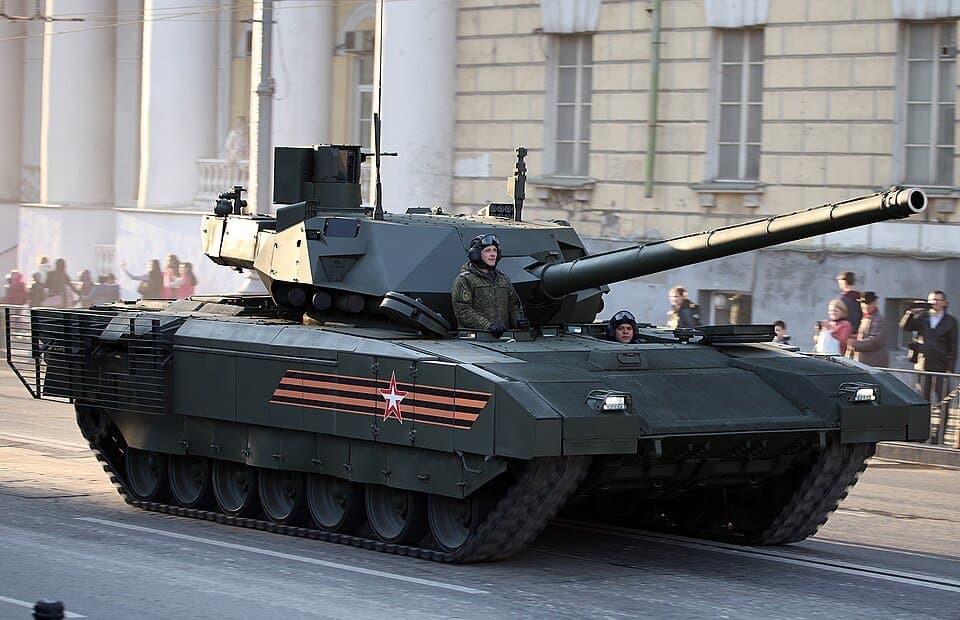
T-14 Armata is a main battle tank originating in Russia. The cited manufacturer or builder is Uralvagonzavod.
 Russia
True scale
Sourced dimensions beside a 1.75 m human reference.
Points represent sourced observations, including revisions. Revisions on the same effective date are not separate inventory events. Ranges appear in the table and are not plotted as exact points.
| Observation / report period | Value | Source | Claim state |
|---|---|---|---|
| 28 Sept 2026 | 125 mm | Wikipedia contributors | superseded |
| 28 Sept 2026 | 125 mm | Wikipedia contributors | superseded |
| 28 Sept 2026 | 125 mm | Wikipedia contributors | superseded |
| 28 Sept 2026 | 125 mm | Wikipedia contributors | approved |
Main battle tank
Russia
Ural Design Bureau of Transport Machine-Building, Uralvagonzavod
2014
Uralvagonzavod
$3.7–$4.6 million in 2015 $5–7.1 million in 2022
2014–2021 (prototypes), 2021–present (claimed serial production)
Unknown/Low tens
55 tonnes
10.7 m (35 ft)
3.5 m (11 ft)
3.3 m (11 ft)
3
125 mm (4.92 in)
5 km, Uralvagonzavod claims
12 km, Uralvagonzavod claims
44S-sv-Sh Steel
2A82-1M 125 mm smoothbore cannon with 45 rounds (of which, 32 in the autoloader ). Future version may use the smoothbore 2A83 152 mm tank gun.
12.7 mm ( 1 ⁄ 2 in) Kord machine gun (6P49), 7.62 mm (0.30 in) PKTM machine gun (6P7К)
12N360 Twin Turbo Diesel 1,100 kW (1,500 hp)
20.4 kW/t (27.3 hp/t)
12-speed automatic gearbox
Hydropneumatic suspension
Min. 500 kilometres (310 mi)
75–80 km/h (47–50 mph) (estimated)
The T-14 Armata ( Russian : Т-14 «Армата» ; industrial designation Russian : Объект 148 , romanized : Obyekt 148 , lit. ' Object 148 ' ) is a Russian fourth-generation main battle tank (MBT) based on the Armata Universal Combat Platform .
After the cancellation of the T-95 in 2010, Uralvagonzavod began the OKR Armata (Armament) design study. The study resulted in the Object 148 based on the T-95 (itself based on the Object 187 ). The Russian Army curtailed T-90 orders beginning in 2012 to prepare for the arrival of the new tank.
The T-14 first publicly appeared in March 2015, when several tanks with covered turrets were seen loaded on train carriage in Alabino . It was subsequently revealed on 9 May during the 2015 Moscow Victory Day Parade . During the 2015 rehearsals, one of the tanks suddenly stopped moving, and after attempts to tow it failed, it moved away under its own power after about 15 minutes.
At least seven T-14 Armata tanks appeared in the 2015 and 2016 Moscow Victory Day parade , five in 2017 and 2018. Four were anticipated in promotional materials in advance of the 2019 parade.
On 25 December 2022, Russian TV presenter Vladimir Solovyov posted footage of the T-14 in combat training with other sources claiming that the tank was being prepared for battle and already deployed to the conflict zone, with a military expert saying the videos were probably shot near Kazan.
The Vacuum-1 Armor-Piercing Fin-Stabilized Discarding Sabot (APFSDS) round, developed for the 2A82-1M gun, has a penetrator that is 900 mm long, and is said to be capable of penetrating 1000 mm of Rolled Homogeneous Armor (RHA) equivalent at a distance of 2 km. The new controlled-detonation Teknik HE-Frag shell is available and has entered service. The gun is capable of firing new guided missiles like the 9M119M1 Invar-M which has an effective range of 100 m to 5 km, and can engage low-flying air targets such as helicopters, with a new 3UBK21 Sprinter Anti-Tank Guided Missile (ATGM) with an effective range up to 12 km developed specifically for it. The 3UBK25 active homing ATGM is currently under development.
The secondary armament consists of a 12.7×108mm Kord ( GRAU index 6P49) machine gun with 300 rounds (not observed during the 2015 parade) and a 7.62×54mmR Pecheneg PKP (GRAU Index: 6P41) or a PKTM (6P7К) machine gun with 1,000 rounds. All guns are remotely controlled. In addition, another 1,000 rounds can be stored separately.
The 152 mm cannon, which was first developed in 2000 for the T-95 prototype, has a high-speed APFSDS shell with a 1,980 m/s muzzle velocity , only dropping to 1,900 m/s at 2 km. However, Russian engineers have so far kept the 125 mm-size gun, assessing that improvements in ammunition are enough to increase effectiveness while concluding that a larger bore weapon would offer few practical advantages.
The T-14 could also be modified to use anti-aircraft missiles. A 30 mm anti-aircraft gun could be installed in the near future.
152 mm main gun
Thermobaric ammo for 152 mm
Supersonic armor-piercing ammo for 152 mm
ATGM for 152 mm with aiming/guidance system "fire and forget"
Redesigned turret and new autoloader for accommodating 152 mm gun and ammo
During the prototype stage, several engines with power outputs ranging from 1,500 to 2,000 hp were tested on the platform, with the 1,500 hp version reportedly allowing a max speed of 82 km/h. The T-14 is powered by a ChTZ 12N360 (A-85-3A) diesel engine with a displacement of 34.6 liters delivering up to 1,100 kW (1,500 hp). The engine's theoretical maximum power, which is not normally used, is 1,500 kW (2,000 hp), at the cost of radically decreasing its service life, with a projected minimum 2,000 hours at a nominal 1,100 kW (1,500 hp), comparable to other modern tank engines, and up to 10,000 hours at a moderated 890 kW (1,200 hp). The engine is electronically controlled. Operational range is over 500 km (300 mi).
The T-14 has a 12-speed automatic gearbox , with a top speed of 80–90 km/h (50–56 mph). Sources suggest a partly or fully hydrostatic transmission .
Unlike previous Russian and Soviet designs, such as the T-90/80/72/ 64 , the T-14 has seven 700 mm road wheels per side, based on the T-80 variant. This may have been done to improve the pivoting ability of the tank, as an active suspension system improves the target lock time by a factor of 2.2, and reduces the timeframe between target detection and reaction by 31%, all due to the resulting smoother ride.
The tank features the Afganit ( Russian : Афганит ) active protection system (APS). Previous Russian APS were either "hard kill" versions (Drozd, Arena) or "soft kill" version (Shtora-1). Hard-kill measures kinetically attack threatening missiles or other munitions, while soft kill measures disrupt guidance systems (laser dazzlers or infrared emitters). Afganit is about to introduce the first dual system with both soft and hard actions incorporated. It includes a millimeter-wave radar to detect, track, and intercept incoming anti-tank munitions, both kinetic energy penetrators and tandem-charges . Currently, the maximum speed of the interceptable target is 1,700 m/s (Mach 5.0), with projected future increases of up to 3,000 m/s (Mach 8.8). According to news sources, it protects the tank from all sides, however it is not geared towards shooting upwards to defend against top-attack munitions.
Defense Update released an analysis of the tank in May 2015, speculating that Afganit' s main sensors are the four panels mounted on the turret's sides, which are probably AESA radar panes spread out for a 360° view, with possibly one more on top of the turret.
In July 2015, the deputy director of the Uralvagonzavod tank manufacturing company claimed the T-14 would be invisible to radar and infrared detection due to radar-absorbing paint and the placement of components with heat signatures deep within the hull. The turret's shape is designed to reduce its radio and thermal signature for a stealth ground vehicle . American and Russian armor experts have doubts about these unproven claims. A retired senior U.S. military officer said that sensitive modern thermal technology could detect things such as vehicle movement, a weapon firing, an exposed crewman, or the exhaust of an engine capable of moving a 50-ton tank regardless of heat-generating component placement. Analysts also pointed out that most stealth technology in Russia has been for aircraft to reduce their radar cross section from airborne or ground-based detection, while in a ground vehicle the approach would be to make it indistinguishable from ground clutter to optimize shielding from air-to-ground detection and the two techniques do not necessarily overlap.
The T-14 is equipped with 26.5–40 GHz active electronically scanned array radar, which is used mainly by the APS. The T-14 uses highly protected communication channels that connect a group of T-14s and the command post.
The commander's sight is installed on the turret top and has a 360° field of view, while the gunner's, situated in the turret's niche to the gun's left, is slaved to it and is additionally equipped with a direct-vision periscopic channel and laser designator for the T-14's gun-launched, SACLOS anti-tank missiles.
The detection distance of tank-sized objects for both sights is 7,500 m (8,000) in daylight, through the TV/periscopic channel, and ≈3,500 m at night through the thermal channel.
There is also a backup night-vision capable sight, with 2,000/1,000 m respective detection distances.
This became partially subject to discussion in 2016 when the Krasnogorsk plant finished testing the Irbis-K night-vision sighting system. Completion of the Irbis-K, the first Russian-produced mercury-cadmium-telluride (MCT) matrix thermal sight, addressed a disadvantage of Russian tanks relative to their Western counterparts. The Irbis-K is capable of identifying targets at ranges up to 3,240 meters during both day and night.
The T-14 Armata has been described as early as 2016 as a major concern for Western armies, and British intelligence views the unmanned turret as providing many advantages. However, at the time Western observers questioned Russia's ability to produce modern tanks like the T-90 and T-14 in significant numbers.
In response to the Armata, German company Rheinmetall has developed a new 130mm L/51 tank gun, claiming it provides a 50 percent increase in armor penetration over the 120mm L/55 in service with the Bundeswehr . Germany and France have joined forces to develop an unspecified " Main Ground Combat System " (MGCS) to compete with the technological advances of the Armata and replace both the Leclerc and Leopard 2 MBTs around 2030; however, by June 2018, deployment of the new vehicles and systems was scheduled for 2035, with full operational capability to be achieved by 2040. Additionally, Rheinmetall began the development of the KF51 Panther , which was unveiled in 2022.
Reference text from Wikipedia contributors, used under CC BY-SA 4.0.
Country inventory links have not yet been documented for this equipment.
Keep exploring
 Iran