FORCETALLY
Loading the evidence…
Preparing your view.


Preparing your view.
TanksIn service
Main battle tank
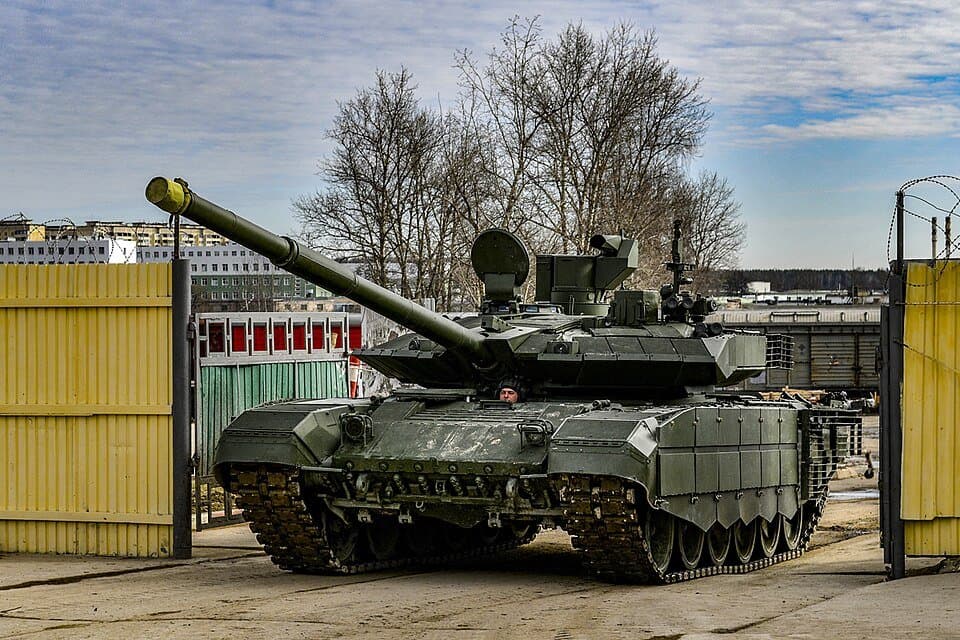
T-90 is a main battle tank originating in Russia. It was built by Uralvagonzavod , Heavy Vehicles Factory. Reported operators include Algeria, Armenia, Azerbaijan, India, Iraq, Russia, Syria, Turkmenistan, Uganda, Ukraine, Vietnam, Kuwait, Malaysia, Pakistan, United States.
 Russia
Technical data
Main battle tank
Russia
From 1992 (T-90) From 2004 (T-90A) From 2019 (T-90M)
See Operators
War in Dagestan Syrian Civil War Second Nagorno-Karabakh War Russo-Ukrainian War War in Donbas Russo-Ukrainian war (2022–present) Wagner Group rebellion
Kartsev-Venediktov
Uralvagonzavod , Heavy Vehicles Factory
USD 2.5 million in 1999, USD 2.77–4.25 million in 2011 (varies by source) T-90SM: USD 4.5 million in 2016
1992–present
≈4,000 (2023, see Operators ) 1,400 units of T-90S/SM built in India under license >1000 delivered to other countries
See Variants
46 tonnes (45 long tons ; 51 short tons ) (T-90) 46.5 tonnes (45.8 long tons ; 51.3 short tons ) (T-90A) 48 tonnes (47 long tons ; 53 short tons ) (T-90SM)
9.63 m (31 ft 7 in) 6.86 m (22 ft 6 in) (hull)
3.78 m (12 ft 5 in)
2.22 m (7 ft 3 in)
3
Steel-composite-reactive blend APFSDS : 550 mm + 250–280 mm with Kontakt-5 = 800–830 mm HEAT : 650–850 mm + 500–700 mm with Kontakt-5 = 1,150–1,550 mm
2A46M 125 mm smoothbore gun with 43 rounds (T-90) 2A46M-2 125 mm smoothbore gun with 42 rounds (T-90A) 2A46M-5 125 mm smoothbore gun with 43 rounds (T-90M)
12.7mm Kord Heavy machine gun , 7.62mm PKMT
V-84MS 12-cyl. diesel (T-90) V-92S2 12-cyl. diesel (T-90A) V-92S2F 840 hp (617 kW) for V-84MS 12-cyl. diesel engine 1000 hp (736 kW) for V-92S2 12-cyl. diesel engine (T-90A and T-90S) 1130 hp (831 kW) for V-92S2F (T-90M and T-90MS)
18.2 hp/tonne (13.3 kW/tonne) (T-90) 21.5hp/tonne (15 kW/tonne) (T-90A)
Torsion bar
550 km (340 mi) (without fuel drums)
60 km/h (37 mph) (T-90A and T-90MS)
Algeria : 600 T-90SA in service as of 2025
Armenia : 1 T-90A in service as of 2025
Azerbaijan : 93 T-90S in service as of 2025
India : 1,200 T-90S in service as of 2025
Iraq : 73 T-90S in service as of 2025
Russia : Some T-90A and 620 T-90M in service as of 2026. Unknown number of T-90 and T-90A tanks in storage been upgraded to T-90M. Remaining T-90A will be upgraded to T-90M.
Syria : Unknown number of T-90 and T-90A tanks in service as of 2024
Turkmenistan : 4 T-90S in service as of 2025
Uganda : 44 T-90S in service as of 2025
Ukraine : Operates an unknown number of T-90A and T-90M tanks captured from Russian forces during the Russo-Ukrainian War
Vietnam : 64 T-90S in service as of 2025
Kuwait : Was looking to acquire 146 T-90MS tanks as replacement for M-84 . Contract could be signed after being approved by the National Assembly. Russian Presidential aide confirmed that Kuwaiti contract could be signed by the end of 2017. Kuwait indefinitely postponed the deal in 2019 and is unlikely to revive it, instead opted for upgrading their M1A2 Abrams .
Malaysia : The tank was in the tender for Malaysia, but they selected the Polish tank PT-91M in 2002.
Pakistan : Planned to acquire 600 battle tanks and considered the T-90 but instead opted for the Chinese VT-4 .
United States : 1 T-90A. The T-90A was first spotted in the middle of April 2023, at a Louisiana truck stop. The tank itself was likely captured by Ukrainian forces during the Kharkiv counteroffensive in 2022 and was in Ukrainian service before being shipped to the United States. A Pentagon spokesperson stated that its destination is Aberdeen Proving Ground for evaluation purposes.
The T-90 is a third-generation Russian main battle tank developed from, and designed to replace the T-72 .
The T-90 is a third-generation Russian main battle tank developed from, and designed to replace the T-72 . It uses a 125 mm 2A46 smoothbore main gun , the 1A45T fire-control system , an upgraded engine, and gunner's thermal sight . Standard protective measures include a blend of steel and composite armour , smoke grenade dischargers, Kontakt-5 explosive reactive armour (ERA) and the Shtora infrared anti-tank guided missile (ATGM) jamming system.
The T-90 was designed and built by Uralvagonzavod , in Nizhny Tagil , Russia. It entered service with the Russian army in 1992. The tank allegedly first saw combat in the 1999 war in Dagestan , with Russian Ground Forces . Russia later used the tank from 2017 in its intervention in the Syrian civil war . Russian T-90s were deployed in the war in Donbas in 2014, as well as in the full-scale Russo-Ukrainian war following the 2022 Russian invasion of Ukraine . The Syrian Arab Army used the tank in the Syrian civil war in 2017, as did the Azerbaijani Land Forces in the 2020 Second Nagorno-Karabakh War .
The principal upgrade in the T-90 is the incorporation of a slightly modified form of the T-80U's more sophisticated 1A45T Irtysh fire control system and an upgraded V-84MS multi-fuel engine developing 840 hp (618 kW). The T-90 was manufactured at the Uralvagonzavod factory in Nizhny Tagil, with low-level production being carried out since 1992 and virtually ceasing towards the end of the 1990s for the native market. Around 120 T-90 tanks were delivered to the Russian Ground Forces before production of an upgraded version was resumed in 2004.
Facing tapering domestic orders, Uralvagonzavod received government approval to export the T-90 in the mid-1990s. The designers at Uralvagonzavod created a new, welded turret that offered improvements in protection and internal space in the same period. In 1997, India signaled interest in the T-90 in response to Pakistan's acquisition of 320 Ukrainian T-80UD tanks. India's Heavy Vehicles Factory in Avadi was already license-manufacturing the T-72 under the name "Ajeya".
The first 42 complete Indian tanks were delivered in 2001 and were designated T-90S ( Object 188S ), still equipped with the older cast turrets of the early series (this exhausted the remaining stocks of cast turrets warehoused at Nizhny Tagil) and powered by the V-84 engine making 840 hp (618 kW). In 2002, 82 vehicles were delivered, now equipped with the new welded turrets and the V-92S2 engine, generating 1,000 hp (735 kW). The initial contract stipulated the following batch of 186 tanks, now officially called Bhishma , to be completed in India from Russian-supplied kits, and then gradually replaced with domestically manufactured parts. Delays in domestic production compelled the Indian authorities to place an additional order for 127 complete vehicles from Uralvagonzavod.
In 2005 the Russian army resumed delivery of the T-90, requesting the "original" specification for the vehicle with a cast turret. But with the new order numbering 14 tanks, and the large capital investment required to set up production of new cast turrets, the Russian Ministry of Defence agreed on a new configuration very close to the Indian T-90S, which was expeditiously accepted into service without any trials as the Object 188A1 or T-90A . 2005 saw delivery of 18 new tanks – enough to equip approximately five tank platoons. These new Russian tanks were powered by the V-92S2 engine, carried a T01-K05 Buran-M gunner's sight (passive-active night-vision channel with an EPM-59G Mirage-K matrix and a maximum observation distance of 1,800 m) and were protected by the most recent Kontakt-5 reactive armor with 4S22 explosive tiles.
In 2012, the Russian-made commander combined sample supervisory-sighting system "T01-K04DT/Agat-MDT" was presented to the public at the International Forum Engineering Technologies 2012. According to Krasnogorsky Zavod plant, Agat-MDT has the ability to install (for further modernization) in the sight the newly developed domestic UPF format 640×512 by 15 microns, which makes possible in the future to extend the range of target identification at night to 3.5–4.0 km without modifications to the sight.
In 2016, the Krasnogorsk plant finished testing the Irbis-K night-vision sighting system for the T-80U and T-90, with first deliveries planned for 2017. Completion of the Irbis-K, the first Russian-produced mercury cadmium telluride (MCT) matrix thermal sight, addressed a disadvantage of Russian tanks relative to their Western counterparts. The Irbis-K can identify targets at ranges up to 3,240 meters during day and night.
After the cancellation of the T-95 in 2010, Uralvagonzavod began the OKR Armata (Armament) design study. The study resulted in the Object 148 based on the T-95 (itself based on the Object 187). The Russian Army curtailed T-90 orders beginning in 2012 to prepare for the arrival of the new tank. In July 2021, Industry and Trade Minister Denis Manturov said the tank, designated the T-14 Armata , will enter serial production in 2022.
Deliveries of upgraded T-90M tanks started in April 2020 to the Guards Tank Army of the RF Western Military District . The T-90M 'Proryv' ('Breakthrough') has received a principally new turret, the 2A46M-5 gun, and a more powerful engine. The Proryv is outfitted with a new multi-channel sighting system that allows employing weapons at any time of day or night and it can exchange data with other vehicles in real time. A new batch was delivered in March 2021. According to Ukrainian intelligence sources, manufacturing of T-90s was slowed because of the effect of International sanctions since the start of the invasion of Ukraine . An article from Forbes magazine in early October 2023 suggested a rise in T-90M's production based on the increasing amount of T90 losses in Ukraine.
It was estimated the Russian army had no more than 85 T-90M, and 380 earlier T-90 variants, in February 2022.
The UK-based International Institute for Strategic Studies (IISS) estimates that annual production of T-90M tanks could reach up to 90 units in 2024. Analysis suggests, however, that the majority of these T-90Ms are likely upgrades of older T-90A models rather than newly built tanks. Sources indicate that over 200 T-90Ms have been delivered since the war in Ukraine started. The UK-based Military Watch Magazine reported in September 2024 that efforts to surge the production rate to well over 1000 per year had fallen far short, with the output remaining uncertain with some reports indicating that over 300 T-90Ms would be delivered throughout the year.
An early variant of the export-oriented T-90S allegedly saw combat action during the 1999 Chechen invasion of Dagestan instead of being delivered to India. The tank's survivability against rocket-propelled grenades (RPGs) is disputed. Gordon L. Rottman writes that T-90s were "frequently" knocked out by three or four hits from a RPG-7 . He adds that Chechens found a way to compromise T-90s fitted with explosive reactive armor : they would fire an RPG-7 from close range (within 50m) to trigger the explosive reactive armor protection, and then re-attack the exposed tank armour underneath with two or more RPG hits, again from close range.
In January 2024, in fighting around Stepove , two Bradley Fighting Vehicles (BFV) from the Ukrainian 47th Separate Mechanized Brigade engaged a T-90M. The tank was disabled by the Bradleys, and its crew escaped before a FPV drone destroyed the tank.
In late September 2024, reports backed by images shared on social media showed a destroyed T-90M that lacked Relikt ERA. The ERA bricks had been replaced by "construction bricks".
As of 13 May 2026, the Oryx blog had documented that Russia had lost at least 213 T-90s since the start of the 2022 Russian invasion of Ukraine (visually confirmed), including 46 T-90A (of which 33 were destroyed, 3 abandoned, 10 captured), 2 T-90AK (1 was captured and later destroyed, and another was captured), 11 T-90S (9 destroyed, 1 abandoned, 1 captured) and 154 T-90M (102 destroyed, 16 damaged, 29 abandoned, 7 captured).
The later T-90M features the 'Kaktus K-6' bolted explosive reactive armour (ERA) package on its frontal hull and turret-top (the T-90S has 'Kontakt-5' ERA), is fitted with an enhanced environmental control system supplied by Israel's Kinetics Ltd for providing cooled air to the fighting compartment, has additional internal volume for housing the cryogenic cooling systems for new-generation thermal imagers like the THALES -built Catherine-FC thermal imager (operating in the 8–12 micrometre bandwidth).
A third contract, worth $1.23 billion, was signed in December 2007 for 347 upgraded T-90Ms, most to be licence-assembled by HVF. The Army hoped to field a force of over 21 regiments of T-90 tanks and 40 regiments of modified T-72s. The Indian Army began receiving its first T-90M main battle tank in completely knocked-down form from Russia's Nizhny Tagil-based Uralvagonzavod JSC at the end of 2009. The first batch of 10 T-90Ms built under licence was inducted into the Indian Army in August 2009. These vehicles were built at the Heavy Vehicles Factory at Avadi, Tamil Nadu. HVF planned to produce 100 units of the tank per year while India already had 700 units of the tank in service.
Bhishma Mk. 3 variant: In May 2024, Heavy Vehicles Factory unveiled the Bhishma Mk. 3 variant of T-90. Enhancements included increase in indigenous content and several upgrades. The upgrades included advanced Mid Wave Thermal Image -based sighting systems (8 km range) and Laser Range Finder (LRF; 5 km range) for commanders developed by DRDO and BEL (replacing Image Converter tube-based sight on older versions), a Digital Ballistic Computer to improve ammunition trajectory (derived from that of Arjun MBT ), Automatic Target Tracker. It is also expected that the new variant tanks will feature new generation ammunition like FSAPDS Mk2 (originally developed for Arjun MBT), and cannon-launched SAMHO missiles that is under development. Reports also suggest the use of a more efficient and powerful engine. There are plans for further upgradation of the T-90 tanks by including indigenous active protection systems , loitering munitions and more advanced ammunitions. India started the licensed production of Russian tank rounds 3VBM17 used by the T-72 and T-90 tanks in July 2024.
Engine upgrade : On 20 March 2025, the Defence Acquisition Council (DAC) cleared the Acceptance of Necessity (AoN) for the procurement of 1,350 hp (1,010 kW) engines for T-90 tanks to improve the power-to-weight ratio and increase mobility in high-altitude regions.
The T-90's main armament is the 2A46 M 125mm smoothbore tank gun. This is a highly modified version of the Sprut anti-tank gun , and is the same gun used as the main armament on the T-80-series tanks. It can be replaced without dismantling the inner turret and can fire armour-piercing fin-stabilized discarding sabot (APFSDS), high-explosive anti-tank (HEAT-FS), high-explosive fragmentation (HE-FRAG) ammunition, and 9M119M Refleks anti-tank guided missiles. The Refleks has semi-automatic command to line of sight (SACLOS) laser beam riding guidance and a tandem shaped charge HEAT warhead. It has an effective range of 100 m to 6 km, and takes 17.5 seconds to reach maximum range. Refleks can penetrate about 950 millimetres (37 in) of steel rolled homogeneous armour (RHA) and can also engage low-flying air targets such as helicopters .
The NSV 12.7mm ( 12.7×10⁸ ) remotely controlled anti-aircraft heavy machine gun can be operated from within the tank by the commander and has a range of 2 km and a cyclic rate of fire of 700–800 rounds per minute with 300 rounds available (the NSV was replaced by the Kord heavy machine gun in the late 1990s). The PKMT 7.62mm ( 7.62×54mmR ) coaxial machine gun weighs about 10.5 kg while the ammunition box carries 250 rounds (2,000 rounds carried) and weighs an additional 9.5 kg.
Like other modern Russian tanks the 2A46M in the T-90 is fed by an automatic loader which removes the need for a manual loader in the tank and reduces the crew to 3 (commander, gunner, and driver). The autoloader can carry 22 ready-to-fire rounds in its carousel and can load a round in 5–8 seconds. It has been suggested that the automatic loaders on modern T-90 tanks have been modified to take advantage of newer ammunition such as the 3BM-44M APFSDS, which like the US M829A3 penetrates armour better than the previous shorter rounds. HEAT rounds that can be fired from the 2A46M includes the 3BK21B (with a depleted uranium liner), 3BK29 (with a credited penetration of 800mm RHA equivalency), and the 3BK29M (with a Triple-tandem charge warhead). Additionally the T-90 features the Ainet fuse setting system which allows the tank to detonate 3OF26 HE-FRAG rounds at a specific distance from the tank as determined by the gunner's laser rangefinder , improving its performance against helicopters and infantry . Accurate firing range of the HE-Frag-FS 10 km, APFSDS 4 km.
Fire-control system of the T-90 showed the following features of combat shooting during state testing. Heavily armoured targets at ranges of up to 5 km were hit by tank T-90 on the move (up to 30 km/h) with a high probability of hit with the first shot. During state testing made 24 launches of missiles at ranges of 4–5 km and they all hit the target (all missile launches were made by inexperienced professionals). An experienced gunner at speeds of 25 km/h hit 7 real armoured targets located at ranges of 1,500–2,500 m and 54sec.
Fire-control system on the T-90 includes the PNK-4S/SR AGAT day and night sighting system mounted at the commanders station which allows for night time detection of a tank sized target at ranges between 700 and 1100 metres depending on the version of the sight. Early models of the T-90 were equipped with the TO1-KO1 BURAN sight but later models (T-90S) were upgraded to use the ESSA thermal imaging sight, which allows for accurate firing to a range of 5,000–8,000m during day and 3,300m during night, using the CATHERINE-FC thermal camera produced by Thales Optronique . The gunner is also provided with the 1G46 day sighting system which includes a laser range finder, missile guidance channel and allows tank-sized targets to be detected and engaged at 5 to 8 kilometres (3.1 to 5.0 mi). The driver uses a TVN-5 day and night sight. In 2010, Russia started licensed production of Thales-developed Catherine FC thermal cameras for T-90M tanks, a Russian daily said. These thermal imagers are also present on T-90M "Bhishma" built in India under licence.
In 2012, the Russian-made combined sample of commander supervisory-sighting system T01-K04DT/Agat-MDT was presented to the public. According to Krasnogorsky Zavod (plant), Agat-MDT has the ability to be installed (for further modernization) in the sight of the newly developed domestic UPF format 640×512 by 15 microns, which is possible in the future to extend the range of target identification at night to 3.5–4.0 km without sight modifications. In 2016, the Krasnogorsk plant finished testing the Irbis-K night-vision gunner's sighting system for the T-80U and T-90, with first deliveries in 2018. Completion of the Irbis-K, the first Russian-produced mercury-cadmium-telluride (MCT) matrix thermal sight, will bridge a gap with the leading NATO countries in this area. The Irbis-K can identify tank targets at ranges up to 3,240 meters during day and night.
The Russian-made thermal imaging device not only meant that Russian tanks would no longer need to be equipped with foreign parts, but it also meant that complete tank modernization was cheaper. Furthermore, there will be no decrease in demand for the T-72 and the T-90 in the next few years. The new tank gunner's heat-vision sight Irbis-K and the commander's combined sighting and observation system Agat-MDT can be supplied to T-72, T-80 and T-90 upgraded versions (T-72B3M, T-80BVM, T-90M...), replacing the Thales Catherine-FC thermal camera.
The prime mover is the V-92S diesel engine , built in the Chelyabinsk Tractor Plant. Different models of the T-90 tank are powered by various motors in its initial models, like the V-84MS 618 kW (840 hp) four-stroke V-12 piston engine , uprated 1,000 hp (750 kW) engines and 1,250 hp (930 kW) engines made by Uralvagonzavod and are delivered by Chelyabinsk Tractor Plant. The Т-90S with 1,000 hp (750 kW) engine can attain a top speed of 60 km/h on the road and up to 45 km/h on rough terrain. The T-90 tank has a typical drivetrain arrangement, with a rear placed engine and transmission. The 1,000 hp (750 kW) engines are V-92 four stroke, 12 cylinder, multi-fuel diesel while the 1,250 hp (930 kW) engine is V-96. The T-90 export version i.e. modified T-90S is fitted with an increased power multi-fuel 1,000 hp (750 kW) diesel engine with turbochargers . The tank has an air conditioning system for work in hot places.
T-90M and T-90MS mounts the more advanced "Relikt" ERA. Relikt defends against tandem warheads, while reducing the penetration of APFSDS rounds by over 50 percent. It can be installed instead of Kontakt-1 or Kontakt-5.
T-90 (Object 188) – The first production version. Object 188 (1989), production 1992. It combined a 125mm smoothbore gun, Kontakt-5 explosive reactive armor , and the Shtora-1 electro-optical countermeasure system to improve survivability against anti-tank guided missiles . At one point during development it was designated as the Upgraded T-72B. 46 tons. T-90K – Commander's version of the T-90, with additional communication (R-163-50K station) and navigation equipment (TNA-4-3). T-90A – Russian army version with welded turret, V-92S2 engine and ESSA thermal viewer. Sometimes called T-90 Vladimir, in honor of its chief designer Vladimir Potkin. T-90AK – Command version of the T-90A. T-90AM ("Proryv-2") – Upgrade of T-90A which was later developed into the T-90MS. Featured a new turret developed in the "Proryv-2" program. Revealed in 2011. 48 tons. Not in service.
T-90M ("Proryv-3") – Heavily upgraded version of the T-90, first appearance in public in 2017.
The main feature is the modernization of turret design ("all welded" instead of cast) with the new advanced fire control system Kalina (with integrated combat information and control systems), new PNM-T gunner's sight and four video cameras that provide a 360° view of the environment for the commander, new upgraded gun 2A46M-5 with coaxial machine gun of 7.62 mm, weapon station "UDP T05BV-1" with the remotely controlled machine gun of 12.7 mm "Kord".
Other improvements include a new 1130 hp V-92S2F engine coupled with automatic transmission, an enhanced environmental control system and GLONASS satellite navigation systems.
T-90S – Export version of the T-90, later adopted by the Russian Armed Forces as the T-90A. These tanks were made by Uralvagonzavod and were updated with 1,000 hp (750 kW) engines made by Chelyabinsk Tractor Plant. These tanks carry an export version of the Shtora-1 passive/active protection system which lacks the infra-red dazzlers carried on the turret, however this area was covered with more Kontakt-5. These were initially supplied with cast turrets of the early T-90, and when stocks were depleted, new, welded turrets were fabricated. T-90SK – Commander's version of the T-90S, with additional communication and navigation equipment. It differs in radio and navigation equipment and Ainet remote-detonation system for HEF rounds.
T-90MS / T-90SM – Export variant and modernized version of T-90AM ("Proryv-2"), first time showed in Abu Dhabi IDEX-2013. It is equipped with a 1,130 hp engine, a Sosna-U gunner sight, a UDP T05BV-1 RWS with a 7.62 mm machine gun, GLONASS , inertial navigation systems, new Relikt explosive reactive armour that covers more of the tank, and a steering wheel. A new removable turret bustle is included, which provides storage for eight additional rounds. The T-90MS is ready for serial production. Four video cameras provide a 360° view of the environment, while the tank is more connected to command. The T-90SM has an upgraded thermal imager that can detect tanks over 3,300 meters away. The same autoloader as the T-90M "Proryv-3" is used.
BREM-1M : Armoured recovery vehicle
IMR-2MA : Combat engineer vehicle. Referred to as the IMR-3M by Russian sources.
Reference text from Wikipedia contributors, used under CC BY-SA 4.0.
True scale
Sourced dimensions beside a 1.75 m human reference.
See it in your room. Scan with your phone to open this model in 3D, then place it in your space.
Points represent sourced observations, including revisions. Revisions on the same effective date are not separate inventory events. Ranges appear in the table and are not plotted as exact points.
| Observation / report period | Value | Source | Claim state |
|---|---|---|---|
| 28 Sept 2026 | 3 people | Wikipedia contributors | superseded |
| 28 Sept 2026 | 3 people | Wikipedia contributors | superseded |
| 28 Sept 2026 | 3 people | Wikipedia contributors | approved |
T-90 equipment records. Variants, orders and quantities are shown as reported in each inventory source; coverage is incomplete.
 Algeria
Army exact named equipment holdings: T-90SA. Active, operational-reserve and training units excluding equipment in store; November 2025 IISS assessment. Named service only; no parent-force or national total inferred. Source role: ARMOURED FIGHTING VEHICLES / ε. Original estimates, ranges, reporting names, reserve, lease and employment scopes retained; nested included counts are not added. Missile-system quantities mean launchers, not rounds. No readiness, crew, carried weapon, payload, factory-production or future order count inherited.
 Armenia
Army exact named equipment holdings: T-90A. Active, operational-reserve and training units excluding equipment in store; November 2025 IISS assessment. Named service only; no parent-force or national total inferred. Source role: ARMOURED FIGHTING VEHICLES / MBT. Original estimates, ranges, reporting names, reserve, lease and employment scopes retained; nested included counts are not added. Missile-system quantities mean launchers, not rounds. No readiness, crew, carried weapon, payload, factory-production or future order count inherited.
 Azerbaijan
Army exact named equipment holdings: T-90S. Active, operational-reserve and training units excluding equipment in store; November 2025 IISS assessment. Named service only; no parent-force or national total inferred. Source role: ARMOURED FIGHTING VEHICLES / MBT. Original estimates, ranges, reporting names, reserve, lease and employment scopes retained; nested included counts are not added. Missile-system quantities mean launchers, not rounds. No readiness, crew, carried weapon, payload, factory-production or future order count inherited.
 India
Indian Army T-90 MkIII and T-90S combined holdings; source marks T-90S estimated.
 Iraq
Army exact named equipment holdings: T-90S. Active, operational-reserve and training units excluding equipment in store; November 2025 IISS assessment. Named service only; no parent-force or national total inferred. Source role: ARMOURED FIGHTING VEHICLES / MBT. Original estimates, ranges, reporting names, reserve, lease and employment scopes retained; nested included counts are not added. Missile-system quantities mean launchers, not rounds. No readiness, crew, carried weapon, payload, factory-production or future order count inherited.
 Kuwait
 Malaysia
 Pakistan Russia
Airborne Forces exact named equipment holdings: T-90M. Active, operational-reserve and training units excluding equipment in store; November 2025 IISS assessment. Named service only; no parent-force or national total inferred. Source role: ARMOURED FIGHTING VEHICLES / MBT. Original estimates, ranges, reporting names, reserve, lease and employment scopes retained; nested included counts are not added. Missile-system quantities mean launchers, not rounds. No readiness, crew, carried weapon, payload, factory-production or future order count inherited.
 Syria
 Turkmenistan
Army exact named equipment holdings: T-90S. Active, operational-reserve and training units excluding equipment in store; November 2025 IISS assessment. Named service only; no parent-force or national total inferred. Source role: ARMOURED FIGHTING VEHICLES / MBT. Original estimates, ranges, reporting names, reserve, lease and employment scopes retained; nested included counts are not added. Missile-system quantities mean launchers, not rounds. No readiness, crew, carried weapon, payload, factory-production or future order count inherited.
 Uganda
n People’s Defence Force exact named equipment holdings: T-90S. Active, operational-reserve and training units excluding equipment in store; November 2025 IISS assessment. Named service only; no parent-force or national total inferred. Source role: ARMOURED FIGHTING VEHICLES / MBT. Original estimates, ranges, reporting names, reserve, lease and employment scopes retained; nested included counts are not added. Missile-system quantities mean launchers, not rounds. No readiness, crew, carried weapon, payload, factory-production or future order count inherited.
 Ukraine
 United States
 Vietnam
Army exact named equipment holdings: T-90S. Active, operational-reserve and training units excluding equipment in store; November 2025 IISS assessment. Named service only; no parent-force or national total inferred. Source role: ARMOURED FIGHTING VEHICLES / MBT. Original estimates, ranges, reporting names, reserve, lease and employment scopes retained; nested included counts are not added. Missile-system quantities mean launchers, not rounds. No readiness, crew, carried weapon, payload, factory-production or future order count inherited.
Algeria, Armenia, Azerbaijan, India, Iraq, Russia, Syria, Turkmenistan, Uganda, Ukraine, Vietnam, Kuwait, Malaysia, Pakistan, United States
Equipment reference ↗Keep exploring
Army exact named equipment holdings: T-90M. Active, operational-reserve and training units excluding equipment in store; November 2025 IISS assessment. Named service only; no parent-force or national total inferred. Source role: ARMOURED FIGHTING VEHICLES / MBT. Original estimates, ranges, reporting names, reserve, lease and employment scopes retained; nested included counts are not added. Missile-system quantities mean launchers, not rounds. No readiness, crew, carried weapon, payload, factory-production or future order count inherited.
Reported count for T-90S. Service scope: Army equipment; does not replace a national total. 1 distinct count cell(s) from the same source list; shared rowspan cells counted once. Retired, wholly reserve and on-order rows are excluded; the reported count retains any explicitly mixed stock scope in the quoted row. Count column(s): quantity: 44. Origin: Russia. The listed variants/roles are the scope, not an immediately deployable count. Dates are the count-cell citations' stated source period (2017), not the article revision. Cited source 2017-07-27; Cited source 2017-07-23. Edition or publication years do not claim an exact inventory census day.
 Iran
 Japan
 China