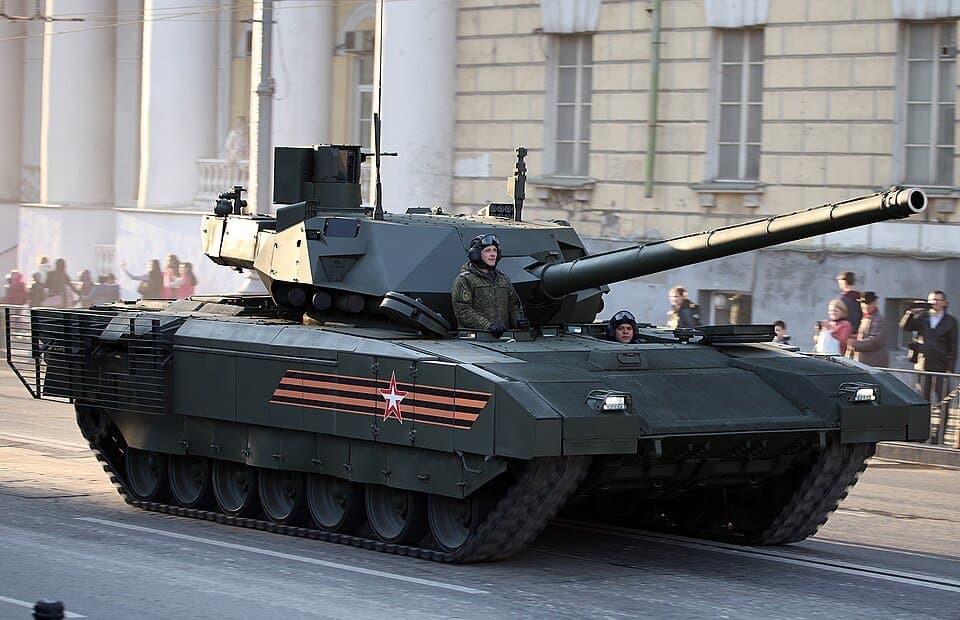

Credit
Vitaly V. Kuzmin · CC BY-SA 4.0 · Resized · CC BY-SA 4.0 · Source ↗ · Modified


Preparing your view.
At a glance
T-14 Armatalarger figure on 2 of 3
T-90
Measured figures
Length
Single source10.7 m (35 ft)[source]
Length
Single sourceConfiguration
| Specification | T-14 Armata | T-90 |
|---|---|---|
| Type | Main battle tank[source] | Main battle tank[source] |
| Place of origin | Russia[source] | Russia[source] |
| Designer | Ural Design Bureau of Transport Machine-Building, Uralvagonzavod[source] | Kartsev-Venediktov[source] |
| Designed | 2014[source] | — |
| Manufacturer | Uralvagonzavod |
Counts only measures both sources give with the same scope. A larger figure is not a better system.
Hull
Single source9.63 m (31 ft 7 in) 6.86 m (22 ft 6 in) (hull)[source]
Effective; Uralvagonzavod claims
Single sourceMaximum; Uralvagonzavod claims
Single sourceOperational; Min
Single source5 km, Uralvagonzavod claims[source]
12 km, Uralvagonzavod claims[source]
Min. 500 kilometres (310 mi)[source]
Operational; without fuel drums
Single source550 km (340 mi) (without fuel drums)[source]
12N360 Twin Turbo Diesel
Single source12N360 Twin Turbo Diesel 1,100 kW (1,500 hp)[source]
for V-92S2 12-cyl. diesel engine (T-90A and T-90S)
Single sourcefor V-92S2F (T-90M and T-90MS)
Single sourceV-84MS 12-cyl. diesel (T-90) V-92S2 12-cyl. diesel (T-90A) V-92S2F for V-84MS 12-cyl. diesel engine
Single sourceV-84MS 12-cyl. diesel (T-90) V-92S2 12-cyl. diesel (T-90A) V-92S2F 840 hp (617 kW) for V-84MS 12-cyl. diesel engine 1000 hp (736 kW) for V-92S2 12-cyl. diesel engine (T-90A and T-90S) 1130 hp (831 kW) for V-92S2F (T-90M and T-90MS)[source]
Bars compare reported quantities only. A larger figure does not make a system better; configurations and test conditions differ.
Uralvagonzavod , Heavy Vehicles Factory[source] |
| Unit cost | $3.7–$4.6 million in 2015 $5–7.1 million in 2022[source] | USD 2.5 million in 1999, USD 2.77–4.25 million in 2011 (varies by source) T-90SM: USD 4.5 million in 2016[source] |
|---|
| Produced | 2014–2021 (prototypes), 2021–present (claimed serial production)[source] | 1992–present[source] |
|---|
| No. built | Unknown/Low tens[source] | ≈4,000 (2023, see Operators ) 1,400 units of T-90S/SM built in India under license >1000 delivered to other countries[source] |
|---|
| Armour | 44S-sv-Sh Steel[source] | — |
|---|
| Main armament | 2A82-1M 125 mm smoothbore cannon with 45 rounds (of which, 32 in the autoloader ). Future version may use the smoothbore 2A83 152 mm tank gun.[source] | 2A46M 125 mm smoothbore gun with 43 rounds (T-90) 2A46M-2 125 mm smoothbore gun with 42 rounds (T-90A) 2A46M-5 125 mm smoothbore gun with 43 rounds (T-90M)[source] |
|---|
| Secondary armament | 12.7 mm ( 1 ⁄ 2 in) Kord machine gun (6P49), 7.62 mm (0.30 in) PKTM machine gun (6P7К)[source] | 12.7mm Kord Heavy machine gun , 7.62mm PKMT[source] |
|---|
| Power/weight | 20.4 kW/t (27.3 hp/t)[source] | 18.2 hp/tonne (13.3 kW/tonne) (T-90) 21.5hp/tonne (15 kW/tonne) (T-90A)[source] |
|---|
| Transmission | 12-speed automatic gearbox[source] | — |
|---|
| Suspension | Hydropneumatic suspension[source] | Torsion bar[source] |
|---|
| Role | Russian fourth-generation main battle tank (MBT)[source] | third-generation Russian main battle tank[source] |
|---|
| Source measurement | After the cancellation of the T-95 in 2010, Uralvagonzavod began the OKR Armata (Armament) design study. The study resulted in the Object 148 based on the T-95 (itself based on the Object 187 ). The Russian Army curtailed T-90 orders beginning in 2012 to prepare for the arrival of the new tank.[source]T-14 Armata · History; only the objects and conditions stated in this passage The T-14 first publicly appeared in March 2015, when several tanks with covered turrets were seen loaded on train carriage in Alabino . It was subsequently revealed on 9 May during the 2015 Moscow Victory Day Parade . During the 2015 rehearsals, one of the tanks suddenly stopped moving, and after attempts to tow it failed, it moved away under its own power after about 15 minutes.[source]T-14 Armata · History; only the objects and conditions stated in this passage At least seven T-14 Armata tanks appeared in the 2015 and 2016 Moscow Victory Day parade , five in 2017 and 2018. Four were anticipated in promotional materials in advance of the 2019 parade.[source]T-14 Armata · History; only the objects and conditions stated in this passage On 25 December 2022, Russian TV presenter Vladimir Solovyov posted footage of the T-14 in combat training with other sources claiming that the tank was being prepared for battle and already deployed to the conflict zone, with a military expert saying the videos were probably shot near Kazan.[source]T-14 Armata · History / Claims of deployment in Ukraine; only the objects and conditions stated in this passage The Vacuum-1 Armor-Piercing Fin-Stabilized Discarding Sabot (APFSDS) round, developed for the 2A82-1M gun, has a penetrator that is 900 mm long, and is said to be capable of penetrating 1000 mm of Rolled Homogeneous Armor (RHA) equivalent at a distance of 2 km. The new controlled-detonation Teknik HE-Frag shell is available and has entered service. The gun is capable of firing new guided missiles like the 9M119M1 Invar-M which has an effective range of 100 m to 5 km, and can engage low-flying air targets such as helicopters, with a new 3UBK21 Sprinter Anti-Tank Guided Missile (ATGM) with an effective range up to 12 km developed specifically for it. The 3UBK25 active homing ATGM is currently under development.[source]T-14 Armata · Design / Armament; only the objects and conditions stated in this passage The secondary armament consists of a 12.7×108mm Kord ( GRAU index 6P49) machine gun with 300 rounds (not observed during the 2015 parade) and a 7.62×54mmR Pecheneg PKP (GRAU Index: 6P41) or a PKTM (6P7К) machine gun with 1,000 rounds. All guns are remotely controlled. In addition, another 1,000 rounds can be stored separately.[source]T-14 Armata · Design / Armament; only the objects and conditions stated in this passage The 152 mm cannon, which was first developed in 2000 for the T-95 prototype, has a high-speed APFSDS shell with a 1,980 m/s muzzle velocity , only dropping to 1,900 m/s at 2 km. However, Russian engineers have so far kept the 125 mm-size gun, assessing that improvements in ammunition are enough to increase effectiveness while concluding that a larger bore weapon would offer few practical advantages.[source]T-14 Armata · Design / Armament; only the objects and conditions stated in this passage The T-14 could also be modified to use anti-aircraft missiles. A 30 mm anti-aircraft gun could be installed in the near future.[source]T-14 Armata · Design / Armament; only the objects and conditions stated in this passage 152 mm main gun[source]T-14 Armata · Design / Armament; only the objects and conditions stated in this passage Thermobaric ammo for 152 mm[source]T-14 Armata · Design / Armament; only the objects and conditions stated in this passage Supersonic armor-piercing ammo for 152 mm[source]T-14 Armata · Design / Armament; only the objects and conditions stated in this passage ATGM for 152 mm with aiming/guidance system "fire and forget"[source]T-14 Armata · Design / Armament; only the objects and conditions stated in this passage Redesigned turret and new autoloader for accommodating 152 mm gun and ammo[source]T-14 Armata · Design / Armament; only the objects and conditions stated in this passage During the prototype stage, several engines with power outputs ranging from 1,500 to 2,000 hp were tested on the platform, with the 1,500 hp version reportedly allowing a max speed of 82 km/h. The T-14 is powered by a ChTZ 12N360 (A-85-3A) diesel engine with a displacement of 34.6 liters delivering up to 1,100 kW (1,500 hp). The engine's theoretical maximum power, which is not normally used, is 1,500 kW (2,000 hp), at the cost of radically decreasing its service life, with a projected minimum 2,000 hours at a nominal 1,100 kW (1,500 hp), comparable to other modern tank engines, and up to 10,000 hours at a moderated 890 kW (1,200 hp). The engine is electronically controlled. Operational range is over 500 km (300 mi).[source]T-14 Armata · Design / Mobility; only the objects and conditions stated in this passage The T-14 has a 12-speed automatic gearbox , with a top speed of 80–90 km/h (50–56 mph). Sources suggest a partly or fully hydrostatic transmission .[source]T-14 Armata · Design / Mobility; only the objects and conditions stated in this passage Unlike previous Russian and Soviet designs, such as the T-90/80/72/ 64 , the T-14 has seven 700 mm road wheels per side, based on the T-80 variant. This may have been done to improve the pivoting ability of the tank, as an active suspension system improves the target lock time by a factor of 2.2, and reduces the timeframe between target detection and reaction by 31%, all due to the resulting smoother ride.[source]T-14 Armata · Design / Mobility; only the objects and conditions stated in this passage The tank features the Afganit ( Russian : Афганит ) active protection system (APS). Previous Russian APS were either "hard kill" versions (Drozd, Arena) or "soft kill" version (Shtora-1). Hard-kill measures kinetically attack threatening missiles or other munitions, while soft kill measures disrupt guidance systems (laser dazzlers or infrared emitters). Afganit is about to introduce the first dual system with both soft and hard actions incorporated. It includes a millimeter-wave radar to detect, track, and intercept incoming anti-tank munitions, both kinetic energy penetrators and tandem-charges . Currently, the maximum speed of the interceptable target is 1,700 m/s (Mach 5.0), with projected future increases of up to 3,000 m/s (Mach 8.8). According to news sources, it protects the tank from all sides, however it is not geared towards shooting upwards to defend against top-attack munitions.[source]T-14 Armata · Design / Protection; only the objects and conditions stated in this passage Defense Update released an analysis of the tank in May 2015, speculating that Afganit' s main sensors are the four panels mounted on the turret's sides, which are probably AESA radar panes spread out for a 360° view, with possibly one more on top of the turret.[source]T-14 Armata · Design / Protection; only the objects and conditions stated in this passage In July 2015, the deputy director of the Uralvagonzavod tank manufacturing company claimed the T-14 would be invisible to radar and infrared detection due to radar-absorbing paint and the placement of components with heat signatures deep within the hull. The turret's shape is designed to reduce its radio and thermal signature for a stealth ground vehicle . American and Russian armor experts have doubts about these unproven claims. A retired senior U.S. military officer said that sensitive modern thermal technology could detect things such as vehicle movement, a weapon firing, an exposed crewman, or the exhaust of an engine capable of moving a 50-ton tank regardless of heat-generating component placement. Analysts also pointed out that most stealth technology in Russia has been for aircraft to reduce their radar cross section from airborne or ground-based detection, while in a ground vehicle the approach would be to make it indistinguishable from ground clutter to optimize shielding from air-to-ground detection and the two techniques do not necessarily overlap.[source]T-14 Armata · Design / Protection; only the objects and conditions stated in this passage The T-14 is equipped with 26.5–40 GHz active electronically scanned array radar, which is used mainly by the APS. The T-14 uses highly protected communication channels that connect a group of T-14s and the command post.[source]T-14 Armata · Design / Sensors and communication; only the objects and conditions stated in this passage The commander's sight is installed on the turret top and has a 360° field of view, while the gunner's, situated in the turret's niche to the gun's left, is slaved to it and is additionally equipped with a direct-vision periscopic channel and laser designator for the T-14's gun-launched, SACLOS anti-tank missiles.[source]T-14 Armata · Design / Sensors and communication; only the objects and conditions stated in this passage The detection distance of tank-sized objects for both sights is 7,500 m (8,000) in daylight, through the TV/periscopic channel, and ≈3,500 m at night through the thermal channel.[source]T-14 Armata · Design / Sensors and communication; only the objects and conditions stated in this passage There is also a backup night-vision capable sight, with 2,000/1,000 m respective detection distances.[source]T-14 Armata · Design / Sensors and communication; only the objects and conditions stated in this passage This became partially subject to discussion in 2016 when the Krasnogorsk plant finished testing the Irbis-K night-vision sighting system. Completion of the Irbis-K, the first Russian-produced mercury-cadmium-telluride (MCT) matrix thermal sight, addressed a disadvantage of Russian tanks relative to their Western counterparts. The Irbis-K is capable of identifying targets at ranges up to 3,240 meters during both day and night.[source]T-14 Armata · Design / Sensors and communication; only the objects and conditions stated in this passage The T-14 Armata has been described as early as 2016 as a major concern for Western armies, and British intelligence views the unmanned turret as providing many advantages. However, at the time Western observers questioned Russia's ability to produce modern tanks like the T-90 and T-14 in significant numbers.[source]T-14 Armata · Foreign reactions; only the objects and conditions stated in this passage In response to the Armata, German company Rheinmetall has developed a new 130mm L/51 tank gun, claiming it provides a 50 percent increase in armor penetration over the 120mm L/55 in service with the Bundeswehr . Germany and France have joined forces to develop an unspecified " Main Ground Combat System " (MGCS) to compete with the technological advances of the Armata and replace both the Leclerc and Leopard 2 MBTs around 2030; however, by June 2018, deployment of the new vehicles and systems was scheduled for 2035, with full operational capability to be achieved by 2040. Additionally, Rheinmetall began the development of the KF51 Panther , which was unveiled in 2022.[source]T-14 Armata · Foreign reactions; only the objects and conditions stated in this passage | The T-90 is a third-generation Russian main battle tank developed from, and designed to replace the T-72 . It uses a 125 mm 2A46 smoothbore main gun , the 1A45T fire-control system , an upgraded engine, and gunner's thermal sight . Standard protective measures include a blend of steel and composite armour , smoke grenade dischargers, Kontakt-5 explosive reactive armour (ERA) and the Shtora infrared anti-tank guided missile (ATGM) jamming system.[source]T-90 · Lead; only the objects and conditions stated in this passage The T-90 was designed and built by Uralvagonzavod , in Nizhny Tagil , Russia. It entered service with the Russian army in 1992. The tank allegedly first saw combat in the 1999 war in Dagestan , with Russian Ground Forces . Russia later used the tank from 2017 in its intervention in the Syrian civil war . Russian T-90s were deployed in the war in Donbas in 2014, as well as in the full-scale Russo-Ukrainian war following the 2022 Russian invasion of Ukraine . The Syrian Arab Army used the tank in the Syrian civil war in 2017, as did the Azerbaijani Land Forces in the 2020 Second Nagorno-Karabakh War .[source]T-90 · Lead; only the objects and conditions stated in this passage The principal upgrade in the T-90 is the incorporation of a slightly modified form of the T-80U's more sophisticated 1A45T Irtysh fire control system and an upgraded V-84MS multi-fuel engine developing 840 hp (618 kW). The T-90 was manufactured at the Uralvagonzavod factory in Nizhny Tagil, with low-level production being carried out since 1992 and virtually ceasing towards the end of the 1990s for the native market. Around 120 T-90 tanks were delivered to the Russian Ground Forces before production of an upgraded version was resumed in 2004.[source]T-90 · Production and service history; only the objects and conditions stated in this passage Facing tapering domestic orders, Uralvagonzavod received government approval to export the T-90 in the mid-1990s. The designers at Uralvagonzavod created a new, welded turret that offered improvements in protection and internal space in the same period. In 1997, India signaled interest in the T-90 in response to Pakistan's acquisition of 320 Ukrainian T-80UD tanks. India's Heavy Vehicles Factory in Avadi was already license-manufacturing the T-72 under the name "Ajeya". |
|---|
| In service | — | From 1992 (T-90) From 2004 (T-90A) From 2019 (T-90M)[source] |
|---|
| Used by | — | See Operators[source] |
|---|
| Wars | — | War in Dagestan Syrian Civil War Second Nagorno-Karabakh War Russo-Ukrainian War War in Donbas Russo-Ukrainian war (2022–present) Wagner Group rebellion[source] |
|---|
| Variants | — | See Variants[source] |
|---|
| Armor | — | Steel-composite-reactive blend APFSDS : 550 mm + 250–280 mm with Kontakt-5 = 800–830 mm HEAT : 650–850 mm + 500–700 mm with Kontakt-5 = 1,150–1,550 mm[source] |
|---|
| Reported operators | — |
|---|
The first 42 complete Indian tanks were delivered in 2001 and were designated T-90S ( Object 188S ), still equipped with the older cast turrets of the early series (this exhausted the remaining stocks of cast turrets warehoused at Nizhny Tagil) and powered by the V-84 engine making 840 hp (618 kW). In 2002, 82 vehicles were delivered, now equipped with the new welded turrets and the V-92S2 engine, generating 1,000 hp (735 kW). The initial contract stipulated the following batch of 186 tanks, now officially called Bhishma , to be completed in India from Russian-supplied kits, and then gradually replaced with domestically manufactured parts. Delays in domestic production compelled the Indian authorities to place an additional order for 127 complete vehicles from Uralvagonzavod.[source]T-90 · Production and service history; only the objects and conditions stated in this passage
In 2005 the Russian army resumed delivery of the T-90, requesting the "original" specification for the vehicle with a cast turret. But with the new order numbering 14 tanks, and the large capital investment required to set up production of new cast turrets, the Russian Ministry of Defence agreed on a new configuration very close to the Indian T-90S, which was expeditiously accepted into service without any trials as the Object 188A1 or T-90A . 2005 saw delivery of 18 new tanks – enough to equip approximately five tank platoons. These new Russian tanks were powered by the V-92S2 engine, carried a T01-K05 Buran-M gunner's sight (passive-active night-vision channel with an EPM-59G Mirage-K matrix and a maximum observation distance of 1,800 m) and were protected by the most recent Kontakt-5 reactive armor with 4S22 explosive tiles.[source]T-90 · Production and service history; only the objects and conditions stated in this passage
In 2012, the Russian-made commander combined sample supervisory-sighting system "T01-K04DT/Agat-MDT" was presented to the public at the International Forum Engineering Technologies 2012. According to Krasnogorsky Zavod plant, Agat-MDT has the ability to install (for further modernization) in the sight the newly developed domestic UPF format 640×512 by 15 microns, which makes possible in the future to extend the range of target identification at night to 3.5–4.0 km without modifications to the sight.[source]T-90 · Production and service history; only the objects and conditions stated in this passage
In 2016, the Krasnogorsk plant finished testing the Irbis-K night-vision sighting system for the T-80U and T-90, with first deliveries planned for 2017. Completion of the Irbis-K, the first Russian-produced mercury cadmium telluride (MCT) matrix thermal sight, addressed a disadvantage of Russian tanks relative to their Western counterparts. The Irbis-K can identify targets at ranges up to 3,240 meters during day and night.[source]T-90 · Production and service history; only the objects and conditions stated in this passage
After the cancellation of the T-95 in 2010, Uralvagonzavod began the OKR Armata (Armament) design study. The study resulted in the Object 148 based on the T-95 (itself based on the Object 187). The Russian Army curtailed T-90 orders beginning in 2012 to prepare for the arrival of the new tank. In July 2021, Industry and Trade Minister Denis Manturov said the tank, designated the T-14 Armata , will enter serial production in 2022.[source]T-90 · Production and service history; only the objects and conditions stated in this passage
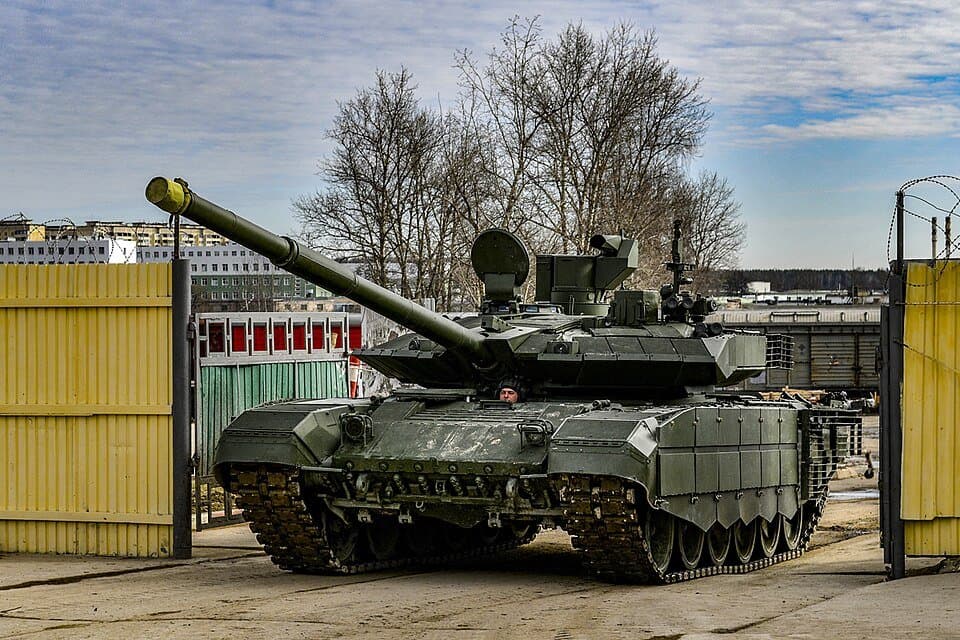
Deliveries of upgraded T-90M tanks started in April 2020 to the Guards Tank Army of the RF Western Military District . The T-90M 'Proryv' ('Breakthrough') has received a principally new turret, the 2A46M-5 gun, and a more powerful engine. The Proryv is outfitted with a new multi-channel sighting system that allows employing weapons at any time of day or night and it can exchange data with other vehicles in real time. A new batch was delivered in March 2021. According to Ukrainian intelligence sources, manufacturing of T-90s was slowed because of the effect of International sanctions since the start of the invasion of Ukraine . An article from Forbes magazine in early October 2023 suggested a rise in T-90M's production based on the increasing amount of T90 losses in Ukraine.[source]T-90 · Production and service history; only the objects and conditions stated in this passage
It was estimated the Russian army had no more than 85 T-90M, and 380 earlier T-90 variants, in February 2022.[source]T-90 · Production and service history; only the objects and conditions stated in this passage
The UK-based International Institute for Strategic Studies (IISS) estimates that annual production of T-90M tanks could reach up to 90 units in 2024. Analysis suggests, however, that the majority of these T-90Ms are likely upgrades of older T-90A models rather than newly built tanks. Sources indicate that over 200 T-90Ms have been delivered since the war in Ukraine started. The UK-based Military Watch Magazine reported in September 2024 that efforts to surge the production rate to well over 1000 per year had fallen far short, with the output remaining uncertain with some reports indicating that over 300 T-90Ms would be delivered throughout the year.[source]T-90 · Production and service history; only the objects and conditions stated in this passage
An early variant of the export-oriented T-90S allegedly saw combat action during the 1999 Chechen invasion of Dagestan instead of being delivered to India. The tank's survivability against rocket-propelled grenades (RPGs) is disputed. Gordon L. Rottman writes that T-90s were "frequently" knocked out by three or four hits from a RPG-7 . He adds that Chechens found a way to compromise T-90s fitted with explosive reactive armor : they would fire an RPG-7 from close range (within 50m) to trigger the explosive reactive armor protection, and then re-attack the exposed tank armour underneath with two or more RPG hits, again from close range.[source]T-90 · Combat use / Russian service; only the objects and conditions stated in this passage
In January 2024, in fighting around Stepove , two Bradley Fighting Vehicles (BFV) from the Ukrainian 47th Separate Mechanized Brigade engaged a T-90M. The tank was disabled by the Bradleys, and its crew escaped before a FPV drone destroyed the tank.[source]T-90 · Combat use / Russian service / Russo-Ukrainian War; only the objects and conditions stated in this passage
In late September 2024, reports backed by images shared on social media showed a destroyed T-90M that lacked Relikt ERA. The ERA bricks had been replaced by "construction bricks".[source]T-90 · Combat use / Russian service / Russo-Ukrainian War; only the objects and conditions stated in this passage
As of 13 May 2026, the Oryx blog had documented that Russia had lost at least 213 T-90s since the start of the 2022 Russian invasion of Ukraine (visually confirmed), including 46 T-90A (of which 33 were destroyed, 3 abandoned, 10 captured), 2 T-90AK (1 was captured and later destroyed, and another was captured), 11 T-90S (9 destroyed, 1 abandoned, 1 captured) and 154 T-90M (102 destroyed, 16 damaged, 29 abandoned, 7 captured).[source]T-90 · Combat use / Russian service / Russo-Ukrainian War; only the objects and conditions stated in this passage
The later T-90M features the 'Kaktus K-6' bolted explosive reactive armour (ERA) package on its frontal hull and turret-top (the T-90S has 'Kontakt-5' ERA), is fitted with an enhanced environmental control system supplied by Israel's Kinetics Ltd for providing cooled air to the fighting compartment, has additional internal volume for housing the cryogenic cooling systems for new-generation thermal imagers like the THALES -built Catherine-FC thermal imager (operating in the 8–12 micrometre bandwidth).[source]T-90 · Export / India; only the objects and conditions stated in this passage
A third contract, worth $1.23 billion, was signed in December 2007 for 347 upgraded T-90Ms, most to be licence-assembled by HVF. The Army hoped to field a force of over 21 regiments of T-90 tanks and 40 regiments of modified T-72s. The Indian Army began receiving its first T-90M main battle tank in completely knocked-down form from Russia's Nizhny Tagil-based Uralvagonzavod JSC at the end of 2009. The first batch of 10 T-90Ms built under licence was inducted into the Indian Army in August 2009. These vehicles were built at the Heavy Vehicles Factory at Avadi, Tamil Nadu. HVF planned to produce 100 units of the tank per year while India already had 700 units of the tank in service.[source]T-90 · Export / India / Orders and deliveries; only the objects and conditions stated in this passage
Bhishma Mk. 3 variant: In May 2024, Heavy Vehicles Factory unveiled the Bhishma Mk. 3 variant of T-90. Enhancements included increase in indigenous content and several upgrades. The upgrades included advanced Mid Wave Thermal Image -based sighting systems (8 km range) and Laser Range Finder (LRF; 5 km range) for commanders developed by DRDO and BEL (replacing Image Converter tube-based sight on older versions), a Digital Ballistic Computer to improve ammunition trajectory (derived from that of Arjun MBT ), Automatic Target Tracker. It is also expected that the new variant tanks will feature new generation ammunition like FSAPDS Mk2 (originally developed for Arjun MBT), and cannon-launched SAMHO missiles that is under development. Reports also suggest the use of a more efficient and powerful engine. There are plans for further upgradation of the T-90 tanks by including indigenous active protection systems , loitering munitions and more advanced ammunitions. India started the licensed production of Russian tank rounds 3VBM17 used by the T-72 and T-90 tanks in July 2024.[source]T-90 · Export / India / Upgrades; only the objects and conditions stated in this passage
Engine upgrade : On 20 March 2025, the Defence Acquisition Council (DAC) cleared the Acceptance of Necessity (AoN) for the procurement of 1,350 hp (1,010 kW) engines for T-90 tanks to improve the power-to-weight ratio and increase mobility in high-altitude regions.[source]T-90 · Export / India / Upgrades; only the objects and conditions stated in this passage
The T-90's main armament is the 2A46 M 125mm smoothbore tank gun. This is a highly modified version of the Sprut anti-tank gun , and is the same gun used as the main armament on the T-80-series tanks. It can be replaced without dismantling the inner turret and can fire armour-piercing fin-stabilized discarding sabot (APFSDS), high-explosive anti-tank (HEAT-FS), high-explosive fragmentation (HE-FRAG) ammunition, and 9M119M Refleks anti-tank guided missiles. The Refleks has semi-automatic command to line of sight (SACLOS) laser beam riding guidance and a tandem shaped charge HEAT warhead. It has an effective range of 100 m to 6 km, and takes 17.5 seconds to reach maximum range. Refleks can penetrate about 950 millimetres (37 in) of steel rolled homogeneous armour (RHA) and can also engage low-flying air targets such as helicopters .[source]T-90 · Design / Armament; only the objects and conditions stated in this passage
The NSV 12.7mm ( 12.7×10⁸ ) remotely controlled anti-aircraft heavy machine gun can be operated from within the tank by the commander and has a range of 2 km and a cyclic rate of fire of 700–800 rounds per minute with 300 rounds available (the NSV was replaced by the Kord heavy machine gun in the late 1990s). The PKMT 7.62mm ( 7.62×54mmR ) coaxial machine gun weighs about 10.5 kg while the ammunition box carries 250 rounds (2,000 rounds carried) and weighs an additional 9.5 kg.[source]T-90 · Design / Armament; only the objects and conditions stated in this passage
Like other modern Russian tanks the 2A46M in the T-90 is fed by an automatic loader which removes the need for a manual loader in the tank and reduces the crew to 3 (commander, gunner, and driver). The autoloader can carry 22 ready-to-fire rounds in its carousel and can load a round in 5–8 seconds. It has been suggested that the automatic loaders on modern T-90 tanks have been modified to take advantage of newer ammunition such as the 3BM-44M APFSDS, which like the US M829A3 penetrates armour better than the previous shorter rounds. HEAT rounds that can be fired from the 2A46M includes the 3BK21B (with a depleted uranium liner), 3BK29 (with a credited penetration of 800mm RHA equivalency), and the 3BK29M (with a Triple-tandem charge warhead). Additionally the T-90 features the Ainet fuse setting system which allows the tank to detonate 3OF26 HE-FRAG rounds at a specific distance from the tank as determined by the gunner's laser rangefinder , improving its performance against helicopters and infantry . Accurate firing range of the HE-Frag-FS 10 km, APFSDS 4 km.[source]T-90 · Design / Armament; only the objects and conditions stated in this passage
Fire-control system of the T-90 showed the following features of combat shooting during state testing. Heavily armoured targets at ranges of up to 5 km were hit by tank T-90 on the move (up to 30 km/h) with a high probability of hit with the first shot. During state testing made 24 launches of missiles at ranges of 4–5 km and they all hit the target (all missile launches were made by inexperienced professionals). An experienced gunner at speeds of 25 km/h hit 7 real armoured targets located at ranges of 1,500–2,500 m and 54sec.[source]T-90 · Design / Armament; only the objects and conditions stated in this passage
Fire-control system on the T-90 includes the PNK-4S/SR AGAT day and night sighting system mounted at the commanders station which allows for night time detection of a tank sized target at ranges between 700 and 1100 metres depending on the version of the sight. Early models of the T-90 were equipped with the TO1-KO1 BURAN sight but later models (T-90S) were upgraded to use the ESSA thermal imaging sight, which allows for accurate firing to a range of 5,000–8,000m during day and 3,300m during night, using the CATHERINE-FC thermal camera produced by Thales Optronique . The gunner is also provided with the 1G46 day sighting system which includes a laser range finder, missile guidance channel and allows tank-sized targets to be detected and engaged at 5 to 8 kilometres (3.1 to 5.0 mi). The driver uses a TVN-5 day and night sight. In 2010, Russia started licensed production of Thales-developed Catherine FC thermal cameras for T-90M tanks, a Russian daily said. These thermal imagers are also present on T-90M "Bhishma" built in India under licence.[source]T-90 · Design / Armament; only the objects and conditions stated in this passage
In 2012, the Russian-made combined sample of commander supervisory-sighting system T01-K04DT/Agat-MDT was presented to the public. According to Krasnogorsky Zavod (plant), Agat-MDT has the ability to be installed (for further modernization) in the sight of the newly developed domestic UPF format 640×512 by 15 microns, which is possible in the future to extend the range of target identification at night to 3.5–4.0 km without sight modifications. In 2016, the Krasnogorsk plant finished testing the Irbis-K night-vision gunner's sighting system for the T-80U and T-90, with first deliveries in 2018. Completion of the Irbis-K, the first Russian-produced mercury-cadmium-telluride (MCT) matrix thermal sight, will bridge a gap with the leading NATO countries in this area. The Irbis-K can identify tank targets at ranges up to 3,240 meters during day and night.[source]T-90 · Design / Armament; only the objects and conditions stated in this passage
The Russian-made thermal imaging device not only meant that Russian tanks would no longer need to be equipped with foreign parts, but it also meant that complete tank modernization was cheaper. Furthermore, there will be no decrease in demand for the T-72 and the T-90 in the next few years. The new tank gunner's heat-vision sight Irbis-K and the commander's combined sighting and observation system Agat-MDT can be supplied to T-72, T-80 and T-90 upgraded versions (T-72B3M, T-80BVM, T-90M...), replacing the Thales Catherine-FC thermal camera.[source]T-90 · Design / Armament; only the objects and conditions stated in this passage
The prime mover is the V-92S diesel engine , built in the Chelyabinsk Tractor Plant. Different models of the T-90 tank are powered by various motors in its initial models, like the V-84MS 618 kW (840 hp) four-stroke V-12 piston engine , uprated 1,000 hp (750 kW) engines and 1,250 hp (930 kW) engines made by Uralvagonzavod and are delivered by Chelyabinsk Tractor Plant. The Т-90S with 1,000 hp (750 kW) engine can attain a top speed of 60 km/h on the road and up to 45 km/h on rough terrain. The T-90 tank has a typical drivetrain arrangement, with a rear placed engine and transmission. The 1,000 hp (750 kW) engines are V-92 four stroke, 12 cylinder, multi-fuel diesel while the 1,250 hp (930 kW) engine is V-96. The T-90 export version i.e. modified T-90S is fitted with an increased power multi-fuel 1,000 hp (750 kW) diesel engine with turbochargers . The tank has an air conditioning system for work in hot places.[source]T-90 · Design / Mobility; only the objects and conditions stated in this passage
T-90M and T-90MS mounts the more advanced "Relikt" ERA. Relikt defends against tandem warheads, while reducing the penetration of APFSDS rounds by over 50 percent. It can be installed instead of Kontakt-1 or Kontakt-5.[source]T-90 · Design / Protection; only the objects and conditions stated in this passage
T-90 (Object 188) – The first production version. Object 188 (1989), production 1992. It combined a 125mm smoothbore gun, Kontakt-5 explosive reactive armor , and the Shtora-1 electro-optical countermeasure system to improve survivability against anti-tank guided missiles . At one point during development it was designated as the Upgraded T-72B. 46 tons. T-90K – Commander's version of the T-90, with additional communication (R-163-50K station) and navigation equipment (TNA-4-3). T-90A – Russian army version with welded turret, V-92S2 engine and ESSA thermal viewer. Sometimes called T-90 Vladimir, in honor of its chief designer Vladimir Potkin. T-90AK – Command version of the T-90A. T-90AM ("Proryv-2") – Upgrade of T-90A which was later developed into the T-90MS. Featured a new turret developed in the "Proryv-2" program. Revealed in 2011. 48 tons. Not in service.[source]T-90 · Variants; only the objects and conditions stated in this passage
T-90M ("Proryv-3") – Heavily upgraded version of the T-90, first appearance in public in 2017.[source]T-90 · Variants; only the objects and conditions stated in this passage
The main feature is the modernization of turret design ("all welded" instead of cast) with the new advanced fire control system Kalina (with integrated combat information and control systems), new PNM-T gunner's sight and four video cameras that provide a 360° view of the environment for the commander, new upgraded gun 2A46M-5 with coaxial machine gun of 7.62 mm, weapon station "UDP T05BV-1" with the remotely controlled machine gun of 12.7 mm "Kord".[source]T-90 · Variants; only the objects and conditions stated in this passage
Other improvements include a new 1130 hp V-92S2F engine coupled with automatic transmission, an enhanced environmental control system and GLONASS satellite navigation systems.[source]T-90 · Variants; only the objects and conditions stated in this passage
T-90S – Export version of the T-90, later adopted by the Russian Armed Forces as the T-90A. These tanks were made by Uralvagonzavod and were updated with 1,000 hp (750 kW) engines made by Chelyabinsk Tractor Plant. These tanks carry an export version of the Shtora-1 passive/active protection system which lacks the infra-red dazzlers carried on the turret, however this area was covered with more Kontakt-5. These were initially supplied with cast turrets of the early T-90, and when stocks were depleted, new, welded turrets were fabricated. T-90SK – Commander's version of the T-90S, with additional communication and navigation equipment. It differs in radio and navigation equipment and Ainet remote-detonation system for HEF rounds.[source]T-90 · Variants; only the objects and conditions stated in this passage
T-90MS / T-90SM – Export variant and modernized version of T-90AM ("Proryv-2"), first time showed in Abu Dhabi IDEX-2013. It is equipped with a 1,130 hp engine, a Sosna-U gunner sight, a UDP T05BV-1 RWS with a 7.62 mm machine gun, GLONASS , inertial navigation systems, new Relikt explosive reactive armour that covers more of the tank, and a steering wheel. A new removable turret bustle is included, which provides storage for eight additional rounds. The T-90MS is ready for serial production. Four video cameras provide a 360° view of the environment, while the tank is more connected to command. The T-90SM has an upgraded thermal imager that can detect tanks over 3,300 meters away. The same autoloader as the T-90M "Proryv-3" is used.[source]T-90 · Variants; only the objects and conditions stated in this passage
BREM-1M : Armoured recovery vehicle[source]T-90 · Variants; only the objects and conditions stated in this passage
IMR-2MA : Combat engineer vehicle. Referred to as the IMR-3M by Russian sources.[source]T-90 · Variants; only the objects and conditions stated in this passage